REPLACE CURRENT SECULARISM MODEL
FEBRUARY 16, 2022
INVITING STALIN TO INAGURATE YADADRI
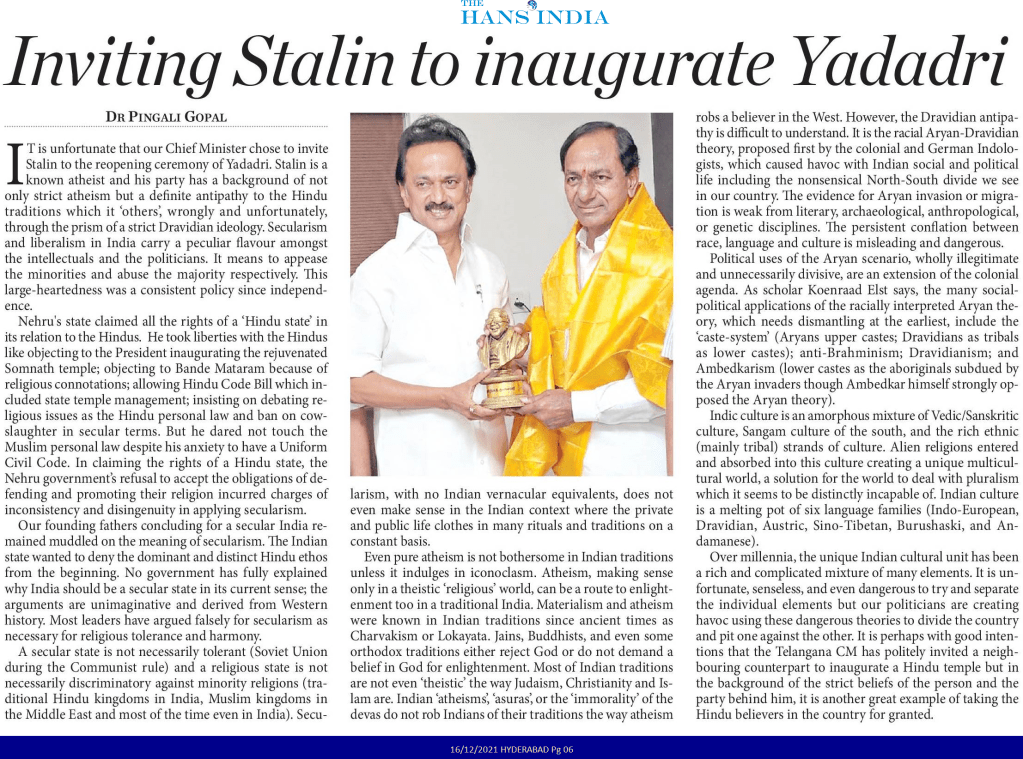
It is unfortunate that our respectable Chief Minister chose to invite Stalin in the reopening ceremony of Yadadri. Stalin is a known atheist and his party has a background of not only strict atheism but a definite antipathy to the Hindu traditions which it ‘others’, wrongly and unfortunately, through the prism of a strict Dravidian ideology. Secularism and liberalism in India carry a peculiar flavour amongst the intellectuals and the politicians. It means to appease the minorities and abuse the majority respectively. This large-heartedness was a consistent policy since independence. Nehru’s state claimed all the rights of a ‘Hindu state’ in its relation to the Hindus. He took liberties with the Hindus like objecting to the President inaugurating the rejuvenated Somnath temple; objecting to Bande Mataram because of religious connotations; allowing Hindu Code Bill which included state temple management; insisting on debating religious issues as the Hindu personal law and ban on cow-slaughter in secular terms. But he dared not touch the Muslim personal law despite his anxiety to have a Uniform Civil Code. In claiming the rights of a Hindu state, Nehru government’s refusal to accept the obligations of defending and promoting their religion incurred charges of inconsistency and disingenuity in applying secularism.
Our founding fathers concluding for a secular India remained muddled on the meaning of secularism. India state wanted to deny the dominant and distinct Hindu ethos from the beginning. No government has fully explained why India should be a secular state in its current sense; the arguments are unimaginative and derived from Western history. Most leaders have argued falsely for secularism as necessary for religious tolerance and harmony. A secular state is not necessarily tolerant (Soviet Union during the Communist rule) and a religious state is not necessarily discriminatory against minority religions (traditional Hindu kingdoms in India, Muslim kingdoms in the Middle East and most of the time even in India). Secularism, with no Indian vernacular equivalents, does not even make sense in the Indian context where the private and public life clothes in many rituals and traditions on a constant basis.
Even pure atheism is not bothersome in Indian traditions unless it indulges in iconoclasm. Atheism, making sense only in a theistic ‘religious’ world, can be a route to enlightenment too in a traditional India. Materialism and atheism were known in Indian traditions since ancient times as Charvakism or Lokayata. Jains, Buddhists, and even some orthodox traditions either reject God or do not demand a belief in God for enlightenment. Most of Indian traditions are not even ‘theistic’ the way Judaism, Christianity and Islam are. Indian ‘atheisms’, ‘asuras’, or the ‘immorality’ of the devas do not rob Indians of their traditions the way atheism robs a believer in the West.
However, the Dravidian antipathy is difficult to understand. It is the racial Aryan-Dravidian theory, proposed first by the colonial and German Indologists, which caused havoc with Indian social and political life including the nonsensical North-South divide we see in our country. The evidence for Aryan invasion or migration is weak from literary, archaeological, anthropological, or genetic disciplines. The persistent conflation between race, language and culture is misleading and dangerous. Political uses of the Aryan scenario, wholly illegitimate and unnecessarily divisive, are an extension of the colonial agenda. As scholar Koenraad Elst says, the many social-political applications of the racially interpreted Aryan theory, which needs dismantling at the earliest, include the ‘caste-system’ (Aryans upper castes; Dravidians as tribals as lower castes); anti-Brahminism; Dravidianism; and Ambedkarism (lower castes as the aboriginals subdued by the Aryan invaders though Ambedkar himself strongly opposed the Aryan theory).
Indic culture is an amorphous mixture of Vedic/Sanskritic culture, Sangam culture of the south, and the rich ethnic (mainly tribal) strands of culture. Alien religions entered and absorbed into this culture creating a unique multi-cultural world, a solution for the world to deal with pluralism which it seems to be distinctly incapable of. Indian culture is a melting pot of six language families (Indo-European, Dravidian, Austric, Sino-Tibetan, Burushaski, and Andamanese). Over millennia, the unique Indian cultural unit has been a rich and complicated mixture of many elements. It is unfortunate, senseless, and even dangerous to try and separate the individual elements but our politicians are creating havoc using these dangerous theories to divide the country and pit one against the other. It is perhaps with good intentions that the Telangana CM has politely invited a neighbouring counterpart to inaugurate a Hindu temple but in the background of the strict beliefs of the person and the party behind him, it is another great example of taking the Hindu believers in the country for granted.
JUDICIAL HOLIDAYS: CAN THEY BE REVIEWED?

Today, including the Sundays and the vacations, the courts do not work for almost 130- 135 days of an year, a whopping amount of official holidays( almost 30-35% of the year). Is it any wonder why the backlogs runs for many decades in many cases? Why cannot the courts run like all other essential services like electricity, railways, hospitals, all days of the week? There can be provision to deal with the cases after hours and on Sundays by emergency rotations of the judges like they do for doctors. Increasing the number of judges, which our articulate CJI seems to batting for, is a good solution, but only a partial one. We need more working hours.
The courts and judges are very quick to make moral judgments on rest of the society but it would be nice if they reflect on their working pattern and also address the extreme corruption rampant in our courts at all levels. Justice and Law, a legacy of colonial system foisted on our indigenous law systems, has only generated corruption, inefficiency, and arbitrariness leading finally to confusion and anger on part of its citizens. An ordinary citizen of the country does not look at law or the judiciary as bodies of protection but only as agencies to be extremely scared of . Our learned and concerned judges should give a thought to address these fears too of it’s ordinary citizens.
The English law was a very corrupt system and our own legal systems had great strengths. Yet, we thought nothing was better than the colonial system in a classic case of colonial consciousness persisting strongly even today, decades after independence. Our legal systems are a complete mess and we need fresh thinking at the root level instead of addressing some superficial issues. Increasing the working hours would be the first step in the right direction.
VIR DAS, CULTURAL MARXISM, AND COLONIAL CONSCIOUSNESS
November 21, 2021
BANNING OF BOOKS IS A BAD IDEA
November 17, 2021
HINDU, HIDUISM, HINDUTVA- NEW PARADIGMS NEEDED
November 14, 2021
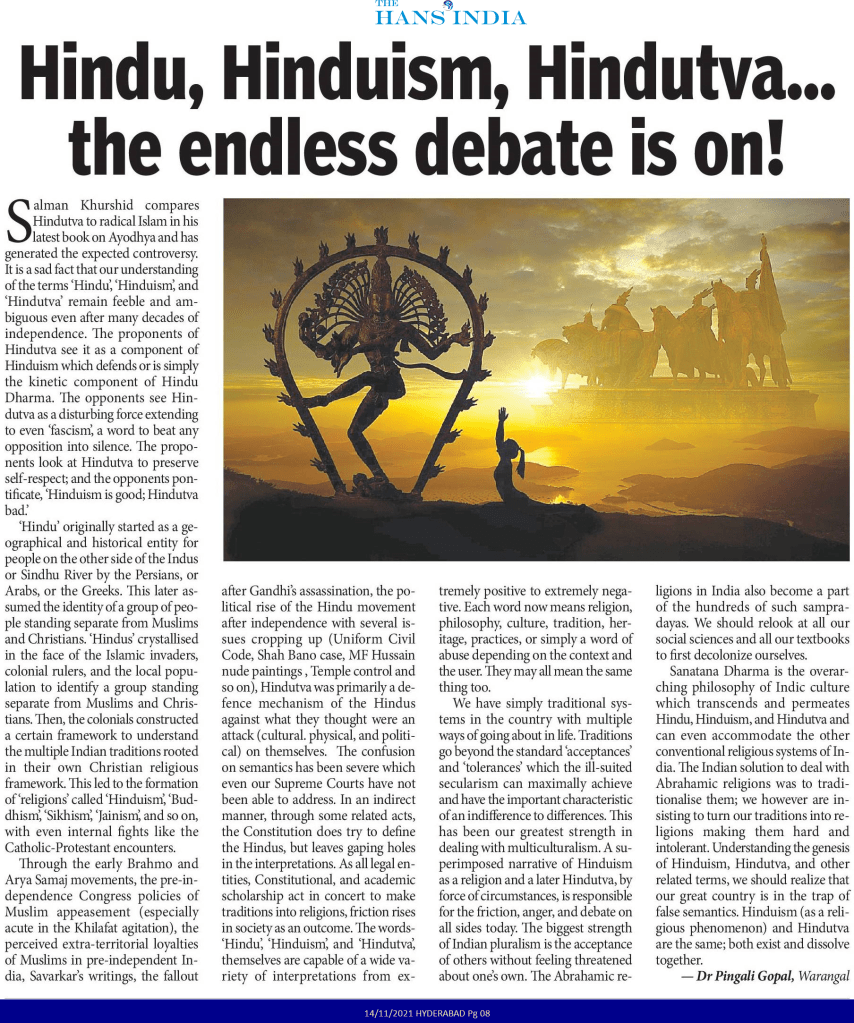
Salman Khurshid compared Hindutva to radical Islam in his latest book on Ayodhya and has generated the expected controversy. It is a sad fact that our understanding of the terms ‘Hindu’, ‘Hinduism’, and ‘Hindutva’ remain feeble and ambiguous even after many decades of independence. The proponents of Hindutva see it as a component of Hinduism which defends or is simply the kinetic component of Hindu Dharma. The opponents see Hindutva as a disturbing force extending to even ‘fascism’, a word to beat any opposition into silence. The proponents look at Hindutva to preserve self-respect; and the opponents pontificate, ‘Hinduism is good; Hindutva bad.’
‘Hindu’ originally started as a geographical and historical entity for people on the other side of the Indus or Sindhu River by the Persians, or Arabs, or the Greeks. This later assumed the identity of a group of people standing separate from Muslims and Christians. ‘Hindus’ crystallised in the face of the Islamic invaders, colonial rulers, and the local population to identify a group standing separate from Muslims and Christians. Then, the colonials constructed a certain framework to understand the multiple Indian traditions rooted in their own Christian religious framework. This led to the formation of ‘religions’ called ‘Hinduism’, ‘Buddhism’, ‘Sikhism’, ‘Jainism’, and so on, with even internal fights like the Catholic-Protestant encounters. As a manifestation of colonial consciousness, the country has collectively believed the idea that religions exist in India when, in fact, they do not, as the Balagangadhara school strongly propagates.
Through the early Brahmo and Arya Samaj movements, the pre-independence Congress policies of Muslim appeasement (especially acute in the Khilafat agitation), the perceived extra-territorial loyalties of Muslims in pre-independent India, Savarkar’s writings, the fallout after Gandhi’s assassination, the political rise of the Hindu movement after independence with several issues cropping up (Uniform Civil Code, Shah Bano case, MF Hussain nude paintings , Temple control and so on), Hindutva was primarily a defence mechanism of the Hindus against what they thought were an attack (cultural. physical, and political) on themselves. Equating it with the radical religious ideas of either killing or converting by force is a gross injustice either by intent or ignorance on the part of the scholars. It betrays a poor understanding of Indian culture and the historical contexts of such movements.
The confusion on semantics has been severe which even our Supreme Courts have not been able to address. In an indirect manner, through some related acts, the Constitution does try to define the Hindus, but leaves gaping holes in the interpretations. As all legal entities, Constitutional, and academic scholarship act in concert to make traditions into religions, friction rises in society as an outcome. The words- ‘Hindu’, ‘Hinduism’, and ‘Hindutva’, themselves are capable of a wide variety of interpretations from extremely positive to extremely negative. Each word now means religion, philosophy, culture, tradition, heritage, practices, or simply a word of abuse depending on the context and the user. They may all mean the same thing too.
We have simply traditional systems in the country with multiple ways of going about in life. Traditions go beyond the standard ‘acceptances’ and ‘tolerances’ (which the ill-suited secularism can maximally achieve) and have the important characteristic of an indifference to differences. This has been our greatest strength in dealing with multiculturalism. A superimposed narrative of Hinduism as a religion and a later Hindutva, by force of circumstances, is responsible for the friction, anger, and debate on all sides today. The biggest strength of Indian pluralism is the acceptance of others without feeling threatened about one’s own. The Abrahamic religions in India also become a part of the hundreds of such sampradayas. We should relook at all our social sciences and all our textbooks to first decolonize ourselves. Sanatana Dharma is the overarching philosophy of Indic culture which transcends and permeates Hindu, Hinduism, and Hindutva and can even accommodate the other conventional religious systems of India. The Indian solution to deal with Abrahamic religions was to traditionalise them; we however are insisting to turn our traditions into religions making them hard and intolerant. Understanding the genesis of Hinduism, Hindutva, and other related terms, we should realize that our great country is in the trap of false semantics. Hinduism (as a religious phenomenon) and Hindutva are the same; both exist and dissolve together.
HEALTH IS BEAUTY
OCTOBER 31, 2021
SAVING INDIA FROM THE IRON GRIP OF POLITICIANS AND BABUS
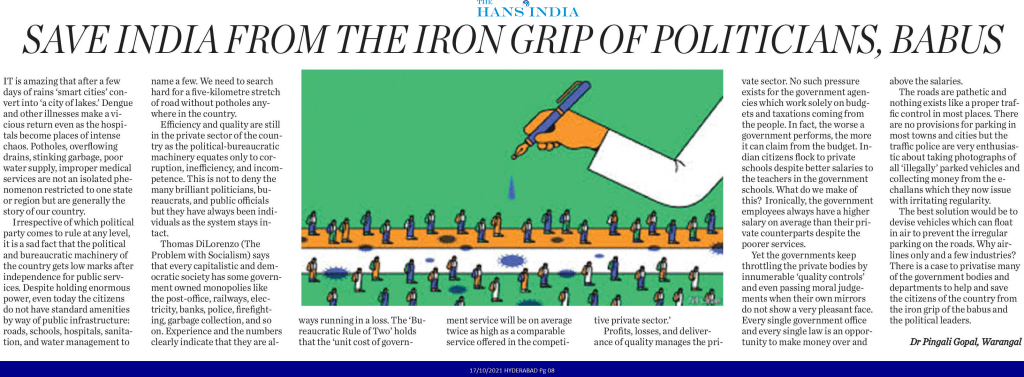
It is amazing that a few rains come and ‘smart cities’ convert into ‘a city of lakes.’ Dengue and other illnesses make a vicious return even as the hospitals become places of intense chaos. Potholes, overflowing drains, stinking garbage, poor water supply, improper medical services are not an isolated phenomenon restricted to one state or region but is generally the story of our country. Irrespective of which political party comes to rule at any level, it is a sad fact that the political and bureaucratic machinery of the country gets low marks after independence for public services. Despite holding enormous power, even today the citizens do not have standard amenities by way of public infrastructure: roads, schools, hospitals, sanitation, and water management to name a few. We need to search hard for a five-kilometre stretch of road without potholes anyplace in the country. Efficiency and quality are still in the private sector of the country as the political-bureaucratic machinery equates only to corruption, inefficiency, and incompetence. This is not to deny the many brilliant politicians, bureaucrats, and public officials but they have always been individuals as the system stays intact.
Thomas DiLorenzo (The Problem with Socialism) says that every capitalistic and democratic society has some government owned monopolies like the post-office, railways, electricity, banks, police, firefighting, garbage collection, and so on. Experience and the numbers clearly indicate that they are always running in a loss. The ‘Bureaucratic Rule of Two’ holds that the ‘unit cost of government service will be on average twice as high as a comparable service offered in the competitive private sector.’ Profits, losses, and deliverance of quality manages the private sector. No such pressure exists for the government agencies which work solely on budgets and taxations coming from the people. In fact, the worse a government performs, the more it can claim from the budget. Indian citizens flock to private schools despite better salaries to the teachers in the government schools. What do we make of this? Ironically, the government employees always have a higher salary on average than their private counterparts despite the poorer services.
Yet the governments keep throttling the private bodies by innumerable ‘quality controls’ and even passing moral judgements when their own mirrors do not show a very pleasant face. Every single government office and every single law is an opportunity to make money over and above the salaries. The roads are pathetic and nothing exists like a proper traffic control in most places. There are no provisions for parking in most towns and cities but the traffic police are very enthusiastic about taking photographs of all ‘illegally’ parked vehicles and collect money from the e-challans which they now issue with irritating regularity. The best solution would be to devise vehicles which can float in air to prevent the irregular parking on the roads. Why airlines only and a few industries? There is a case to privatise many of the government bodies and departments to help and save the citizens of the country from the iron grip of the babus and the political leaders.
DEMYSTIFYING THE SUPERIOR STATUS OF BRAHMINS
OCTOBER 3, 2021
Further to the article on Brahmin Welfare Corporations on the editorial page (THI, October 1), it is unfortunate that Brahmins have faced a strong antipathy for centuries. The basic Brahminical account standing rock like from 17th century European narratives to present day ‘scientific’ explanations is this: ‘As a priesthood, the Brahmins mediate between the devotees and their deities by sacrificial rituals. They are the creators of a four-tiered hierarchy of classes, assigning the highest status to their own priestly class and the lowest to the Sudra or servant class. Traditionally, the learned Brahmin is the recipient of many privileges. Lacking military prowess and political-economic power, the minority Brahmins drew on their ritual status to seek a special alliance with the warrior-ruler class. They reduced the lower castes to a state of subjugation by imposing many restrictions like denying access to the Vedas and treating them as impure or untouchable, and preventing upward mobility between castes.’
Our textbooks describe the Brahmins as oppressors, exploiters, and creators of the caste system. The Left- influenced academia with their theories of exploiter and the exploited, the missionaries, and the brainwashed intellectuals continued the British story post-independence. Brahmins were neither rich nor powerful at any point of time in history. The present social sciences just build up data to show the validity of previous truths; rarely, do they turn back to reflect that these narratives could be false too.
Dharampal (The Beautiful Tree) deconstructs the popular idea that education was the exclusive domain of high caste Brahmins, who denied education to others, based on reports commissioned by the British themselves. A survey from 1822 to 1825 in the Madras Presidency showed that the predominant castes in schools were the Sudras. In the Tamil areas, the composition of the school going children was forward castes, 13-23 per cent; Muslims, 3-10 per cent; and Sudras and other castes, 70-84 per cent. In Malabar areas, the forward castes were 20 per cent, Muslims 27 per cent, and Sudras about 50 per cent. Another report in 1825 showed that out of 1,88,680 scholars in Madras Presidency, Brahmins were 23 per cent and Sudras 45 per cent. In Telugu areas, Brahmins were between 24-46 per cent, and Sudras between 35-41 per cent. This is a problem for British historiography because the literacy rate when they left India was about 12 per cent. It was not the outcome of the forward castes ‘denying’ others the access to education but the replacement of the traditional and classical education system by the Anglicised education.
Many thousands of Brahmins lost their lives in the Islamic invasions and the Goan Inquisitions as they were the primary target of the ire of the invaders. Francis Xavier made his position clear when he wrote to the king of Portugal, his patron, ‘If there were no Brahmins, all pagans would be converted to our faith‘, calling them the ‘most perverse people.’
In many feudalistic excesses, many non-Brahmin communities as land owners were responsible for oppression of the deprived. Somehow, our social sciences ensured that Brahmins became the prime villains in society. Meenakshi Jain writes that Brahmins were prominent in the freedom movement confirming the worst British suspicions of the community. Even though for centuries Brahmins and non-Brahmins had been active political and social partners, the fissures grew by the machinations of the British. Some British observers like Colebrooke concede that there was little difference in the condition of the Brahmin and the rest of the native population.
The British census operations, especially that of Risley (1901), were determined to show race as the basis for the caste-system. The British census operations destroyed the flexible jati-varna system and raised caste consciousness to a feverish pitch, inciting animosities, and a general hardening of the system. Caste consequently became a tool in the political, religious, and cultural battles.
Post-independence, many studies have shown Brahmins to be in a continuous downward spiral mode. Land holdings have reduced. Traditional occupations like family and temple priesthood, recitation of the Vedas and practice of Ayurvedic medicine no longer prove remunerative nor command respect. A few decades back (1978), the Karnataka state finance minister stated the per capita income of various communities: Christians 1,562; Vokkaligas Rs 914; Muslims Rs 794; Scheduled castes Rs 680; Scheduled Tribes Rs 577; and Brahmins Rs 537. One study in the previous united Andhra Pradesh showed 55 per cent of them living below the poverty line, 10 per cent higher than other groups. The unemployment rate among them was as high as 75 per cent. Such is the deep antipathy to Brahmin community that despite consisting of hundreds of jatis, with no uniform rules of living and social interaction, a success is a result of ‘privilege’ and individual faults project to the whole community across the length and breadth of the country.
Academia, media, NGO activists, and intellectuals project the Shramana (Buddhism and Jainism) and Bhakti movements as egalitarian anti-caste revolts carrying a ‘millennial-long’ conflict with Brahmanism and the ‘tyranny of caste.’ This hypothesis places Buddha (Martin Luther of India) as the first reformer opposing corrupted Brahmanas and preaching the equality of man. Scholars have shown that Buddhists neither rejected Brahmanas nor did they fight against the ‘caste system’. Buddha and Buddhists considered varna divisions to be an appropriate dharmic grouping of society. Buddhism was just another tradition in the Hindu land where new traditions, sects, and gurus evolve all the time showing many paths to the final enlightenment.
Unbroken, this narrative about the wily Brahmins continues prominently in introductory works, encyclopaedia entries, and other sources as elementary facts about Indian culture and religion. The Balagangadhara school shows that Christian-theological ideas concerning heathen priesthood and idolatry; Aryan racial notions of biological and cultural superiority and inferiority; and anthropological speculations about ‘primitive man’ and his ‘magical thinking’ explained the role of Brahmins in Indian society till about three decades back. These concepts, crucial to the speculations about the Brahmin priesthood rise, reflected Protestant and philosophical critique of priesthood pervading 18th- and 19th-century Europe.
Imre Lakatos, 20th-century philosopher of science, characterised every research programme as having three elements: a ‘hard core’ of basic theses and assumptions; a ‘protective belt’ of auxiliary hypotheses surrounding this core; and a ‘heuristic’ or problem-solving machinery. The protective belt allows it to cope with the problems by immunizing its hard core against falsification. Jakob De Roover says that the basic assumptions about the religion of the Brahmin are part of this program’s hard core, whereas the claims concerning the Aryan invasion, racial superiority, magical thinking, and the varna ideology are part of its protective belt. The British attacked Brahmins for many reasons, but it is sad that our politicians, social sciences, and society failed to look beyond what the colonials said even after seven decades of independence.
TALIBAN, RELIGIONS, TRADITIONS, AND INDIAN SOLUTIONS TO PEACE
AUGUST 22, 2021
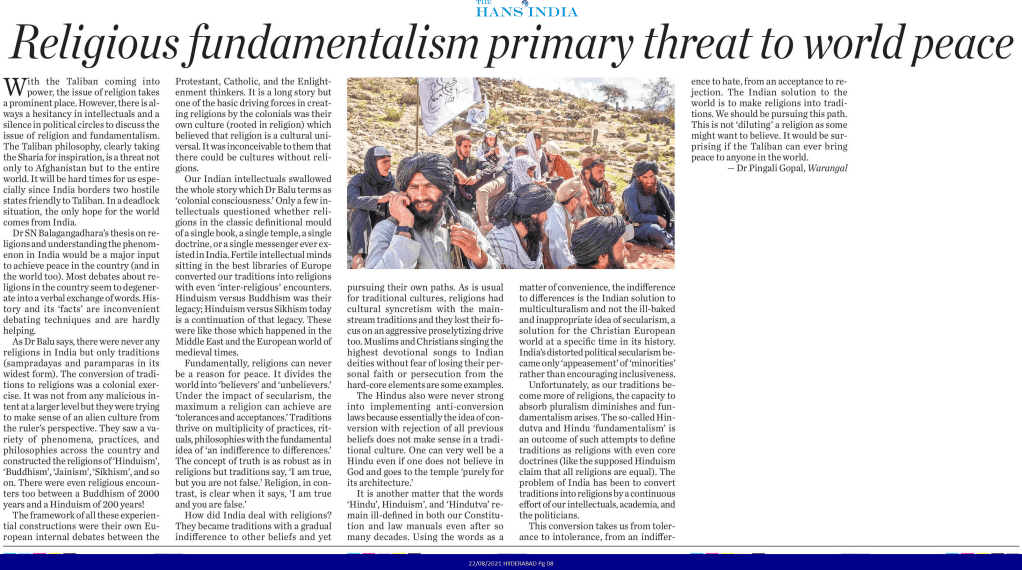
With the Taliban coming into power, the issue of religion takes a prominent place. However, there is always a hesitancy in intellectuals and a silence in political circles to discuss the issue of religion and fundamentalism. The Taliban philosophy, clearly taking the Sharia for inspiration, is a threat not only to Afghanistan but to the entire world. It will be hard times for us especially since India borders two hostile states friendly to Taliban. In a deadlock situation, the only hope for the world comes from India. Dr SN Balagangadhara’s thesis on religions and understanding the phenomenon in India would be a major input to achieve peace in the country (and in the world too). Most debates about religions in the country seem to degenerate into a verbal exchange of words. History and its ‘facts’ are inconvenient debating techniques and are hardly helping.
As Dr Balu says, there were never any religions in India but only traditions (sampradayas and paramparas in its widest form). The conversion of traditions to religions was a colonial exercise. It was not from any malicious intent at a larger level but they were trying to make sense of an alien culture from the ruler’s perspective. They saw a variety of phenomena, practices, and philosophies across the country and constructed the religions of ‘Hinduism’, ‘Buddhism’, ‘Jainism’, ‘Sikhism’, and so on. There were even religious encounters too between a Buddhism of 2000 years and a Hinduism of 200 years! The framework of all these experiential constructions were their own European internal debates between the Protestant, Catholic, and the Enlightenment thinkers. It is a long story but one of the basic driving forces in creating religions by the colonials was their own culture (rooted in religion) which believed that religion is a cultural universal. It was inconceivable to them that there could be cultures without religions.
Our Indian intellectuals swallowed the whole story which Dr Balu terms as ‘colonial consciousness.’ Only a few intellectuals questioned whether religions in the classic definitional mould of a single book, a single temple, a single doctrine, or a single messenger ever existed in India. Fertile intellectual minds sitting in the best libraries of Europe converted our traditions into religions with even ‘inter-religious’ encounters. Hinduism versus Buddhism was their legacy; Hinduism versus Sikhism today is a continuation of that legacy. These were like those which happened in the Middle East and the European world of medieval times.
Fundamentally, religions can never be a reason for peace. It divides the world into ‘believers’ and ‘unbelievers.’ Under the impact of secularism, the maximum a religion can achieve are ‘tolerances and acceptances.’ Traditions thrive on multiplicity of practices, rituals, philosophies with the fundamental idea of ‘an indifference to differences.’ The concept of truth is as robust as in religions but traditions say, ‘I am true, but you are not false.’ Religion, in contrast, is clear when it says, ‘I am true and you are false.’
How did India deal with religions? They became traditions with a gradual indifference to other beliefs and yet pursuing their own paths. As is usual for traditional cultures, religions had cultural syncretism with the mainstream traditions and they lost their focus on their aggressive proselytizing drive too. Muslims and Christians singing the highest devotional songs to Indian deities without fear of losing their personal faith or persecution from the hard-core elements are some examples. The Hindus also were never strong into implementing anti-conversion laws because essentially the idea of conversion with rejection of all previous beliefs does not make sense in a traditional culture. One can very well be a Hindu even if one does not believe in God and goes to the temple purely for its ‘architecture.’
It is another matter that the words ‘Hindu’, Hinduism’, and ‘Hindutva’ remain ill-defined in both our Constitution and Law even after so many decades. Using the words as a matter of convenience, the indifference to differences is the Indian solution to multiculturalism and not the ill-baked and inappropriate idea of secularism, a solution for the Christian European world at a specific time in its history. India’s distorted political secularism became only ‘appeasement’ of ‘minorities’ rather than encouraging inclusiveness.
Unfortunately, as our traditions become more of religions, the capacity to absorb pluralism diminishes and fundamentalism arises. The so-called Hindutva and Hindu ‘fundamentalism’ is an outcome of such attempts to define traditions as religions with even core doctrines (like the supposed claim that all religions are equal). The problem of India has been to convert traditions into religions by a continuous effort of our intellectuals, academia, and the politicians. This conversion takes us from tolerance to intolerance, from an indifference to hate, from an acceptance to rejection. The Indian solution to the world is to make religions into traditions. We should be pursuing this path. This is not ‘diluting’ a religion as some might want to believe. It would be surprising if the Taliban can ever bring peace to anyone in the world.
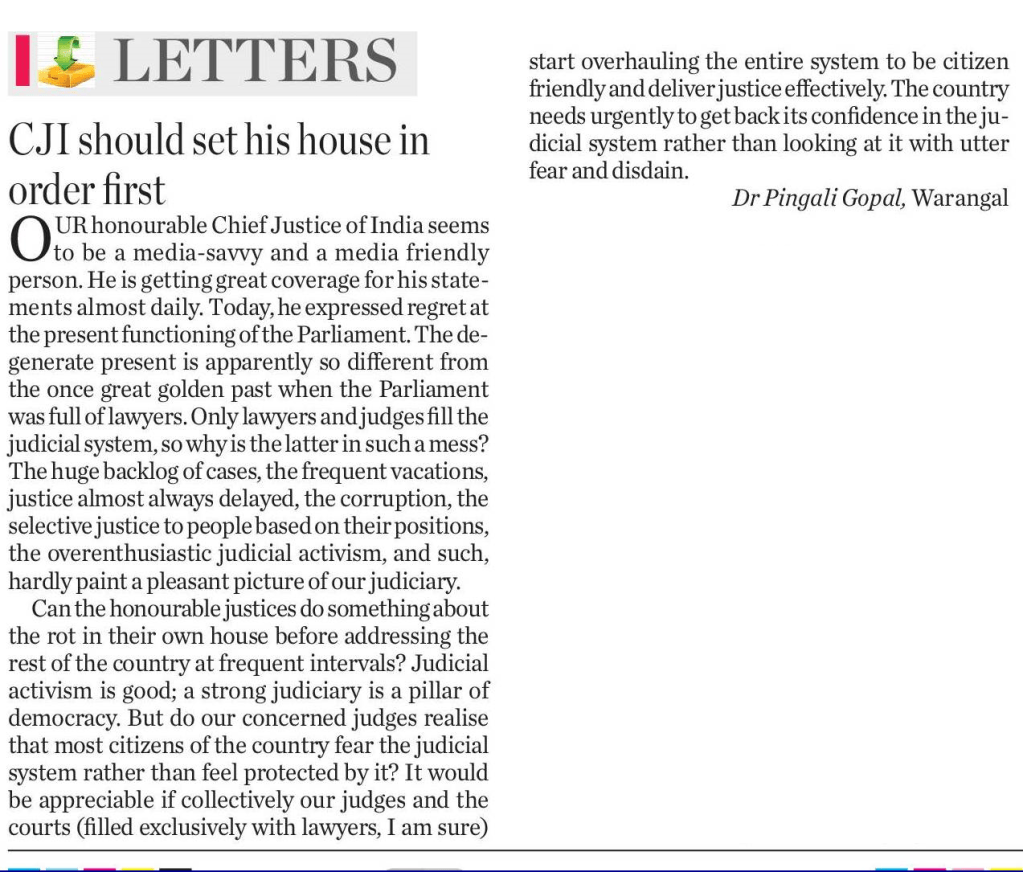
CHIEF JUSTICE OF INDIA AND JUDICIAL ACTIVISM
WATER WARS AND RIVER SHARING

THE UNEDITED VERSION
Madabhushi Sridharji has written an informative article on the difficulties between the two Telugu states and the involvement of the central government on the issue of Krishna and Godavari rivers. Fresh water will be the reason for future conflict and violence across the world in the future. Timothy Clack, in his book ‘Ancestral Roots’, describes this as ‘War of the World’. Water ‘scarcity’ and ‘stress’ are less than 1000 and 1500 cubic meters of water per person per year respectively. In the next three decades, fresh water coming mainly from rivers, would be a cause for severe fights unless we utilise our technology and environment in a proper manner. Fresh waters make up less than 2.9% of all water on the planet, and of this only 0.007% is accessible for use. An enormous pressure will arise for the world as stark predictions say that by 2050, water stress and scarcity will affect 7 billion people in 60 countries and 2 billion in 48 countries respectively. Chillingly, the global population would be likely 9.2 billion in 2050, so practically there would be strife for the whole world.
River water control is a source of conflict from a district level to an international level. As an informed professor involved in water management tells, river water should be under a central scientific body; ideally one body for each individual river. Each river has a specific way for utilisation without degrading it and without causing an environmental damage. Many factors come into play apart from a simple flow. Though an important consideration, it is rarely an equation of saying that since 50% of the river is in one state, it should get 50% of the river water. That would be a recipe for disaster on a broader scale. The Mekong River Commission is one such example which guides the Mekong River utilisation flowing across six countries starting from China. We do have dedicated water resources scholars in various academic departments across the country who do a serious study of the river waters and give solid proposals. However, all their outputs become invalid as politics take over and neighbours start fighting for its share. The allegations against each other fly thick and fast on the issue of height of dams or the number of canals constructed.
It was perhaps a Constitutional error to make river waters a combined Central and State subject. All kinds of politics and not science now determine how we utilise the precious river waters. The political equations also play a role as the Center allegedly favours one state over another. Madabhushi gently alludes to this in the article. Narrow parochial interests take over the larger interest of the nation while managing water resources. River Jordan is a source of trouble in the Arab world even as China interferes with Brahmaputra, a potential issue in the future between not-so-friendly countries. Narmada, Godavari, Krishna, Cauvery are all causes of conflicts between districts, states, and regions in the country today. The fights over water are not surprising. However, the collective humanity does throw up surprises and it may just come together to save the world from the potential ‘water bomb’ of the future, more serious than all previous bombs.
COMMUNISM-A PECULIAR AND SHORT-SIGHTED PHILOSOPHY
https://epaper.thehansindia.com/Home/ShareArticle?OrgId=660b534687&imageview=0
The two-part article by Mohan Kandaji (June 5, 2021) manages to give a highly sanitised version of Communism in India. No single ideology has been more damaging to the spirit of India and Sanatana Dharma than the imperialistic ideology of Communism and Marxism. Sita Ram Goel and Arun Shourie have explored them deeply in their essays and books.
Communist societies (Soviet Russia, China) reduced Marxism to a severe monotheism by being the only doctrine and the only Saviour. They could not help becoming totalitarian enemies of human freedom. Communism was an instrument of Soviet foreign policy, particularly with Stalin, in its drive towards world domination. It inevitably comes into conflict with positive nationalism drawing inspiration from its own cultural heritage and socio-political traditions.
Communist Party of India, a section of the Communist International, started in far-off Tashkent in October, 1920. The British initially imposed a ban on the Communist party and made the its literature easily available to revolutionaries to wean them away from this ‘terrorist’ path. Paradoxically, many patriots became convinced Communists and swelled the ranks of the party after discharge from the prison. In public eye, these patriots retained their stature for their services. Communists became patriots in a reflected glory.
The dissonance between Communism and positive nationalism in India was starkly evident during the Second World War. The Communist Party of India had initially opposed British imperialism and the Muslim League. In 1941, Hitler invaded the Soviet Union. Simultaneously, the Congress launched the Quit India Movement in August 1942. The Communists in the Congress opposed the Quit India resolution because now the ‘imperialist war’ became a ‘people’s war’ simply because an enemy of Britain has invaded the Soviet Union. An enemy (British) of an enemy (Germany) invading a friend (Soviet Union) became a friend. British imperialism became British bureaucracy. The Communists had a significant contribution towards the creation of Pakistan, perhaps next only to that of the Muslim League.
Its intellectuals have remained intensely inimical to the cultural traditions and heritage of India. Communism targets Sanatana Dharma as superstition, obscurantism, and priestcraft and denounces the Dharmashastras as repositories of primitive prescriptions, Machiavellian morality, caste oppression, untouchability, degradation of women, and so on. It condemns all Indic philosophies as Brahminical conspiracies to suppress Lokayata or atheism.
However, as the most important exercise in Independent India, Communist historians, gaining great influential power in the academic universities under a political patronage, have ridiculed every hero, period, episode, and precedent in which Hindus can take pride. In a peculiar and short-sighted philosophy of associating today’s Muslims with Islamic rulers of the past, they managed to completely whitewash the brutality of the Islamic invaders. This gross falsification of history is an injustice to all Indians, including Muslims.
Communism use effectively a difficult language of doublespeak; it constantly discovers conspiracies against the working class and the minorities preventing harmony by pitching one against the other; and are adept at ‘swearology.’ Mahatma Gandhi (bourgeois scoundrel), Rabindranath (mageer dalal or pimp), Patel and Nehru (fascist duo) had some colourful names.
Unfortunately, India’s political language describes ‘Leftist’, ‘Rightist’, ‘Centrist’, and ‘Right or Left of Center’ positions without telling us what ‘Center’ means. Certain groups appropriated one label- ‘Leftist’ for themselves and reserved ‘Rightist’ for opponents without permission or prior consultation. The political language of Communists has been rich in introducing new terms. The heavy influence of this philosophy in the dominant ruling party after independence, the academia, and the media made sure that we internalised many of these toxic discourses. The peculiar political language evolved mainly by the Communists have not only misunderstood the Indian traditions but have gone a step further in maligning the Hindu traditions and culture.
Hindu society becomes a ‘crowd of caste-ridden, cow-worshipping and practitioner of obnoxious obscurantism’. The Leftists-Communists-Marxist-Socialist rainbow spectrum laud themselves as progressive, revolutionary, socialist, secularist, and democratic. Simultaneous is the denunciation of ‘Rightists’ or any opponent as reactionary, revivalist, capitalist, and fascist. The intellectual elite are extremely good at using difficult to counter Communist catchphrases: bourgeois and proletarian; class struggle and class collaboration; revolution and counter-revolution; bourgeois nationalism and proletarian internationalism; fascist forces and the democratic front, and so on. Nationalists led by Gandhi could not understand the nature and purpose of this obscure language.
The Communists considered Gandhi as their greatest enemy because he could wean away the masses effectively, something which they hoped to do with their Indian leaders. Though the intellectuals and the academia soak itself in a rich Communist language, it is fortunate that Indian population have thought it fit to reject them politically. Historically, Russia, China, and Bengal show clearly how Communism and Socialism can only cause physical and intellectual violence but not progress.
GREED, RATIONALITY, AND ETHICS IN MEDICINE
MAY 29, 2021
Autonomy (for the patient), justice (ensuring availability to all), beneficence (only for the good of the patient), and non-maleficence (not causing harm to individual or society) are the four basic principles of health care ethics. At the core of health ethics is the sense of right and wrong; and beliefs about rights and duties. Like all domains, ethics and morals are fluid and debatable with even cultural differences too. What is moral or ethical in one culture may not be so in another one. Ethics is dynamic. What was good ethics a hundred years ago may not be so today. Despite many controversies and discussions on the above four principles, most agree that patient autonomy is by far the most important overriding all the other considerations in event of a clash.
There are rights and duties of the doctor and there are rights and duties for the patient too. Unfortunately, the entire discourse of the governments, media, and the intelligentsia focusses on the duties of the doctor and the rights of the patient. In this process, a heartburn ensues which finally damages the profession.
Medicine, like many other professions, is a fine balance of art and science. Somebody in a malaria endemic area may choose to start anti-malarials for a fever with chills. There might be another doctor who would want an investigation to confirm malaria before starting treatment. Both are perhaps correct and cannot undergo comparison in the binaries of ‘non-academic/ academic’ or ‘non-commercial/commercial.’ The conflicts doctors encounter in the profession many times are complex beyond the understanding of even other non-involved doctors, not to mention the laypeople.
There is a list of many do and don’ts for the doctors divided as compulsory duties, voluntary duties, unethical acts, and misconduct. There are some we are quite aware of as it makes a lot of noise in the media. Some are more subtle. The unethical acts include advertising, printing a self-photograph on the letterhead, commissions, euthanasia, and so on. Misconduct includes sex determination tests, not maintaining records, and disclosing secrets, amongst many others. Active euthanasia is thankfully not a big debate issue in India as in some western countries.
Significantly, there are no guidelines on what should be the ideal charging for the patient. There might be official bureaucratic orders to display the consultation charges or the charges of various services provided in the hospital. However, the ethical guidelines provided by the medical council do not address the charges for services in the non-public sector at an individual or institutional level.
In terms of legal attacks, governmental regulations, and popular perception, the majority of medical private sector has come in the ambit of a business model. Thus, there is an inherent and fundamental contradiction between the service model and the business model in our medical systems. The patient in a private hospital expects the best possible services but at the most reasonable charges. How is this balance decided? How can one calculate the rational pricing when an expert surgeon saves the life of an individual? Why should capping be applicable only to the medical sector? The business proposition seriously mixes with humanitarian considerations in medicine and this is the main reason there is so much debate in society. Consumer protection and legal questions stay intact making the doctor always vulnerable in case of adverse outcomes. The art of medicine loses out in legal battles as the focus becomes only the guidelines and scientificity.
One goes to a five-star hotel and pays twenty times more than the nice hotel in the neighbourhood for the same idli. An individual or institute approaching a top-shot private lawyer would grumble but would happily pay a Himalayan amount of money for the services rendered. There is a choice available to the person. The reason for grumbling and heartburn in society happens because poor patients and uninsured patients forcibly go to the private sector instead of utilising the public sector.
This lack of choice should make our thinkers reflect on the state of the public services in the country or the lack of proper and rational insurance policies. Ironically, the government insurance schemes for the public sector are so poorly structured that there is enormous hesitation to take up difficult cases and generates a whole set of practices which ultimately does not benefit the health of the individual or the society. Similarly, attacking individual doctors or slapping notices on corporate hospitals for being greedy is a short-term populist method of solving issues.
When the capping comes for private institutes in the health sector, what should be the limits? To what extent business practices apply to the medical sector? The point is, these are difficult issues and there is certainly a need for wide debate instead of unthinking reactions which can only harden stances. Ethics and morals are a very difficult subject, especially in the practice of medicine. Rationalising any unethical practice (on part of the doctors) and outright condemnation of any practice (not fitting into popular common-sense perceptions) are both wrong; and there should be perhaps an attempt to achieve a balance. The public-private model of health should deliver the goods to all the citizens of India in an effective manner without physical or intellectual violence in society. Is there hope for such a debate?
CAN THE WORLD EVER UNITE
MAY 6, 2021
Can the world ever unite? A pandemic should unite theoretically all nations and humanity as one. Instead, we have only massive fights at almost every level. In India, the entire narrative fixes around the central pole of our PM. The haters hold him responsible for every single evil in the country including the cat which lapped up their milk or the abusive drunk in their neighbourhood. The lovers make it a point to inform that Modi is responsible for the butterfly looking beautiful in their gardens. The pandemic has overwhelmed all the countries in the world (except perhaps China). People in the western world are also rebelling against instructions and causing problems for the governments by holding public parties without masks. Vaccination shortage is acute even in the western world. Without exonerating our government which took the extremely foolish step of conducting elections across the country which no political party, media, intellectuals, or the judiciary (perhaps in summer vacation) bothered to oppose, these are just desperate times for the world.
This is a time when we should have risen above the need for making money at every level (vegetable sellers inflating their prices; hospitals raising their charges; journalists selling shocking photographs for big money; pharma companies making huge profits; crooks selling fake medicines; individuals in black market schemes) or from the desperate desire for power.
Only two threats could have possibly dissolved borders and joined humanity as one: a pandemic or an extra-terrestrial threat (meteors, asteroids, and maybe aliens too). We have lost the first opportunity; perhaps the second undesired option remains the only hope. Carl Sagan said that we should always strive to become a two-planet species because the frail human mind does not have the intellectual and emotional capacity to protect itself and the Earth indefinitely. We need a back-up. Another scientist says, our Earth may have reached this stage of civilization many times before. At a crucial stage of nuclear development, humans or their equivalents endowed with similar kinds of brains might have simply blown themselves up. Our combined nuclear power has the capacity to destroy humanity and all living life many times over. But, a small corner of the human mind still allows us to live with some optimism as everyone seems to be fighting just about everyone else and solutions become new questions.
THE PROBLEM PERHAPS IS DEMOCRACY
APRIL 30, 2021
Political parties eagerly conduct elections (from state level to municipal) in the deadly pandemic throwing all precautions to the wind. This shows how illogical it is on the part of the voters to trust the governments they form to protect its citizens. Elections during a pandemic is simply a complete disregard for its citizens. Hospital beds are not available even for the most powerful and the rich; doctors and nurses are losing their sanity; many families are losing their near and dears; and yet, there remains a pressing need to conduct not even state but municipal elections! Most citizens are also aware that these elections will achieve nothing and will maintain a status quo with respect to development.
The power of the vote is a myth as Indian democracy amply shows. Plato (4th century BCE) thought that like all forms of governance, even democracy ruins itself by excess of its basic principle of an equal right of all to hold office and determine public policy. Democracy becomes disastrous because people are deficient by education to select the best and wisest rulers even as the most educated and capable choose to stay away from the process of elections. Oratory skills, nepotism, money, corruption, and general incompetence take over with the single purpose to garner votes and gain power. There is a complete disconnect with good administration. Aristotle thought that democracy bases on a false assumption that those who are equal in one respect (like the law) are equal in all respects, including governing. He says that in a democracy, ability sacrifices itself to number, while trickery manipulates numbers.
Yet, over the centuries, through revolutions, through public opinion, through emotions, democracy has become the norm- an ‘ought to’, all over the world. The major issue is the balance between individual rights and the government rights. As one increases, the other correspondingly decreases. The golden mean is apparently democracy today.
The search in western traditions was always present in the ideal for maximal individual liberty under the umbrella of minimal state interference and maximal state security. Seeking that harmony remains a distant dream even as a bewildering array of ‘isms’ generate. The political philosophies of right, left, center permeating into Indian thinking do not simply make sense in the light of our thousands of years of cultural traditions and lived experiences. And yet, we think liberal secularism as the best form of political philosophy.
Indian traditions had evolved a way with an enlightened monarchy and free citizens ages back. Important treatises, texts, and wisdoms of ancient and medieval India focussed on the qualities and duties at all levels from the king to the ordinary citizen unlike western intellectual rights-based traditions. Kings rule was to ensure peace, prosperity, and happiness to its people. The wars of the kind fought in Europe in the medieval times were perhaps unusual in the Indian context. Indian wars, by principle, mostly left the agricultural lands and the temples intact.
A bond linking rulers and people across kingdoms allowed free movement for pilgrimages and access to knowledge. Shankaracharya surely would have moved across various kingdoms to set up the four mathas in four corners of the country. Hence, alternatives to democracy did thrive without affecting trade, agriculture, literature, and sciences across the country. Indian civilization, at least five thousand years old, apart from a high quotient of personal happiness, had a thriving economy with highly-evolved arts, literature, education, sciences, spirituality, architecture, and so on. Our indigenous systems had some worth as its outcomes did certainly attract thousands from Central Asia, Middle East, and Europe. And then came the western political philosophies which persistently ill-fit with our experiences.
Thousands of years of lived experience and culture has also moulded a special Indic philosophy which we knowingly or unknowingly subscribe to. Most Indians are ‘Indic Liberals’ by a natural inclination combining principles of both the so-called leftist and conservative thoughts. Politico-economically, Indic Liberal is a unique form of ‘Religious Left’ aspiring to become a ‘Liberal Right’. As ‘Liberal Right’, we always had the principles of limited government, free markets, individual liberty, equality of opportunity, and an assertive defence policy. While Left is normally non-religious it need not be so for us. At the same time, the necessity to provide equal opportunity to the poor warrants an understanding of the need for welfare measures.
Diversity, multi-culturalism, and pluralism is an inbuilt lived experience in our society. Democracy with its principles of ‘liberal secularism’ seems to be thriving on these to win power by dividing and thus destroying this pluralism. Hence, if a pandemic comes in the way, the response is, so what?
INDIAN FEMINISM: DIFFERENT CONTEXTS, DIFFERENT SOLUTIONS
MARCH 9, 2021

Nowhere is the disconnectedness and inappropriateness of western philosophies to Indian issues starker than in feminism. Western feminism took the form of waves; the first wave and second wave achieved a huge victory in terms of voting rights, political participation, equal pay, and emancipation of women. In this demand for political, cultural, educational, and economic equality, feminism took various forms like liberal feminism, Marxist feminism, and radical feminism. However, the subsequent approach leads to a confrontation with strong narratives today of ‘patriarchy’; ‘toxic masculinity’; and a general distrust of the males and the institute of marriage.
However, thinkers using western frameworks to define Indian gender issues do not realise that many familial, societal, cultural, marital, and economic factors apart from individual consciousness condition women issues. Indian feminists taking western theories simply washout the divine component of women in Indian scheme of things. The huge number of goddesses and Shakti traditions simply disappears from their understanding of Indian culture. The explanation of Goddess worship as a part of patriarchal and casteist practices, masked as ‘respect for women’, simply undermines the entire civilizational heritage of the country.
India’s huge body of texts and traditions were always about Dharma, rights, harmony, and women working as equals in maintaining the family and society (Sahayogini and a Sahakarmini forming a unit of Dampati). Indian ideas of Ardhanareshwar (man-Shiva and women-Shakti representing two aspects of one person); women in bhakti traditions achieving gender equality and equal respect; women protesting patriarchy, kings, caste divides, oppressive social norms; hundreds of inspiring women in history and literature do not figure in discussions of Indian feminism. As one author Jasbir Jain says, ‘Draupadi deconstructed the notions of chastity and sati; Sita, of power and motherhood; Kali, of violence; Puru’s young wife, of sexuality; the bhakta women, of marriage and prayer.’
The utilitarianism approach of gender equality in the west finally lost the understanding of the exclusive value that birthing, motherhood and lactating bring to women. A biological function became a matter of rights which is extremely confusing in the Indian context. This is not to suggest that everything is great about Indian women with regards to their educational, political, social, or economical rights and respect, but the issues and solutions are simply different.
The low respect for women voicing out choices in lower socio-economic classes and the struggle of an urban woman in balancing work and home leads to the belief that Hindu texts are extremely misogynistic. As is usual with many narratives, an association with traditions becomes the cause of social problems. Some Indian scholars feel that western feminism when applied to the Indian culture leads to anti-Hinduism instead of anti-misogyny. Political and demographical hijacking of feminism by west funded NGO activism is primarily responsible for it.
The Sabarimala temple entry issue exemplified how traditional belief systems became a set of ideas related to gender discrimination – a direct influence of global feminism. The ridicule of ‘patriarchy’ and ‘regressive nature’ constantly sticks to many Indian festivals and customs. As the later waves spill over to India, the themes of both father and mother as evils, Mangalasutra and sindoor as regressive symbols, and deeply patriarchal social systems tries to unsettle the Hindu family and the marriage system. Many Indian feminists have an acute sense of discomfort as postcolonial theories related to feminism addresses the need of western academia. One Indian scholar says that what counts as ‘marginal’ in relation to the West has often been central and foundational in the non-West.
India is large, diverse, and unequal. The stories of feminism are likewise different. It is perhaps the second wave of global feminism which found resonance with some contemporary Indian issues like land rights, political representation, divorce laws, custody, guardianship, sexual harassment at work, alcoholism, dowry, and rape. There are gender issues in India, some very severe, and they need correction but through our own solutions. Feminism is a modern expansionist creation of the West based on the ideas of ‘everything patriarchal’ theme, the disparate natures of men and women, and liberal secularism. Transposing it to Indian culture finally hits out at our traditional society. Like for multi-culturalism, India perhaps has better solutions for the world which seeks harmony, deifies women, and asks women to be just women, true to their physical, mental, and intellectual natures.
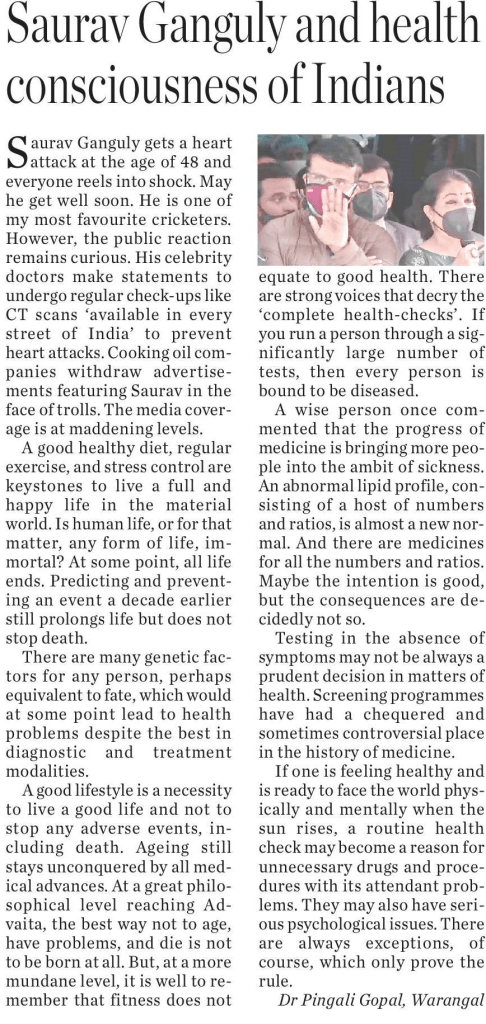
SAURAV GANGULY AND HIS UNFORTUNATE HEART ATTACK. CELEBRITY DOCTORS MAKING STATEMENTS
OF INTELLECTUALS AND DEMOCRACY
Top scientific journals like Nature, Scientific American, and New England Journal of Medicine in recent times ran articles and editorials condemning the present President of the US and seeking to change him. Similarly, many intellectuals, academicians, and politicians publicly declare that they do not accept our present PM as their leader. This is all fine for intellectuals to like or dislike politicians in the best principles of liberalism and freedom and expression. But, this has extremely disturbing moral and ethical implications for the role of democracy and the importance of voting in free countries. When the majority votes for a particular person or a party in a democratic mode, does it not imply that one should honour the decision of the majority till the next elections when one can exercise their franchise? How can supposedly non-political, secular, and neutral scientific intellectuals publicly call for removal, change, or rejection of popularly elected leaders because they have problems with the leadership? Whatever may be the motivation and however correct their reasons are, it is a cornerstone of democracy to accept the decision of majority. A blatant refusal or rejection points to the whole idea of democracy as an extremely flawed institution. Indian traditional ideal of governance was an enlightened monarchy. The ideal of philosopher-kings was also prominent in ancient Greek philosophers. Perhaps, we can question the whole concept of a liberal democracy as the best form of governance. Can scientific journals run strong editorials to bias voters not to vote for a particular person and can someone in the country refuse to call a person as ‘my PM’? As ancient philosophers stressed, all forms of governance, including democracy, come in cycles with each ending in breakdown and revolution. The ability to garner votes disconnected with the ability to administer, the power of oratory skills, nepotism, corruption, mediocrity rising to the top, and the ‘wisest and the best’ removed far away from elections were the critical points of Socratic philosophers against democracy. They remain eerily true even today across the world. What does democracy and voting rights actually mean? Accepting democracy as the ideal and then not accepting the decision of the majority shows the inherent stress and contradiction of this model. Dr Pingali Gopal, Warangal
https://www.thehansindia.com/my-voice/myvoice-views-of-our-readers-5th-november-2020-654744
TIME TO ‘TRADITIONALISE’ RELIGIONS
The controversy from a simple and beautiful advertisement points to a deeper problem in understanding Indian society. Defining religion in Indian context through a book, a God, a doctrine, a Temple is problematic. India does not have religions but a huge number of traditions (sampradayas) with rituals as its foundational basis. Rituals unite people and religions divide people. The defining aspect of any traditional culture is an indifference to differences going beyond the standard tolerances or acceptances. It is a metaphysical and sociological impossibility that Indian culture knows of religions as reasoned by eminent scholars. Ironically, secularism seems to be generating fundamentalism instead of being an antidote to it. No state or court possesses an impartial uniformly applicable scientific criterion of identifying and delimiting religion. Core issues of Uniform Civil Code, temple control by governments, and proselytization become key sore points in the discourse of secularism in the country. Historically, Indian society was far more tolerant and liberal than any society so far. For over a millennium, India had presence of Vedic, non-Vedic, and even atheistic traditions living with Zoroastrian Parsis, Muslims, Jews, and Christians in mostly peace. Indian society never disintegrated despite the diversity; hence it must have known successful practices and mechanisms of coexistence. The assumption that all conflicts are in support of ‘ultimate ideals’ and ‘truth value’ of individual groups is brilliantly wrong in the Hindu-Muslim conflicts in India. Different from religious conflicts between Christian confessions or between Islam and Christianity in the West, these conflicts have been more socio-economic and political. There are no attempts to study this. Due to an inappropriate secularism, a flexible, absorbing mass of traditions slowly converts to a religion in trying to define holy books, principles, and ideals. Starting with the Arya Samaj and the Brahmo Samaj, through Savarkar’s writings, through the political movements post-independence, a rich mass of pluralistic traditions stringently defines itself, crystallizing into ‘Hindutva’, which the critics want to eagerly label as the almost oxymoronic ‘Hindu fundamentalism’ or even ‘fascism’.
https://www.thehansindia.com/my-voice/myvoice-views-of-our-readers-20th-october-2020-652050
THE UNEDITED VERSION
THE AFTERMATH OF THE TANISHQ AD
Defining religion in Indian context through a book, a God, a doctrine, a Temple is problematic. India does not have religions but a huge number of traditions (sampradayas) with rituals as its foundational basis. Rituals unite people and religions divide people. The defining aspect of any traditional culture is an indifference to differences going beyond the standard tolerances or acceptances. It is a metaphysical and sociological impossibility that Indian culture knows of religions as reasoned by eminent scholars.
Europe, in its framework of a religious culture, understood traditions as religions in India. Indian traditions confused the intellectuals with many texts, sub-texts, stories, Puranas, mythologies. They finally zeroed on to the ‘Vedas’ and Upanishads. Anything explicitly not religious like ‘grammar’ became non-holy. Despite this, frustratingly most Indians had an indifference to the differences in the texts, and were oblivious of most of the doctrines. Hinduism turned loose, non-canonical, vague, wavering, illusory, obscure, inconsistent by people like Hume and James Mill.
It never occurred to people then and now also that the amorphous nature of Hinduism is simply because ‘Hinduism’ did not exist. It was an imaginary entity, conjured up in the best minds of Europeans due to their absolute conviction that there had to be a religion in the natives. The standard understanding of religion has only given us wars, strives, conversions, and Inquisitions. To understand ‘religio’ as a tradition allowing varied practices with a characteristic indifference to the differences will build up far more harmony and understanding in the world still in the grip of religious frictions. The West in trying to make sense of the tree of Indian traditions, took hold of the branches and made them into different religions, sometimes even fighting each other. Sadly, we have collectively and completely internalised these discourses.
Ironically, secularism seems to be generating fundamentalism instead of being an antidote to it. Huge problems arise when a solution for a Western non-plural society at a specific time became a universal solution for all societies. In Europe, the separation of politics from religion resulted from a specific understanding of confessional strife which divided Christendom into various factions, each claiming to be the true religion. The continuum of theological and political principles firmly established the two kingdoms of the secular and the religious- the realm of the public and the private respectively. In India, secularism becomes problematic in defining the spheres of ‘religion’ and ‘public life’ needing separation. No state or court possesses an impartial uniformly applicable scientific criterion of identifying and delimiting religion. Core issues of Uniform Civil Code, temple control by governments, and proselytization become key sore points in the discourse of secularism in the country.
Historically, Indian society was far more tolerant and liberal than any society so far. For over a millennium, India had presence of Vedic, non-Vedic, and even atheistic traditions living with Zoroastrian Parsis, Muslims, Jews, and Christians in mostly peace. Indian society never disintegrated despite the diversity; hence it must have known successful practices and mechanisms of coexistence. The assumption that all conflicts are in support of ‘ultimate ideals’ and ‘truth value’ of individual groups is brilliantly wrong in the Hindu-Muslim conflicts in India. Different from religious conflicts between Christian confessions or between Islam and Christianity in the West, these conflicts have been more socio-economic and political. There are no attempts to study this.
Religion needs to demarcate by doctrines; traditions are plural and flexible involving the inherited practices of the community rather than doctrines. For reasons unclear now, Christianity and Islam took the character of traditions like other traditions in India; they lost the fixation on distinguishing between the true and the false and the resulting proselytizing drive. A syncretism with Hindu thought also grew in India with some fine examples all over the country. These aspects need urgent explorations to finally reject our previous inappropriately transferred concepts from the European context to deal with our problems.
Due to an inappropriate secularism, a flexible, absorbing mass of traditions slowly converts to a religion in trying to define holy books, principles, and ideals. Starting with the Arya Samaj and the Brahmo Samaj, through Savarkar’s writings, through the political movements post-independence, a rich mass of pluralistic traditions stringently defines itself, crystallizing into ‘Hindutva’, which the critics want to eagerly label as the almost oxymoronic ‘Hindu fundamentalism’ or even ‘fascism’. Secularism is flawed to the core and will continue to fail in the country. We need to look within ourselves to seek better models which we always had; perhaps even a solution for the world grappling with multi-culturalism. The answer might be in traditionalising religions rather than religionising traditions.
Social system: It’s time for alternative theories
With regards to the article ‘Rapes show double struggle of low-caste women in India’ (Oct 9), rape is indeed the worst possible crime deserving the highest form of punishment as human exploitation based on social hierarchies. However, in India, a huge distortive discourse by the social sciences and humanities over decades dominated by a single ideology has caused huge damage at a national and international level. We failed to develop alternative theories on our social systems. ‘Colonial consciousness’, a continuing intellectual violence by the colonised minds in a different period, refuses to remove the western lenses to understand ourselves. The dated narratives try to fit every social problem into the Marxist paradigm of the exploiter and the exploited.
Rape is a neither a generalised phenomenon nor India the rape capital of the world. Assuming a uniform meaning to the word despite varying definitions, in fact, rapes in India is much lower as compared to other countries. The incidence of rape in India in 2010 stood at 1.8 per 100,000. The comparative figures were 27.3 for USA, 28.8 for UK, 65.3 for Sweden, and an overwhelming 120 per 100,000 for South Africa. Regarding the oft-repeated ‘underreporting’ criticism, even if we assume ten times under-reporting in India and absolutely no underreporting in the Western countries, we still have a hard time catching up. The under-reporting must be thirty-six times before it reaches levels in Sweden. Rape is a distinct phenomenon with biological roots. Attaching it to traditions, religions, cultures, or even education, it is a classical bad statistical practice of conflating causation to correlation.
Sweden has one of the highest number of atheists and the highest literacy rates in the world. Would that be an argument to show that either a lack of belief in god and/or good education is responsible for high rapes?
The so-called caste-system, the biggest punching bag for intellectuals, remains a continuing and colossal semantic trap for the whole country. No equivalent to the word ‘caste’ exists in any of our scriptures. A Portuguese word ‘casta’ applied to groups of people (New Christians and the Old Christians) in the Iberian Peninsula when the Portuguese landed on the shores of Goa became an internal story of India amazingly.
If horror stories of ‘caste discrimination’; the social humiliation of groups, poverty, and so on are evidences of the existence of ‘the caste system’, then the latter is present everywhere in the world. Discrimination, poverty, and social humiliation of groups are in slavery, in the feudal societies of Europe, in the capitalist societies of today, and so on. These are compatible with multiple social structures.
Our lived reality is the four varnas and the thousands of jatis. The varnas are normative, categorical classification to which attached a hierarchical ordering by the colonials by a very selective reading of our scriptures. Jatis evolving and dissolving, going up and down the social-political-economic scale with their own rules of marriage, food and customs have been the only social reality. One of the most impossible and futile exercises in social theorising has been to correlate the varnas to the jatis. Force-fitting continues to persist despite problems.
Amazingly, by constant decrees, legislation, and politics, a diverse population, numbering 64.5 million at the last census, born into one thousand two hundred communities, each with its own identity has become a single category of ‘scheduled castes’. The single criteria for this grouping, a political and legal creation rather than a social reality, is ‘untouchability’- an extremely tenuous idea.
Importantly, the data for caste atrocities simply does not exist. The definitions have been narrow; discriminations studied only in isolated groups; and the whole narrative of ‘caste discrimination’ finally is a case of data manipulation, statistical cherry-picking, and making macro claims based on micro evidence. The same hard data from the National Crime Records Bureau which helps in giving us a terrible international reputation shows, for example, on an average, every percentage of the non-SC population faces roughly 1.19% of the incidences of crime, while every percentage of the SC population faces about 0.04% (30 times less) of the crime. The ambit of soft data remains wide with ad hoc explanations and even more manipulations.
Successive governments, by creating categories like forward caste, backward caste (with further sub-categories like A, B, C, D), and scheduled castes, have happily promoted the racial categories we detest so much and instilling false notions of superiority, inferiority, guilt, anger, and shame in various proportions in society while wanting ironically to create an equal society. The colonials had a purpose to break our society, but why did our own politicians and intellectuals fail us after independence?
Our natural sciences declare boldly that all humans share 99.99% of genes; any slightest notion of race or inherent superiority or inferiority of a group of people is wrong. Yet, our intellectuals keep hitting at India to be the worst place in the world for a woman or a Dalit. We absorbed and assimilated every culture from across the world for thousands of years, and yet we are in the dock for the ‘ugly caste-system’, ‘patriarchy’, a rape culture’. It is time for us to dissipate unfortunate angers and start fresher narratives.
https://www.thehansindia.com/my-voice/social-system-its-time-for-alternative-theories-650603
THE ANTI-HINDU BIAS OF INTELLECTUALS AGAIN

ENCOUNTER CULTURE
WHEN WILL THE HATE END?
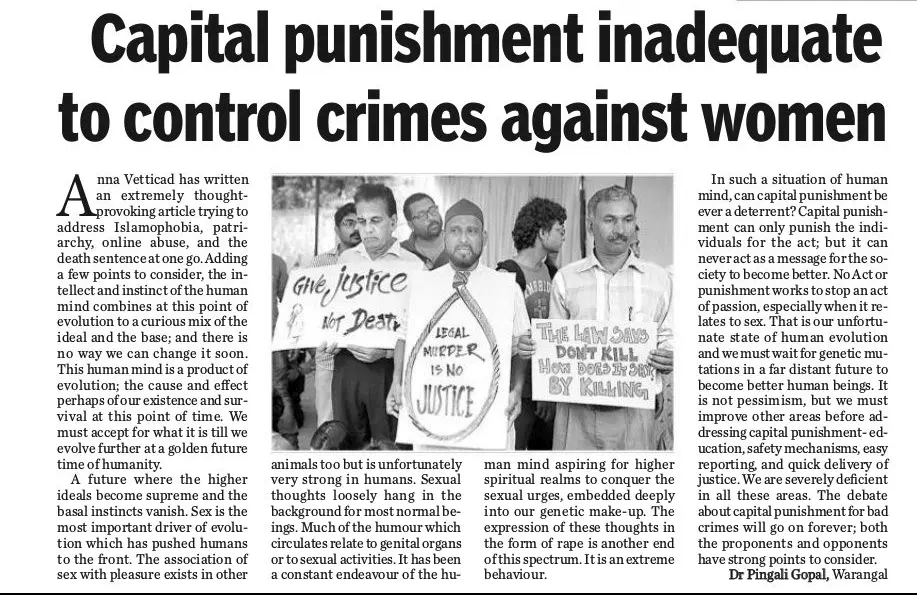
CAN CAPITAL PUNISHMENT BE A DETERRENT FOR RAPE?
BLAME GAME IN CORONA PANDEMIC

ON THE CORONAVIRUS SCARE

ON VEGETARIANISM AND NON-VEGETARIANISM: THE MORAL DEBATES- DO THEY REALLY EXIST?
The biggest strength of Indian traditions is an ‘indifference to differences.’ I may not eat meat, but I would not mind somebody eating the same across the table. Indian tradition does not talk of acceptance or tolerance, which by connotation means that one is superior and what I am tolerating is inferior. Homo sapiens have an unequal and complicated relationship with rest of the animal kingdom which has evolved over many million years. Animals come into an equation with humans in myriad ways: as food, as pets, for entertainment (sports which may or may not involve killing the animals), as experimental animals in pharmaceutical and medical industry, as beasts of burden, and as war animals. The number of animals used in the medicinal industry is too mind boggling to even mention. We are enjoying the longevity provided by the medical and pharmaceutical industry because of experimentation and trials on an infinitude of animals. Many brilliant surgical careers launch in animal labs.
Food animals are too numerous to mention. The point is, do we need to eat animals to survive? There are many arguments in favour of consuming meat- nutrition content being one of them. A well-rounded vegetarian diet is equal in nutritional content to a non-vegetarian one. A major argument is that land agricultural produce would not be enough to feed the ever-increasing population. Again, this is arguable. The land on Earth is enough to feed the humans with crops many times over its present population.
Low cost food is another. The price of meat produce in shops is low because the agricultural industry spreads the cost elsewhere. Timothy clack in ‘Ancestral Roots’ writes that plants allowed us to live, but meat was probably important in evolution. However, the vegetarian option is seven times more efficient than the non-vegetarian option. Feeding livestock with foods to which they are not normally adapted, like corn to livestock, most of it being beef cattle, has a consequence of converting lands for agriculture to produce corn. Today, in the US, 60% of the corn is a feed for livestock. Lands converted to feed the livestock and process their excretions are a great cause of land, water, and air pollution. Marine life also disappears by a process of Eutrophication, seen in 50% of lakes in USA and Europe. Some authorities, in fact, have put the blame of global warming on animal farming.
So, one should not really make an argument for availability of meat at a low cost as a reason to universal non-vegetarianism. The meat industry has become the biggest threat to the continued existence of modern humans. At any time, the global agriculture industry is feeding 1.1 billion pigs, 1.8 billion sheep and goats and 15.4 billion chickens. Meat industry consumes more water as compared to the agricultural practices. Each pound of steer meat from a US feedlot requires about 10,000 litres of water. A pound of potato requires about 50 litres of water. Livestock drink about half the water consumed in the USA. There are such kind of serious arguments against non-vegetarianism, nobody takes them seriously.
The exclusive link of holiness to vegetarianism does not exist in our scriptures. Most scriptures and our deities too consumed meat. Our saints like Ramana Maharishi never made vegetarianism mandatory. It is only an argument to badger the traditionalists into silence by showing scriptural references. It would be simply foolish to even expect that the world will stop eating meat. The percentage of vegetarians in almost all countries of the world is in single digits; like 3% in the US and 6% for Europe! India stands between 29-40%, which is clearly an outlier. The choice rests with the individuals.
Swami Vivekananda spoke at length on meat consumption and he was aware that it was a highly controversial topic. He says: ‘So long as man shall have to live a Rajasika (active) life, there is no other way except through meat-eating. Rather let those belonging to the upper ten, who do not earn their livelihood by manual labour, not take meat; but the forcing of vegetarianism upon those who must earn their bread by labouring day and night is one of the causes of the loss of our national freedom. All liking for fish and meat disappears when pure Sattva is highly developed. And where such indications are absent, and yet you find men siding with the nonkilling party, know it for a certainty that here there is either hypocrisy or a show of religion. The injunction of the Hindu Shastras which lays down the rule that food, like many other things, must be different as per the difference of birth and profession is the sound conclusion.’
The use and abuse of animals is part of the evolutionary game, and there is no way we can avoid that. We have reached where we are because of exploitation and selective killing of other species. We cannot apply moral standards and ethics in our behavior towards them selectively. We have variable standards; and in such circumstances to talk about cruelty of Jallikattu while having a chicken tikka masala does not make any sense. The Jain monks probably have some moral authority to talk about cruelty to animals; but for most of us, we must accept that humans are a branch of evolution with some distinct exploitative advantages towards survival, and we make use of it. It is good to have some moral standards in dealing with animal use; but they will always be fluid, grey, and interpretable. A totalitarian view which goes against common sense as the world will never stop eating meat. Also, they are fighting evolutionary principles and hence is a lost battle from the word go. I believe all animals are holy, not only the cow; but my tradition says that if someone wants to eat them, feel free. But do not throw scriptures at me. Do not generalize the stand of few unaware individuals to the entire Hindu Right.
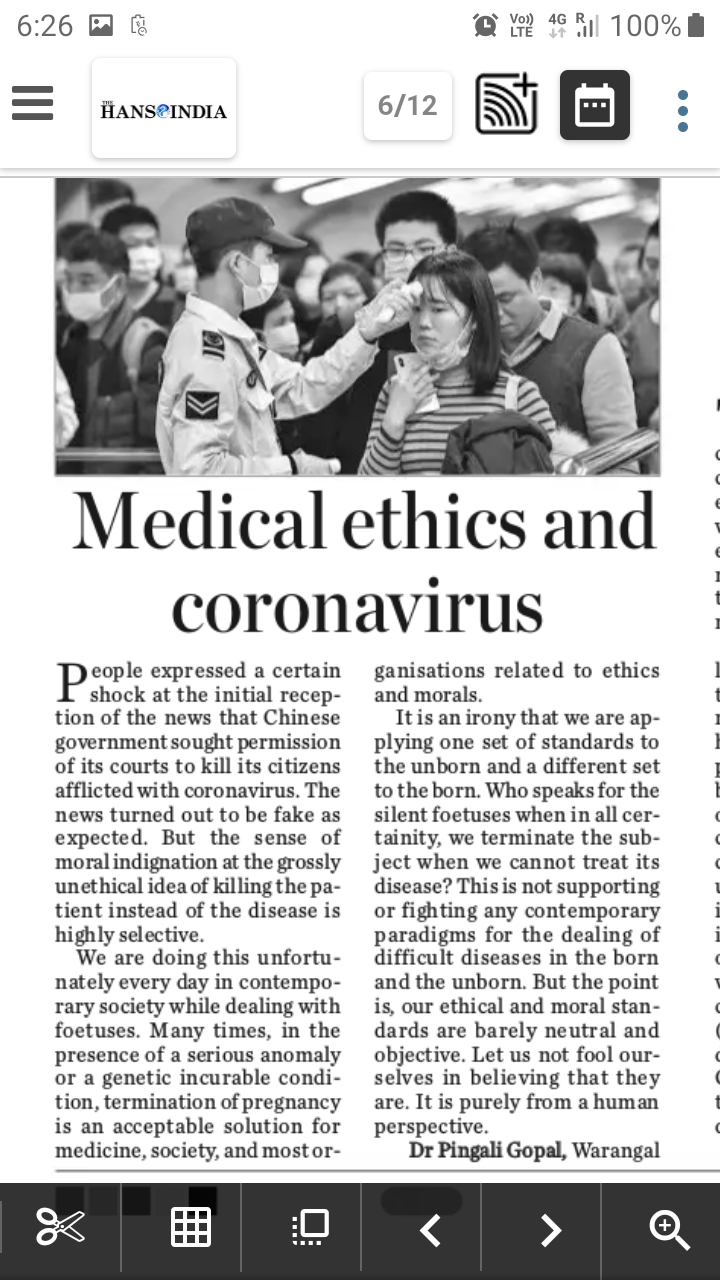
MEDICAL ETHICS-DIFFERENT FOR THE BORN AND THE UNBORN
LETTER ON SECULARISM: PARADOXICALLY GENERATING HINDU FUNDAMENTALISM
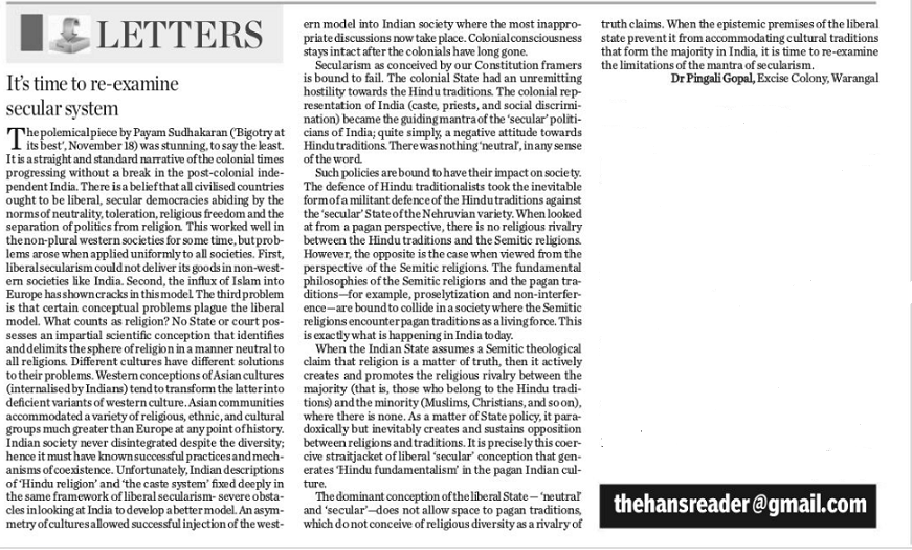
The text of the above letter:
The polemical piece by Payam Sudhakaran was stunning, to say the least. It is a straight and standard narrative of the colonial times progressing without a break in the post-colonial independent India. There is a belief that all civilized countries ought to be liberal secular democracies abiding by the norms of neutrality, toleration, religious freedom, and the separation of politics from religion. This worked well in the non-plural Western societies for some time, but problems arose when applied uniformly to all societies. First, liberal secularism could not deliver its goods in non-Western societies like India. Second, the influx of Islam into Europe has shown cracks in this model. The third problem is that certain conceptual problems plague the liberal model. What counts as religion? No state or court possesses an impartial scientific conception that identifies and delimits the sphere of religion in a manner neutral to all religions.
Different cultures have different solutions to their problems. Western conceptions of Asian cultures (internalised by Indians) tend to transform the latter into deficient variants of Western culture. Asian communities accommodated a variety of religious, ethnic, and cultural groups much greater than Europe at any point of history. For over a millennium, India had presence of Hindu, Buddhist, Jain, and Sikh traditions living with Zoroastrian Parsis, Muslims, Jews, and Christians of various denominations in mostly peace. Indian society never disintegrated despite the diversity; hence it must have known successful practices and mechanisms of coexistence.
Unfortunately, Indian descriptions of ‘Hindu religion’ and ‘the caste system’ fixed deeply in the same framework of liberal secularism- severe obstacles in looking at India to develop a better model. An asymmetry of cultures allowed successful injection of the Western model into Indian society where the most inappropriate discussions now take place. Colonial consciousness stays intact after the colonials have long gone.
Secularism as conceived by our Constitution framers is bound to fail. The colonial state had an unremitting hostility towards the Hindu traditions. The colonial representation of India (caste, priests, and social discrimination) became the guiding mantra of the ‘secular’ politicians of India; quite simply, a negative attitude towards Hindu traditions. There was nothing ‘neutral’, in any sense of the word.
Such policies are bound to have their impact on society. The defence of Hindu traditionalists took the inevitable form of a militant defence of the Hindu traditions against the ‘secular’ state of the Nehruvian variety. When looked at from a pagan perspective, there is no religious rivalry between the Hindu traditions and the Semitic religions. However, the opposite is the case when viewed from the perspective of the Semitic religions. The fundamental philosophies of the Semitic religions and the pagan traditions—for example, proselytization and non-interference—are bound to collide in a society where the Semitic religions encounter pagan traditions as a living force. This is exactly what is happening in India today.
When the Indian state assumes a Semitic theological claim that religion is matter of truth, then it actively creates and promotes the religious rivalry between the majority (that is, those who belong to the Hindu traditions) and the minority (Muslims, Christians, and so on), where there is none. As a matter of state policy, it paradoxically but inevitably creates and sustains opposition between religions and traditions. It is precisely this coercive straitjacket of liberal ‘secular’ conception that generates ‘Hindu fundamentalism’ in the pagan Indian culture. The dominant conception of the liberal state— ‘neutral’ and ‘secular’—does not allow space to pagan traditions, which do not conceive of religious diversity as a rivalry of truth claims. When the epistemic premises of the liberal state prevent it from accommodating cultural traditions that form the majority in India, it is time to re-examine the limitations of the mantra of secularism.
BRUTAL KILLING OF A LADY GOVERNMENT OFFICER
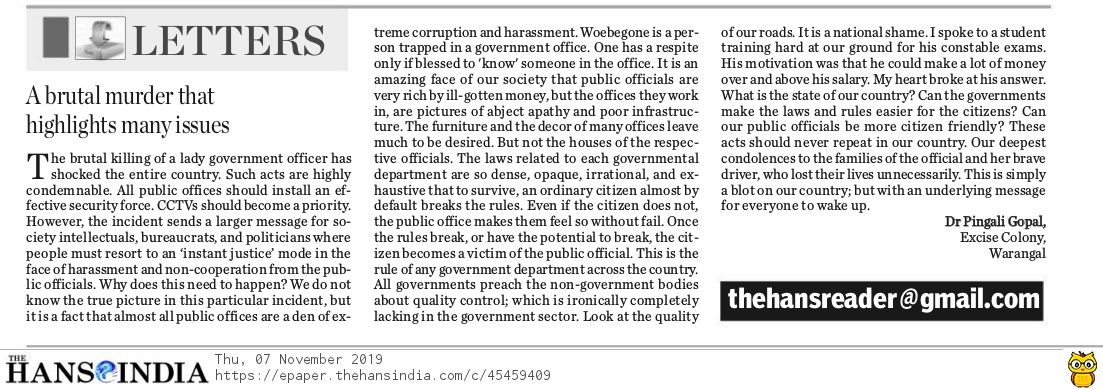
MARX AND SOCIALISM: AN ALTERNATIVE NARRATIVE
LGBT PEOPLE NEED GREATER SOCIETAL ACCEPTANCE
EXCESSIVE VIOLENCE IN TELUGU FILMS
INCENTIVE TO STAY UNEMPLOYED
THE DEPLORABLE ROADS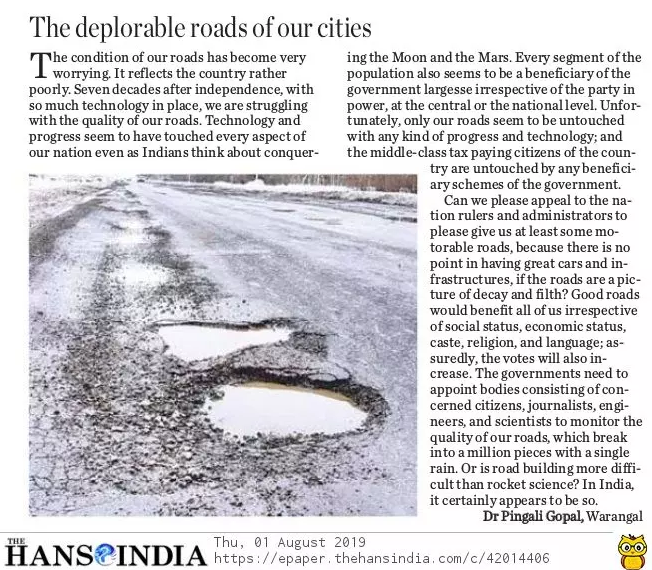
SECULARISM IN INDIA

SANSKRIT OR HINDI
WARS FOR CAUVERY WATERS
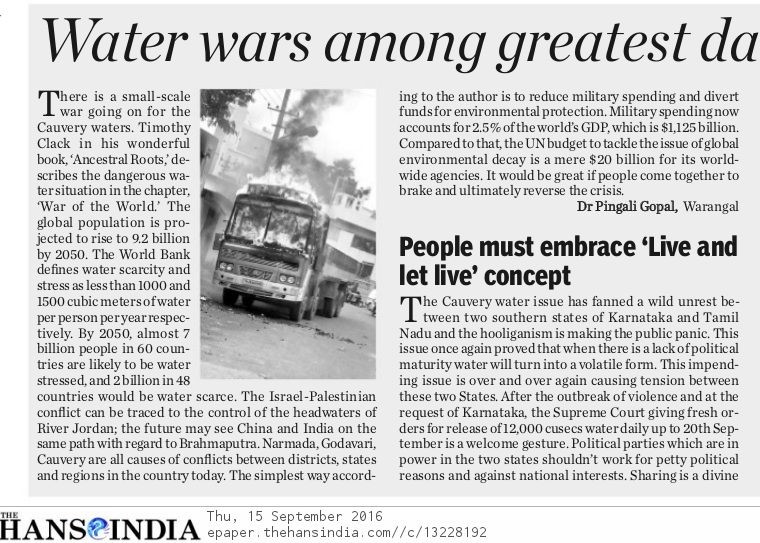
MAKING MOUNTAINS OVER MOLEHILLS
RESERVATIONS
CASTING COUCH PHENOMENON
CAN A SAGE HOLD POLITICAL POWER?

ME TOO MOVEMENT


POTHOLES ON ROADS

RAMA, RAMAYANA, AND AYODHYA BELONG TO THE COUNTRY

MOVE TO DIVIDE WARANGAL AND HANAMKONDA
BIAS AGAINST HINDUISM
DO WE REALLY HAVE A DEMOCRACY?
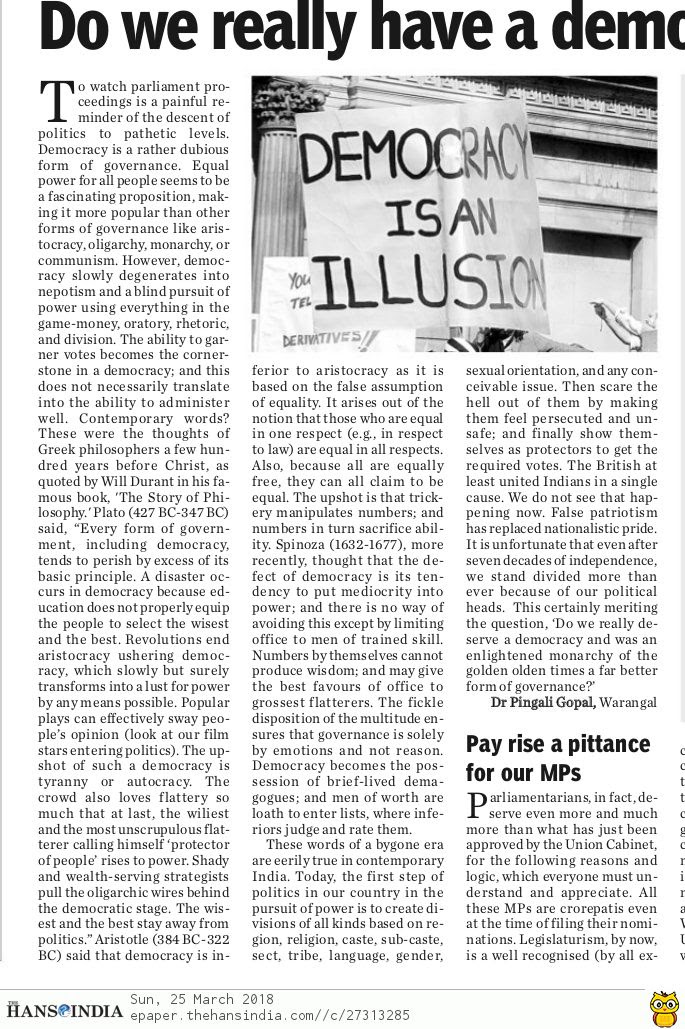
SOCIALIST PHILOSOPHY BREEDS LAXITY
 RANDOM MUSINGS