PART 1
There are two theories regarding the history of ancient Indian civilization. The first is the AIT or the Aryan Invasion Theory, postulating that a group of people from South West Russia speaking Indo-European languages (or Aryan languages) entered India in the second millennium BCE; and conquered North India establishing their language, culture, and religion all over. A modified version is the AMT or the Aryan Migration Theory, which holds that there was no invasion, but a gradual and a trickling migration into an existing culture. The semantics may be slightly different, but the implications remain the same. This AIT/AMT story has a two-century history of propagation and relies on three academic disciplines: Archaeology, linguistics, and textual/inscriptional data. The textual data is mainly the Vedas.
The author says that the weight of the evidence in the above three fields strongly support, in fact, the rival theory called the OIT or the ‘Out of India’ theory, which sees India as the original homeland of the languages and people of the West. The Proto-Indo-European (PIE) group of languages started the speculation of an original Indian homeland in 1800, but it went into complete hibernation as scholars vigorously propagated the AIT theory for more than a century. The reasons were many.
Koenraad Elst in his wonderful preface says that the political applications of the racially interpreted AIT include:
- The colonial justification of the rule by the pure Aryans (the British) over the mixed Aryans (the upper castes) and the black aboriginals (the lower castes)
- The perfect illustration of Nazi scheme of rule by the pure Aryan race and the degeneracy of India-based Aryans through mixing with lower races
- Anti-Brahminism
- Dravidianism, claiming that the Aryans pushed out the Dravidians from the original Harappan homelands to the South of India.
- Ambedkarism, claiming that the lower castes were the aboriginals subdued by the Aryan invaders and forced into lowly labour (even though Ambedkar himself strongly opposed the AIT)
- British-cum-missionary construction of the tribals as Adivasis (or aboriginals), a neologism created in the 20th century creating the message that the non-tribals were the invaders
- Some Western advocates of Russian homelands attach PIE with the European race and an inherent European intellectual superiority.
Talageri, Koenraad Elst, Nicholas Kazanas, Russian scholars Igor Tonoyan-Belyayev, and Aleksandr Semenenko are some OIT scholars arguing their case strongly as the theory gained ground once again in 1990. The AIT scholars, when confronted with evidence shaking their very foundations took the following routes to respond: by calling it a migration rather than an invasion; by denying it completely; by questioning the validity of the data; by questioning the personal identities and moral values of the authors; by avoiding them in public forums on the issue; and finally, by shutting their eyes and ears, completely ignoring them.
But a saviour came. A saviour called Tony Joseph riding on a shining horse called genetics. Tony wrote a series of articles, finally culminating into a book called the ‘Early Indians’ where he collects all the genetic evidence to finally show that Aryans did enter India and create the caste system. The AIT proponents are no wonder ecstatically hugging him. There is complete ignoring of the archaeological, linguistic, and the textual sources, and they recede into the background. And now Talageri steps in.
WERE THE HARAPPANS DRAVIDIAN-LANGUAGE SPEAKERS?
The Indus or the Harappan script is not yet deciphered, but it is antique predating the Indo-Iranian languages and the Vedic Sanskrit of North-West India. The Harappan language even predates the Davidian languages spoken in the South. In the absence of any recorded foreign invasions historically, it would be reasonable to assume that the Indus or Harappan language would have been an ancestor to the Indo-Iranian language family of the same region, used at a much later date.
AIT proponents are very keen to establish by circular reasoning that the Harappan language is the precursor to the Dravidian family of languages; and that the evidence for linking Harappan to the Indo-Iranian language family is absent. Remember the Aryans came from outside to establish their language of Sanskrit by force.
Talageri says that the evidence for linking the Harappan language to the Dravidian language family is even ‘more absent’. It is more logical to think of a continuity as the Harappan language developing into the Indo-Iranian languages of the North. But that would be a deathblow to the entire edifice of the Aryan-Dravidian debate and the chronology of events where the Aryans forced their way into a Harappan culture and drove then South.
The standard story claims that Aryans developed their Sanskrit and wrote the Vedas; and the Dravidians- dominated and subjugated- continued with altered forms of an original Harappan language. The evidence for all these speculations is very weak according to Talageri. Palli is a word for a village or a hamlet, and it is a Dravidian word. The name places in coastal and south-western Maharashtra have a lot of –vali or –oli as suffixes which could be derivation of the word –palli. And thus proved, that the Dravidians migrated along these places on coastal and south-western Maharashtra to the South of Vindhyas!
What about the Brahuis of Baluchistan, an isolated Dravidian language in Pakistan? Tony Joseph quotes the now abandoned theory that some pastoralists stayed back in Baluchistan, while the urbanites moved south. However, it is very clear by the voice of many scholars that the Dravidian languages mainly concentrate in the south, though there are a few in the tribal areas of the Bengal region. The presence of Dravidian language in the Baluchistan region is the result of a recent northward migration from the south, as all linguists now accept.
Talageri says that the idea of the urban and pastoralist segments of the Harappans referred to by Tony Joseph is strange and funny. One of the proofs that the Rigvedic Aryans are not identifiable with the Harappans is that the Rigvedic Aryans were ‘pastoralists’ and not ‘urbanites,’ according to AIT groups. Talageri quotes scholars who strongly feel that the Vedic collection is not the output of wandering pastoralists, but rather well-fed priests in a prosperous urban community!
Similarly, if palli as root of the words vali and oli come to usage in the geographical reconstructions of migrations; then the author suggests that the Greek place name suffix –polis (as in Persepolis, Heliopolis, Annapolis) can also be rooted in the same word palli. And that could imply even a westward migration of the Greeks from a Dravidian area to Greece! Finally, the evidence which Tony Joseph shows in the downward migration of the Dravidian languages is on flimsy evidence and shows a great level of bias and a lack of scientific nature, according to Shrikant Talageri.
WHY IS THE PERIOD 2000-1000 BCE SO SIGNIFICANT AND IMPORTANT?
Aryan or the Indo-European migration from across Asia came as a theory because of a discovery of common features in the languages between northern India and Europe sweeping across many regions and countries. This ‘language family’ had to be a result of a common origin from where the original people migrated to different parts, where new languages developed, albeit with strong links to the parent language.
So, where is the origin? The Steppes of South Russia, say the unanimous voice of the scholars. At least the voice of the AIT/AMT scholars. From the Steppes of Russia to North West India is the traced migration of these Aryans where they encountered the local Harappans, drove them South, established the language of Sanskrit and then wrote the Vedas.
The Indo-European languages are twelve living and extinct branches of languages. From the west to the east they are: Celtic, Italian, Germanic, Baltic, Slavic, Albanian, Greek, Anatolian (extinct), Armenian, Iranian, Tocharian (extinct), and Indo-Aryan. The common ancestral language gets the term PIE (Proto-Indo-European). The whole theory is purely based on linguistic analysis and only on the logic of a common origin of languages in a geographically-restricted ‘Homeland’ from where the migrations took place. Talageri now constructs the time periods for these events and the route taken by these invaders/migrants in the dominant discourse.
- Around 3000 BCE, from the PIE, the Anatolian and the Tocharian branches separated. Then the European branches separated in the following order: Italic, Celtic, Germanic, Baltic, and Slavic. The five last branches to remain in the Homeland were Albanian, Hellenic (Greek), Armenian, Iranian, and Indo-Aryan. The last five existed in an area of mutual interaction and developed many New linguistic features. The Indo-Aryan migrations hence would start long after 3000 BCE.
- The Indo-Aryan and the Iranian branches have a lot of common linguistic, textual, ritual, and religious features as seen from analysing the Rigveda and the Avesta respectively. So, this combined family, long after 3000 BCE migrated together from the Steppes to Central Asia (Bactria) region.
- The third stage is the separation of Indo-Aryans from the Iranian branch and their migration towards the southern Saptasindhu area/ northern Pakistan, into the area of the Harappans. According to Tony Joseph book claims, around 2000 BCE, the Indo-Aryans went across the Ural mountain range and spread eastwards across the Steppe.
- And finally, between 1400 BCE and 1000 BCE, the Rigveda came into being by the Aryan people after driving the Harappans down south. Clearly, the Rigveda had to before 600 BCE too, the dating of the Buddha. At the time of Buddha, the entire Vedic literature was well in place.
Unfortunately, there are lot of problems with this story. Most importantly, there is absolutely no archaeological evidence, not a shred, to support this remarkable migration from the Steppes of Russia to North West India and the full-blown development of Sanskrit/ Rigveda in a remarkably short span of less than two thousand years. Archaeology of the Harappan area shows an extremely stable civilization without any cataclysmic changes propounded by the forced entry of the Aryans from 4500 BCE to 500 BCE. Again, archaeology is a nail in the coffin of AIT, because whatever evidence it has, it is more in favour of an exact opposite trend of migration, from out of India to the west!
Studying the Rigvedic data shows clearly that the Indo-Aryan speaking Vedic people were present in a wide area from South- East Afghanistan to westernmost UP. The Rigveda does not contain a single reference of any tradition, name, or place in memory of its previous journeys from the Russian steppes. Also, the river and place names have no connection to the Dravidian languages who were allegedly living there before. Rivers in Europe carry the original names even after the influx of European languages, but this does not funnily seem to happen in the North West India. All the names and places are Indo-European. The area is, in short, purely Indo-Aryan in the Veda itself.
A very populous Dravidian civilization in a short span from 2000 BCE to 1200 BCE could not have just left the area for the invading or the trickling nomadic Aryans to become completely obliterated from any reference whatsoever. There is no reference in the Vedas or archaeology which records such great cataclysmic events.
The other Samhitas follow the Rigveda: the Yajurveda, the Samaveda, and the Atharvaveda. Then there are the Brahmanas, the Aranyakas, the Upanishads, and the Sutras. Each of these have their own chronological periods showing linguistic changes indicating that they were of different periods of time; but all before the Buddha. This squeezes the entire period of the Vedic corpus into a narrow window of 400-600 years. Remarkable!
For the AIT/AMT to hold, the period between 2000 BCE to 1000 BCE is extremely important, as this is the period when everything related to Aryan migration into India, driving away the Harappans/Dravidians, development of the perfect language of Sanskrit and writing the entire corpus of the Rigveda happened. The major problem comes that all evidence from archaeology, textual/inscriptional analysis, and even linguistics show the presence of Indo-Aryans much before 2000 BCE. In fact, evidence from above can show a reverse migration as the OIT (Out of India) proponents aggressively suggest.
And now comes the superhero for the AIT- ‘genetics.’ A paper written by ninety-two scientists called ‘The Genomic formation of South and Central Asia’ apparently proves for Tony Joseph that multiple waves of Steppe pastoralist migrants between 2000 BCE and 1000 BCE from Central Asia into South Asia brought Indo-European languages and new religious/ cultural practices.
The migrations may be a fact based on genomics; but the conclusion of bringing in languages and culture is pure speculation of the AIT/AMT proponents who still want to hold on to the period 2000-1000 BCE says Talageri. All the recorded evidence in the three important branches of archaeology, textual corpus, and linguistics show evidence to the contrary. Genetics should hold its findings in confirmation to established evidence, but not in confirmation of theoretical speculations. It is an attempt to fit forcibly the data into a pre-supposed theory. The science may not be bad here, but the interpretations are suspect.
CAN GENETIC EVIDENCE TELL US THAT IE-LANGUAGE SPEAKERS MIGRATED TO INDIA FROM CENTRAL ASIA?
There are two components to the claim of Tony Joseph in the book. The first is that between 2000-1000 BCE, multiple waves of Steppe pastoralist migrants from central Asia entered south Asia, and could be a fact. The second component is that they brought Indo-European languages and new religious practices into an existing civilization and completely changed the pattern of civilization without any force. It is almost like one entering a random beautiful mansion peacefully and asking the owners to leave. The latter do so willingly without any resistance leaving the mansion to the people who asked so politely. Obviously, the second part is pure speculation and doubtful if genetics can make any such claims, as Talageri says.
Genetics is a super science no doubt and it has made great contributions in tracing ancestries and migrations of humans across the globe. Adam Rutherford in his book, ‘A Brief History of Everyone Who Ever Lived’ traces the ancestry of all humankind brilliantly. Adam Rutherford says, ‘a few thousand years back, a few thousand men were the ancestors of all people who are living now. Hence, a Chinese, a Russian, an Indian, a European, an African, an Arab are all living in your and my DNA as information, some expressed and some not. We are all related and not only that; we are all related to the Neanderthals too, whom we successfully eliminated or integrated with. About 2-3% of genes belong to the Neanderthals. Yes, we procreated with them. Humans have been certainly very promiscuous.’ Some do not agree to the Neanderthal bit though.
Genes can track the movements of species across various geographical locations; and it is nearly clear that we all came out of Africa. The humankind presently populating the entire globe started as a small group of people in Africa who started walking. The unifying message of Rutherford’s book is we are all one; but each one is unique. What a wonderful way to celebrate!
Another myth which the Rutherford successfully blows up are the claims of discovery of genes for complex human traits like sexual orientation or alcoholism. That is almost always fictitious science something akin to phrenology which predicted human behaviour by looking at bumps on the skull. Genetic code is very complex for most human traits with hundreds and thousands of genes being involved in each human trait. And all the genes interact in a highly-complicated manner with the environment they are in. The behaviour of humans is simply too complex to have the paradigm of one gene leading to one disease or one trait. In such a situation, it might be difficult to conceive of language and cultural migrations based solely on genetic studies. Language and culture are components of evolution mechanisms, independent of genetics with maybe some interlinking, in the words of authors Eva Jablonka and Marion Lamb (Evolution in Four Dimensions), but a study of the genes themselves to predict linguistic movements is tricky science.
Anyway, according to Tony Joseph, the only criterion for the identifying genetic evidence of the influx from Central Asia is the dating of the Rigveda also between 2000 to 1000 BCE. Vedic composition is between 1400 BCE to 1000 BCE, claims Tony Joseph on the authority of Michael Witzel. It is important for the Aryan theory bringing in Indo-European languages to also have a linkage in the linguistic sense. This means tallying with the dating of the oldest of the Vedas too.
The philosophy of science has a deep principle of falsification. If there is falsification of a key component of any theory, then the whole theory stands to scrutiny. If the Vedas are older than 2000 BCE, then the whole edifice of the Aryan invasion or migration theory collapses. This is what Talageri proves repeatedly that the Vedas are at least beyond 3000 BCE. And the AIT/AMT school shuts itself from Talageri and indulges in neither proving or disproving his contrary claims. And that is bad science.
THE OLD RIGVEDA AND THE NEW RIGVEDA
The Rigveda is the oldest manuscript in the world. It is also the longest inscription from the ancient world. The Rigveda consists of 10 mandalas or books; 1028 suktas or hymns; and 10552 mantras or verses. The Rigveda is amazing in the sense that its preservation has been in a perfectly pristine form for over thousands of years in an oral form. The textual form came much later. Every word, every syllable, and even the tonal accent to pronounce the words has an exact preservation across time and space. They are a tape recording of the Vedic era transmitted orally; and hence, an autobiography of the time when composed. The names of places or persons refer to contemporary sources of that time; and this is the unanimous opinion of great scholars, both Indian and western.
The Rigveda is an inscription telling us about the Vedic age. Unfortunately, there is no exact dating of the Vedic texts in a direct manner. However, Talageri says the dating becomes possible when compared to other related data from the Avesta and the Mittani records.
Scholars after deep study have concluded the division of the Rigveda into the New books and the Old books. The Old books are 2, 3, 4, 6, 7 and the New books are 1, 5, 8,9,10. There is also another division as family books which are basically the Old books along with book 5; and the non-family books which are the New books except book 5. There are several add on verses called the redacted hymns which are present only in the Old books and they come as an addition either between the verses or at the end of the book. The redacted hymns were additions at the time of writing the New books.
So finally, the Old Rigveda are the books 2, 3, 4, 6, 7 with 280 hymns and 2351 verses after subtracting the redacted hymns; and the New Rigveda are books 1, 5, 8, 9, 10 with 686 hymns and 7311 verses. The 62 redacted hymns with 890 verses form a late appendix to the Old Rigveda- a kind of grey area between the two epochs.
The author’s scholarship comes into the fore in this chapter where Talageri discusses the differences between the Old and the New books of the Rigveda. The differences are in the authors, the structure of the verses, the meters used, the sacred numerical formulae, categories of words, usage of personal names, usage of suffixes or prefixes in forming compound words, grammatical forms, certain mythical and sociological concepts, categories of words, differing meaning of same words, totally new words in the New books, and so on.
The conclusion from all the above is that the two parts of the text fall in two distinct chronological eras; the era of the Old Rigveda followed by the era of the New Rigveda.
PART 2
In the first part, we saw the basic framework of the Aryan invasion or migration theory as propagated by decades of motivated and biased scholarship. We saw how the three main evidence sources in the form of archaeology, linguistics, and textual sources provides a framework in stronger terms of a reverse out of India migration. Genetics is a new ‘kid on the block’ which tries to give strength to the Aryan ‘invasion’ or ‘migration’, whatever the semantics may be. Shrikant Talageri strongly refutes the genetic framework based on his deep and solid analysis of the Rigvedic data. Genetic studies may show human migrations, but do not have the capacity perhaps to show migrations of languages and culture. He now debates on his position in this part.
THE REAL CHRONOLOGICAL EVIDENCE
Emperor Ashoka’s inscriptions in Indo-Aryan languages dated to 300 BCE make it impossible to claim that the IA languages came into India any time after that. Similarly, the Mittani kingdom of Syria-Iraq in West Asia shows the first decipherable and datable inscriptional data in Indo-Aryan languages outside India in the 16th-15th centuries BCE. As per the standard story of migrations where India is the last bit of the journey, the Mittani dates makes it impossible for the date of entry into India before that time too. Even 2000 BCE becomes difficult with the Mittani records.
The Mittani kingdom flourished in Syria-Iraq around 1500 BCE onwards for two centuries. Experts and scholars have come to a strong conclusion based on data that there were two components in the Mittani languages. The people spoke Hurrian or Hurrite languages, a non-Indo-European language. The names and works of the ruling clans however show that they were descendants of Vedic Indo-Aryan speaking or Vedic Aryan influenced ancestors.
The Vedic-Indo-Aryan elements in the Mittani records, discovered only by a deep study in the 20th century, are the ‘residue of a dead language or remnants’ of the pre-Mittani ancestors of the ruling clans of the Mittani kingdom. If these remnants of a ‘dead language’ related to Vedas is evident in the recordings in 1677 BCE, the logical conclusion would be that the ‘living language’ would have existed for many centuries before that time. A strong case for a reverse migration from India to Syria-Iraq instead of the other way around! Indology scholars now had to get around the problem of Vedic remnants in a culture which existed before the Aryans entered India, before the Vedas were even scripted. A time for some more stories.
The Indologists now claimed that there was a ‘pre-Rigvedic group’ that split from the other Indo-Aryans in Central Asia itself and migrated westwards, so that the Vedic Indo-Aryans who later composed the Vedas, were entering India at around the same time when this pre-Rigvedic Indo-Aryan ancestors of the ruling clans of Mittani entered West Asia. Can explanations become more ad hoc?
Now comes the crux of the debate when Talageri shows his line of arguments against the standard story by extensive documentation and references from the Vedas themselves in a manner stunning and spectacular. Are the common Indo-Aryan elements found in the Mittani data and in the Rigveda, the so called ‘pre-Rigvedic elements’? The common elements cover a wide range of semantic fields of horses, their colours, horse racing, chariots, names of Gods, and personal names of the ruling elite.
Now Talageri says that if these common elements are pre-Rigvedic, then they should show evidence in the Old Rigveda, at the very least. With passage of time, these elements should reduce in the New Rigveda and be the least in later Sanskrit-both Vedic and post-Vedic. The evidence is, however, exactly the opposite. All the common elements are completely absent in the Old Rigveda! Not a single hymn or verse. However, New Rigveda books 1, 5, 8, 9, 10 (108 hymns for names of composers; 77 hymns referring to these names or words within the hymns) widely notes the names of composers and other references in common with these Mittani elements.
Talageri has studied the Iranian Avesta too deeply. He claims a not just a common Vedic-Mittani culture, but also a common Vedic-Mittani-Iranian culture analysing the names, suffixes, prefixes, and other words. The common elements are absent from the Old Rigveda, but extensively present in the New books of Rigveda (309 hymns and 3389 verses in the names of composers; 225 hymns, 434 verses, 506 references within the hymns). Hence, the common culture shared by the Mittani and the Rigveda (the Avesta too) is the culture of New Rigveda. The Old Rigveda predates all the three.
THE CHRONOLOGY AND THE GEOGRAPHY OF THE RIGVEDA, STEP BY STEP
The pre-Mittani ancestors, Indo-Aryan speaking, and carrying Vedic terms reached Iraq-Syria in West Asia at around the same time as the Aryan migrants to India. The common branch split in Central Asia as the AIT story goes. Roughly, from 3000 BCE to 2000 BCE, the Aryans reach from Russian Steppes to Central Asia. From 2000 BCE to 1000 BCE, the Aryans trek towards the North West India where they later composed the Vedas.
But the definite chronology of the Vedic literature in India is Old Rigveda followed by the New Rigveda, followed by the post-Rigvedic Vedic texts, and then followed by the Epics and the Puranas. The Sanskrit texts then followed. Talageri clearly shows that the common culture of Mittani and the Rigveda (and the Avesta too) is that of the New Rigveda. With this background and some serious references in the Vedas, he creates the chronology and geography of the Rigveda period. And shows that the Rigvedic people migrated from an area between Haryana/ Western UP to South-West Afghanistan to the area of Mittani kingdom in West Asia.
If 1700 BCE is the date of Mittani records, then the New Rigveda people must be at least 400-600 years before, for the travel to take place and establish themselves in the Mittani kingdom. That would be 2300 BCE where the New Rigveda was an established civilization. At least 500 years back for the Old Rigveda takes us to 3000 BCE, by very conservative estimates. The presence of spoked wheels in the second half of third millennium BCE and the domestication of Bactrian camel in the late third millennium BCE are important chronological markers in the dating of the New Rigveda. The New Rigveda (books 1, 5,8, 10) has references to the spoked wheel and the camel. The references to these are completely absent in the Old books. This is additional reference to the dating of the New Rigveda books.
Similarly, the Old Rigveda shows the composers in deeper parts of east India residing in Haryana and westernmost UP with other ‘non-Vedic Aryans’ residing even further to their east. The Old Rigveda has no references to the North-West areas and Afghan area where the Aryans supposedly came from. In fact, later books of Rigveda show a serial progression of the geographical descriptions towards the west. The historical events described in the Rigveda also show a westward progression from Haryana/ west UP area to Afghanistan, occupying the entire Rigvedic area only by the period of New Rigveda.
The Old Rigveda mentions the eastern name places and the western name places appear only in the New books. Book 5 is a New book, but a family book unlike other New books 1,8,9,10. Book 5 is more ancient than the latter books and even in this, there are no western geographical references. The western places, lakes, mountains, and animals appear only in the non-family books-the New books minus book 5.
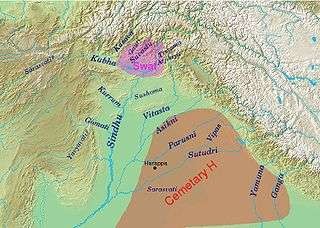
The only western geographical name found in the Old Rigveda (only book 4) are the names of three rivers: the Sindhu and two of its western tributaries. These rivers appear as the last stage in the east-to-west expansion of the peoples from Haryana/West UP area towards Afghanistan. The oldest book 6 refers to only Jahnavi (Ganga), Sarasvati, and the latter’s eastern tributaries; the next book 3 to Ganga and the first two easternmost rivers of Punjab-the Vipas and Sutudri. The next book 7 refers to Yamuna and the third easternmost river of Punjab, the Parusni. It also mentions the battle of the ten Anu tribes referred as the Asikni people. The latter are fighting from the west from the direction of the fourth most eastern river of Punjab, the Asikni. The next oldest book 4 refers for the first time to Sindhu and its western tributaries, the Sarayu and the Rasa.
The author makes his deeply researched claim that Indo-European languages and Vedas were already existing deep in the Indian area in 3000 BCE. Later migrants may have come from the Steppes of Central Asia, but they did not bring their languages and culture with them. At best, they would have merged with an existing civilization.
In the appendix, the author details all his references for the curious and the sceptic to go into the original Vedas. Many argue about the theory without a reading of the Vedas unfortunately. Even a sprinkling of Sanskrit or Rigvedic data is absent in their understanding.
The names of eastern places, lakes, and animals are abundant in all the books of Rigveda-New and Old. But the western places, mountains, animals, and lakes are only in the non-family New books (1,8,9,10) and completely absent from the Older books (the family books 2,3, 4, 6, 7 and the family New book 5). The chronological placing of the books shows clearly both the geographical descriptions and historical progression from east to west unambiguously.
DOES THE GENETIC EVIDENCE PROVE THE AIT?
Tony Joseph makes a claim of a Hindu conspiracy in trying to delay the publication of the book. The key paper suggesting that modern Indians carry a significant amount of West Asian related ancestry was unpalatable to some Hindu authors in the initial study of 2009. Hence, some key changes came into the conclusions.
The paper of the genetic study in 2009 stated (under pressure from two Hindu scientists) that the ‘people of India today are a mixture of two highly differentiated populations, the ANI and the ASI (ANI-Ancestral North Indians; ASI-Ancestral South Indians). The ANI are related to Europeans, central Asians, Near Easterners, and people of the Caucasus, but there is no claim about the location of their homeland or any migration.’
But the New paper in 2018 rectifies the problems of the previous paper and classifies the major genetic components of Indian population into three major genetic groups migrating into India at three different time periods.
- 65000 years before present: The First Indians migrated from Africa to South Asia.
- 7000 BCE: Zagros/Iranian Agriculturalists migrated to South Asia from the Zagros mountain area of Iran.
- 2000 BCE- 1000 BCE: Steppe pastoralists migrated to South Asia from the Kazakh Steppes and beyond.
The Tony Joseph book claims that from 65000 years before present to about 7000-4700 BCE (a broad period), the First Indians were the exclusive inhabitants of South Asia. From 7000-4700 BCE to about 3000 BCE, Zagros/Iranian Agriculturalists mixed with these First Indians to produce the Harappans and then the Harappan civilization. Between 2000 BCE to 1000 BCE period, the genetics paper shows that Steppe DNA had its presence in the area, thus proving that New people entered from the Swat area of Pakistan and mingled with the Harappans. This mingling resulted in the ANI- a mixture of the First Indians, Iranian/Zagros Agriculturalists, and Steppe pastoralists.
The ASI group forms by a combination of the First Indians already living in the South and the Harappans who migrated from the North. As noted, the Harappans themselves are a combination of the First Indians and the Zagros/Iranian Agriculturalists. So, the ASI equation would be First Indians (of South) + First Indians (of the North) + Zagros/Iranian Agriculturalists!
The present India then is again a combination of ANI and ASI in varying proportions in different areas and communities. There has certainly been a lot of churning even in the dominant story.
OBFUSCATIONS, LIES, CHERRY-PICKING, SELECTIVE INTERPRETATIONS AND TORTURE
The original paper, the conclusions, and speculations of Tony Joseph pay tribute to the old dictum about statistics which says that data, if tortured enough, can confess to anything. The whole agenda seems to establish that there was a distinct North and a distinct South, and they had separate languages and culture. The fight continues into present times as the native Dravidians take up cudgels against the Aryan Brahmins and the Aryan north.
The terminology is confusing, the mixing scenarios are confusing, and plenty of conclusions are pure speculations based on a thin evidence base. ANI and ASI suggestively come into play to depict the north and the south, even when Reich and Joseph both suggest that they are inaccurate.
According to Joseph, in each stage there were the ‘first arrivals’ into North India with an admixture of the existing locals. The admixed group then moved downwards. The First Indians mixed with the Zagros/Iranian people and became the Harappans. The Harappans moved downwards toward the First Indians in the South and become the ASI. Then the Steppe pastoralists came and mixed with the Harappans in the north. The mixture became the ANI. Today’s Indians are a mix of ANI and ASI. And confusingly, the First Indians get the term AASI- Ancient Ancestral South Indians. Gives a headache, no doubt about it.
Just three samples in the Indus periphery area represents the entire Harappan population in the study. Tony sometimes denotes Harappans as the Zagros people alone and sometimes as a combination of the First Indians and the Zagros. The author says that the genetic composition of India throughout is a constantly moving and expanding one, but the AIT proponents are keen to fix the genetic evidence by freezing the time when all the Indo-Aryan speaking people in North India have First Indians, Zagros/Iranian, and Steppe pastoralist ancestry and all the Dravidian-speaking people have First Indians and Zagros ancestry.
This is an impossibility because there is no DNA evidence from all parts of India at one point in time in the past; and it is also impossible that such a rigid situation ever existed in India, with a clear separation of a distinct North and South genetically. The major conclusion after all the obfuscations in terminology, cherry picking, and erroneous interpretations is that Steppe DNA entered India in the period between 2000-1000 BCE. This is also the period of the alleged invasion/migration by the Indo-European speaking Aryans as told by Indologists and linguists. Hence, this proves the AIT/AMT. Circular reasoning cannot get better.
The three major things which come out of Tony Joseph’s arguments are:
- The entire Indian population is a mix of First Indians, Zagros, and Steppes irrespective of caste, creed, and religion.
- There are no ancient DNA specimens from any part of India for the Harappan period. It is surprising that three outliers in the periphery of the Indus civilization stands as proxy for the entire Harappan population.
- The only DNA from ancient India is from the Swat valley in northern Pakistan from a post-Harappan period-1200 BCE to 100 BCE.
That these migrations brought the languages and culture hangs deeply on the position that the Rigveda is between 2000-1000 BCE as held by the linguists and the Indologists. This is precisely what Talageri sets to disprove, since the Old Rigveda does not show any memory of migrations; it dates beyond 2500 BCE at the very least; and whatever migrations noted, they are in an east to west direction starting from Haryana and West UP. The evidence for the last coming from the chronologically later New Rigveda.
The migrations of people may have happened, but the migrations of languages and culture did not. Talageri slightly exonerates Tony Joseph by saying that perhaps he is not at fault, because the problem is in the conclusions derived by the original 92 authors of the data. Tony Joseph only quotes these erroneous conclusions. Talageri then delves deeply into the actual paper to show the problems of obfuscation and confusion. A layperson may find some difficulty in this part of the book.
DOES THE GENETIC EVIDENCE NEGATE THE OIT?
The spread of languages and culture is different from the spread of genes and DNA. It is perfectly natural for one to spread without a parallel spread of the other. There is something called the ‘elite dominance’ model for the spread of languages. We speak, write, and read even better English than the English perhaps, but our genes may not show any commonality. The reasons for English language in India are very clear, and has nothing to do with interbreeding and genetic transfer. The ‘elite dominance’ model is at play here obviously. The terminology is self-explanatory.
People of Tibet, Mongolia, China, Korea, and Japan do not have any First Indian ancestry in their genes showing a connection with the Indians. Can this be a reason to make a claim that Buddhism could not have spread to these places from India? The OIT migration is a strong possibility based on internal evidence from the Vedic texts and archaeological documents. The genetic evidence is irrelevant in the debate, says Talageri strongly.
The Mittani documents, the pre-Mittani Rigvedic roots related to the New Rigveda take the latter to at least 2500 BCE and the Old Rigveda even further back. When claims supposedly based on genetics blatantly contradicts recorded history and scientific disciplines like archaeology and linguistics, then it is only scientific to reject those claims and not everything else. Especially when there are other models to show that spread of languages and culture can happen without a simultaneous spread of genes.
The ‘elite dominance’ model may in fact help to explain the scenario of New Rigvedic elements in the Mittani culture and the Avestan culture of the Zoroastrians. This may very well have happened without the passing of the First Indians genes. The roots of shoots of Greek, Latin, Kelt, Teuton, Slavonian are in the Rigveda, but not in the Avesta. The absence of First Indians in the European ancestry is the reason against the OIT scenario by the AIT/AMT proponents. However, Talageri is clear when he says that this evidence is not relevant in the face of linguistic, textual, and archaeological records.
The scenario for AIT however suggests a speeding Aryans and not a spreading Aryans, says Talageri. They started after 3000 BCE from the Russian Steppes, ran top speed eastwards and then southwards, bypassed the BMAC(Bactrian) people on the way completely, and reached in less than a thousand years to North-West frontiers of South Asia by 2000 BCE. Within less than 1000 years, they completed the composition of the most pristine Rigveda too between 1400 BCE- 1000 BCE. The genetic data does not prove any immigration of Aryans into India after 2000 BCE. The chronological and geographical data of the Vedas and the Mittani documents show clearly the presence of Indo-European languages already in India much before 3000 BCE. Steppe people entered and maybe contributed their genome to the common pool, but they did not bring the languages and the Vedas. All this story happening without a ripple in the archaeological record and without any memory or references of older places in the texts is indeed hard to believe.
PART 3
In the previous two parts, we saw Talageri deconstructing the new genetic evidence presented in support of an Aryan theory. So strong is the textual data of the Rigveda, almost inscriptional, in matters of chronology, that evidence from other disciplines should hold up to it. In fact, archaeological and linguistic evidence is in staunch support of the evidence in Rigveda. Talageri, in fact, draws an opposite conclusion of an ‘Out of India’ migration based on these evidences. He simply says that the genetic evidence, itself on sticky grounds, is in contradiction to extensive evidence available till now. Hence, it is only logical and adhering to basic tenets of scientific endeavour that the claims of the new evidence come into serious question. Peculiarly, in a reverse manner, the existing and established evidence measures up to the candle of genetic evidence. Think of the drowning man and the clutching of straws. If Aryan theory is there; the caste system, the horse, and the Saraswati cannot be too far behind. Talageri looks at them critically and finally comments on the ethical and moral issues involved in the whole debate in this concluding part.
THE INDO-IRANIAN PARADIGM
The linguists propose that Indo-Iranians migrated from Steppes to Central Asia and then split into two, and migrated into the Saptasindhu and Afghanistan areas respectively. They shared a common ‘Indo-Iranian’ culture, manifesting in the two closely related texts-the Rigveda and Avesta.
R1a1 is a haplotype claimed to be a genetic signature prevalent in Indo-European language speaking countries. The Aryan proponents claim an injection of the Steppe DNA and the R1a1 into the local populations and tribals of India from the custodians of the Sanskrit language- the upper castes, and the Brahmins in particular.
The author asks us to consider two things. The Steppe DNA evidence in India is only after 2000 BCE; the first attested being in the Swat sample from 1200-100 BCE. More importantly is the distribution of the R1a1 haplotype which should show good presence in Iran as much as the Chenchu tribals (26%) and Manipur (50%) in the East India. Iran however shows a dismal 3-4% presence of this haplogroup in western parts, and less than 20% in the central and eastern parts. This is grossly less than the presence of R1a1 haplotype in the Dravidian tribes of South India. The same haplotype is higher in the west of Iran: 43% amongst the Semitic Shammar tribes of Kuwait and 52% among the Ashkenazi Levites in Israel! Hence, IE languages can spread without the genetic spread; and genetic spread can happen without spread of languages. At best, it is only a weak correlation; and correlations do not make for causation as our most basic statistics courses tell us.
Hence, Talageri says that the lack of the First Indian ancestry in the DNA of Indo-European speakers outside is no argument against OIT theory. Rigveda has roots and shoots of many languages of the west. The Avesta, which appeared in parallel shows no such signs. It however shows connection with only the mythology and language of Rigveda. This is strong evidence of the spread of language and culture from India outwards rather than the reverse.
WHEN DID THE CASTE SYSTEM BEGIN?
The ubiquitous Aryans again enter into the ‘caste system’, something which Prakash Shah, Dunkin Jalki and others take down so completely in their book, ‘Western Foundations of the Caste System.’ Tony Joseph now proposes his theory on the Aryan related caste system based on ‘latest genetic evidence.’ There are plenty of pleasing assumptions and startling inferences from those assumptions as Ambedkar wrote about the Aryans and the caste system while completely rejecting the thesis. ‘The Aryan theory is so absurd that it ought to have been dead long ago,’ wrote Ambedkar. Genetic evidence is the new kid which Ambedkar was not aware about. But the assumptions and the derived conclusions stay intact.
Quoting from a 2013 genetics paper called ‘Genetic Evidence for Recent Population Mixture in India’ by Priya Moorjani and others, Tony Joseph stakes his claim saying that from 2200 BCE to 100 CE, there was an extensive mixing of the genomic pool with the result that almost all Indians including the so-called isolated tribals have a mixture of the First Indian, Harappan, and Steppe ancestries in varying degrees. Around 100 CE, there was ‘sudden downing’ of the shutters on the intermixing. A new ideology gained power which engineered society on a massive scale. This widely successful social engineering was the ‘caste system’. The traditional custodians of the oldest layer of IE languages in India broke the society by this system. Who else were these breakers, but the wily ‘Aryan’ brahmins?
From 2000 BCE to 100 CE, the Aryans did not have the caste system, but it fell on the ankles of Indian society around 100 CE. A social engineering on a never attempted scale gained wide success in ordering the hierarchies based on caste. The proof for this comes from the Ra1a haplotype which is in higher prevalence among the upper castes than the lower castes, and it is twice as high in the Brahmins as compared to scheduled castes and scheduled tribes. Another proof which Tony Joseph explains is that Steppe genes has the highest levels again in the groups of traditional priests, expected to have written the Sanskrit texts. This could be because people with higher Steppe ancestry seemed to have a central role in propagating the Vedic culture. Endogamy rules allowed excessive Steppe ancestry persisting even today. A neat theory, but a block of soft cheese. And Talageri puts a lot of bullets here.
Firstly, there was never a time in the history of India, especially in 100 CE, when there was an all controlling authoritative regime which could plan and implement a wildly successful social engineering. Secondly, it is unbelievable that after a free intermixing for two millennia, suddenly the brahmins could differentiate from their own Aryan and non-Aryan brethren an exclusive status to start the caste system. Certainly, they did not have genetic studies at their disposal. Thirdly, if Aryans are not co-terminus with the caste system as per Tony Joseph, but came much later in 100 CE, then how are they still associated? The caste system would be more a result of contemporary factors of that era like invasions by Greeks, Persians, or Scythians or by injection of new western ideas and ideologies due to contacts with the first Christians or the Imperial Romans. Fourthly, the Sanskrit texts, especially the much-maligned Manu Smriti, as agreed by many scholars, are often descriptive texts of that time and place, and they were not prescriptive, normative, or authorized for enforcement by any authority.
Further, intermixing and flow of every single kind of racial type and nationality has been going all along from time immemorial to the present day. Nationalities, religions, regions, occupations, communities, jatis have mixed so thoroughly that it would be funny to freeze the period of 100 CE when suddenly a group identifies itself having special characteristics to become the wily priests. And so powerful is the segregation and dominance that it continues till present without any questions and without rebellion.
The final criticism is on the R1a1 gene. It is higher in South Indian brahmins only because they could have migrated from North India in the recent 2000 years. North India has a higher proportion of this gene as many studies quote and the decreasing proportion of this haplotype as one move from North to South could be because that happens naturally with migrations. In the closest area of contact with the Steppes, the proportion is higher. With downward migrations, the proportions would decrease. A more movement of Brahmins towards South may explain the higher proportion, but the reasons are geographical rather than Aryanism. R1a1 gene has higher proportions in many non-brahmin castes of the North and West: Khatri (67%), Ahir (63%), Gujarat Lohana (60%) and so on, much more as compared to the brahmins of that area. The Ror, Jat, and Pathan communities have higher proportions than the brahmin communities of the north!
In such a highly mixed state of communities for 4000 years, Tony Joseph manages to extract exact numbers and figures for various communities from few random samples and constructs a highly implausible story on the origin and propagation of the caste system. Weak correlations should not be confused for strong causations, as the AIT/AMT authors so eagerly indulge in.
THE SARASVATI
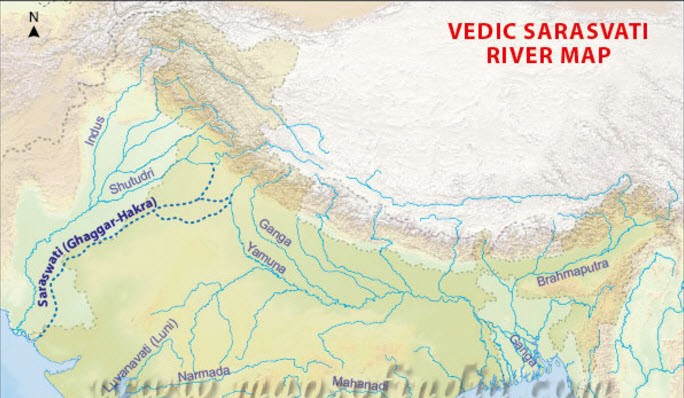
AIT/AMT proponents have an impelling need to deny the Sarasvati identification with the Ghaggar-Hakra river since their whole theory comes into question. The author shows by clear textual references that the Sarasvati was a glowing and flowing river mentioned clearly in the Old Rigveda. The New Rigveda gives more importance to Indus river and spoke even in celestial terms about Sarasvati. The geography of the rivers, the flora, and the fauna described in the Old Rigveda clearly puts Sarasvati at the place where Ghaggar-Hakra stands today. Plate tectonics and diverting river courses changed the flow of rivers, making the Sarasvati dry so that by 1900 BCE- the end of a mature urban phase, a very prosperous civilization on the banks of the entire course of Sarasvati left towards the east and west too.
Archaeological records of this Sarasvati civilization go back to even 7000 BCE. There is a huge archaeological evidence of different phases of a thriving civilization on the banks of the river Sarasvati as shown very elegantly by Michel Danino in his book, ‘The Lost River.’ Archaeology, linguistic analysis, and textual analysis show a continuing Vedic Harappan civilization with absolutely no evidence of a forced invasion of any kind by outside foreigners. The Steppe pastoralists may have come in 2000 BCE, but at best they came silently and mixed with an existing civilization.
The author also shows clearly by his deep analysis of the Avesta and Rigveda that all the commonalities between the two are in the New books. There is no connection with the Old Rigveda, proving again a one-way migration from India outwards as far as the textual evidence is concerned.
AIT/AMT proponents obviously go into a counter-argument mode rather strongly, because this picture strongly puts a live atom bomb under their seat. And they start making ludicrous propositions and extreme efforts in denial. The Sarasvati becomes identified with a river in Afghanistan called Harahvaiti, the sea mentioned in the Veda becomes a lake, linguistic derivations get distorted, and so on and so forth. Talageri shows that there are early and prolific references to Sarasvati for a river in Haryana in the exact place geographically where the Ghaggar-Hakra flows, and a very late and single record of the name of Harahvaiti in Afghanistan. The Rigvedic-Avestan records and documents show a movement of Iranians from Haryana to Afghanistan accounting for taking the name of Sarasvati and giving it to a river in Afghanistan. The proof is convincing, especially if taken in conjunction with archaeology.
Tony Joseph starts on the same mode with same circle of proponents patting each other’s backs. This is eerily like the Sanskrit German Indological scholarship on Mahabharata, Gita, and other texts where a closed circle of scholars kept perpetuating the lies and frauds by offering scholarships, academic posts, travelling allowances while at the same time ignoring the traditional scholars and commentators. This perpetuation however is a hot air balloon, as Talageri shows. The main argument of Tony Joseph apparently is that the enfeebling and reinvigorating of rivers is a recurring phenomenon and there was nothing special about the enfeebling in around 2000 BCE leading to large scale migrations. This could have been more because of a drought in that period as shown by geological evidence. Second, Tony Joseph concentrates on a poetic reference to the waves of the powerful Sarasvati bursting the ridges of the hills, to argue that Sarasvati could not be Ghaggar -Hakra, which was never that powerful. Because Ghaggar-Hakra is weak, say the AIT scholars, it cannot be the Sarasvati. Circular reasoning rears its head again!
Sarasvati was powerful; it became weak due to several reasons; it became the Ghaggar-Hakra as the matching of all records is near perfect. But quoting a Vedic source draws Talageri into a battle where he is best at. He has analysed the complete set of data in the Rigveda deeply and thoroughly. The evidence from the Vedas which he mounts on this aspect would put any contrary position to shame.
The author Talageri concludes that the Sarasvati of Rigveda and the Ghaggar-Hakra of the present times, and with all that it implies. The first implication is the death of the AIT theory.
THE HORSE
The poor horse again gets into the arguments for the AIT hypothesis. The horse as skeletal remains or as images in seals and artefacts is rare in Harappan civilization excavations. It is ubiquitous in the Rigveda. The Aryans wrote the Vedas. The Aryans came from the Russian Steppes or some other foreign place riding on horses. The horse is an import to India. Hence, the Harappans are not Vedic, but the Steppe immigrants are. The Aryans rode them, domesticated them, used them in sacrifices, and made extensive references to them in the Vedas.
There are three claims of the AIT proponents: The horse was well known to the Proto-Indo-European speakers in their Homeland, before 3000 BCE; the horse was known to the Vedic people throughout the period of its composition; and the horse is not native to India, but native to a large area spread from the Steppes of South Russia in the west to Central Asia in the east.
Talageri accepts the first two and proves in reverse that the very fact that the horse is an import shows that the Homeland is India, in fact. There are unambiguous archaeological records of the horse remains in the pre-2000 BCE era of India. Chess sets depicting horses at Lothal amongst many other representations elsewhere too make similar claims about the non-existent horse light. Linguistic evidence also completely disproves any idea that the horse was unknown to the non-Indo-European language speakers of India before the Aryans supposedly came, says the author. This is a very emphatic argument for the horse existence before the Aryans came. But the opposing proponents do not want to listen and debate.
THE MORALS, ETHICS, AND IDEALS IN THE DEBATE
Tony Joseph accuses the anti-AIT proponents of being super-sensitive to the idea of foreign arrivals into India. This is to claim an originally pure status of Indic civilization. Invasions and migrations have been a constant feature of the world in shaping demographics. However, Talageri says the difference is the political use of the AIT to divide the nation. Also, the migrations and invasions are recorded events in places like America and Africa, whereas Indo-European language arrivals are not. They base on speculations, theories, and analyses in various field like archaeology, linguistics, texts, and now genetics. There is hence a difference in the Indian context.
Talageri feels that the AIT theory basically, based on false premises and conclusions, tries to deny the Indic or Hindu civilization roots to the people of the country. The Anglo-Saxons invaded the British Isles and established the English language, but it would be foolish to call them foreigners. But a Hindu claim of being a native of the country has the whole of AIT coming down to prove that he/she is a foreigner. The AIT is an attempt, consciously or not, to deconstruct and dismantle whatever remains of a Hindu identity, says Talageri.
Talageri believes that unfortunately two diverse groups support the AIT for their own purposes and agendas. Some class of Brahmins use the AIT to declare their own superiority; and equally virulent in the support of AIT are the anti-Brahmins and ‘anti-Brahmanism ideologists’ like the Dravidians, leftists, neo-Dalit groups, and such politically motivated intellectuals, parties, and forces.
Ironically, Talageri says clearly that Indian culture is not identical with Sanskrit or Vedic culture and denies that they are the fundamental well-spring of Indian culture. This is in fact agreeing with the AIT proponents. But he goes further on this. He shows in his previous works that Rigveda was not the work of any ancestral ‘Indo-Aryans’, but a local text composed in the Bharata sub-tribe of the Puru people. The Puru lived in the areas of Haryana and UP.

The Anu and Druhyu tribes were to the west and north of Puru. The other eleven branches of Indo-European speakers spread from these Anu and Druhyu tribes to the other parts of the world. There were also IE speakers in the east of Puru, the Iksvaku, just as there were in the south too like the Yadu and Turvasa/Turvasu. Apart from this, there were speakers of other language families than the IE: Dravidian in south, Austric further east, and Burushaski in the far north.
Indian culture and tradition are a melting pot of three races (Caucasoid, Mongoloid, and Negroid) and six language families (Indo-European, Dravidian, Austric, Sino-Tibetan, Burushaski, and Andamanese). The original Puru element of Hinduism may have gained prominence due to political power, but over millennia, there has been a rich and complicated mixture of all the Indic elements. The complete mixture to a unified Hindu religio-cultural unit is such that it is unfortunate and even dangerous to separate the individual elements. It is an attempt which does not make sense, says Talageri forcefully. The Vedic Sanskrit is an important part, but it is a part of the organic whole and trying to weed it out is only a desperate effort to balkanize our country. The practices of the Andaman islanders, and the pre-Christian Nagas are as Hindu in the territorial sense, as Sanatana in the spiritual sense as is classical Sanskritic Hinduism.
Indian culture and Hinduism are an amorphous mixture of Vedic/Sanskritic culture, Sangam culture of the south and the rich ethnic (mainly tribal) strands of culture. Talageri makes his point on the OIT theory proposing India as the Homeland, and disagreeing thus with Tony Joseph. The conclusions from archaeology, linguistics, textual sources, and now from geology is clear on this which makes genetics irrelevant in this issue, says Talageri emphatically. Future debates should be honest, open, informed, and logical taking the evidence into consideration. It should not rely on media or academic power. Is Tony Joseph ready to pick up the challenge? Or take the major route of AIT/AMT proponents- just shut the eyes and ears to ignore.
FINAL THOUGHTS
Indic civilization and culture are an unbroken continuity for thousands of years. The Vedic civilization continued into the Harappan civilization and the later post-Harappan eras too. At the heart of all these Aryan arguments of a ‘foreign culture’ and thus a discontinuity is to deny this longest civilizational continuity. India is an amorphous homogenous mix of different cultures and different people. The Vedas constitute an important component, but not the only one in this complete whole. It is dangerous and divisive to try and weed out the individual components. It is an attempt at Balkanisation of this great country which today is the only one standing on the principles of Sanatana Dharma. Everyone of this land is a part and inheritor of this great culture irrespective of what faith they may be following. Instead of accepting our common and great civilizational past as a true Indic liberal, the Aryan proponents are keen to show that a strong root of our culture does not belong to us!
We all grew up fed on the Aryan invasion theory, which is now completely internalised. Nobody ever bothered to question it. Scholars, academics, intellectuals, scientists, linguists have now started questioning the AIT/AMT based on solid evidence. The problem is that the AIT theory has constructed a great super edifice for decades, and if the foundational base rips out, the entire edifice collapses. Therefore, the huge resistance to discard the theory. Genetics shows a ray of hope, and thus this last straw has a vigorous promotion to silence the AIT/AMT critics.
Genetics is an important science and it clearly shows migrations across the world. Language and culture may have a different and important role in directing evolution and selecting some genes; but genes carrying languages and culture along with them is very doubtful in the present scientific context. Language and culture can spread without a concomitant genetic spread. Even if genetics has that capacity to prove migrations of languages, it should not contradict other established findings; and should not become an independent candle to which established evidence needs matching to in reverse. That is bad science.
The main contention of Talageri is that texts, linguistics, and archaeology represent the data and hard evidence; and genetics is akin to experiment and theories. It is only proper science that if experiments do not match the data, the theories and experiments need rejection and not the data. Unfortunately, in the Aryan issue, there is ignoring or questioning of the data itself in a classic case of improper science! The fault is not with genetics, a wonderful science, but the way of its application by a faulty or even mischievous understanding.
Michel Danino has looked at the Sarasvati extensively in his classic, ‘The Lost River’ and completely rejects the Aryan theory. There is incontrovertible evidence of the existence of Sarasvati and its association with the Ghaggar-Hakra of present times. Koenraad Elst, in his recently published ‘Still No Trace of an Aryan Invasion’, shows extensive evidence against the Aryan theory, again rejecting it directly. Elst rues the fact that the AIT proponents do not even want to look at the researches of Srikant Talageri, leave alone reading the Vedas. The discussion has become one-sided and closed to any modifications, which is rather sad. Marianne Keppens devotes a full chapter on the Aryan linkage to the caste system in the deeply researched book, ‘Western Foundations of the Caste System’ based on the works of Dr SN Balagangadhara. Keppens contends that these link claims, propagated by political concerns mainly, are faulty and bogus.
Talageri says strongly that genetics is irrelevant to the whole issue of the Aryan debate. Without genetics, the evidence is clear on disproving AIT/AMT and proving a reverse migration. For him, the textual Rigvedic chronology is strong enough to establish an out of India migration. It is an independent witness, regardless of even archaeological evidence. However, archaeology stays solidly in support of Talageri. AL Chavda and Dr Priyadarshi, the latter in a four-part series, have written great rebuttals of the original paper on which Tony Joseph’s book stands. They have shown the original Reich paper to be having more holes than a Swiss cheese. So, finally we have a double whammy; genetic evidence is irrelevant to the debate; and the bit of evidence is questionable.
SOME QUESTIONS RAISED TO SHRIKANT TALAGERI AND HIS RESPONSES
Query 1: Sir, the slightest criticism which one can offer is you calling genetics ‘mumbo-zumbo’ and personal criticism of a few individuals. It threatens to take some shine off his arguments. In a clinical rebuttal of an issue or a person, the language perhaps needs to be above criticism. The strength of Talageri’s arguments should suffice to silence the critics.
Response by Shrikant Talageri: I have specifically stated that genetics is “mumbo-jumbo”; when it is used to “prove” certain alleged movements of cultural features like language, religion, games, music, etc. I have never denied that it can show the movements of people and can help map out ancestral lineages. About personal criticism of a few individuals, you are doubtless referring to my use of the phrase “racist-casteist “. I have used this phrase twice: once on p.20 and again on p.164.
Let me clarify: I stand by my use of the phrase on p.164, since it is part of an explanation for the strong support that this theory receives from certain Brahmin scholars who, in spite of being staunch Hindus, support the AIT, and believe in a relationship between caste differences and the “Aryan invasion/immigration “. Dr. Ambedkar took note of this phenomenon of certain Brahmins supporting the AIT in order to maintain their ethnic superiority to, or at least ethnic difference from other castes. But this will require a separate discussion.
About my use of the phrase on p.20, I wrote it in my first draft in the first flush of writing, and never got around to rereading and correcting that particular part of my book. It was only when I was rereading my own computer file, when the book was fully printed, that I realized that my use of the phrase in that particular sentence was unnecessary and unwarranted, and even a bit petty and in bad taste. I felt uncomfortable about it, but it was too late to change it. I do respect the person named for his other important work on Hindu issues, but have contempt for his utter arrogance and intransigence in flatly refusing to discuss or even consider the irrefutable evidence for the OIT. This of course, did not warrant my use of the phrase in that sentence but it explains why I ever used it in the first place.
However, I immediately contacted my publisher, and made the following correction for the next print (only 150 copies were printed in the first shot, as per the publisher Aditya Goel, and the corrections have now already been made in the next batch of printed books): the phrase “the racist-casteist Hindu activist”; has already been changed to the “AIT-supporting Hindu activist” on p.20.
Query 2: Sir, ironically you say clearly that Indian culture is not identical with Sanskrit or Vedic culture and deny that they are the fundamental well-spring of Indian culture. This is in fact agreeing with the AIT proponents. Can he please explain this a little more?
Response by Shrikant Talageri: In fact, it is those who accept that Indian culture is identical with Sanskrit or Vedic culture who are in agreement with the AIT proponents. Both agree that the Vedic culture (originally restricted, in the Rigveda, to an area from westernmost Uttar Pradesh westwards to the borders of Afghanistan, and which refers to no other part of India to the east or south of this area) is the “fundamental well-spring” of the at least the “Indo-Aryan” culture of the whole of India!
In fact, these AIT opponents go even further than the AIT proponents: the latter at least agree that other aspects of Hinduism (idol-worship and temple culture, eastern philosophies, tantric rites, and countless other things not found in the Rigveda) are equally Indian, being the equally old religious features of other parts of India (which they however treat as “non-Aryan”). But the former will have to tie themselves into knots to try and explain why, if the Rigvedic culture alone is the well-spring of Indian/Hindu culture, all those other things should also be regarded as Indian/Hindu when they are not found in the Rigveda. They must then be regarded as “later developments” from an originally Rigvedic culture. This then can lead to the Arya Samaj kind of reaction, which wants to discard “later things” as “impurities” in an originally Vedic all-India culture!
The AIT regards the different Puranic tribes, kingdoms, and dynasties as all being descendants of the invading “Aryans”; who are first recorded in the restricted space of northwestern India. The AIT opponents who regard ancient Indian culture as identical with Sanskrit or Vedic culture likewise believe all the different Puranic tribes, kingdoms and dynasties are components or descendant- components of the northwestern composers of the Rigveda! My analysis of the evidence tallies with the traditional Indian picture depicted in our historical traditions. A comparison of the Puranas with the Rigveda shows other Indo-European and non-Indo-European tribes/peoples spread out all over India, and also shows that the composers of the Rigveda were the Bharata Purus who occupied the identical area described in the Puranas as the (western part of the) area of the Purus. The aspects of Hinduism not found in the Rigveda are the religious features of all these other tribes/peoples. All as equally old, as equally Indian, and as equally Hindu as the religion of the Rigveda.
FIRST PUBLISHED IN INDIAFACTS
 RANDOM MUSINGS