DISHA RAPE AND MURDER CASE
The moral, ethical, and legal conundrums related to crime, punishment, justice, and revenge come to the fore again with the extra-judicial killings of the accused in the Disha rape and murder case. All the four deserved the highest punishment, about this there is no second opinion. What is debatable is the means to achieve the end, which raises more uncomfortable questions than answers. Death or imprisonment for life for heinous crimes is a matter of debate for many centuries in any civilised society. When the entire country erupts in joy at the dramatic and instant killing of the four accused, it reflects directly on the judicial system of the country. The delays, the leniency, the ineffectiveness, the injustices of the courts themselves has come to a point that a civilised society is rejoicing in a revenge killing. The Chief Justice’s platitudes that revenge should not be a part of justice is all very good for sound bites. However, more importantly, the country exhorts him to do something to increase the country’s confidence and trust in the effectiveness of the judicial system. The crime of passion was alcohol driven. Again, it is a dubious moral stance we are taking when alcohol becomes a major source of revenue for the governments. The sense of shame or privacy in consuming alcohol is no longer present and has, in fact, come out in the public domain with serious implications. There is something wrong with the society and the governments too where alcohol becomes a huge consideration in winning elections or for the sake of targets by Excise Departments. Personally, I would want each one of them to hang, but I would have held my head in pride at the country if a fast-track court had convicted them as guilty and then proceeded with the punishment. The present situation is feel-good solution but leaves a huge set of questions for the citizens, the governments, and the judicial systems. The larger picture does not cover anybody with glory.
https://www.thehansindia.com/my-voice/myvoice-views-of-our-readers–8-dec-588290
SETTING THE HOUSE IN ORDER
Our honourable Chief Justice of India seems to be a media-savvy and a media friendly person. He is getting great coverage for his statements almost daily. Today, he expressed regret at the present functioning of the Parliament. The degenerate present is apparently so different from the once great golden past when the Parliament was full of lawyers. Only lawyers and judges fill the judicial system, so why is the latter in such a mess? The huge backlog of cases, the frequent vacations, justice almost always delayed, the corruption, the selective justice to people based on their positions, the overenthusiastic judicial activism, and such, hardly paint a pleasant picture of our judiciary. Can the honourable justices do something about the rot in their own house before addressing the rest of the country at frequent intervals? Judicial activism is good; a strong judiciary is a pillar of democracy. But do our concerned judges realise that most citizens of the country fear the judicial system rather than feel protected by it? It would be appreciable if collectively our judges and the courts (filled exclusively with lawyers, I am sure) start overhauling the entire system to be citizen friendly and deliver justice effectively. The country needs urgently to get back its confidence in the judicial system rather than looking at it with utter fear and disdain.
https://www.thehansindia.com/my-voice/myvoice-views-of-our-readers-17th-august-2021-701915
JUDICIAL HOLIDAYS
Our honourable CJI seems to be very keen on improving the legal services in India. This is commendable and gives some hope for the beleaguered citizens of the country squeezed by the weight of our legal systems especially in the delays involved. He has rightly assessed that the pendency of cases is a multi faceted issue and the Parliament is also responsible in some ways. The Parliament does not seem to assess the impact of its laws, he says. Maybe true, but as an ordinary citizen of the country, why cannot the important pillar of democracy be made into an essential services?
Today, including the Sundays and the vacations, the courts do not work for almost 130- 135 days of an year, a whopping amount of official holidays( almost 30-35% of the year). Is it any wonder why the backlogs runs for many decades in many cases? Why cannot the courts run like all other essential services like electricity, railways, hospitals, all days of the week? There can be provision to deal with the cases after hours and on Sundays by emergency rotations of the judges like they do for doctors. Increasing the number of judges, which our articulate CJI seems to batting for, is a good solution, but only a partial one. We need more working hours.
The courts and judges are very quick to make moral judgments on rest of the society but it would be nice if they reflect on their working pattern and also address the extreme corruption rampant in our courts at all levels. Justice and Law, a legacy of colonial system foisted on our indigenous law systems, has only generated corruption, inefficiency, and arbitrariness leading finally to confusion and anger on part of its citizens. An ordinary citizen of the country does not look at law or the judiciary as bodies of protection but only as agencies to be extremely scared of . Our learned and concerned judges should give a thought to address these fears too of it’s ordinary citizens.
The English law was a very corrupt system and our own legal systems had great strengths. Yet, we thought nothing was better than the colonial system in a classic case of colonial consciousness persisting strongly even today, decades after independence. Our legal systems are a complete mess and we need fresh thinking at the root level instead of addressing some superficial issues. Increasing the working hours would be the first step in the right direction.
BRUTAL KILLING OF A LADY GOVERNMENT OFFICER

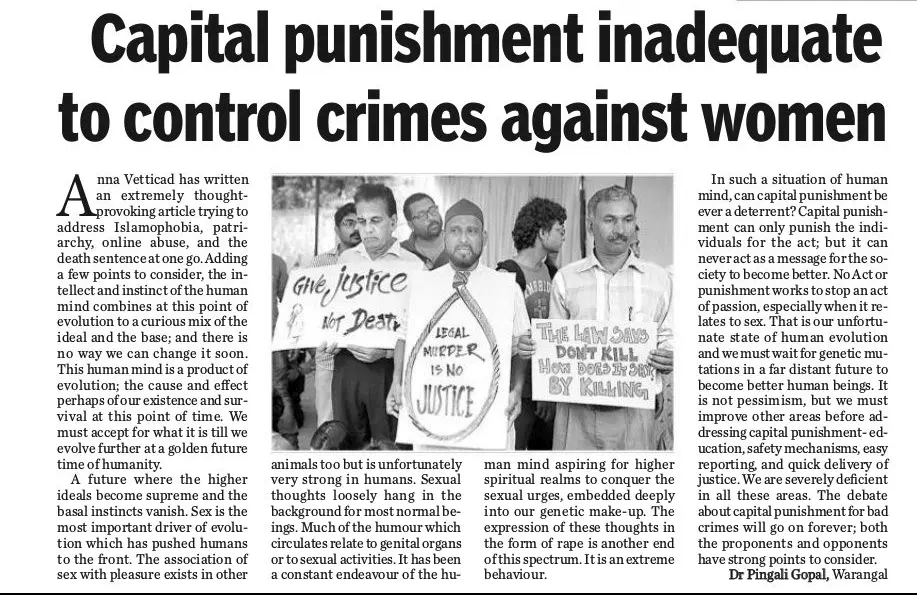
CAN CAPITAL PUNISHMENT BE A DETERRENT FOR RAPE?
ENCOUNTER CULTURE
‘Encountering’ hostility
One may call it cynicism or a clear understanding but most citizens were sure that Pallamkonda Raju would be having an unnatural death. It is an amazing facet of Indian society that whenever such a gruesome incident happens, both the citizens and its leaders talk the language of ‘encounters’ and instant justice. The human rights activists, who seem to have plenty of voice only in free countries paradoxically, end up with just a raised voice. Clearly, they simply add colour to the proceedings with absolutely no ability to influence anyone in society. Every time an encounter happens and the society rejoices, it is simply the most severe indictment of the entire legal system of the country. The judiciary needs to introspect at every such death. What are the extraordinary reasons why the citizens have lost complete faith in the judiciary to deliver effective and quick justice? The instant solutions gaining popularity and causing questionable and generalized happiness is simply a mirror of the state of law in our country. It is also a distressing matter that our law enforcers become effective only when the perpetrator comes from not a privileged position. The law in the country unfortunately goes by the adage, ‘show me a man and I will show you a rule.’ We are also equally cynical about the Law offices and agencies making great fuss about the celebrities in the drug case. Except for some unknown persons, no celebrity is going to see the inside of a jail. The rape and murder of an innocent child is the most distressing thing in the world. The encounter of the accused however raises larger questions to our society and is arguably more disturbing.
https://www.thehansindia.com/my-voice/myvoice-views-of-our-readers-22nd-september-2021-707558
 RANDOM MUSINGS