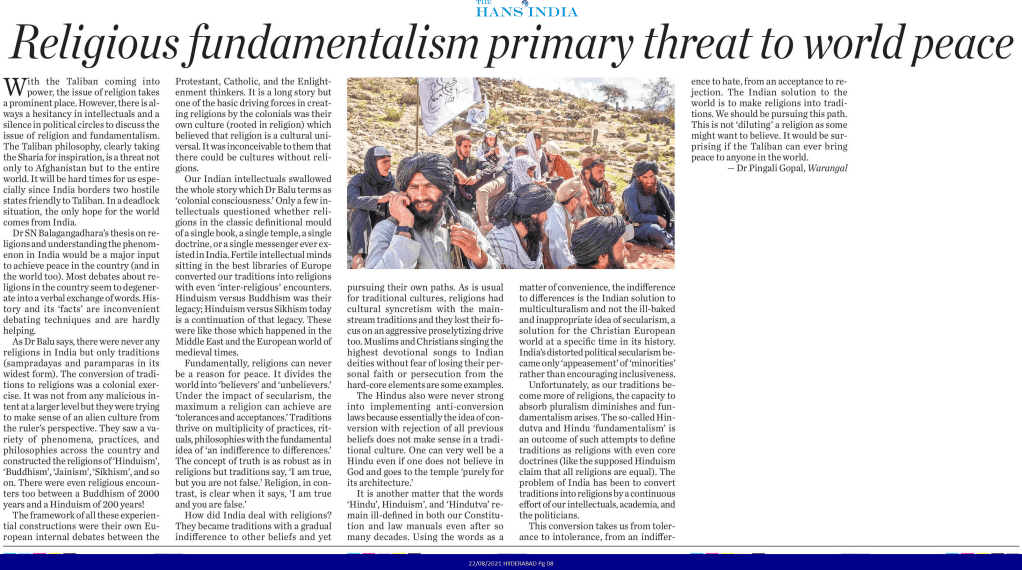
With the Taliban coming into power, the issue of religion takes a prominent place. However, there is always a hesitancy in intellectuals and a silence in political circles to discuss the issue of religion and fundamentalism. The Taliban philosophy, clearly taking the Sharia for inspiration, is a threat not only to Afghanistan but to the entire world. It will be hard times for us especially since India borders two hostile states friendly to Taliban. In a deadlock situation, the only hope for the world comes from India. Dr SN Balagangadhara’s thesis on religions and understanding the phenomenon in India would be a major input to achieve peace in the country (and in the world too). Most debates about religions in the country seem to degenerate into a verbal exchange of words. History and its ‘facts’ are inconvenient debating techniques and are hardly helping.
As Dr Balu says, there were never any religions in India but only traditions (sampradayas and paramparas in its widest form). The conversion of traditions to religions was a colonial exercise. It was not from any malicious intent at a larger level but they were trying to make sense of an alien culture from the ruler’s perspective. They saw a variety of phenomena, practices, and philosophies across the country and constructed the religions of ‘Hinduism’, ‘Buddhism’, ‘Jainism’, ‘Sikhism’, and so on. There were even religious encounters too between a Buddhism of 2000 years and a Hinduism of 200 years! The framework of all these experiential constructions were their own European internal debates between the Protestant, Catholic, and the Enlightenment thinkers. It is a long story but one of the basic driving forces in creating religions by the colonials was their own culture (rooted in religion) which believed that religion is a cultural universal. It was inconceivable to them that there could be cultures without religions.
Our Indian intellectuals swallowed the whole story which Dr Balu terms as ‘colonial consciousness.’ Only a few intellectuals questioned whether religions in the classic definitional mould of a single book, a single temple, a single doctrine, or a single messenger ever existed in India. Fertile intellectual minds sitting in the best libraries of Europe converted our traditions into religions with even ‘inter-religious’ encounters. Hinduism versus Buddhism was their legacy; Hinduism versus Sikhism today is a continuation of that legacy. These were like those which happened in the Middle East and the European world of medieval times.
Fundamentally, religions can never be a reason for peace. It divides the world into ‘believers’ and ‘unbelievers.’ Under the impact of secularism, the maximum a religion can achieve are ‘tolerances and acceptances.’ Traditions thrive on multiplicity of practices, rituals, philosophies with the fundamental idea of ‘an indifference to differences.’ The concept of truth is as robust as in religions but traditions say, ‘I am true, but you are not false.’ Religion, in contrast, is clear when it says, ‘I am true and you are false.’
How did India deal with religions? They became traditions with a gradual indifference to other beliefs and yet pursuing their own paths. As is usual for traditional cultures, religions had cultural syncretism with the mainstream traditions and they lost their focus on their aggressive proselytizing drive too. Muslims and Christians singing the highest devotional songs to Indian deities without fear of losing their personal faith or persecution from the hard-core elements are some examples. The Hindus also were never strong into implementing anti-conversion laws because essentially the idea of conversion with rejection of all previous beliefs does not make sense in a traditional culture. One can very well be a Hindu even if one does not believe in God and goes to the temple purely for its ‘architecture.’
It is another matter that the words ‘Hindu’, Hinduism’, and ‘Hindutva’ remain ill-defined in both our Constitution and Law even after so many decades. Using the words as a matter of convenience, the indifference to differences is the Indian solution to multiculturalism and not the ill-baked and inappropriate idea of secularism, a solution for the Christian European world at a specific time in its history. India’s distorted political secularism became only ‘appeasement’ of ‘minorities’ rather than encouraging inclusiveness.
Unfortunately, as our traditions become more of religions, the capacity to absorb pluralism diminishes and fundamentalism arises. The so-called Hindutva and Hindu ‘fundamentalism’ is an outcome of such attempts to define traditions as religions with even core doctrines (like the supposed claim that all religions are equal). The problem of India has been to convert traditions into religions by a continuous effort of our intellectuals, academia, and the politicians. This conversion takes us from tolerance to intolerance, from an indifference to hate, from an acceptance to rejection. The Indian solution to the world is to make religions into traditions. We should be pursuing this path. This is not ‘diluting’ a religion as some might want to believe. It would be surprising if the Taliban can ever bring peace to anyone in the world.
 RANDOM MUSINGS