INTEGRATING AYURVEDA AND ALLOPATHY–LATERAL ENTRY THAT CAN PROVE LETHAL
The attempts to integrate Ayurveda, especially surgery, into mainstream medicine must be one of the worst decisions across time and space for any government. Surgery in modern medicine has specialised and sub-specialised to high levels. It is disconcerting to see the government trying to encourage Ayurvedic doctors what most allopathic practitioners see as an inappropriate and highly questionable ‘lateral entry’. There are huge medical, ethical, and legal implications for such moves. These are not political institutions to allow lateral entry. There are certainly better ways of doing this ‘integration’ to improve the health of the nation, but the present efforts are not doing any service to either Ayurveda or Allopathy. The bureaucracy and the political thinktank should work towards evolving better ways of integrating, instead of simply allowing Ayurveda practitioners to do surgeries which requires allopathic set-ups and highly complicated anaesthesia techniques.
https://www.thehansindia.com/my-voice/myvoice-views-of-our-readers-12th-december-2020-661418
CASTE CARD IN ELECTIONS
It was distressing to read the news item that parties are using the caste card to win elections in Tirupati. It is extremely unfortunate that we went so wrong in understanding and correcting a terrible discourse after independence. The only reality of the Indian social systems are the castes (jatis); thousands of them which have vibrantly and dynamically evolved or dissolved across centuries. These castes are based on many things and Indian experience has been that political, social, and economic power lay with different castes at different times. Varnas have been always four in number and these have been categories. The one-to-one correlation between the jatis and varnas has been one of the most dubious and difficult exercises across all times. One cannot give a hierarchical ordering to Varnas but extreme cherry picking and selective readings of the colonials (especially the reading of the Purusasukta) created a hierarchy of varnas. There have been equally valid and important texts which calls for equality of all the varnas or even reverses them. The colonials and our scholars have conveniently ignored them. The colonials did not ‘create’ the caste system but this was an ‘experiential unity’ for them of the hundreds of jatis and the social system they saw in India. The country is dividing deeply as new castes come into existence and the existing discourse solidifies further. The political pundits complicated the issue by introducing further classifications like ‘forward’, ‘backward’ (with sub-categories), ‘scheduled’ and so on. These have only created frictions and angers in our society when we should be moving forward in harmony and unity. The Varna Vyavastha and the jatis have been the bedrock of our civilisation and the reason we could survive so many physical and intellectual onslaughts to obliterate us. But we need new narratives- based solely on our past traditional understanding ironically. The people who should remain far away from creating fresher narratives to the agitated country where everyone is fighting for rights based on ‘caste’ are the politicians. Ironically, they are the most significant people in charge. Meanwhile, we learn that caste system is bad and ugly, while at the same time mentioning our caste in every application form.
https://www.thehansindia.com/my-voice/myvoice-views-of-our-readers-1st-april-2021-679556
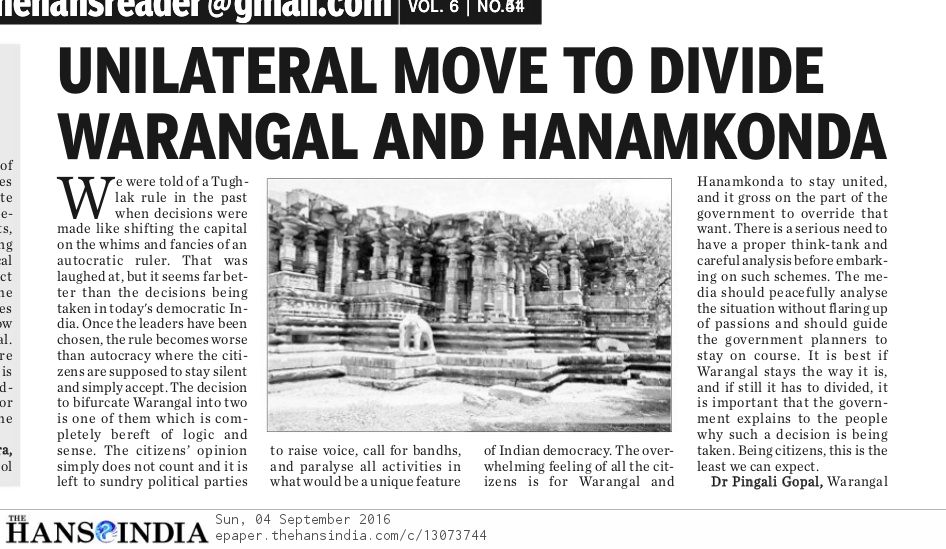
MOVE TO DIVIDE WARANGAL AND HANAMKONDA
POTHOLES ON ROADS

CAN A SAGE HOLD POLITICAL POWER?

RESERVATIONS
SANSKRIT OR HINDI
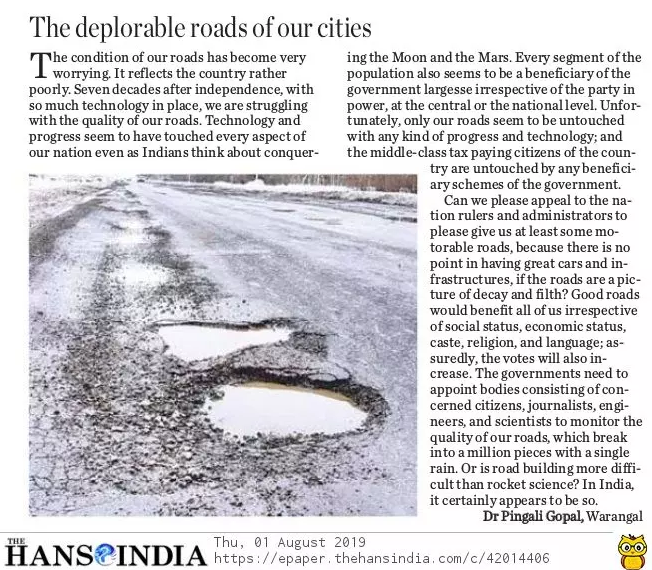
THE DEPLORABLE ROADS
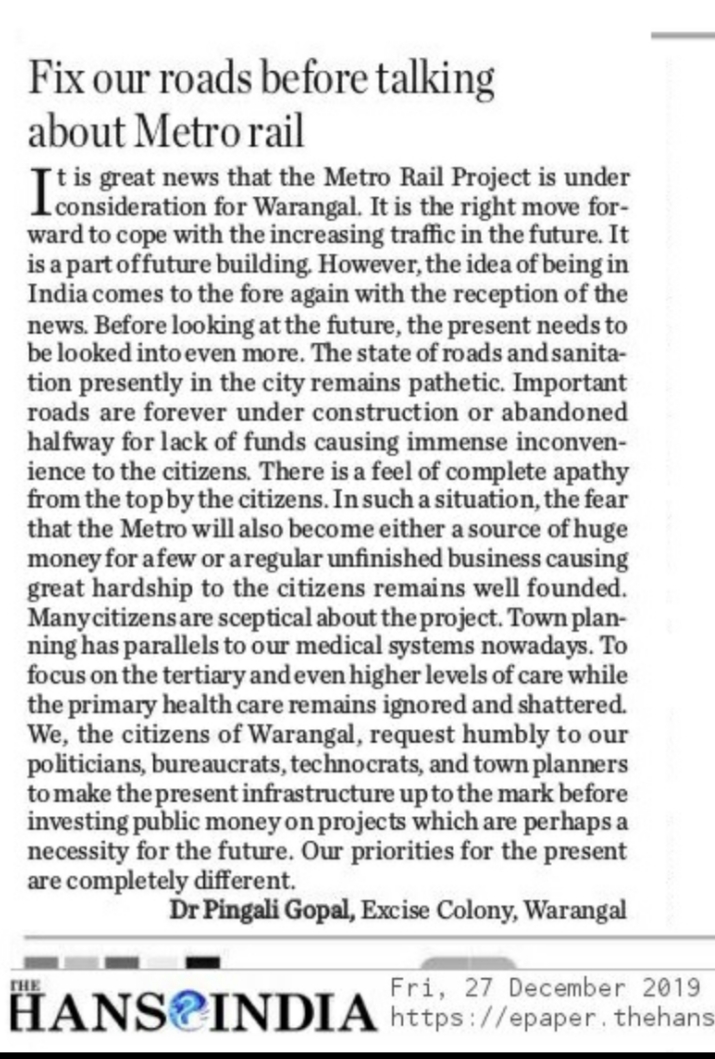
FIX OUR ROADS BEFORE TALKING ABOUT METRO RAIL
PARLIAMENTARY AND UNPARLIAMENTARY LANGUAGE
We grew up with the teaching that our language should always be ‘parliamentary’. This word always evoked a feeling of dignity and decency while conversing. However, the theory does not seem to match the facts of Indian politics. The recent episode of a Congress leader calling another senior leader of the same party a donkey is a graphic illustration of this. In choosing to exploit the recorded conversation, the opposition leaders also chose to give colourful epithets to the Congress leader. Is this ‘parliamentary language’ all about and is this the example our political leaders set to the growing generation of the country? The normalisation of such language which starts right at the top level of political leaders calling each other scumbags, criminals, donkeys, and such colourful epithets leaves one with a bitter taste about the nature of politics and politicians. At a deeper fundamental level, one begins to suspect the democratic form of governance as a gold standard. The parliamentarian language has become very unparliamentary. This distressing kind of language makes a huge case for the dictionary people across the world to remove the word and the idea of ‘parliamentary language.’ It seems extremely incongruous in the present times.
https://www.thehansindia.com/my-voice/myvoice-views-of-our-readers-19th-september-2021-707101
 RANDOM MUSINGS