Letter Dated 26th June 2022
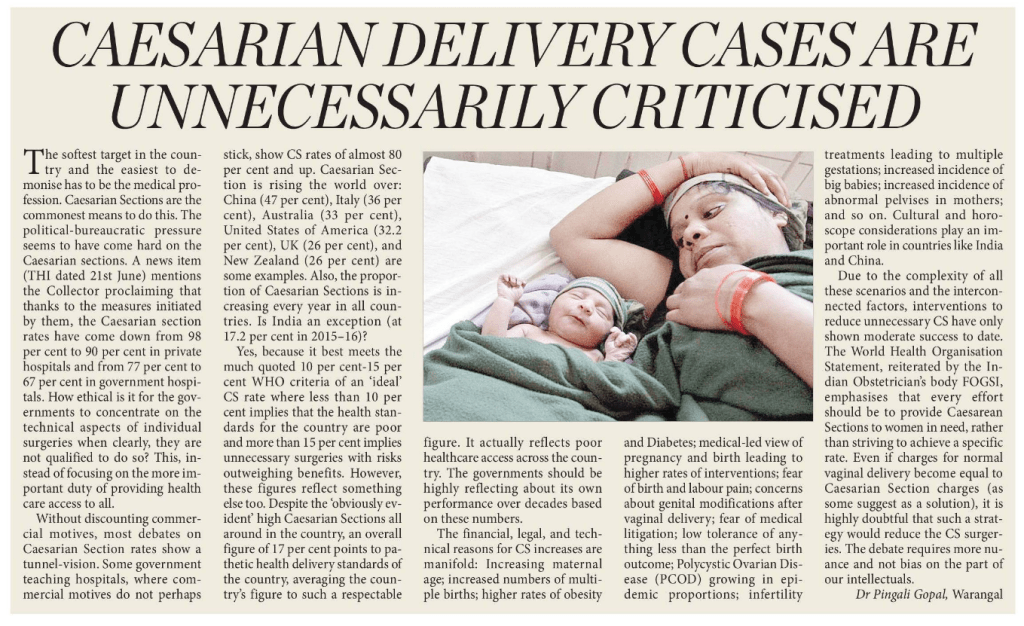
The softest target in the country and the easiest to demonize has to be the medical profession. Caesarian Sections are the commonest means to do this. The political-bureaucratic pressure seems to have come hard on the Caesarian sections. A news item (THI dated 21st June) mentions the Collector proclaiming that thanks to the measures initiated by them, the Caesarian section rates have come down from 98% to 90% in private hospitals and from 77% to 67% in government hospitals. How ethical is it for the governments to concentrate on the technical aspects of individual surgeries when clearly, they are not qualified to do so? This, instead of focusing on the more important duty of providing health care access to all.
Without discounting commercial motives, most debates on Caesarian Section rates show a tunnel-vision. Some government teaching hospitals, where commercial motives do not perhaps stick, show CS rates of almost 80% and up. Caesarian Section is rising the world over: China (47%), Italy (36%), Australia (33%), United States of America (32.2%), UK (26%), and New Zealand (26%) are some examples. Also, the proportion of Caesarian Sections is increasing every year in all countries. Is India an exception (at 17.2% in 2015–16)? Yes, because it meets best the much quoted 10%-15% WHO criteria of an ‘ideal’ CS rate where less than 10% implies that the health standards for the country are poor and more than 15% implies unnecessary surgeries with risks outweighing benefits. However, these figures reflect something else too. Despite the ‘obviously evident’ high Caesarian Sections all around in the country, an overall figure of 17% points to pathetic health delivery standards of the country, averaging the country’s figure to such a respectable figure. It actually reflects a poor healthcare access across the country. The governments should be highly reflecting about its own performance over decades based on these numbers.
The financial, legal, and technical reasons for CS increases are manifold: Increasing maternal age; increased numbers of multiple births; higher rates of obesity and Diabetes; medical-led view of pregnancy and birth leading to higher rates of interventions; fear of birth and labour pain; concerns about genital modifications after vaginal delivery; fear of medical litigation; low tolerance of anything less than the perfect birth outcome; Polycystic Ovarian Disease (PCOD) growing in epidemic proportions; infertility treatments leading to multiple gestations; increased incidence of big babies; increased incidence of abnormal pelvises in mothers; and so on. Cultural and horoscope considerations play an important role in countries like India and China.
Due to the complexity of all these scenarios and the interconnected factors, interventions to reduce unnecessary CS have only shown moderate success to date. The World Health Organization Statement, reiterated by the Indian Obstetrician’s body FOGSI, emphasizes that every effort should be to provide Caesarean Sections to women in need, rather than striving to achieve a specific rate. Even if charges for normal vaginal delivery become equal to Caesarian Section charges (as some suggest as a solution), it is highly doubtful that such a strategy would reduce the CS surgeries. The debate requires more nuance and not bias on the part of our intellectuals.
Some More Details
 RANDOM MUSINGS