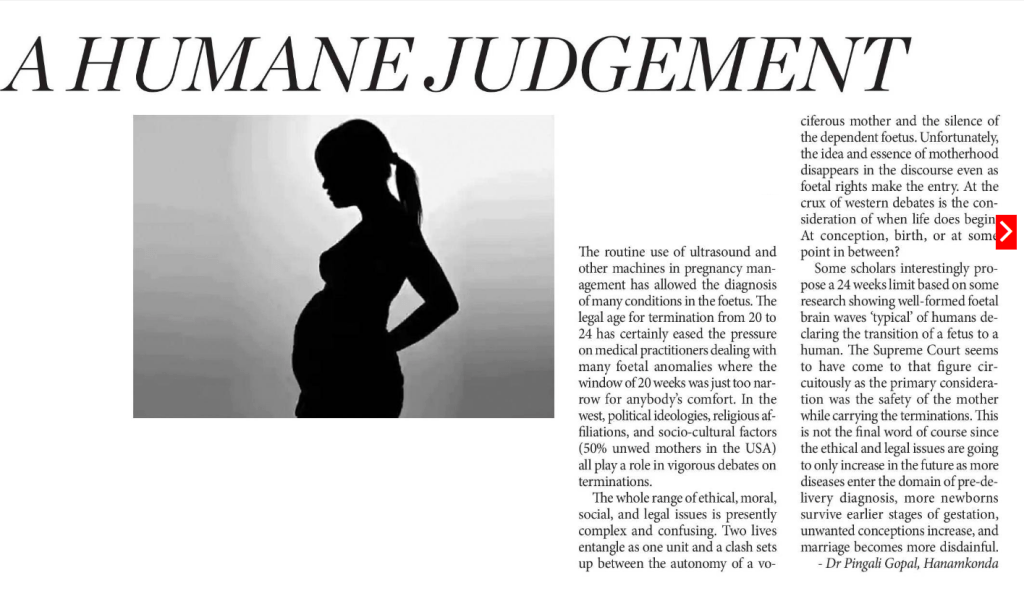
The routine use of ultrasound and other machines in pregnancy management has allowed the diagnosis of many conditions in the foetus. The legal age for termination from 20 to 24 has certainly eased the pressure on medical practitioners dealing with many foetal anomalies where the window of 20 weeks was just too narrow for anybody’s comfort. In the west, political ideologies, religious affiliations, and socio-cultural factors (50% unwed mothers in the USA) all play a role in vigorous debates on terminations. The whole range of ethical, moral, social, and legal issues is presently complex and confusing. Two lives entangle as one unit and a clash sets up between the autonomy of a vociferous mother and the silence of the dependent foetus. Unfortunately, the idea and essence of motherhood disappears in the discourse even as foetal rights makes its entry. At the crux of western debates is the consideration of when does life begin? At conception, birth, or at some point in between? Some scholars interestingly propose a 24 weeks limit based on some research showing well-formed foetal brain waves ‘typical’ of humans declaring the transition of a fetus to a human. The Supreme Court seems to have come to that figure circuitously as the primary consideration was the safety of the mother while carrying the terminations. This is not the final word of course since the ethical and legal issues are going to only increase in the future as more diseases enter the domain of pre-delivery diagnosis, more newborns survive earlier stages of gestation, unwanted conceptions increase, and marriage becomes more disdainful.
LETTER PUBLISHED IN THE HANS INDIA DATED 2ND OCTOBER 2022
 RANDOM MUSINGS