PART 1
FIRST PUBLISHED IN INDIAFACTS
The dominant story about ancient India is the AIT (Aryan Invasion Theory) or its softer version, AMT (Aryan Migration Theory). The debates surrounding this matter are both contentious and vigorous. This essay in two parts gives an overview of the scholarship which not only rejects the AIT but proposes an alternative version or the Out of India (OIT) hypothesis. This work draws primarily from the works of Michel Danino, Shrikant Talageri, and Koenraad Elst. Part II can be accessed here.
Introduction: The Basic Story of the Aryans
The dominant theory regarding ancient Indian civilization is the AIT (Aryan Invasion Theory) proposed first in the 19th century. This postulates a group of horse-riding invaders called the Aryans, speaking an early form of Sanskrit, from Central Asia, invading North India around 1500 BCE where and when there was an existing Harappan civilization. These light-skinned Aryans defeated the dark-skinned racially different indigenous natives of the Harappan Civilization called Dasas and Dasyus and drove them south.
The subjugated population adopted the language, religion, and the Vedic culture of the invaders and agreed to stay at the bottom of a hierarchical scale as slaves and Sudras in the Aryan devised varna system. The Dāsas and Dāsyus, correlating with the Harappans, were the ancestors of today’s tribals, Sudras, Dalits, and Dravidians.
In the newer and softer versions, the Aryans migrated peacefully into the subcontinent (the Aryan Migration Theory or AMT). However, the implications remain the same.
Ironically, the original homeland of these Aryans was speculated to be in India but it later shifted across various regions to settle now in the Russian Steppes. German Indologists involved themselves aggressively in the AIT constructions. Max Mueller speculated, “how the [British] descendants of the same [Aryan] race, to which the first conquerors and masters of India belonged, return … to accomplish the glorious work of civilization, which had been left unfinished by their Aryan brethren”. The British justifications portrayed their new colonial rule as one more Aryan wave.
The Aryan settlers, in a remarkably brief time after 1500 BCE, first created the near perfect language of Sanskrit and then composed the Rig Veda around 1200 BCE. They later moved into the Ganges Valley by clearing the thick forest cover of the Gangetic plains with their strong iron tools. This AIT/AMT story has a two-century history of propagation by academics relying on disciplines like archaeology, linguistics, and textual/inscriptional data.
The Major Problems with AIT/AMT
Similarities between Sanskrit and other European languages (noted by William Jones and Jesuit scholars) led to the idea/hypothesis of a common precursor Proto-Indo-European (PIE) language and a common homeland to which the language belonged. From here, people and languages migrated to different lands. Thus, the Aryan invasion/migration theories began with linguistics.
However, the evidence for Aryans invading/migrating remains slim, especially in archaeology. The discovery of the Harappan civilization much before independence flew in the face of the Aryan Invasion Theory. Yet, the powerful post-independent Marxist historians continued with their speculations and assertion about “invading Aryans” and the “exploited Dravidians” fitting well with their exploiter-exploited paradigm. Aryans simply filled our textbooks. Data from genetics, a new weapon for the AIT/AMT proponents today, remains ambiguous and contradictory.
The original homeland of the Aryans speculated in 1800 was India since scholars thought of Sanskrit as the mother language. However, this went into hibernation as the idea of invasion became popular. There is now a strong scholarship which shows that linguistics and textual data strongly support the rival OIT or “Out of India” theory in which India is proposed as the original homeland. The theory gained ground once again in the early 1990s as various scholars offered support for this hypothesis. Textual sources like the Vedas, as scholars like Talageri show, offer narratives of a reverse migration – i.e., people moving from India to different parts of Europe.
It is irrelevant whether Aryans existed, according to some scholars. That may be true, but it is a fact that most narratives disrupting the fabric of India are based on AIT/AMT. The indigenous people of India driven south became the Dravidians. Those pushed into forests became the tribals (Adivasi/Vanavasi), and the people who stayed back became subjugated as the lowest in the hierarchy of the caste system (Shudras, and especially the “untouchables”). The most pernicious outcome of the AIT/AMT hypotheses is the well-entrenched narrative of the dominant, upper caste “Hindus” trying to always exploit and subsume Dravidians, tribals, and Dalits into a Vedic-Sanskritic-Brahmanical culture. In this narrative, Sanskrit as a language becomes oppressive and, being the carrier of Vedas, stands in opposition to non-Vedic cultures and Dravidian languages.
However, despite all evidence to the contrary, Indians seem to have simply internalised this story and even built a huge edifice of conclusions based on the AIT/AMT assumptions. The major repercussion has of course been a near permanent fissure in relations between the North and the South with political movements based on a “pure” Dravidian identity.
Koenraad Elst, in his seminal work Still No Trace of an Aryan Invasion, summarizes the many political applications of the racially interpreted AIT:
- The colonial justification of the rule by the pure Aryans (the British) over the mixed Aryans (the upper castes) and the black aboriginals (the lower castes)
- The Nazi scheme of rule by the pure Aryan race and the degeneracy of India-based Aryans through mixing with lower races
- Anti-Brahminism
- Dravidianism
- Ambedkarism (lower castes as the aboriginals subdued by the Aryan invaders though Ambedkar himself strongly opposed the AIT)
- British-cum-missionary construction of the tribals as Adivasis (or aboriginals), a neologism created in the 20th century offering the message that the non-tribals were invaders
- PIE attached with the European race and thus indicating an inherent European intellectual superiority
Changing Interpretations of the Aryans: Cauldron of Race, Caste, Language, Religion
In an important book, India In The Eyes of Europeans, Martin Farek deals with the changing interpretations of AIT/AMT and how the story started on the basis of pernicious race theories. The Brahmin priests, in the invading foreign groups, in connivance with the rulers (Kshatriyas), created a caste system where the first three orders — Brahmins, Kshatriyas, and Vysyas (the original exploiters) — were Aryans. The subjugated people as the lowest in the hierarchy became the Sudras, tribals, and the untouchables. Thus, the mysterious Aryans were cut from “whole cloth” to explain the many practices, beliefs, groups, languages, and attitudes prevalent in India.
The only scientifically established fact of the entire AIT/AMT theories is the relatedness of Indo-European languages noted first by “Oriental” (European) scholars and others predating them (like Newton or Leibnitz). The vibrant area of comparative philology arrived at the idea of a mother language (PIE or Proto-Indian-European) originating from a motherland from which people migrated to various areas. Each migrating group developed a degenerated version of the original language.
Martin Farek explains how theological assumptions formed the basic structure of the first ideas of the theory and laid the basis for later 19th century linguistic and anthropological research. The discussions were on three related questions: What was the primary language of humankind? How did languages come to separate from each other and spread in the world? Is it possible to find the ideal language? The basis for these questions, especially for William Jones, was the Biblical Genesis and the later dispersal of Noah’s descendants as the truthful account of global history. In this story, the Europeans were descendants of Japheth and Indians perhaps either of Ham or Japheth.
Jones’ comparative project attempted to discover the earliest history of humankind along with the original and the oldest religion of humankind. It was more of speculative identifications and parallelism of Biblical and Graeco-Roman characters with Indian ones rather than comparative linguistics. Thus, a language family originated in the quest for an original religion. A common original homeland originated in the belief of a “Great Flood” in the aftermath of which Noah and his descendants moved to all parts of the world. As Farek notes, a truly linguistic proof of identity with European languages came, in fact, from Franz Bopp, who in turn, ironically, took inspiration from Indian linguistics.
Though later scholars rejected explicit theology, there was secularization of the post-flood dispersion of nations in linguistic and anthropological speculations about the “noble Aryan race” subjugating the uncivilized peoples of India. Thus, Aryan theories clearly are rooted in theology which presupposes the universal truth of the Biblical accounts. The prism of presupposed invasion remained a framework for explaining even later linguistic and archaeological discoveries. The “core” hypothesis today has a strong protection from contradictory data both old and new through adjustments of the data (mostly ad-hoc). There is never a rejection of the primary assumption of the invading Aryans.
Approaches to the Issues of Aryans
Michel Danino uses following evidences to deconstruct the Aryan theory:
- Literary
- Geographical: The Aryans’ geography
- Archaeological
- Cultural: Is there a break between pre- and post-Aryan periods?
- Linguistics
- Astronomical data
- Anthropological and genetic: Evidence for an Aryan race or ethnic entity
The Literary Evidence
Dr Ambedkar wanted the Aryan theory to “die”. He thought that the Dāsas and Dāsyus, or the non-Vedic Aryans, were more likely non-believers of Vedas, but clearly integrated into the society. Swami Vivekananda too vehemently objected to the idea of Aryans. Sri Aurobindo called the supposed Aryans a “conjecture supported only by other conjectures”. Western Vedic scholars like Thomas Trautmann also debunk the notion that the Rig Veda supported the colonial and racial readings of “dark-skinned, stub-nosed” aborigines living in “forts”.
Scholars remarkably twisted the words in the Vedas to give a racial interpretation. Anāsa occurring only once in the Rig Veda became a stub-nose in the description of the Dāsyus! Surprisingly, even the Tamil Sangam literature (300 BCE to 100 CE) does not mention any clash of the Aryans with native Dravidians or of a homeland outside Tamil land. In fact, Sangam poems and texts often praise Vedic and classical Hindu Gods and Goddesses and have many references to the Vedas. This would hardly be the case if the two cultures had clashed brutally as the result of an Aryan invasion.
The Old Rig Veda and the New Rig Veda
The Rig Veda, the longest and the most ancient manuscript, consists of 10 mandalas (books), 1,028 suktas (hymns), and 10,552 mantras (verses). Scholars classify the ten Rigveda books into the Old Books (2, 3, 4, 6, 7) and the New Books (1, 5, 8, 9, 10). The Old Rig Veda has 342 hymns and 3,241 verses; the New Rig Veda has 686 hymns and 7,311 verses. The text came much later but there has been an oral preservation of every word, syllable, and even the tonal accent to pronounce the words for over thousands of years. Places or persons refer to contemporary sources of the Vedic era as scholars confirm.
Shrikant Talageri has studied the Vedas and the Avesta from the perspective of linguistics, geography, and chronology to firmly conclude an “out of India” migration scenario. In his essays and books, he has analyzed in great detail the authors, verse structures, the meters used, the numerical formulae, categories of words, usage of personal names, usage of suffixes or prefixes in forming compound words, grammatical forms, certain mythical and sociological concepts, categories of words, differing meaning of same words, totally new words in the New Books, and so on, to establish the differences between the Old and the New Books. He says that the inescapable conclusion is that chronologically the New Rig Veda era follows the Old Rig Veda era.
The Chronological Evidence: Mittani Languages, the Old Books, and the New Books
The Mittani Kingdom of Syria-Iraq shows the first inscriptional data in Indo-Aryan languages outside India between 1500 BCE and 1600 BCE. The Mittani data implies entry of Aryans into India after the 16th century BCE only, India being the last part of migration from the Russian Steppes. The Mittani Kingdom had two components in the languages according to scholars: the people spoke Hurrian, a non-Indo-European language; and problematically, the ruling clans had Vedic Indo-Aryan speaking ancestors. The Vedic elements in the Mittani records are apparently the “remnants of a dead language” of the pre-Mittani ancestors of the ruling clans.
If a “dead language” related to Vedas is evident in the recordings in 1677 BCE, then logically a “living language” would have existed many centuries prior: a strong case for a reverse migration from India to Syria-Iraq. Indology scholars, to explain the problematic Vedic remnants in a culture existing before the Aryans entered India, and before the scripting of the Vedas, now claim a “pre-Rigvedic group” which split from the other Indo-Aryans in Central Asia itself and migrated westwards. The Vedic Indo-Aryans (who later composed the Vedas) entered India and simultaneously, this pre-Rigvedic Indo-Aryan ancestors of the ruling clans of Mittani were entering West Asia. Can explanations become more ad hoc?
Talageri uses Vedic data extensively to prove these speculations wrong. The common elements in the Mittani data and in the Rig Veda include a wide range of semantic fields of horses, their colors, horse racing, chariots, names of Gods, and personal names of the ruling elite. All the common elements are completely absent in the Old Rigveda but are extensive in the New Books! Even the Iranian Avesta shows common elements implying a Vedic-Mittani-Iranian culture. Talageri shows that the Old Rig Veda clearly predates the common New Rig Veda- Mittani- Avesta culture.
The Chronology and the Geography of the Rig Veda: Vedic Data
Vedic literature follows a definite chronological sequence of the Old Rig Veda, the New Rig Veda, and post-Rigvedic Vedic texts (Epics, Puranas, and other Sanskrit texts). Talageri’s data shows that the Rigvedic people migrated from an area between Haryana/ Western UP to South-West Afghanistan and then to the area of Mittani Kingdom in West Asia: 1700 BCE is the accepted date of the Mittani records. New Rig Veda people, at least 400-600 years before, and the Old Rig Veda another 500-700 years before (to account for the travel and establishing in the Mittani Kingdom) takes us to 2800 BCE and 3000 BCE. The Old Rig Vedic civilization of 2800 BCE is by conservative estimates. The crux of OIT arguments lies in proving that many of the so-called Aryan influences, including the languages and texts, existed before 2000 BCE in India.
The Old Rigveda shows absolutely no references to the North-West or Afghan areas where the Aryans supposedly came from. Later books show a serial East to West progression of the geographical and historical descriptions from Haryana area to Afghanistan, occupying the entire Rigvedic area only by the period of New Rigveda. The western places, lakes, mountains, and animals appear exclusively in New Books.
Geographical References
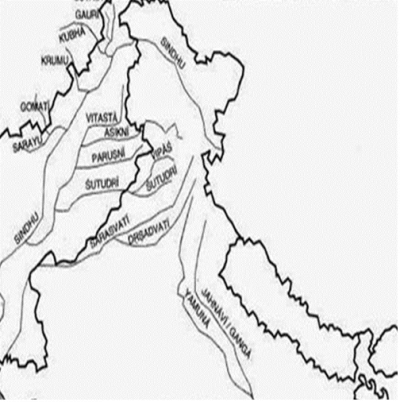
The Vedic Rivers
The chronological placing of the books unambiguously correlates with both the geographical descriptions and historical progression from east to west. Eastern places, lakes, and animals are abundant in all the books of the New Rig Veda (1, 5, 8, 9, 10) and the Old (2, 3, 4, 6, 7). The western places, mountains, animals, and lakes are only in the New Books. The oldest Book 6 refers to Jahnavi (Ganga), Sarasvati, and the latter’s eastern tributaries; the next, Book 3, refers to Ganga and the two easternmost rivers of Punjab — the Vipas and Satudri. The next, Book 7, refers to Yamuna and the western river of Punjab, the Parusni. It also mentions the battle of the ten Anu tribes — the Asikni people fighting from the direction of the further western river, the Asikni. The next, Book 4, refers for the first time to the western geographical name Sindhu and its western tributaries, the Sarayu and the Rasa.
The Saraswati
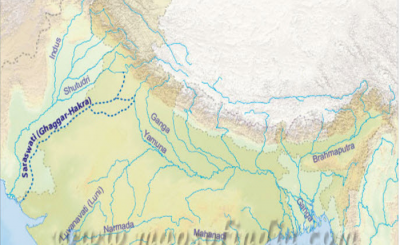
The existence of River Saraswati has many implications, most importantly, the death of the AIT/AMT. The AIT/AMT proponents must deny River Saraswati and its identification with the present Ghaggar-Hakra. The Old Rig Veda speaks of Saraswati as a glowing and flowing river. The New Rig Veda gives more importance to the Indus River and speaks in celestial terms about Saraswati. The geography, flora, and fauna in the Old Rig Veda puts Saraswati at the place where the Ghaggar-Hakra flows today as Michel Danino shows (The Lost River).
Plate tectonics changed the flow of rivers, making the Saraswati dry. At the end of a mature urban phase of the Indus Valley Civilization (1900 BCE), a prosperous civilization along the Saraswati migrated towards the east and west. There is a large amount of archaeological evidence of different phases of a thriving civilization on the banks of Saraswati (going back to 7000 BCE), as shown elegantly by Danino. Archaeology, most importantly, shows no evidence of a forced invasion of any kind.
AIT/AMT proponents make the Saraswati a river in Afghanistan called Harahvaiti; and the sea mentioned in the Veda as a lake. There is a late and single record of Harahvaiti in Afghanistan. The Rigvedic-Avestan records more plausibly suggests people moving from Haryana to Afghanistan giving the name of Saraswati to a local river in Afghanistan. Some concentrate on a poetic reference (an exaggeration) to the waves of the powerful Saraswati bursting the ridges of the hills. Ghaggar-Hakra was never that powerful. Circularly, because Ghaggar-Hakra is weak, say the AIT scholars, it cannot be the Saraswati!
Archaeology
The most important source for rejecting the Aryan theory comes from archaeology. Till date, there is not a shred of evidence supporting the invasion or migration scenario. Unfortunately, this Aryan theory became an established fact and selective words with fancy interpretations from the Vedic corpus became their supporting evidence. Words such as varna became color and a-nas became “without a nose” or “stub” nose to support many racial speculations of distinct Aryan and Dravidian races. Such interpretations laid the basis of physical anthropology studies. As Farek notes in his book, on a dubious interpretation of a single passage from the large Vedic corpus by Max Mueller, the promoter of anthropometry, H. H. Risley, claimed that the Vedic Aryans referred to their enemies as noseless.
Archaeology remained the biggest problem even as the Indus excavations (the Harappan and Mohenjo-Daro civilizations in the 1920s and the Mehrgarh excavations later) contradicted the Aryan theory. In fact, as the OIT group insists, all the evidence (archaeology, textual, Vedic, inscriptions, astronomical) has suggested not only an indigenous Vedic civilization without any Aryan-Dravidian divide but even a possible reverse migration from India to other parts of Europe. But in the dominant academic circles, the idea of Aryan invasion remains a primary assumption which they will not let be falsified by new findings.
The mature Harappan urban phase (2600–1900 BCE) covered an area of about one million square kilometres and there are over 1,200 excavated sites along the Saraswati river bed. Surprisingly, by 1900 BCE, most of a thriving civilization had stopped functioning. The explanations have varied including an economic decline from the evidence of an end of thriving trade with Mesopotamia in 2000 BCE. The plausible explanation seems to be a drying up of Saraswati around 1900 BCE which might have led to severe drought conditions. Harappans also may have accelerated the region’s ecological degradation through deforestation.
The time gap between 1900 BCE (end of Indus civilization) and 1500 BCE (supposed arrival of the Aryans) shows that, in any case, the latter could not have been the cause of the Harappan decline. Most startling is the absence of archaeological evidence of a possible Aryan invasion. Prominent, well-known archaeologists repeatedly affirm that the Aryans defy any archaeological definition. So far, no type of artefact, and no class of pottery exists that would enable us to say, “Aryans came this way”.
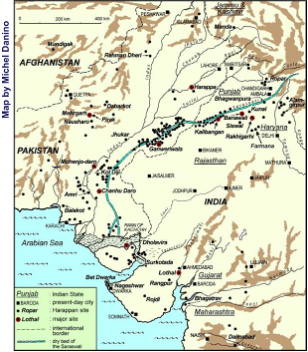 A thriving civilization along the River Saraswati
Archaeology and Texts: Why Is the Period 2000-1000 BCE Significant and Important?
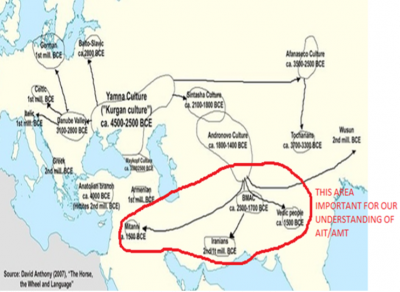
Aryan or the Indo-European migration theory is only and solely based on linguistic analysis. Discovery of common linguistic features between Northern Indian and many European languages logically pointed to a common origin of languages in a geographically-restricted “Homeland”. As Talageri explicates clearly in his books and essays, the twelve living and extinct branches of Indo-European languages from the west to the east are: Celtic, Italian, Germanic, Baltic, Slavic, Albanian, Greek, Anatolian (extinct), Armenian, Iranian, Tocharian (extinct), and Indo-Aryan. The common ancestral language gets the term PIE (Proto-Indo-European).
The theorized timeline, as Talageri explains, is as follows:
- Around 3000 BCE, from the “Homeland,” the Anatolian and the Tocharian branches separated. Then the European branches separated as following: Italic, Celtic, Germanic, Baltic, and Slavic. The five last branches to remain in the “Homeland” were Albanian, Hellenic (Greek), Armenian, Iranian, and Indo-Aryan.
- The Indo-Aryan (or the Vedic people) and the Iranian branches have many common linguistic, textual, ritual, and religious features as the Rig Veda and the Avesta show. This combined family, long after 3000 BCE, migrated together from the Steppes to the Central Asian (Bactria) region.
- Then, Indo-Aryans separated from the Iranian branch and migrated towards the Saptasindhu area/ northern Pakistan, into the area of the Harappans. Around 2000 BCE, the Indo-Aryans went across the Ural Mountain range and spread eastwards.
- Finally, between 1400 BCE and 1000 BCE, the Aryans compiled the Rig Veda. The Rig Veda had to be compiled before 600 BCE too, since by Buddha’s time, the entire Vedic literature was well in place.
As seen earlier, problematically, archaeology of the Harappan area shows an extremely stable civilization from 4500 BCE to 500 BCE without any cataclysmic changes effected by the forced entry of the Aryans. Talageri’s Rigvedic data shows no reference to any tradition, name, or place in memory of its previous journeys from the Russian steppes. Rivers in Europe carry the indigenous names even after the influx of European languages, but the names of rivers and places are purely Indo-Aryan in the Veda itself with no remnant of any original Dravidian name. The extensive Tamil Sangam literature does not even mention any great events of a populous Dravidian civilization leaving the area in a short span from 2000 BCE to 1200 BCE.
Following the Rig Veda, each of the other Samhitas (Yajurveda, Samaveda, Atharvaveda), the Brahmanas, the Aranyakas, the Upanishads, and the Sutras have their own chronological periods showing linguistic changes of different periods of time — but all before the Buddha. This remarkably squeezes the entire period of the Vedic corpus into a narrow window of 400-600 years. For the AIT/AMT to hold, 2000 BCE to 1000 BCE is the extremely important period when everything related to Aryan migration into India happened. Archaeology, textual-inscriptional analysis, and linguistics problematically, for the AIT/AMT that is, show the presence of Indo-Aryans much before 2000 BCE, and in fact, point towards a reverse migration out of India.
The Horse
The presence or absence of the horse in Harappan Civilization has been a source of continuous debate. The basic argument goes like this: Rig Veda uses the word “asva” over 200 times. Hence, the Vedic society must have been full of horses. Horse remains have been conspicuously absent in Harappan Civilization archaeology and therefore Harappans are both pre-Vedic and non-Aryan. The horse came to India around 1500 BCE brought by the Indo-Aryans, who used its speed to crushing advantage in order to subdue the native, ox-driven populations. This line of reasoning is most self-evident and claimed to be “fool proof” in scholarly writings of the AIT/AMT proponents. Danino (The Horse and The Aryan Debate) shows that there are serious flaws at every step of the argument. He shows elegantly how there has been cherry-picking of data that ignores the horse remains from various protohistoric sites along with problems of methodology, especially in the persistent misreading of the Rig Veda.
The horse, “central to Vedic culture,” seems to have accompanied the migrating Aryans, according to the AIT proponents. They assert to the near absence of horses in both the excavated Indus cities and in the Harappan cultural depictions as proof that the original Harappans did not compose the Vedas. This is a tenuous argument where the absence of evidence becomes the evidence of absence. As Michel Danino says, at least 12 Harappan sites (as well as a few Neolithic and pre-Harappan sites) have yielded horse bones and teeth confirmed by archaeo-zoologists like Sandor Bokonyi, an authority on the prehistory of the horse.
Harappan seals may not depict the horse but neither do they depict lions, cows, camels, wolves, cats, or jackals, all known to the Harappans. Depiction and non-depiction simply may be a cultural choice; not a proof of existence or non-existence. In the Aryan scenario, we should see an increase of horse remains and depictions after 1500 BCE; the depiction of the horse remains largely absent until the Mauryan age (321 BCE-185 BCE), more than a thousand years later! There is no radical archaeological change between pre-1500 and post-1500 BCE for horses.
In the Rig Veda, the adversaries (Dāsyus) also have “horses” — even a marker for them in some passages. The equation horse equals Aryan is therefore invalid. The metaphors also need an understanding as Sri Aurobindo pointed out. According to him, ashva often does not refer to the animal, but for energy and speed, just as gou (cow) is often a metaphor for “light”. Chess sets beyond 2000 BCE depicting horses at Lothal, and linguistic evidence that the horse was well known to the non-Indo-European language speakers of India before the Aryans supposedly came show that the horse did exist in India. Only the proof of its existence seems to be rare, for whatever reasons. Some scholars suggest that in the Vedic society the ownership of horses was a rarity, reserved for aristocrats and kings. If such is the case, then the Harappan civilization cannot be seen as separate from Vedic culture on grounds of the horse argument alone.
Cultural and Linguistic Issues
Cultural Breaks
The fertile Gangetic-Vindhya civilization flowered a few centuries after the fading of the Harappan civilization and with the slow migration of the settlers. In the Aryan paradigm however, the Ganga-Vindhya civilization is completely disconnected from the Harappan; an independent settling place for the Aryans after the Harappans vanished. The Aryan theory demands a distinct break in the civilizational continuity. However, recent archaeological work shows a substantial Harappan cultural legacy in the Gangetic civilization of the first millennium BCE. House designs, trapezoid shaped bricks, coins, weight measures, craft traditions, ornaments, iconography, fire altars, tree worship, mother-goddess worship, and figurines pointing to yogic and meditation practices suggest a cultural continuum of the Harappan civilization into the Gangetic civilization without any break. Archaeologist John Marshall (1931) says, “The [Harappan] religion is so characteristically Indian as hardly to be distinguished from still living Hinduism”.
Linguistics
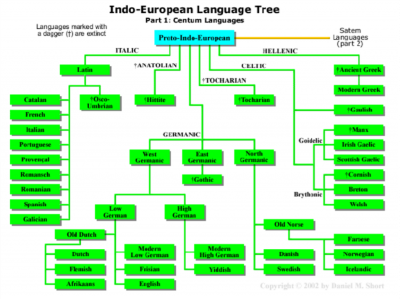
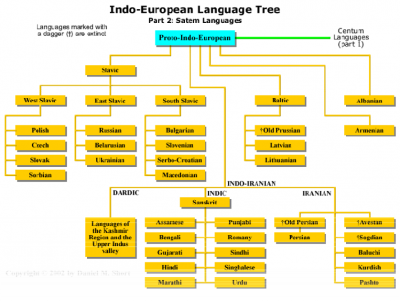
The flow-charts by Daniel M Short shows the western and eastern branches of the PIE language family. The Indo-European (IE) and the Dravidian languages dominate India’s linguistic families. The Dravidian languages (mainly Tamil), dominating the southern part of India, though interacting with Indo-European languages in an organic manner over many centuries, show a separate origin and an independent evolution.
Most linguistic theories assumed a defined homeland and a defined people speaking this PIE language. Problematically, linguists have been unable to agree on the homeland’s location. Linguists have proposed over twenty places at different times. One scholar conceded that the quagmire of speculation and disagreement has been characteristic of the Indo-European homeland quest since its inception. Regarding the dating of the PIE, theories propose from 4000 BCE to 7000 BCE, but the evidence is a house of cards. One linguist, Dixon, says that the only honest answer to questions about dating a proto-language is “We do not know”.
One linguist calls PIE reconstruction a fiction; another feels that scholars ignore, minimize, or justify at any cost when they confront data contradicting the IE theory. As James Clackson says, “from the linguistic data alone, without considering the evidence of archaeology or early texts, it is not possible to draw definite conclusions about the homeland of the speakers or Proto-Indo-European or even the age of the language family”. Clearly, the migrations of people may be completely independent of the migration of languages. The AIT scholars generally exclude India because of the “centre of gravity” argument – with the Indian languages thought to be “too far” on the periphery of the IE family.
Linguistics: Were the Harappans Dravidian-Language Speakers?
The confusion between language and “race” persists till date. German nationalism in the 19th century took the theme of a “pure Aryan” ancestral race which later became the ideological foundation for Nazism. Scholars try to show that the development of comparative philology (or study of languages) preceded anthropology; and that it was only the latter that gave rise to race theories. However, Vishwa Adluri and Joydeep Bagchee (authors of The Nay Science) emphatically show that racism in the humanities clearly started with linguistic studies and Indology in the German universities. More recent versions have abandoned the “race” concept, keeping only the arrival of “Indo-Aryan” speakers.
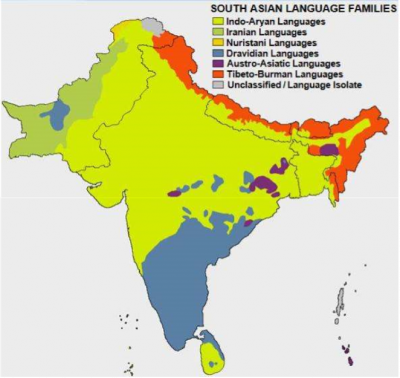
The Indus or the Harappan script is the oldest but undeciphered script in the world predating the Indo-Iranian languages, Sanskrit, and even the southern Dravidian languages. AIT proponents claim that the Aryans came (who later developed Sanskrit) and drove Harappans (speaking the Indus language) down south where the latter’s language developed into the Dravidian languages. The link between Harappan language to both north Indian and Dravidian language families remains weak even today. As Talageri says, in the absence of any recorded foreign invasions historically, the Indus or Harappan language would perhaps qualify as an ancestor to all languages used in the same region later. But that would be a deathblow to the entire edifice of the Aryan-Dravidian debate and the standard story where the Aryans forced their way into a separate Harappan culture with a different language.
The north-to-south movement of Dravidians is a vital component for the AIT proponents. The resemblance of the word “palli” (village or hamlet) in Dravidian languages to the word “oli” or “vali” for name places in Maharashtra is offered as proof for the Dravidian migration from the north to the south of the Vindhyas. This is strange reasoning, according to Talageri, because if words can denote geographical migrations, then the Greek place name suffix “polis” (Persepolis, Heliopolis, Annapolis) can also derive from the same word “palli” implying even a westward migration of the Greeks from a Dravidian area to Greece!
For the Aryan theorists, Brahui, a surprising Dravidian language spoken in parts of Baluchistan, becomes a Harappan relic and proof that the Harappan language was Dravidian. They explain this as some “pastoralists” staying back while a majority “urbanites” moved south. These speculative ideas are contradictory because it was the Aryans who were clearly the wandering pastoralists. This also becomes strange because the Rig Veda they composed is the output of rather well-fed priests in a prosperous urban community according to scholars, says Shrikant Talageri. Brahui, however, clearly is a recent import into the region, going back no more than 1,000 years. Linguistic pockets prove nothing without a historical perspective: the presence of an Anglo-Indian community in the Nilgiris of Tamil Nadu does not indicate that Tamil Nadu’s earliest language was English!
In the next section, we will consider the evidence from archeoastronomy and genetics in settling the Aryan debate. Archeoastronomy is an important field to date our scriptures. Our scriptures characteristically do not give exact dates of their composition but many times give the exact positions of the stars and planets during the various events described. That gives enough clues to chronological dating of the scriptures. It is a simple Occam’s razor principle to assume that the poets described the positions of the stars as they observed and not as when they may have existed in the distant past! Genetics is of course the new superstar.
PART 2
FIRST PUBLISHED IN INDIAFACTS
In Part I, we summarized the variety of evidence against the Aryan Invasion/ Migration Theories. In this section, we shall consider the evidence from archeoastronomy which takes our scriptures many millennia back. Though the exact dating differ according to various interpretations the common feature is that our scriptures based on Vedas go far back in time — much before the arrival of the Aryans in 1500 BCE. The study of genetics is the latest straw for the Aryan proponents to clutch at, which seems to have settled the debate in favor of the Aryans. However, this evidence remains contradictory and ambiguous. The problem is not the science, but the people using it to support their ideologically-inspired theories.
Archeoastronomy
Archeoastronomy, the study of astronomy in ancient cultures, uses the precession of equinoxes (a spin-top motion of the earth’s axis shifting by 1° in about 72 years, taking 25,800 years for a full rotation). For over 200 years, scholars have used this “clock” to date astronomical configurations in ancient Indian texts. Texts like the Rig Veda, Ramayana, Mahabharata, and the Vedanga Jyotisha have recorded the positions of stars and planets with amazing precision. The data provided is extremely useful to date our scriptures.
Bal Gangadhar Tilak dated the Rig Veda to between 4500 and 3500 BCE. The data from Yajur Veda (using the moon’s path) and the Shatapatha Brahmana points to a 2400–2900 BCE range. India’s oldest text of astronomy, the Vedanga Jyotisha records summer and winter solstices in the middle of the nakshatra Ashlesha (in Hydrae) and the beginning of Dhanishtha (in Delphinus): this points to about the 1400 BCE time-period, says Subhash Kak.
Many Indian scholars estimate the Mahabharata epic to be at least a third millennium BCE product (Nilesh Oak claims 5561 BCE for the Mahabharata war). By itself, extremely conservative estimates of the antiquity based on astronomical descriptions in Indian scriptures makes the Aryan timeline and Vedic texts between 1500 BCE and 1200 BCE untenable. The counter-arguments either dismiss these precise, consistent, and detailed references as meaningless, or suggest that the Vedic texts somehow preserved the memory of more ancient astronomical events. But it looks extremely implausible that the authors of the texts while writing chose to precisely locate the position of the stars and planets as recorded in the past. It would be rather that they observed the positions at the time of writing. Such an implausibility of describing past positions of stars in contemporary texts does not deter the Aryan proponents however.
Bioanthropology
AIT/AMT proponents dangerously mix race and language in their speculative exercise, which sadly refuses to go away completely. In 1892, French archaeologist Salomon Reinach thought an Aryan race existing three thousand years ago as a “gratuitous” hypothesis. Yet, in India, colonial ethnology divided “native” populations into imaginary “races” (forty-three of them by H.H. Risley for the 1901 Census). Tribals and some “low castes” were the “aboriginals” while the “higher castes” became members of the Aryan race.
In the 20th century, especially after World War II, bioanthropology rejected all such racial classifications. Anthropologists firmly established that the term “race” as generally applied to humans is scientifically without justification. Anthropology now acknowledges that anatomical type, language, and culture do not have necessarily the same fates; one may vary as the other two remain constant. The assumption that a certain blood related people or a certain cultural group must have carried Aryan language throughout history is purely arbitrary. Anthropologists remain unable to support any of the theories concerning an Aryan biological or demographic entity. The colonial concepts of “Adivasi” (original inhabitant), “Aryan race,” and “Dravidian race,” are rooted in discredited 19th-century race theories and have no scientific basis. There are Dravidian languages and a tradition but not a Dravidian race.
Aryans and Dravidians; Tamilians and the Rest
The Dravidian Movement, initiated by EV Ramaswamy Naicker, takes the help of this Aryan hypothesis to turn most North Indians and Brahmins into descendants of the invading Aryans, and asserting that Tamils are members of the indigenous Dravidian race that have claimed India home for a longer period of time than the so-called Aryans. However, all the evidence from archaeology, epigraphy (study of inscriptions), numismatics (study of coins), and literature (the Sangam literature) proves otherwise. Danino (Vedic Roots of Early Tamil Culture) makes a compelling argument to show the organic syncretism of Tamil sub-culture with other cultures of India completely rejecting the great “Aryan-Dravidian” mythical fight.
According to Danino, archaeological studies have so far fixed the emergence of urban civilization in Tamil Nadu two and a half millennia after the appearance of Indus cities. Inscriptions, coins, and literature suggest the establishment of the earliest Tamil kingdoms around the fourth century BCE, and urban developments a century or two later. Excavations clearly shows a cultural connection between the people of the South and the North with regards to many beliefs and practices, especially the cult of the dead and the ancestors. The Pandya era coins show extensive evidence of Vedic sacrifices and Vedic-Puranic symbols related to Vishnu and Shiva both.
Surprisingly, as scholars have repeatedly pointed out, the rich Sangam literature (300 BCE to 300 CE) show not only extensive references to Vedic sacrifices but a complete absence of any mention of a great clash between Aryans and Dravidians. Scholars have shown by innumerable examples that knowledge of Sanskrit literature from the Vedic period to the Classical period is essential to appreciate Tamil literature. Vedic and Puranic themes inextricably weave into the most ancient culture of the Tamil land known to us. Tamil language has assimilated and uses between 20-40 percent of the commonly used vocabulary from Sanskrit.
As Joshi and Harshavardhana have argued in one paper, there are no references to the word “Dravida” in Tolkappiyam –– the oldest surviving work on Tamil grammar, literature, and linguistics. The first use of “Dravida” in Tamil is by the sage Tayumanvar in the 18th century. In the Vedic-Puranic-Itihaasic literature, “Arya” denoted a noble person, and “Dravida” was a purely geographical marker. As one scholar shows, “Dravida” is not of Tamil origin at all because Tamil grammar neither provides for a word beginning with a sonant (hence cannot begin with d) nor with a half-syllable. The word has most likely Prakrit or Sanskrit roots.
Leet us paraphrase Michel Danino here: The historical period of the great Pallava, Chola, and Pandya temples and overflowing devotional literature by the Alwars, the Nayanmars, and other seekers show a clear integration of Vedic-Sanskritic elements into Tamil. Without conflict, there was every sign of a deep cultural interaction between North and South. In reverse, the genius of Tamil land has contributed extensively by way of temple architecture, music, dance, and literature to the North and other South Asian countries too. “Dravidian” has a meaning either in the old geographical sense or in the modern linguistic sense; racial and cultural meanings are unscientific and irrational and are simply a manifestation of a colonial mindset. Every region of India has developed according to its own genius, creating its own bent, but while remaining faithful to the central Indian spirit.
Genetics – The Latest Superstar but with Contradictions
Tony Joseph, a journalist, wrote an influential book, titled, “Early Indians: The Story of Our Ancestors and Where We Came From“. Joseph, relying on papers in genetics, argues that in essence everyone in India are migrants and foreigners. The indigenous Hindus are apparently as foreign to the land as the Muslims and Christians who came much later. This controversial claim, repeated ad nauseum by AIT/AMT proponents, led to a new round of debate among both geneticists and non-geneticists alike.
Talageri, in a book-length rebuttal, titled, “Genetics and the Aryan debate: ‘Early Indians’ — Tony Joseph’s Latest Assault,” showed how selective and faulty Joseph’s data and arguments were. The following section on genetics summarizes the main arguments of Talageri against Joseph’s much-reviewed book.
Genetics has contributed immensely in tracing ancestries and migrations of humans across geographical locations. Thousands of genes interacting complexly with the environment determines traits and human behavior. Language and culture are components of evolution mechanisms independent of genetics, as Eva Jablonka and Marion Lamb (Evolution in Four Dimensions) say. However, a study of the genes themselves to predict linguistic and cultural movements is tricky science.
Recent genetic research based on hundreds of skeletons has now become the latest crutch for Aryan proponents as other disciplines are posing problems. Archaeogenetics (genetics of ancient populations) broadly studies the Y-DNA (transmitted from father to son) and mtDNA (mitochondrial DNA transmitted by the mother alone). However, genetics cannot define “races,” but only “haplogroups” of people who have common sets of genetic mutations. It can measure the genetic proximity or distance between ethnic groups.
However, Indian populations with the greatest genetic diversity after Africa are complex. Multiple studies confirm the genetic proximity between linguistic affiliations (Indo-European, Dravidian); castes of North and South India; and between castes and tribes. Language families present today in India are all much younger than the majority of indigenous mtDNA lineages found among their present-day speakers. Studies have ruled out a major addition to the Indian gene pool in the second millennium BCE and a genetic continuum between the Harappans and the present-day people of the region (Haryanvis, Punjabis, Rajasthanis, Sindhis, and Gujaratis). All these run against the Aryan invasion scenario.
Genetic Claims for AIT
The Aryan proponents use the genetic evidence to make two claims: first, between 2000-1000 BCE, multiple waves of pastoralists migrated from Central to South Asia; and second, they brought Indo-European languages and religious practices into an existing civilization changing its pattern without any force. A much-quoted influential genetics paper in (2009) stated that the “Indian people today are a mixture of two highly differentiated populations, the ANI and the ASI (ANI — Ancestral North Indians; ASI — Ancestral South Indians)”. A new paper (2018) rectified some positions to classify the three major genetic groups migrating into India at three different time periods:
- 65,000 years BP (Before Present) — 7000 BCE: The First Indians migrated from Africa to South Asia and were the exclusive inhabitants.
- 7000 BCE — 4700 BCE: Zagros/Iranian agriculturalists migrated to South Asia from the Zagros area of Iran. Their mixing with the First Indians produced the Harappans and Harappan Civilization.
- 2000 BCE — 1000 BCE: Steppe pastoralists migrated to South Asia from the Steppes and mingled with the Harappans.
ANI (Ancestral North Indians) are a mixture of the above three groups. The ASI (Ancestral South Indians) are a combination of the First Indians of the South and the Harappans (First Indians of the North + Zagros/Iranian Agriculturalists) who migrated from the North. Present day India is finally a combination of the ANI and the ASI in varying proportions in different areas and communities. Confusingly, the First Indians get the term AASI — Ancient Ancestral South Indians. Certainly, a churning.
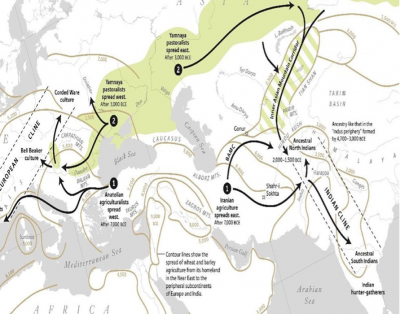
Image: Migrations hypothesized on Genetic Studies
Is the Genetic Evidence Relevant to Negate the OIT (Out of India Theory)?
Language and culture spread can be independent from the spread of genes and DNA. The “elite dominance” model for language spread explains India’s good English completely without invoking “common genes” for language, interbreeding, or genetic transfer. The “elite dominance” model may explain the New Rigvedic elements in the Mittani culture and the Avestan culture of the Zoroastrians without the passing of the First Indians’ genes. The chronological and geographical data of the Vedas and the Mittani documents show presence of Indo-European languages already in India much before 3000 BCE.
OIT migration is a strong possibility based on internal evidence from the Vedic texts and archaeological documents themselves. The roots of Greek, Latin, Celt, Teuton, and Slavonian are in the Rig Veda, but not in the Avesta. The lack of the First Indian ancestry in the DNA of Indo-European speakers outside is no argument against OIT theory. Finally, genetic evidence is irrelevant in the debate despite its importance, says Talageri. When claims contradict recorded history and disciplines like archaeology and linguistics, then it is only scientific to reject those claims. Especially when there are models to show that linguistic spread is independent of simultaneous genetic spread. Steppe migrants may have contributed their genome to a common pool but they did not bring the languages and the Vedas. This story without a ripple in the archaeological record and without any memory or references of older places in the texts is implausible.
Obfuscations, Lies, Cherry-Picking, Selective Interpretations, and Tortuous Speculations
Political agendas seek a distinct North and a distinct South with separate languages and cultures. Today, the native “Dravidians” take up cudgels against the Aryan Brahmins and the Aryan North. The terminology, mixing of scenarios, and conclusions are confusing and based on thin evidence. ANI and ASI suggestively depict the north and the south even when geneticists say that they are inaccurate.
Three samples in the Indus periphery area represent the entire Harappan population in the study the AIT proponents take refuge under. The genetic composition of India is constantly changing but these proponents keenly freeze the time when all the Indo-Aryan speaking people in North India have First Indians, Zagros/Iranian, and Steppe pastoralist ancestry and all the Dravidian-speaking people have First Indians and Zagros ancestry. It is impossible that such a rigid and clear North and South genetically separated groups ever existed as there is no DNA evidence from all parts of India at one past point in time.
All the terminology obfuscations, cherry picking, and erroneous interpretations conclude that Steppe DNA entered India in the period between 2000-1000 BCE. That these migrations brought the languages and culture hangs deeply on the position of the linguists and Indologists that the Rig Veda can be also dated between 2000-1000 BCE, allegedly brought by the invading Aryans. Circular reasoning cannot get better.
The Indo-Iranian Paradigm and the R1a1 Haplotype
Linguists propose that Indo-Iranians migrated from the Russian Steppes to Central Asia and then, splitting into two, migrated into the Saptasindhu and Afghanistan-Iran areas, sharing a common “Indo-Iranian” culture and the two closely related texts – the Rig Veda and the Avesta. R1a1 haplotype is supposedly a genetic signature prevalent in Indo-European language speaking countries. AIT proponents claim Steppe DNA and R1a1 injection into local populations and tribals by Aryan custodians of the Sanskrit language — the upper castes and the Brahmins.
However, R1a1 haplotype distributions show a mismatch between speculated migratory routes and actual data. West Iran, at one end of the split, shows a dismal 3%- 4% haplotype presence. At the other end, it is 26% in Chenchu tribals, and 50% in Manipur (East India). The 20% R1a1 haplotype in central and eastern Iran is grossly less than the Dravidian tribes of South India. This haplotype increases further west of Iran: 43% (Semitic Shammar tribes of Kuwait), and 52% (Ashkenazi Levites in Israel). Hence, the IE languages spread and the genetic spread are independent; at best, they are only weakly correlated.
Aryans and Caste System — New Theories and Old Associations
Quoting from a 2013 genetics paper, one author claims that from 2200 BCE to 100 CE, there was an extensive mixing of the genomic pool with the result that almost all Indians become a mixture of the First Indian, Harappan, and Steppe ancestries in varying degrees. Around 100 CE, a new ideology by the “wily Brahmins” shackled Indian society through the caste system, engineering society on a massive scale. This suddenly “downed the shutters” on intermixing. The proof allegedly comes from the Ra1a haplotype in higher prevalence among the North Indians, upper castes, and Brahmins than in South Indians, lower castes, and scheduled tribes. These conclusions are problematic.
Talageri argues against this. Firstly, never in the history, especially since 100 CE, there was an all controlling authoritative regime which could implement a wildly successful social engineering program. Secondly, it is incredulous that after free intermixing for two millennia, suddenly the Brahmins could differentiate between Aryan and non-Aryan brethren to start the caste system. Thirdly, if Aryans are not co-terminus with the caste system which came after 2,000 years in 100 CE, then how are they still associated? The caste system would be more a result of contemporary factors of that era (invasions by Greeks, Persians, or Scythians; and new western ideas due to contacts with the first Christians or the Imperial Romans). Further, intermixing of all jatis — ethnic, religious, occupational, and nationality groups has been going on all along from time immemorial to the present day. It is unbelievable that we can discover and identify 100 CE as when suddenly a special group started/invented the “caste system”.
North India has a higher proportion of this gene as many studies show and the decreasing proportion of this R1a1 haplotype as one move from North to South could be a natural effect of migrations. A higher movement of Brahmins towards South may explain the higher proportion, but the reasons are geographical rather than Aryanism. Contradictorily, the R1a1 gene is found in higher proportions in many non-Brahmin castes of the North and West than Brahmins of the same area: Khatri (67%), Ahir (63%), Gujarat Lohana (60%). Even Ror, Jat, and Pathan communities show higher percentages. In a highly mixed state of communities for 4,000 years, extracting exact numbers for various communities from a few random samples and then constructing a story on the origin and propagation of the caste system is a dubious and a politically mischievous exercise.
The “Out of India” Migration – Broadly Speaking
The OIT proponents, agreeing with the Aryan theorists, say that Indian culture is not identical with Sanskrit or Vedic culture. The Rig Veda is a text of the Bharata sub-tribe of the Puru people in Haryana and Uttar Pradesh regions, Talageri insists. The Anu and Druhyu tribes, to the north-west of Puru, was the homeland from where the other eleven IE branches spread to other parts of the world. There were IE speakers in the east (Iksvaku) and south (Yadu and Turvasa/Turvasu) of Puru too. Apart from this, there were non-IE language families: Dravidian in the south; Austric further east; and Burushaski in the far north.
As Talageri says, “Indian culture is a melting pot of six language families (Indo-European, Dravidian, Austric, Sino-Tibetan, Burushaski, and Andamanese). The original Puru element of Hinduism may have gained prominence due to political power, but over millennia, the unique Indian cultural unit has been a rich and complicated mixture of many elements. It is unfortunate, and even dangerous, to try and separate the individual elements”. He points out that Indic culture and “Hinduism” are amorphous mixtures of Vedic/Sanskritic culture, the Sangam culture of the south, and the rich ethnic (mainly tribal) strands of culture. The various disciplines clearly favor OIT but the AIT theorists have too much at stake, and have invested in their thesis too long to accept this.
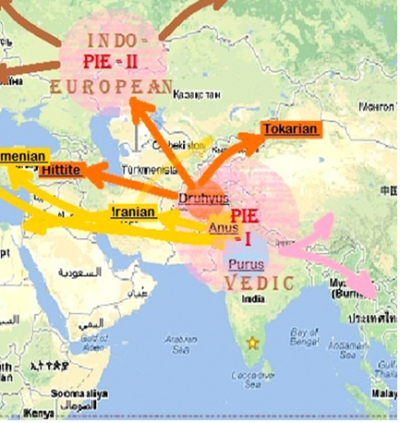
Image: The “Out of India” proposal by Shrikant Talageri
OIT Versus AIT/AMT
Michel Danino, in an incisive article (The Death of Debate), shows how strong were the debating traditions of India. One Buddhist scholar tells a king who wanted to debate with the former that the debate should be as a scholar and not as a king. A debate as a scholar does not make one angry at a loss but a debate against a king where the king loses could invite punishment. Thus, a debate as a king is just power play. This is exactly what is happening in the present debates on the Aryan theory. It is only power structures and a hegemonical narrative which refuses to listen to opposing views.
The AIT/AMT proponents are keen to label anyone proposing an alternative view by unflattering labels such as “Hindu nationalist” or “champions of Hindutva”. The same applies to the OIT camp too who, without a proper understanding of the debate, blindly call the opposing camp as “Marxist fundamentalists,” and so on. This labelling does not make for a proper debate. Danino quotes Laurie Patton and Edwin Bryant in the introduction to their book (The Indo-Aryan Controversy) who write that there has been “very little conversation between the opponents, [but] great opportunity for creating straw men on both sides”.
Danino writes:
One disturbing aspect of the acrimonious exchanges has been the notion that those who reject the theory of an Aryan paradigm are perforce pro-Hindutva activists or their western supporters. Endlessly relayed by a controversy-hungry media, it has concealed the fact that the staunchest opponents of the theory have often been respected by mainstream western academics. The British anthropologist Edmund Leach, the US bioanthropologist Kenneth AR Kennedy, the French archaeologist Jean-Paul Demoule, the US archaeologist Jim Shaffer, the Canadian historian Klaus Klostermaier, the Greek Sanskritist Nicholas Kazanas, the Italian linguist Angela Marcantonio, the Estonian biologist Toomas Kivisild, among others, have challenged the Aryan scenario in its Indian or Eurasian ramifications. However, none of the Indian historians still promoting it (from a “hard” version of an aggressive invasion to a “softer” one of a peaceful migration of small numbers) ever discusses these distinguished objectors; were they to do so, the convenient media-friendly story that communal-minded fanatics alone contest the dominant view would be unmaintainable.
Conclusions
AIT proponents counter the opposing evidence by accusing OIT proponents of being super-sensitive to the idea of foreign arrivals into India and an unjustifiable belief in an originally “pure” Indic civilization. Invasions and migrations do constantly shape the world but the difference in the Indian context is its political use to divide the nation. Unlike the recorded history of migrations and invasions in places like America and Africa, Indo-European language arrivals are based on speculation, hypotheses, and theories in various fields.
AIT proponents use selective evidence and convenient interpretations to deny the civilizational roots of the country. A Hindu claiming to be an original native of the country has the whole world of AIT proponents coming down on him trying to prove that he is a foreigner. Ironically, two diverse groups support the AIT: some class of Brahmins to prove their own superiority; and equally strong “anti-Brahmin ideologues” like the Dravidians, left-Marxists, neo-Dalit groups, and politically motivated intellectuals.
Aryans arriving from the Russian Steppes starting after 3000 BCE, reaching India within thousand years, and then composing the most pristine Vedas within less than one thousand years suggests an incredulously “speeding” of history and not “spreading” of Aryans. At the heart of all AIT arguments is the injection of a foreign, non-existent Aryan into an existing culture seeking to discount the continuity and the existence of the longest civilizational community. The Aryan theory has been responsible for increasingly vicious narratives on race and caste, seeking to divide the North and the South.
One scholar says it is amazing that European scientists were convinced for a long time about an Aryan race despite there being no biological criteria that would characterise the Aryans. Martin Farek shows elegantly how Enlightenment theories (progress of civilization from a primitive society to its supposed culmination, represented by the Western world) and Darwin’s evolutionary theories (spinning of racial ideas) played a crucial role in the Aryan debate and the subsequent speculations of the caste-system in India. Selective bits of Vedic corpus texts supported their preconceived theories and ad hoc adjustments explained away uncomfortable archaeological findings, but the basic idea of invading Aryans remains consistent. The core hypothesis of the invading Aryans stays intact even as adjustments happen with any new findings related to the field. One such adjustment, on the discovery of the Dravidian Brahui language in the North, involves even the mysterious Dravidian race invading from the South and destroying Harappan culture!
Indic civilization is a millennia old, unbroken continuity. The evidence is more in favor of a Vedic civilization continuing into the Harappan and the later post-Harappan eras too. India is an amorphous and homogenous mix of different sub-cultures and different traditions. Everyone of this land is a part and inheritor of this great culture irrespective of what tradition they may be following. Instead of accepting our common and great civilizational past, the Aryan proponents are keen to show that the Brahmins (especially), Kshatriyas, and Vysyas are foreigners and that they are perennially exploiting the Shudras (and the recently added Dalits).
Scholars in various disciplines, based on evidence, are now questioning the AIT/AMT. Problematically, the AIT has constructed a super edifice over decades, and if the foundational base collapses, the entire building comes down. Therefore, there is a huge resistance to discard the theory. Genetics offers a ray of hope to the AIT/AMT proponents who hope to use the findings to silence their critics. Genetics, an important science, clearly shows migrations across the world, but it should not contradict other established findings. It is only proper science that if experiments/theories do not match the data, the theories and experiments need to be rejected and not the data! Unfortunately, in the application of genetics, there is ignoring of the archaeological, linguistic, and textual data itself.
Lavanya Vemsani uses the results from genetic studies to argue that India is the original homeland with migrations to Australia and South-East Asia. Chavda and Priyadarshi have pointed in detail the many flaws to the original genetics paper on which the Aryan proponents seek to build their case. Alas, selective and convenient application of archaeological and genetic findings, torturing Vedic texts to find racially themed discourses on Aryans and Dravidians, selective linguistic analyses, closed circle of academic scholarships disallowing alternative voices, ad-hominem attacks, and prominent power positions have all helped in perpetuating the AIT/AMT propositions.
Talageri feels that the textual Rigvedic chronology is strong enough independently to establish an “out of India” migration. Archaeology offers solid support in rejecting AIT/AMT and even supporting an OIT scenario. Michel Danino (The Lost River) and Koenraad Elst (Still No Trace of an Aryan Invasion) offer extensive evidence challenging AIT/AMT. Marianne Keppens (Western Foundations of the Caste System) devotes a full chapter on the Aryan linkage to the caste system and concludes that these claims, propagated by political activists, are faulty and bogus. Unfortunately, the discussion has become one-sided and is closed to any modification/changes.
Some Aryan proponents, late in the 20th century, in the face of overwhelming lack of archaeological evidence, made an invasion into a “slow wave like migration”. Michael Witzel (2001) proposes something even more radical: a “trickle-in by just one Afghan Indo-Aryan tribe that did not return to the highland”! Large-scale invasion is undetected in archaeology, bioanthropology, and genetics. The migrations and “trickle ins” overcome this obstacle but can such small-scale influences overturn the subcontinent’s cultural and linguistic landscape so radically even when substantial invasions by Persians, Greeks, Scythians, Kushanas, and Huns could not affect such a change?
British anthropologist Edmund Leach (1989) sums it all up: “Even today, the Aryan invasions of the second millennium BC are still treated as if they were an established fact of history. Why do serious scholars persist in believing in the Aryan invasions? Why has the development of early Sanskrit come to be so dogmatically associated with an Aryan invasion? The details of this theory fit in with racist framework. The origin myth of British colonial imperialism helped the elite administrators to see themselves as bringing ‘pure’ civilization to a country in which civilization of the most sophisticated (but ‘morally corrupt’) kind was already nearly 6,000 years old. The Aryan invasions never happened at all. Of course, no one is going to believe that”.
The evidence for Aryan invasion or migration is weak from literary, archaeological, anthropological, or genetic disciplines. The persistent conflation between race, language, and culture is misleading and dangerous. Political uses of the Aryan scenario are wholly illegitimate and unnecessarily divisive; they are an extension of the colonial agenda. Can we change the story to a better one based on proper evidence? It is of concern that both Western, as well as Indian scholars, have not discarded the noxious Aryan theory despite the lack of evidence as well as the damage the theory has inflicted on the social fabric of India.
Selected Works and Further Reading
- Malhotra, R., & Neelakandan, A. (2012). Breaking India: Western Interventions in Dravidian and Dalit Faultlines. Princeton: Infinity Foundation.
- Danino, M. (2012). The Problem of Indian History. Dialogue, 13:4, https://www.academia.edu/29567478/The_Problem_of_Indian_History
- Farek, M. (2021). India In The Eyes of Europeans: Conceptualization of Religion in Theology and Oriental Studies. Karolinum Press.
- Danino, M. (2010). The Lost River: On the Trail of The Sarasvati. New Delhi: Penguin.
- Talageri, S. (2004). The Rigveda: A Historical Analysis. Delhi: Aditya Prakashan.
- Talageri, S. (2008). Rigveda and the Avesta: The Final Evidence. Delhi: Aditya Prakashan.
- Talageri, S. (2019). Genetics and the Aryan debate: “Early Indians” Tony Joseph’s Latest Assault. New Delhi: Voice of India.
- Elst, K. (2018). Still No Trace of an Aryan Invasion: A Collection on Indo-European Origins. New Delhi: Aryan Books International.
- Keppens, M. (2017). The Aryans and the Ancient System of Caste (in Western Foundations of the Caste System, edited by Martin Fárek, Dunkin Jalki, Sufiya Pathan, Prakash Shah). London: Palgrave Macmillan.
- Danino, M (2001/2009). “Vedic Roots of Early Tamil Culture,” in Saundaryashri: Studies of Indian History, Archaelogy, Literature and Philosophy. New Delhi: Sharada Publishing House. https://www.academia.edu/1573411/Vedic_Roots_of_Early_Tamil_Culture:
- Danino, M. (2006). “The Horse and The Aryan Debate,” (https://www.researchgate.net/publication/237413669_THE_HORSE_AND_THE_ARYAN_DEBATE)
- Clackson, J. (2013) “The Origins of the Indic Languages: the Indo-European model,” in Angela Marcantonio and
Girish Nath Jha (eds.) Perspectives on the Origin of Indian civilization. New Delhi: D. K. Printworld. https://www.academia.edu/9452122/_The_Origins_of_the_Indic_Languages_the_Indo-European_model_in_Angela_Marcantonio_and_Girish_Nath_Jha_eds._Perspectives_on_the
_origin_of_Indian_civilization_New_Delhi_259-287 - Kak, S. (1998). “The Sun’s Orbit in the Brahmanas,” Indian Journal of History of Science, 33:3, https://www.ece.lsu.edu/kak/skak1998.pdf
- Land of Dharma: Studies in Tamil Civilization Proceedings from the Swadeshi Indology Conference (2021). Series edited by Shrinivas Tilak et al. Princeton: Infinity Foundation.
- Joshi, R., & Harshavardhana, Y. (2021). Dravidianism with Language Equaling Race — The Third Wheel in Tamil-Sanskrit Interactions (In Land of Dharma: Proceedings from the Swadeshi Indology Series). Princeton: Infinity Foundation.
- https://www.youtube.com/watch?v=RT4pUJMDV2Y. A series of lectures on the Aryan issue. Michel Danino’s series of lectures at Amrutha Institute is a wonderful resource to get the perspective of Out of India Theory and how the Aryans appear tenuous.
- Danino, M. (2017). “The Death Of Debate,” Pragyata, https://pragyata.com/death-of-debate/
- Adluri, V. & Bagchee, J. (2014). The Nay Science. London: Oxford University Press.
- Vemsani, L. “Genetic Evidence of Early Human Migrations in the Indian Ocean Region Disproves Aryan Migration/Invasion Theories: An Examination of Small-statured Human Groups of the Indian Ocean Region,” https://www.academia.edu/7893126/Genetic_Evidence_of_Early_Human_Migrations_in_the_Indian_Ocean_Region_Disproves_Aryan_Migration_Invasion_Theories
- Chavda, A.L. (2017). “Propagandizing the Aryan Invasion Debate: A Rebuttal to Tony Joseph,” India Facts, https://indiafacts.org/propagandizing-aryan-invasion-debate-rebuttal-tony-joseph/
- Elst, K. (2017). “Genetics and the Aryan Invasion Debate,” Pragyata, https://www.academia.edu/34215125/Genetics_and_the_Aryan_invasion_debate
- Priyadarsh, P. (2018). The Aryan Invasion Issues. https://aryaninvasionmyth.wordpress.com/2018/08/27/la-genetique-scandale/
 RANDOM MUSINGS