1. Indian philosophical systems give a far better explanation of life, the world around us, and God better than the majority of western philosophies.
2. Indian philosophies were pushed away by western universities into the realm of ‘religion’ because they either did not understand it or they wanted to ward off the challenge posed to them as they were potentially providing far clearer answers on the nature of reality.
3. Indian philosophies has an intense power to transform a person leading to moksha , something non-existent in western philosophies.
4. The subservience to science leads to failure in western philosophies. Indian philosophies acknowledge science without the so called clash between ‘religion’ and ‘science’ of the western world. But it does not let scientific achievements come in the way of its ideas.
5. Our successive governments have failed completely to remove this colonial narrative that Indian philosophies are religious, esoteric and thus non secular and non scientific. It is is the greatest tragedy of post independent India.
6. Indian philosophies have no need either of science or even God in its explanation of reality or the world around us.
7. Drawing heavily from various authors, especially Chittaranjan Naik and without claiming any primary scholarship, here is a 5 part series summarising the essentials of Indian philosophies and how different and perhaps even better they are from Western philosophies.
I hope you enjoy them. I would like you to share them too in your circles if possible so that some awareness can be created regarding the richness, depth , and the sheer profundity of Indian philosophies or Darshanas.
FIRST PUBLISHED IN PRAGYATA ONLINE MAGAZINE AS A 5-PART SERIES
Philosophical Systems Of India – A Primer – Part 1
Philosophical Systems Of India – A Primer – Part 2
Philosophical Systems Of India – A Primer – Part 3
Philosophical Systems Of India – A Primer – Part 4
Philosophical Systems Of India – A Primer – Part 5
PART 1
Philosophy in India has been the intellectual canaliser of spiritual knowledge and experience, but the philosophical intellect has not as yet decidedly begun the work of new creation; it has been rather busy with the restatement of its past gains than with any new statement which would visibly and rapidly enlarge the boundaries of its thought and aspiration. The contact of European philosophy has not been fruitful of any creative reaction; first, because the past philosophies of Europe have very little that could be of any utility in this direction, nothing of the first importance in fact which India has not already stated in forms better suited to her own spiritual temper and genius, and though the thought of Nietzsche, of Bergson and of James has recently touched more vitally just a few minds here and there, their drift is much too externally pragmatic and vitalistic to be genuinely assimilable by the Indian spirit. But, principally, a real Indian philosophy can only be evolved out of spiritual experience and as the fruit of the spiritual seeking which all the religious movements of the past century have helped to generalise. It cannot spring, as in Europe, out of the critical intellect solely or as the fruit of scientific thought and knowledge. SRI AUROBINDO
INTRODUCTION
This 5-part series aims to introduce the ideas of the great Indian philosophical systems to the uninitiated. The author claims no expertise or primary scholarship in the subject matter but attempts to disseminate some of the readings he has had in a summary form to some of the curious but ignorant. The books of Ramakrishna Puligandla (Fundamentals of Indian Philosophy), Karl Potter (Presuppositions of Indian Philosophies) and Chittaranjan Naik (Natural Realism and the Contact Theory of Perception) form the core basis of these essays. Hopefully, this should stimulate the readers to explore further and understand how rich and brilliant the Indian systems are and how they significantly compare and contrast with western philosophies in dealing with basic existential questions.
A strictly materialistic or ‘scientific’ view of the process of perception has caused deep troubles for the western philosophical world to date. Indian thinkers and philosophers had a different and perhaps a better understanding of the process of perception which they covered in their treatises almost a thousand years back. It is the most unfortunate debacle of our education systems after independence, a continuation of the colonial legacy, that they ignored teaching the growing generations the richness, depth, antiquity, and sophistication of Indian philosophy.
Philosophy deals with the most engaging questions for humanity: the purpose of life and Universe; reality status of the world; the presence and role of God; the matter-mind relation; and so on. Philosophers equate philosophy with only western thought which, in turn, is either ignorant or dismissive of Indian thought. This is surprising, because any person, irrespective of time and place, can have philosophical insights applicable to the whole of humanity. Thinking about some basic questions concerning humans cannot be the sole prerogative of a narrow group of people (mainly the White Europeans of the West) looking only through certain lenses (either Christian theological or its social sciences which is many times a secularized theology) developed in their cultural milieu.
The West puts philosophy between theology and science. As Bertrand Russell (1872-1970) says (History of Western Philosophy), like theology, it speculates on matters of indefinite knowledge; like science, it appeals to human reason rather than to the authority of a tradition. The separation of theology and philosophy did not happen in Europe until the Reformation (16th century CE). When we accuse Indian philosophy of being ‘religion,’ it is an application of a post-Reformation prejudice (religion – a matter of faith; philosophy – for self-reflection or critique but nothing about God or the soul). Hegel (1770-1831), the German philosopher originated this prejudice and largely fashioned the Western image of India. As Adluri and Bagchee say (The Nay Science), the standard themes were: India only developed an abstract Absolute; it lacks a historical sense; it does not know of concrete individuality; and so on. Once Hegel sent Indian systems to departments of Religion and Indology, Philosophy never reclaimed it.
Indic philosophy has an overriding concern for its ‘soteriological’ power; an insight leading to intense individual transformation from bondage to freedom. There is no sacrifice to reason and experience, but characteristically, Indian philosophy (or Darshanas) does not have an extreme reverence for science. Indian Darshanas, unfortunately, disappeared from popular discourses because its paradigms seemed absurd to the dominant Western discourses. Additionally, western universities (especially German) aggressively pushed Indian philosophical systems as ‘religions’ and hence lacking any validity in a ‘secular’ world.
INDIC PHILOSOPHICAL SYSTEMS: BASIC FRAMEWORK AND THE ROLE OF PRAMANAS
Each of the four Vedas (Rig, Sama, Yajur, and Atharva), the earliest source of Indian thought, consist of four parts – Samhitas, Brahmanas, Aranyakas, Upanishads; the first three related to rituals and the last to philosophical speculations. They are either successive stages of Vedic literature or suggest parallel ideas. In the Brahmanas portion, ideas of monism start coming when a single supreme principle of both an immanent and transcendent power through all gods, individual souls, and nature takes hold. The Upanishidic teaching (the Vedanta portion or the ‘end of Vedas’) crystallises the notion of absolute monism which calls the Brahman as the all comprehensive only reality, the ultimate cosmic principle, the source and destination of the whole universe, and accounting for individual selves too as Atman.
The core classification of Indian systems as orthodox and non-orthodox is on the acceptance or rejection respectively of the Vedas as a reliable authority. The non-orthodox systems are Charvaka (materialism), Buddhism, and Jainism. The orthodox systems include the six systems called Samkhya, Yoga, Nyaya, Vaisesika, Mimansa, and Vedanta. The orthodox schools come in pairs; broadly, the first pertains to practice, the second element to theory: Yoga-Samkhya; Nyaya-Vaisesika; and Mimansa-Vedanta.
Any knowledge must have certain ‘means’ of acquiring it. Pramana (proof or a valid ‘means of true knowledge’) plays an important role in Indian philosophical traditions. Ancient texts identify six pramanas whose variable acceptance and rejection form a basis for classifying the thought systems. These are:
- Perception or direct sensory experience (pratyaksha)
- Inference (anumana)
- Testimony of reliable authorities (sabda)
- Comparison and analogy (upamana)
- Postulation and derivation from circumstances (arthapatti)
- Non-perceptive negative proof (anupalabdhi).
Materialism (Lokayata or Charvaka) holds only perception as a valid pramana; Buddhism: perception and inference; and Jainism: perception, inference, and testimony. Mimamsa and Advaita Vedanta hold all six as useful means to knowledge.
Apart from materialism, both non-orthodox and orthodox schools have certain core ideas of commonality. Most important is that explanation of reality should not sacrifice reasoning and experience. Philosophy, never a dry intellectual exercise, carries a soteriological power – the power of intense individual transformation from ignorance and bondage to freedom and wisdom. There is no original sin but original ignorance. In all systems (except Charvakism), Karma is a central doctrine of cause and effect at the levels of body, mind, and intellect. Whatever one does, it has consequences, if not in this birth, then in a future birth. Karma thus intricately links to the idea of reincarnation in all systems. Moksha, a common theme for all, is the final state of enlightenment with no further births, in stark contrast to western focus for an eternal life. Almost all Indian philosophies accept perfect happiness as a state of no further births.
The practical aspects of Yoga and meditation are acceptable routes in all systems to reach the state of liberation. All stress the inability of senses or intellect to understand reality. Reality is an intuitive, non-perceptual, and non-conceptual experience. All are initially pessimistic in that they speak of ignorance and misery, but ultimately become optimistic as they give immense hope in gaining the state of eternal happiness. All focus on individual effort, if necessary, across many births to liberate from ignorance. The role of a teacher or books is only as a guide on the path, but finally, the individual’s effort is responsible for one’s own moksha, achievable in the present life.
The goal of human life in Indic philosophies firmly remains moksha or enlightenment. The journey starts from an intellectual apprehension of this goal to finally attain moksha through various routes. This is the basic framework of Indian Darshanas. The differences mainly are in the nature of the routes taken to reach there. The multiple routes are all valid like ‘various rivers merging into one ocean.’ The distinguishing feature of the varied paths is ‘an indifference to differences’ with each taking its view as the valid one (‘I am true, but you are not false’). The concept of truth stays robust in Indian traditions. There have been debates, interactions, and assimilation of ideas from across philosophies giving a richness and diversity of thought without fear of persecution. Religious clashes of the European world based on ‘truth values’ (I am true and you are false) are almost unknown in India. ‘Philosophy is dead,’ declared scientist Stephen Hawking. In the Indic context, it is relevant perennially ending only with total human freedom.
TRADITIONAL INDIAN PHILOSOPHIES ARE DARSHANAS, NOT SPECULATIVE PHILOSOPHIES
Indian Philosophy often gets the label of ‘speculative philosophy.’ Unlike in science, wherein the scientific proposition has a criterion of physical verifiability, philosophy in the West had a different criterion. It is for this reason that philosophy earned a notoriously bad name in the early years of the twentieth century when the entire field of metaphysics became ‘nonsense.’ The attack against philosophy came from the ‘Analytical Philosophers.’ Hence, in the absence of either empirically verifiable propositions or derivation out of already defined terms, metaphysical statements became meaningless.
Since metaphysics, philosophy, ethics, religion, and aesthetics are all of this nature, the only task that remained for philosophy was that of clarification and analysis. They concluded that the propositions of philosophy are linguistic, not factual, and philosophy was a department of logic. Based on such assertions, Analytical Philosophy swept aside two millennia of lofty human thought into the dustbin of ‘emotive’ thinking. Western philosophy had failed to provide a sound basis for epistemology (theory of knowledge) and it became a complex maze of verbiage that ultimately led to the discrediting of everything metaphysical and of philosophy herself, says Chittaranjan Naik (Apaurusheyatva of the Vedas).
In traditional Indian Philosophy, assertions about the objects of the world ground either in perception or in inference. Hence, there is no scope for these assertions to stray into speculative thought. If they do stray, it is only due to the incorrect application of the pramanas and not due to the nature of the philosophy itself. And when it comes to assertions about things that lie beyond the range of the senses, the assertions ground in Scriptural sentences (Shabda) and in inferences that depend entirely on these scriptural sentences. If they do stray here too, it is again due to an incorrect understanding of the scriptural sentences or the inferences drawn from them. There is a lot of misconception about Indian Philosophy that comes from modern authors, both Indian as well as Western.
Traditional Indian Darshanas are not something derived from basic principles to finally arrive at a conclusion. As Naik says: A Darshana is a Single Vision in which all its elements including epistemology, ontology, metaphysics, the practice, and the fruits of sadhana are like various organs that form a single integral whole. Each of the traditional philosophies or Darshanas is eternal and is part of the Vedic structure. That is why they constitute one of the fourteen branches of learning (vidhyasthanas) known as Chaturdasa Vidyas. ‘Darshana’ strictly is not synonymous with ‘philosophy.’ However, to avoid confusion and when seen as intellectual activity contemplating the world around us, one can broadly consider them as equivalent terms.
NON-VEDIC SCHOOLS
Charvakism or Lokayata: Materialism
Sage Charvak’s ancient Indian tradition, pre-Buddhist and post-Upanishadic, are known mainly from its criticism in later works. For a materialist, only pratyaksha (perception) is the single valid criteria for knowledge. The major criticism against materialism is that despite rejecting inference, implying rejecting generalizations, their own practice in dealing with the world (a generalization that ‘perception and only perception’ is reliable) contradicts that stand. For them, God, souls, heaven, hell, and immortality are non-existent. Matter is the only reality and the world forms by a combination of primordial elements- earth, air, fire, and water; it rejects akasa (ether) as an element. Consciousness is secondary to matter. Nature is enough to explain creation, sustenance, and destruction. Death is the final annihilation with no further births. Of the four Purusharthas, the ends of human life – dharma (right conduct in the broadest sense), artha (wealth), kama (desire), and moksha (liberation), only the pursuit of pleasure and enjoyment of possessions remain sensible ends to life.
Importantly, Charvakism or Lokayata is not the crude hedonism we tend to associate with the materialists. There were certain ethics in that pleasure should not be at the cost of pain and misery. It was also altruistic. They recognized the need for society, law, and order and certainly did not advocate an anarchic society based on an unbridled catering to the senses. The philosophy tempered with self-discipline, intelligence, refined taste, and a genuine capacity for friendship, says Ramakrishna Puligundla (Fundamentals of Indian Philosophy). Amazingly, in Indian society, Charvaks since antiquity had no issues of persecution by the non-Charvaks of any kind.
Jainism
Prince Vardhaman (540 BCE- 468 BCE), twenty-fourth in the line of perfect souls (Tirthamkaras), popularised Jainism and was not its founder. Unlike Buddhism, Jainism stayed in India where it is still a thriving tradition. There are minor doctrinal differences between the two main sects of Jains – the Svetambaras and the Digambaras. The seven principles of Jainism are: Jiva (soul), Ajiva (matter), Asrava (movement of Karma), Bandha (bondage), Samvara (karma-check), Nirjara (falling off Karma), and Moksa (liberation). Jainism is dualistic-pluralism. The two distinct categories of substances- animate (jivas or souls) and inanimate (ajivas or non-souls), make up for its dualism. Pluralism is the infinite number of substances.
The substance (dravya) has either ‘essential’ gunas (eternal and unchanging) or ‘accidental’ paryayas (allowing for impermanence). Hence, both change and permanence are real features of all existence. For example, the ‘soul’ in Jain conception has the essential feature of consciousness and the accidental feature of pain and pleasure. All substances (souls, matter, space, dharma, adharma, and so on) except Time (kala) extend into space. Time is the only ajiva which is infinite and all-pervasive where all things and changes take place. The universe has no beginning or end; it is an endless cycle of creation and destruction.
Souls grade on the sense organs they possess. Plants have only touch and are the lowest; the soul of man has six, including the mind, and is most evolved. The whole universe is thus throbbing with souls. Jiva, the eternal substance with the essential properties of consciousness and knowledge, is atomic and capable of change in magnitude. The sense organs and material body, attaching as karmic particles, are obstacles for the soul (Jiva) to gain primordial omniscience. The goal of life is to remove the limitations of matter and reach the state of pure, perfect, and all-encompassing knowledge. Jainism upholds karma, rebirth, and transmigration of souls. Any soul can achieve liberation by self-effort, discipline, prayer, worship, austerity, simple life, extreme non-violence, compassion, and truthfulness. Jainism rejects God as a creator believing nature is enough to account for the universe. Jainism rejects both the unchanging Brahman of Upanishads or the ‘absolute change’ devoid of anything permanent (Buddhism).
Buddhism
Prince Gautama (563 BCE-486 BCE) following his enlightenment became the Buddha. His teachings form the basis of Buddhist tradition. The rich and vast Buddhist literature divides into many traditions but two are important: the Hinayana in Pali language and the Mahayana in Sanskrit. The core of the former is the Pali Canon, the original teachings of Buddha after his enlightenment. The Four Noble Truths formed the subject of the first sermon Buddha delivered at Benares:
- Life is evil and full of pain and suffering
- The origin of all evil is ignorance (avidya) – not knowing the true nature of the self. The feeling of self as apart from the body-mind complex is false and it is undergoing constant change. Nirvana is cessation of this change. The clinging to the false self is the reason for all misery in life.
- There are twelve links in the ‘chain of causation’ of evil. This chain starts with ignorance leading to a craving. The unfulfilled cravings lead to repeated cycles of rebirth and deaths. Breaking from this karmic chain of repeated lives, one attains a state of serene composure – Nirvana.
- Right knowledge (prajna) is the means of removing evil. Right conduct was a means to right knowledge in the original teaching.
The recommended middle path of Buddha for everyone was devoid of severe austerities. Right conduct (sila), right knowledge (prajna), and right concentration (samadhi) are the most important. The rest five of the ‘Eight-Fold Path’ is for those entering the order of ascetics. Buddhism, spreading to other countries broke up into many schools of thought. Common to the main two creeds is the most important doctrine of momentariness. Everything continues as a series for any length of time giving the illusion of continuity. Regarding differences, Hinayana school was atheistic looking at the Buddha as a human being but divinely gifted; the Mahayana deified Buddha with elaborate worship rituals.
The Mahayana school in turn has two doctrines: the Yogachara and the Madhyamika. The former, akin to the modern subjective idealism, reduces all reality to only thought with no external objective counterpart. Madhyamika is nihilism which denies reality of both the external world and the self too. The Madhyamika school hence maintains the important doctrine of sunya-vada -the ultimate reality is the void or vacuity-in-itself. Hinayana Buddhism and the Yogachara doctrine of Mahayana Buddhism admit to an Absolute Consciousness, a positive ground for all experience. The goal of life would be to merge in this Absolute. The Madhyamika doctrine rejects any positive ground and the goal is annihilation of all illusion into a void. However, the enlightened person (Bodhisattva) still works for the good of society.

VEDIC OR ORTHODOX SCHOOLS
Nyaya-Vaisesika
Nyaya system is the most systematic application of logic in the acquisition of knowledge (epistemology). Vaisesika is an explanation of the reality around us (ontology), beginning with the description of the indestructible atoms as the basis of all reality. Though arising independently, gradually they merged for common study. In its classical form, Nyaya accepted four sources of valid knowledge (perception, inference, comparison, and testimony); the Vaisesika, only two (perception and inference). Gautama (not to be confused with Buddha) founded the Nyaya school in 3rd century BCE; later modifications resulted in the modern school – Navya Nyaya, by Gangesa in 1200 CE.
As the shortest description, Nyaya is logical realism and atomic pluralism. Logic and critical thinking can defend that the physical reality is independent of our awareness not requiring belief, faith, or intuition. Atoms constitute matter and the pluralism stems from the idea there is not one but many entities (material and spiritual) as ultimate constituents of the universe. Nyaya studies philosophy under sixteen categories (padarthas), which includes objects for knowledge (prameyas), the means for knowledge (pramanas), and the purpose of such knowledge.
Thus, the Nyaya system studies the Self; the body; the senses; the objects of the senses; the mind, knowledge, and activity; mental imperfections; rebirth; pleasure and suffering; freedom from suffering; substance; quality; motions; universals (samanya); particulars (visesa); inherence (samavaya); and non-existence (abhava).
Nyaya develops the most elaborate rules of logic for acquisition of knowledge. Indian logic is an instrument for the understanding and discovery of reality quite unlike Western logic- a formal structural inquiry unrelated to the world. The Self is an individual substance- eternal, all pervading, and non-physical; pure consciousness is only an accidental attribute of the Self (unlike Advaita). The aim of Nyaya is liberation of the Self from the bondage and suffering due to its association with the body. Knowledge arising from listening (sravana), intellectual comprehension (manana), and Yogic meditation (nidhidhyasana) leads to cessation of all activity related to the body and thus to liberation. Though there was no focus on God initially, later Nyaya works, especially Udayana’s Nyayakusumanjali, offers proofs for the existence of God from different perspectives including atomism.
Kanada was the founder of Vaisesika system and later authors like Prasastapada and Sridhara wrote commentaries. As old as Jainism and Buddhism, it is also known as the ‘atomistic school’ because of its elaborate atomic theory to explain the universe. However, Vaisesika has a central tenet of particulars (vaisesas) constituting all of existence, out of which some are atomic and some are non-atomic.
Vaisesika, as a philosophy for ontology (explanation of universe), is pluralistic realism. Pluralism, because it holds the universe consisting of a combination of a variety and diversity of irreducible elements. Realism, because it holds reality as independent of our perceptions. Vaisesika recognizes seven padarthas or categories (included in the sixteen of Nyaya) to comprehend the objects making up the world.
Substance (dravya) is the substratum in which qualities and action exist. There are nine ultimate substances in total: five material (earth, water, fire, air, and akasa) and four non-material (space, time, soul, and mind). Material substances except akasa exist as indivisibles called paramanus (atoms), known only through inference. Two atoms combine to form a dyad; three dyads combine to form a triad, the smallest perceptible object. Everything material in the universe is a combination of these triads. Akasa (ether) is non-atomic, all-pervading, and infinite. Only composites made of different combinations of earth, air, fire, and water atoms are perceivable; and being a composite, are transient and impermanent.
The non-material substances – time, space, mind, and soul are indivisible, all-pervading, and eternal. All the non-material substances are known by inference only except the soul known only by direct perception. The most important idea of Vaisesika is the property of ‘particularity’ (or vaisesas) of the indivisible and eternal substances- atoms, akasa, space, time, souls, and minds. This particularity does not extend to composite objects like tables and chairs. Vaisesika also focusses on samayoga and samvaya between two conjoint objects. Samayoga (a book on a table) is temporary, mechanical, external relation between objects coming together when there is no destruction of the components on separation. Samavaya is a conjoint existence of objects, where separation implies destruction of the component objects. Thus, samavaya is necessary, eternal, and internal relation.
Vaisesika maintains the asatkaryavada view of causation- the effect does not pre-exist in the cause. God is co-existent with the eternal atoms and becomes only a designer of the universe by giving a push to these atoms. Hence, atoms and other substances are the material cause of the universe; and God is its efficient cause. Existence is bondage and ignorance where the soul falls prey to desire and passion to identify itself with the non-soul. Like in all other schools, knowledge is the means to freedom and liberation; and the way to break the karmic chain is cessation of action. In contrast to Advaita, the Vaisesika conception of liberation is a state beyond both pleasure and happiness, a substance devoid of any attributes including consciousness. The points of criticism in Vaisesika are its conception of God and the state of the liberated soul.
Samkhya-Yoga
Samkhya, one of the oldest schools pre-dating Buddha, founded by Sage Kapila, influenced all other orthodox and non-orthodox Indian schools significantly. The earliest of the many commentaries is Samkhya-Karika of the 5th century CE. Samkhya philosophy, summarized as dualistic realism, has two equal and ultimate realities: Purusa (Self or spirit), the eternal experiencing subject and Prakriti (matter), the eternal experienced object. Both Samkhya and Yoga recognise three sources of knowledge: perception, inference, and testimony.
Prakriti is the first cause of all objects of the universe including the body, senses, mind, and the intellect. It is uncaused, eternal, all-pervading, and being subtlest – unperceivable; inferred only by its effects. Prakriti, a dynamic mix of three component essences called sattva (purity), rajas (action), and tamas (ignorance and heaviness), manifests as objects of experience (gross or material) for Purusa. Change and activity are the essence of prakriti.
Samkhya holds the satkaryavada theory of causation where the effect is identical with the cause. The three components sattva, rajas, and tamas are present in each object producing pleasure, pain, or indifference in us depending on the relative amount of each component. Dissolution into the primordial cause following evolution of matter leads to cosmic cycles of creation and destruction. The intellect (mahat), ego (ahamkara), and mind (manas) arise in succession from sattva first. This complex is the internal organ or antah-karana, the basis of our mental life.

Ahamkara or ego, from which two sets of objects emanate, is the central reason for the entire world. The first set consists of the five sense organs, the five motor organs, and the mind. The second set, emanating from the tamas aspect, comprises five elements that again exist in two forms – subtle and gross. The five subtle elements (tanmatras) give rise to the five gross elements by combinations. The five tanmatras are elemental sound, elemental touch, elemental colour, elemental taste, and elemental smell. Elemental sound gives rise to space; sound and touch combine to form air; sound, touch, and colour combine to form fire; sound, touch, colour, and taste give rise to water; and all five combine to form earth. Depending on the constituent tanmatras, the gross acquires its properties. Evolution and dissolution go on constantly.
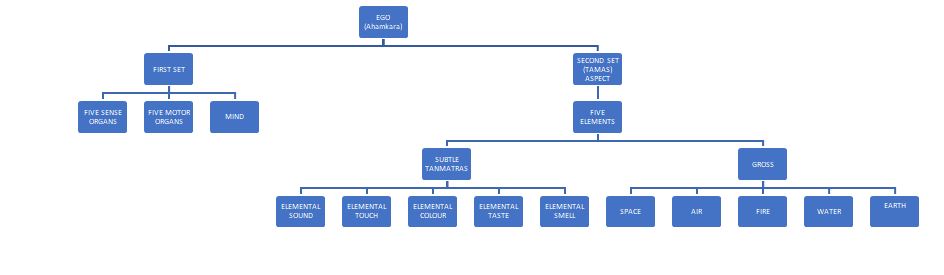
Purusa (the Self within), the second ultimate reality, is pure consciousness or sentience separate from the insentient prakriti. Purusa is a pure subject, never an object of our intellect or mind, and whose existence is only by inference. The important argument for the existence of the Self is the most indubitable and incontrovertible experience of one’s own existence. Samkhya believes in the plurality of purusas- a spiritual pluralism. No two humans are mentally and morally identical. Regarding purposes, Samkhya explains by saying that it is ignorance on part of the purusa to get attachment to prakriti; and liberation consists in the knowledge of its absolute and eternal independence from the latter. The liberating knowledge is total independence of the self from the non-self, a state beyond joy and sorrow. Moral perfection is a necessity to achieve this salvation or a state of absolute freedom (kaivalya) from further births. The means of achieving this is through Yoga.
Yoga, as a system of philosophy, closely attaches to Samkhya. Amazingly, despite theoretical differences, all Indian schools, except Charvaka, recommend and recognize Yoga as important means to attain liberation. Yoga differs from Samkhya importantly in the consideration of a Supreme Purusa (or Ishwara, God or the Self) above all the individual selves of Samkhya. The Supreme Purusa guides contact of individual purusa and prakriti to help in the evolution of varying degrees of perfection of purusa. The upper limit of perfection is the Supreme Purusa. Patanjali, not particularly recognizing God in his scheme, however, taught devotion to God for surrendering egoism, the biggest obstacle in the realization of Truth.
Yoga aims for knowledge to free an individual from the shackles of prakriti, most importantly the intellect, mind, and senses. The Yoga-sutras of Patanjali, the first authoritative exposition laying the theoretical and practical foundations, has had many important commentaries later. Yoga has an eight-fold (Astanga-Yoga) path on the route to perfection of an individual. The first five limbs are yama, niyama (control of desires and emotions), asana, pranayama (physical and breath exercises to have a healthy body), and pratyahara (detaching sense organs from the mind). These five are pre-requisites for the further stages of dharana (concentrated focus on limited objects), dhyana (total focus of the mind on a single object). The final stage is Samadhi- the state of pure consciousness where the mind completely dissolves with disappearance of brain-bound intellect.
Can the intuitive knowledge so obtained be a basis for intellectual knowledge, such as that of science? There are two stages again of Samadhi- the savitarka (with its three knowledge components of sabda, artha, and jnana) and the nirvitarka. In the jnana state of the former, knowledge based on perception and reasoning can build conceptual knowledge. In the nirvitarka, the complete Yogi has an instantaneous cognition and complete knowledge of the manifested universe. The state of pure subjectivity is kaivalya or liberation. Yoga is thus a wonderful whole much more than the physical exercises.
There is a needless discussion on whether Yoga is Indian or is it universal like the law of gravity by prominent personalities on both sides of the fence. The confusion mainly arises from the universal application of the asanas and pranayama in achieving the physical health of the human body. In that respect of a narrow domain understanding of a purely physical aspect Yoga definitely is universal and applicable to any human being. But Yoga as a comprehensive philosophy is definitely Indian where its application leads to moksha or liberation. As regards the origin, Yoga is Indian without any compromise and to give examples like gravity is misleading. There is no confusion, the circles of modern western science, about Newton being the one who discovered gravity.
In the next part, we shall review the most important Darshanas- Mimansa and Vedanta, which dominates Indian traditional thinking. We shall also see some important ideas in Indian philosophy and how the so-called antagonism between the orthodox and non-orthodox schools is a figment of overworked imagination arising especially in the western academia.
PART 2
In the first part we saw the basic structure of Indian philosophical systems and how the individual Darshanas compare and contrast with each other. Despite the differences, some points like belief in karma and reincarnation binds all the Darshanas (both the orthodox and non-orthodox) except Charvakism. In this part we shall look at Mimansa and Vedanta which forms the most important component of Indian Darshanas and also discuss the general features of the latter.
Purva-Mimansa and Uttara-Mimansa (Vedanta)
Vedanta, the pinnacle of Indian philosophical thought, literally means the ‘the culmination of the teachings and wisdom of Vedas.’ In terms of historical progression, the earlier schools dealing with rituals (karmakanda) is Purva-Mimansa or simply Mimansa. The later schools with philosophical aspects and speculative thinking (jnanakanda) were Uttara-Mimansa or Vedanta. Purva-Mimansa lays the basis for the pramanas for valid knowledge which Vedanta strictly follows:
- Perception
- Inference
- Testimony
- Comparison
- Postulation
- Non-cognition.
Initially, Vedanta meant only the Upanishads, but later interpretations saw emergence of the three distinct schools of Vedanta. The three main schools of Vedanta are: Shankara’s Advaita Vedanta (most prominent and popular); Ramanuja’s Vishishtadvaita Vedanta; and Madhava’s Dvaita Vedanta.
The Vedas are the oldest scriptures in the history of humanity and may even stretch to before 10,000 BCE according to some scholars. Western Indologists tend to date it much later (mostly after 1500 BCE). Each of the four Vedas (Rig, Sama, Yajur, and Atharva) consist of four parts-Samhitas, Brahmanas, Aranyakas, and Upanishads. There are 108 known Upanishads of which ten are ‘major’ only because of detailed commentaries on them. It is again a big mistake to describe the later portions as more ‘evolved philosophy’ and the ritualistic early portions as primitive with terms like polytheism, animism, nature worship, or the faulty ‘henotheism’ of Max Mueller.
The Rig Veda conceptualises clearly all existence as a manifestation of a single ultimate reality – indescribable, indeterminate, and absolute; beyond thought and words; and beyond names and forms. The philosophy was well in place right from the beginning; the later Upanishads crystallised and articulated these thoughts. The various interpretations gave rise to many schools over time but with some basic unity in the foundations.
All Upanishads distinguish between a higher knowledge (paravidya) and lower knowledge (aparavidya). The lower knowledge is that of Vedas, phonetics, ceremonials, grammar, etymology, meter, astronomy, and in fact everything in realm of the senses, brain, and intellect. The higher knowledge is non-perceptual, non-conceptual, and intuitive– transcending all three categories of empirical experience; the knower, knowledge, and the known. Moksa, or freedom from ignorance is attainable here and now, where one attains the immortality of no further births. Such an immortality is the state of sat-chit-ananda (pure being, pure consciousness, pure bliss).
Advaita declares Brahman as the sole reality, immanent and transcendent to all creation, as the untiring message of all Upanishads. It is unborn, eternal, and uncreated. The innermost self of every being is Atman; and this is also unborn, uncreated, and eternal. This Atman is separate from the ‘empirical ego’- the idea of the ‘I’ we normally identify ourselves with. The greatest insight of the Advaita is that Atman and Brahman are the same. The Upanishadic wisdom reaches the pinnacle in the mahavakyas or the great statements: tat tvam asi (That thou art), aham brahmasmi (I am Brahman), ayam atma brahma (This Self is Brahman), Prajnanam Brahma (Pure Consciousness is Brahman).
For Advaita, the entire material world is only a superimposition arising out of ignorance (avidya or maya). Maya is the creative power of reality through which the world of variety and multiplicity comes into existence. The phenomenal world is an illusion no doubt, says Shankara, but it is not non-existent nor unreal. The example of the rope and the snake illustrates Shankara’s idea of superimposition. In the darkness of ignorance, the rope is a snake by mistake of the mind; when light flashes, ignorance goes and the rope is immediately recognized in a flash and the snake disappears. Liberating knowledge reveals the true nature of the world as only Brahman (just as light reveals the true nature of the rope).
Brahman and the Atman are the unchanging realities underlying the changing external world and internal appearances respectively. Where all distinctions between the external and internal vanish, the distinction between the Self and the non-Self vanishes and there is an experience of Pure Consciousness. One who does not realise this goes through repeated cycles of births and deaths till the point of realisation. Hence, crucially the illusory world is at the same time real and non-real. Advaita never can degenerate into the false narrative of denying the reality of the world in its entirety and thus stop doing any activity.
God exists in two forms: God with qualities (Saguna-Brahman or Ishwara) and God without qualities (Nirguna Brahman). The former is a personal God while the latter is beyond form and names and is Pure Being, Pure Consciousness, and Pure Bliss. Saguna Brahman is a stepping stone to reach Nirguna Brahman.
Vishishtadvaita (qualified non-dualism) holds three categorical distinctions:
- The support (adhara) and the supported (adheya)
- The controller (niyamaka) and the controlled (niyamya)
- The Lord (shesin) and the servant (sesa).
The first refers to Brahman; the second refers to world. Hence, there are multiple selves in the form of sesas. Reality is like a person; the various selves and material objects are the body, and Brahman its soul. Individual selves and material objects are related to Brahman as parts to a whole. The selves and objects are thus real as parts of an ultimate reality but cannot exist independently of it. The world of phenomena, in contrast to Advaita, is as real as Brahman. God is the Saguna Brahman of Advaita. There are other subtle differences in the schools, but it becomes clear that the individual self of Ramanuja’s Vedanta is not the atman but the empirical ‘I’ of the ego. Liberation, according to Ramanuja, implies an eternal union of a jiva (who has eradicated ignorance) with Brahman to enjoy the highest bliss and infinite glory. The individual identity and consciousness stay intact in this communion, unlike the idea in Advaita.
Dvaita Vedanta, the third school of Madhava, is ‘unqualified dualism.’ Both Brahman and the world are equally and irreducibly different. In Vishishtadvaita Vedanta, selves and material objects are distinctions within Brahman; in contrast, Dvaita Advaita claims the distinction of individual selves and material objects as different from Brahman.
For Shankara,
- Maya manifests Brahman as the world
- It is responsible for the illusory nature of the world
- It is the cause of ignorance in the jiva about his true nature.
Ramanuja treats the world as real but agrees with the first and last positions. Madhava categorically rejects Maya in Dvaita Vedanta. Nirguna Brahman is an absurd idea for both Ramanuja and Madhava. Only the Saguna Brahman, a perfect personality with positive attributes, is the final reality with the power to create, sustain, and destroy the world. Jnana or knowledge is a means to achieve liberation and reach the Brahman state for Shankara; both Ramanuja and Madhava however place bhakti or devotion with total surrender to the divine as the sole means of liberation and uniting with Brahman.
In Advaita, there is loss of individuality in the final state of Moksha. Both Vishishtadvaita and Dvaita disagree by saying that individual consciousness as an independent jiva remains while enjoying the eternal bliss of Brahman. Madhava, in the entire Indian tradition, teaches that God condemns some selves to eternal damnation; and some see similarities with Christian ideas in the propagation of his doctrines.
Vedanta thus has three main schools, but it is generally Advaita Vedanta that is most popular. The philosophy of Shankara has stood the test of time and many Indian savants and saints like Sri Ramana Maharishi, Sri Ramakrishna Paramhansa, Sri Chandrasekhar Saraswati, and Swami Vivekananda generally conform to Advaitic ideas. The three schools are descriptions of the routes of enlightenment and perspectives on the nature of the individual (jiva) with respect to Brahman. There are no differences amongst these three ideas neither on the goal of human life nor in the final state of enlightenment. All flourished with strong individual proponents without any violent frictions.
The gurus stressed that individuals have different temperaments, and hence, the need and evolution of different methods. The goal of Self-realization stays the same. David Frawley says that the simplest definition of Sanatana Dharma is the science and art of Self-Realization. Dvaita philosophies with a personal god as a representation of Brahman and efforts to unite with that god have their echoes in the Abrahamic religions. Hence, generally, Indic traditional systems never had problems with accepting the Christian and Muslim thought. It just added to the diversity.
UNDERSTANDING INDIAN PHILOSOPHIES
Advaita and Buddhism- The Creation of a Clash by The Best European Minds
Koenraad Elst shows that Buddha was every inch a Hindu and his so-called clash with Hinduism is later intellectuals’ fevered imagination. SN Balagangadhara (The Heathen in His Blindness) shows that the supposed clash between Hinduism and Buddhism was a European colonial project simply failing to understand the nature of Indian traditions. Unjustly transposing European ideas to the Indian soil, Buddha became a Martin Luther and Buddhism a Protestant-like attack on Hinduism. Writers after writers successfully made a ‘religion’ of Buddhism rebelling against the tyrannies of ‘Hinduism.’ There were deep flaws in their conceptualisation. As an example, Buddha tried to define the ideal ‘Brahmin’ in his discourses. While rejecting something, one does not try to define the ideal of the rejected. Buddhism had clearer texts and in a rapid time of seventy years in the 19th century, crystallised into a proper religion in Western libraries and institutes. A West, that alone knew what Buddhism was, started judging Buddhism that existed ‘out there.’ Shankara driving out Buddhism with his debates is ignorance on the part of believers of both.
Ignorance for Advaitins is thinking that our senses, intellect, and the phenomenal world is the ultimate reality; for Buddha, ignorance is absent knowledge about the impermanence of everything. Both believe that Karma is a state of bondage due to ignorance, generated by one’s own thoughts, words, and deeds leading to repeated births. Moksha or Nirvana is freedom from ignorance and bondage which one must strive to attain here and now. Most importantly, both agree that Knowledge and Truth are of two kinds – the higher and the lower. The lower is the product of our senses and the intellect applicable to the phenomenal world; and the higher is transcendental; non-conceptual, non-relative, and intuitive. The higher knowledge is soteriological – capable of intense transformation.
With so many common ideas, it is an ignorant notion that Advaita and Buddhism were in opposition. Buddhism spread to other countries due to many factors – royal patronage and the missionary zeal of its monks to name a few. It just receded in the country of origin as people might have continued with their regular traditions. The destruction of Buddhist libraries by invading Muslims helped its demise to some extent too. After the demise of Buddha, Buddhism was divided into many schools and teachings. Regarding some nuanced differences, Advaita claims Brahman to be the unchanging reality. Buddhism however believes there are no eternal entities. The final state of enlightenment is merging in the Brahman for Advaita, whereas Buddhism speaks of Sunyata – silence and nothingness. Hardly a reason for violent or unpleasant encounters with the background of Indian traditions. Finally, it was another tradition that grew in our country with the characteristic of indifference to differences.
Atheism, Time, and Historicity in Indian Philosophies
In Indian traditions, one’s enlightenment is the result of one’s own effort. The discovery that all there is to life is one life or body does not rob an Indian of anything, as Dr. Balagangadhara says. In Indian traditions, ‘atheism’ can also be a way of reaching enlightenment. There is no shock at the claim that ‘God is dead.’ Materialism and atheism were known in Indian traditions since ancient times as Charvakism or Lokayata. Kautilya’s Arthashastra makes a clear mention of this. Western atheism makes no sense to many Indian traditions. Jains, Buddhists, and even some orthodox traditions either reject God or do not demand a belief in God for enlightenment. Most of the Indian traditions are not even ‘theistic’ the way Judaism, Christianity, and Islam are. Indian asuras are not like the devil or his minions in the Bible. Not only do they seek ‘enlightenment’, but some of them are also the biggest bhaktas of our devatas, like a Ravana or a Bali. Indian ‘atheisms,’ ‘asuras,’ or the ‘immorality’ of the devas do not rob Indians of their traditions the way atheism robs a believer in the West. Consequently, without rejecting any piece of knowledge ever learnt, Indians can access the traditions and experiences in a profound way without a belief in God.
Similarly, Indic traditions place time and history as of secondary importance in the realm of the phenomenal world. The higher Truth and reality are beyond time and history and hence, this knowledge becomes timeless and eternal. It is thus futile to try and gain liberating knowledge through history which belongs to the phenomenal world. Thus Mahabharata, Ramayana, Vedas, Upanishads, and all our scriptures are messages permeating across time and generations. The truth about the existence of Rama or Krishna is irrelevant; a major point of divergence from other history-centric religions. Mahabharata and Ramayana may be just imaginations of a talented poet (or many poets as the Indologists would like to believe), but they are real for Indians which is incomprehensible to western culture. The problems arise when the West, rooted in a linear progression of history – from darkness to light, from primitiveness to advancement tries to understand Indian scriptures. History was important in documenting our kings, but it never played a role in dealing with the past; either for intellectuals or the public. From the Indic perspective, for both a theist believing history to be real, and an atheist believing only history to be God; reality will remain elusive.
The Clash Between ‘Science’ and ‘Religion’
The two exclusive features of Hindu traditions and thought are their acceptance of a higher knowledge and a lower knowledge; and that there are no falsehoods. The only purpose of life is the higher knowledge of Reality. The lower knowledge, that of the phenomenal world, in turn, is composed of the body, mind, intellect, space, time, matter, energy, cause, and effect – everything that science deals with. The clear-cut acceptance of the ‘higher’ (para vidya) and ‘lower’ (apara vidya) knowledge never allowed antagonism to science or arts; the latter hence progressed without any fear of persecution. In Indian culture, in one extended spectrum of arts, sciences, spiritual thought, tradition, and philosophy, nothing denied any other; and each was an expression of the others.
In medieval Europe, science was in constant clash with religion; and many times, the scientists compromised to avoid a clash. The clash subtly continues in the western world with an uncomfortable compromise; nowhere more prominent than in evolutionary science. Even today, despite being an educational heavyweight, the US has trouble with the teaching of evolution. Disturbing voices still want alternatives to Darwinism taught in schools – Intelligent design or its older form, God. As late as 1996, the Pope issued a statement in support of evolution, and scientists celebrated this as finally religion seeing reason.
On the other hand, in the last decade of the 19th century when Darwinism was peaking in controversy, Swami Vivekananda simply wondered what the fuss was all about. Evolution is in fact a necessity of matter, he said. There is hardly a western scientist-writer who has spoken about Sri Aurobindo’s deep thoughts on evolution. Indian traditions, temples, and the Brahmanical ‘priests’ never stood in the way of science, astronomy, or even depiction of the most elaborate expressions of sexuality.
Many scientists and physicists in the Western world turn to atheism to do their science. Of course, there were great priest-scientists like Gregor Mendel, but the overall picture is that of antagonism. There were never such issues in India in the so-called ‘secular fields’ of science, technology, medicine, engineering, and others. The divine Goddess could inspire the deepest poetry of Kalidas or the most profound mathematics of Ramanujam. There is also no dichotomy when the chairperson of ISRO breaks a coconut at Tirupati before the launch of high-technology rockets.
INDIAN DARSHANAS: DIVERSE, RICH, AND YET IGNORED
Karl Potter (Presuppositions of India’s philosophies) says: ‘To understand the philosophy of a culture we must come to some understanding of its ultimate values.’ Greek and European philosophers affirm the view that morality, the highest value, lies in the exercise of reason and the subjugation of passions. In contrast, the ultimate value in Indian Darshanas is not morality but freedom and control. It is not rational self-control in the community’s interest, but complete control over one’s environment. Freedom consists of complete liberation from the karmic chains of cause and effect with the achievement of complete peace; and in this life. This freedom is possible for every human being and there is a route for every human, not necessarily the same route. The supreme practical value is renunciation as Krishna tells Arjuna; giving up the fruits of the acts that one is capable of performing successfully.
As Karl Potter notes, the broad classification of non-orthodox and the six orthodox schools is a simplistic division of the huge and rich traditions of India. There were many great philosophers and many individual schools, equally important, with many debates, expositions, commentaries, and criticisms of mainstream schools. Across different philosophies, there were common and differing ideas. Indian philosophical systems have sought answers to most of the existential questions much before western philosophy took its roots in the age of Enlightenment during the 16th to 18th centuries. Even by the time of the Greek philosophers, the basic framework of philosophical thought of India was in place and has remained without many modifications. The narrative of a linear progression of religion followed by its ‘reformation’ and then a rejection of religion itself by science and enlightenment values profoundly fails to make sense in the Indian context. Yet, the phenomenon of ‘colonial consciousness’ has allowed Indians to continue believing that developments particular to European culture could faithfully transpose to Indian soil and explain a completely different culture.
The pre-Socratic philosophers, Socrates, and the later Greeks (like Plato and Aristotle) showed many similar thoughts like Indian philosophers giving credence to the thought that there might have been an interaction. Western philosophy considers itself an inheritor of Greek philosophy but it might have just distorted the views to conform to scientific developments. Indian schools were never antithetical to science, logic, arts, literature, and metaphors when applied to the phenomenal world. The conflict between ‘priests or temples’ and intellectual thoughts is prominently and particularly missing in Indian culture.
Karma and reincarnation are an extremely integral part of Indian thought. The lower and higher truths are important in understanding Indian culture with its rich variety of customs, rituals, gods, and traditions. The greatest strength of Indian culture are the rituals. It was the great genius of our rishis and sages of the past who created a ritual-based society that fulfilled the need for a harmonious society. The entire corpus of Indian thought strives to tell human beings that freedom is possible for everyone; freedom comes by many routes; freedom does not involve stopping any ‘secular’ activity; and freedom never involves a pressure to convert any ‘other’.
Traditional cultures differ from the religious cultures of the west. As Balagangadhara Rao explains in detail (The Heathen In His Blindness), the former roots in ‘rituals’ that bring people together, and where the focus is on performative learning. A huge number of ideas grow in such a culture whose fundamental method of dealing with a differing opinion is indifference. Religious cultures rooted in ‘doctrines’ generally divide people. The focus is on theoretical learning in such cultures and the birth and growth of both atheism and science are on stronger footing here. In such a religious culture, the best it can do to deal with pluralism are ‘acceptances’ and ‘mutual respects.’ But, as Balagangadhara Rao insists, this is not to say one is superior or inferior but the West and the East have different ideas and they stand facing each other as equals. Each has the potential to learn from the other. It is not a one-way street.
Karl Potter says, ‘Very few practising philosophers in India nowadays know the details of the classical systems, and when they do, they know them by rote and not in such a way as to make them relevant to living problems. Yet this is strange, for the aims of classical Indian thought are such as to guarantee the relevance of philosophy to a human predicament and longing which does not change through the ages.’ Any human being with an unfinished purpose of total freedom points to the important fact of Indian traditions that philosophy can never ‘be dead.’
Unfortunately, our schools do not teach us about the rich Indian systems in a perverted application of secularism perhaps; an old European idea that everything related to philosophy in India is religious. Today, these systems have become an area of specialist knowledge for the few interested mostly by accident. Praising it is perceived as an unnecessary glorification of a dead past. As Potter says, it is time that Western professional philosophers – and Indians too, stopped ignoring the contributions of classical Indian thinkers to their pet problems.
APAURUSHEYATVA OF THE VEDAS: A NOTE
Vedic traditions, which have Veda as its central scripture are not based on the revelation of a single Prophet but on the Eternal Word seen by multiple sages – ‘rishis.’ The greatest hindrance we face in grasping the unauthored-ness of the Vedas (apaurusheyatva) is the inability of the mind to form such a conception. Chittaranjan Naik, in a meticulous essay (Apaurusheyatva of the Vedas), discusses the misconception that the Vedas are ‘unauthored’ because there is a failure to know the author. However, tradition says that the Vedas are known to have no human author. The former indicates a failure to know the author, whereas the latter asserts knowledge about its unauthored-ness.
Authoredness, by its nature, is perceptible to the senses whereas unauthored-ness is not. Perception is the wrong means of knowledge (pramana) to know about unauthored-ness. There is a separate pramana in Advaita Vedanta called ‘anupalabdi’ for ascertaining the non-existence of an object. The correct articulation of the traditional position is that the unauthored-ness of Vedas is an object of knowledge and not an absence of knowledge of its author. This knowledge arises from the fact that no author is known despite a beginningless tradition in which the memory of an author would have been known had there been an author.
Naik explains the deep Vedantic idea of words in all forms (from the unmanifest to manifest). Words can exist even if there be no human present in the universe because the principle in which words reside and from which they arise as speech is the eternally existent Consciousness. Just as in a stringed musical instrument where the musical note exists as the ‘unstruck’ note, the ground for the existence of words is the all-pervading and eternal Consciousness.
There are two kinds of proof offered in the Vedic tradition to show that the Vedas are apaurusheya. One is philosophical proof based on Mimamsa. The tradition also offers an alternate proof that does not depend on knowledge of Mimamsa. At first sight, the proof may not appear to be proof at all: it is simply the fact that there happens to be an unbroken tradition that holds the Vedas to be unauthored. But despite its seeming naivety, it is incontrovertible proof. Of course, whether scripture is paurusheya or apaurusheya would make no sense to a person who does not believe in scriptures.
There are three aspects that holds the Vedas to be unauthored.
- Unbrokenness of the tradition
- Etymology of the word ‘rishi’ (‘Rishi’ comes from ‘being a seer’: ‘rishi Darshanath’). So, the very word ‘rishi’ has its origin in the event of ‘seeing,’ of being a drshta (seer) and not a creator of mantra.
- Existence of multiple rishis for the same mantra. The multiplicity of rishis for the same mantras forms the core immune system that guards the tradition of unauthored-ness against counter-claims.
The idea of apaurusheyatva of the Vedas was the prime factor due to which language itself had two categories: the language of the Vedas (Vaidika) and the language of mortals (laukika). The two primary vidyas related to language – Vyakarana (Grammar) and Nirukta (Etymology) had as their fundamental ground the apaurusheyatva of the Vedas. The idea of apaurusheyatva of the Vedas has pervaded all six traditional Darshanas starting from their original texts themselves. This exists in all other branches of learning, and stretches across a vast geographical stretch of land.
The preservation of Sound (the Vedic hymns) in its phonetic and metrical purity is directly based on the special significance of the Vedas as Sruti – the Eternal Sound. The very idea of safeguarding it as a vehicle that carries the Supreme Knowledge grounds in the idea of Vedas as being uncreated, unauthored, perfect, and faultless. What other reason can make so many people in a society or a civilization undertake such onerous tasks as learning to pronounce the Vedas for 10 years or 15 years to protect its purity? And we are not speaking here of a small segment of society, but of a large section of the population stretching across the length and breadth of Bharatvarsha.
One may object by saying that a single dissonant element can rupture this coherency. The onus of proof of a contrary thesis to explain the perceptible and coherent facts has always been with the one who disagrees with the tradition. And no one, so far, has provided such contrary proof. Thus, the conclusion that the Vedas are eternal, beginningless, and Apaurusheya is from the facts that there exists an extensive tradition of the Vedas being ‘handed down’; the tradition forms a tightly coupled coherent system in which one cannot deny a single element without throwing the onus of proof on to the denier; and any alternate hypothesis needs rejection on the law of parsimony.
In the next section, we shall see how Indian Darshanas explain the process of perception and reality of the world around us. These significantly differ from the western ideas of the description of the world around us. The two systems also differ in dealing with the trickiest problem of consciousness. For Indian philosophy, it is a primary entity with varying relations to the material world. For western philosophies, it is generally a secondary entity arising from the matter.
PART 3
CONSCIOUSNESS, PERCEPTION, AND DESCRIPTION OF REALITY
INDIAN PHILOSOPHY IN A NUTSHELL
In the previous parts 1 and 2, we have seen a gross description of the Indian philosophical systems (or Darshanas) and how they generally differ from the western philosophies. In the next section, we shall see how Indian systems, focussing especially on Advaitic Vedanta, deals with the descriptions of reality of the world around us and on the tricky subject of consciousness. The subsequent parts rest primarily on the seminal book of Chittaranjan Naik (Natural Realism and The Contact Theory of Perception).
Western philosophy in explaining perception starts with the objects of the world. For vision; light falls on the objects and is reflected by said objects to reach the retina. The generated neural impulses then reach the brain where an image forms. It is a mystery, however, how an internal image projects as an ‘outside’ world. Similar to other sensations – hearing, taste, smell, and touch, our brains reconstruct the world after receiving the data through our senses.
The finite speed of light ensures that what we perceive is no longer an instant picture of the world. The more distant the object, the farther back in time our object of perception. Humans will know about a suddenly disappearing Sun only after about 8 minutes, the time taken for light to travel from the Sun to Earth. Furthermore, we never know the actual state of reality since our perception is a brain construction – an indirect realism. Thus, all the objects in the world have two components- a ‘noumenon’ (the original, forever beyond our comprehension) and the ‘phenomenon’ (the representation in our brain of the world). Hence, in terms of ontology – the reality of the world, the real and actual is always unknown.
The sense of ‘I’, is the ‘consciousness’ that allows us to participate in the world and gives us a sense of doership. The classic western paradigm of consciousness is the state of awareness beginning after waking up from a dreamless sleep and continuing till going back to sleep again, or slipping into a coma, or dying. It excludes deep dreamless sleep. Dreams and ‘self-awareness’ are special forms of consciousness. The overwhelming western paradigm is that consciousness is a product of the mind.
Indian philosophy has a completely different take on perception and consciousness. There is an incommensurability problem when western paradigms try to understand Indian philosophy through their frameworks of understanding.
CONSCIOUSNESS AND COMPUTATION
‘Who is the I in the I?’
Consciousness studies have become respectable science now with the application of the latest in technology. The biggest mystery is how brain processes, involving 100 billion neurons and 50 trillion synapses, can give rise to consciousness – a unified, well-ordered, coherent, inner subjective state of awareness in response to multiple stimuli of all sorts. There are three main problems of the soul, mind, and matter in philosophy. The west rejects the soul; all discussions are about the properties and interrelation between mind and matter.
The dualists believe that the mind and the body (matter) are fundamentally two different phenomena. In contrast, the ‘monists’ hold that there is only one source of origin giving rise to the other; either mental alone (‘idealist’ monists), or physical alone (‘materialist’ monists). The overwhelming contemporary scientific-philosophic view favours the ‘materialist monist’ theory. Thus the mental stuff, including consciousness, comes from the realm of physical stuff. Matter organizes itself into higher orders of complexity leading to life, bodies, mind, intelligence, and finally consciousness. By logical extension, a computer can lead to consciousness too. This is the basis for Artificial Intelligence (AI) machines.
As John Searle explains in his wonderful book (The Mystery of Consciousness), the strong debate amongst scientists and philosophers between computation and consciousness takes four positions:
- Strong AI (Artificial Intelligence): A computational process entirely generates consciousness
- Weak AI: Brain processes cause consciousness. A computer can simulate the processes but does not generate consciousness.
- Brain causes consciousness; there can be no simulation computationally.
- Consciousness is a complete mystery.
The first two have the strongest proponents. The strong AI model contends that the implemented program, by itself, guarantees a mental life. There is no first-person inner state at all. Everything boils down to stimulus inputs, discriminative states, and reactive dispositions hanging together in a computer-like brain of ours, and consciousness is a certain type of software of the brain. The weak AI model says that the computer program can give near-perfect answers to questions but does not understand the meaning of the answers at all. Consciousness gives internal, subjective meaning to answers. Programs are entirely syntactical having rules, principles, and processes; minds have semantics with meanings. Syntax is different from semantics.
ONTOLOGY AND PERCEPTION IN WESTERN PHILOSOPHY
Ontology (‘onto’- real; ‘logia’ – science) studies what is real and what exists; the fundamental parts of the world and their relation to each other. The standard Western paradigm is the ‘stimulus-response theory of perception,’ a stimulus (light, sound, smell, taste, touch) evoking an inside brain response through an intermediate causal chain. This is also Representationalism – the perceived world as an internal representation of an external world; hence, an indirect form of reality.
In Kantian philosophy, the original unknown is the ‘noumenon’ (in modern parlance – the ‘non-linguistic’ world) and the known constructed reality is the ‘phenomenon.’ This is the contemporary scientific and philosophical view and gets the terms ‘Scientific Realism’ or ‘Indirect Realism.’ The world being a construction in the observer’s mind is thus mind-dependent. What we perceive are secondary qualities as presented to our sensory faculties and their specific powers. They are not the primary qualities that belong to the objects themselves. All Representationalist systems cannot thus effectively address the topic of ontology (reality) as the real world (noumenon) is always beyond our capacity of comprehension.
A stimulus-response system from the external object to the mind is incoherent in explaining the reality of the world. There is an assumption that the intervening medium, space, time, and their relations carrying data to the sense organs are all noumena; actually, they more logically fit into the category of phenomena. Every object in the causal chain from the external world to the perceiver, including the intervening medium, sense organs, and the final brain becomes a ‘phenomenon’ and have an unknown ‘noumenon realm.’ This logical extension of the current thinking questioning the truth status of the body and the sense organs leads to conundrums and inconsistencies. The stimulus-response theory of perception presents a riddle – what is the actual reality? This problem is unresolved to this day despite untiring efforts.
There have been attempts to develop a Direct Realism theory in western traditions saying that there is no transformation by the intervening medium. Somehow, we experience the world directly ‘as it exists.’ However, these positions do not reject the scientific principle of reflected light on matter reaching our senses and the brain converting the neural data. Problematically, the scientific paradigm of data reaching our brain and then undergoing transformation is perfectly incompatible with Direct Realism. One either rejects science or rejects Direct Realism finally in the western philosophical traditions.
PERCEPTION AND ONTOLOGY: THE COUNTER-NARRATIVE OF INDIAN PHILOSOPHY AND THE PROBLEM OF INCOMMENSURABILITY
Indian traditions have a completely different take on consciousness, perception, and ontology. This has been the consistent view of all the philosophical systems across thousands of years with a few minor variations. The major principles of the Indian philosophical stand are:
- The Self is a primary substance in Indian traditions with consciousness as its essential attribute and with a subjective notion of ‘self-awareness.’ An empirical criterion cannot verify the existence of this Self. The knowledge comes from Sabda-pramana; inference from the words of an authority, the Vedas here. The Self as a distinct substance resolves the perplexing problem in establishing a coherent ontology (reality) of the world. Thus, perception is of ‘real’ objects only, since the self-effulgent consciousness is a ‘revealer’ of objects. It is like light in revealing objects but the analogy is not completely correct as even light comes under the category of objects.
- Direct Realism states that there the two entities in perception – the Self and the physical organs of the body, in their respective roles as the primary cause and occasioning cause. The physical processes of the body do not cause transformations in the percept. The sense organs give only a transparency to the Self in the experience of the world.
- There is a dissolution of the artificial reality-divide, in the form of the phenomenal and the noumenal because all objects are namable and knowable.
- Entities are fundamentally of two kinds: sentient purusha (soul) and inert prakriti (mind and matter) clearing the confusion to the meanings of the three terms used in philosophical discourse: ‘soul,’ ‘mind’ and ‘matter.’
- The mind and matter are the same appearing in two different modes of presentations. This explains the correspondence between concepts appearing in the mind and objects appearing in the physical world in a lucid manner without resorting to reduction of one to the other.
- Importantly, the object that appears in the mind is universal while the object appearing in the world is an individual object. The universal maintains the word reference under all conditions. For, when we refer to Devadatta, what exists in the mind is the universal Devadattahood; and hence, even though Devadatta changes in time from being a child to a youth to a toothless old man, the name would refer to the same person.
- Objects of the world are mind-independent because their existence, not determined by the individual self, is public. An independent object should be available for perception and interaction by other individual beings. This distinguishes a valid perception from an illusion or hallucination. Thus, material processes are real and reality exists independent of the observer.
DIRECT REALISM OF INDIAN TRADITIONS
Most systems of Indian philosophy have only one clear stand of ‘Natural Realism’ or ‘Direct Realism.’ This is an active ‘contact theory of perception’ where the perceiver (central in the scheme) goes out, contacts the object in the external world to gain direct information about the world as it exists. The external world experienced is an actual world in its reality and not a construction. Direct Realism, to reiterate, is the experience of the objects in an instantaneous and direct manner without any transformations of the intervening medium. Thus, pratyaksha or direct perception is a valid pramaana or means of knowledge. In Western traditions, perception is never a valid source of knowledge as the world remains unknown in its reality.
Thus, Indian philosophy gives an alternative explanation to reality. The reasonings of western paradigms are not applicable in proving or disproving the Indian view – the problem of incommensurability. Representationalism (Indirect Realism) is altogether absent. In Indian philosophy; the closest it has come to is the Sautantrika school of Buddhism. For western traditions honouring science, Indian paradigms do seem difficult to digest or understand. However, the latter has far more important consequences, even leading to enlightenment (moksha, liberation, or salvation) – the highest ideal. In Indian traditions, a belief in a personal God is not a mandatory requirement for liberation. Amazingly, in Indian traditions, ‘philosophy’ is not an independent exercise, but intricately weaves itself into the fabric of both science and tradition.
THE PRAMANAS AND THE NATURE OF THE PRAMEYAS
All traditional Darshanas begin with an explanation of the pramanas. A pramana is a means of obtaining knowledge about an object. There are three basic pramanas in traditional Indian Philosophies. They are Agama or Sabda (Scripture), pratyaksha (perception), and anumana (inference). The object known by means of a pramana is the prameya. The knowledge of the object is prama. Knowledge of an object is not a distinct entity that stands between the subject and the object but a qualification of the subject or the knower.
Now, there is a distinct mark of the prameya, or object, in traditional Indian philosophies that is missing in Science and Western philosophy. This mark is the mark of ‘being seen’ or the mark of ‘knowableness.’ This point is so vital that if we fail to recognize it, it is likely to lead us into such a position that we would not be speaking Indian Philosophy at all. The mark of ‘being seen’ is a mark of prakriti. This feature of objects being ‘the seen’ finds expression in the philosophical tenet that there is a contact between the seer and the seen object – sannikrishna. The form that the (reflected) consciousness of the seer assumes in seeing the object is ‘vritti.’ Thus, the entire world, directly seen ‘as it is’ has no extraneous mediating factor between the seer and the seen.
SABDA (AGAMA OR SCRIPTURE) AS VERBAL AUTHORITY
Testimony from reliable authorities (Sabda) is a routine way we acquire knowledge in the material or the laukika world. When a high school student accepts Newtonian equations or Einsteinian physics as valid after reading the textbooks, it is sabda in a way as a means for acquiring knowledge. However, the world also shows the means by which the student can actually confirm or deny these equations by way of a channelised education and individualised efforts.
In Indian orthodox Darshanas, sabda as a verbal testimony applies specifically to the alaukika sphere which claims the existence of Brahman. However, like in the laukika sphere which gives the means to confirm the verbal statements of authorities, the Indian Darshanas show the way (Yoga, meditation, and other practices) to confirm the existence of Brahman and achieve liberation. The non-orthodox schools like Buddhism and Jainism accept Yoga and meditation practices as a route to achieve liberation despite denying the existence of Brahman. The problem mainly arises when critics do not want to subject themselves to the means and yet proclaim that these statements from the Vedic seers have no validity. Assertions of any kind should also declare the means by which one can confirm or deny the assertion. These, Indian Darshanas offer plenty and hence ‘sabda’ as testimony is never a statement that one needs to accept in blind faith.
DIRECT REALISM OF INDIAN PHILOSOPHIES VERSUS THE INDIRECT REALISM OF MODERN CONTEMPORARY WESTERN PHILOSOPHIES
Indian philosophy for thousands of years has been clear on its stand of a ‘Natural Realism’ or ‘Direct Realism.’ Hence, the external world as seen or heard is an actual world in its reality and not a construction. Perception is never a valid source of knowledge in western traditions but it is the most important source of knowledge in Indian traditions. Perception involves transparency between the self and the object and contact between the two. There is no time lag in perception. The physical organs are only to enable this transparency and work as seats of experience too. Perception, an inside-to-outside process, is thus a composite process in which the self, the mind, and the sense organs together participate to establish contact with the object.
Western philosophy stays subservient to science and ties itself in knots in trying to explain the reality status of the objects in the world. Proving Indian thought from western perspective and the other way around remains difficult due to the incommensurability problem, but Indian philosophy seems to give far better explanations of reality and the world than western philosophy. Indian philosophy, most importantly, is also a means to liberation (moksha). If only our education systems would teach this.
The most important differing point of Indian philosophies from Western philosophy is perception as a valid means of obtaining knowledge regarding the objects of the senses. In the Indian tradition, perception is the Jyeshta pramana, the eldest of the pramanas (or the proofs).
THE NATURE OF THE WORLD AROUND US OR ONTOLOGY DESCRIPTIONS
What is the ‘nature of the world’ as it appears through the theories of science? Firstly, there is no distinct thing in science called ‘the seer.’ Secondly, science postulates an elaborate mechanism by which perceptions of objects occur. Accordingly, signals from the object arrive at the sensory organs of the body, these signals then transform into electro-neural signals which various sensory channels carry by to the brain, and then there is the processing of signals to present outputs in the form of images of the objects in the world. Thus, by the very nature of this postulated mechanism, the things seen are of the nature of images and are not the objects themselves.
We have no means by which to verify that these images actually possess the same forms as the forms of objects in the world. In other words, every attempt to see them brings to us images rather than the object as it is. Therefore, the theory presents a host of conundrums if we should insist that the images, we see, are the real objects that exist in the world. Therefore, those who hold on to such a belief, i.e., the belief that what we see is the real world, are Naïve Realists. And the philosophy that holds the perceived world to be the real world is ‘Naïve Realism.’
Then there are those philosophers who argue that there can be no means to know whether there are real objects in the world given that the things we experience arise in our minds and contain in the mind itself. This is a philosophical position termed as ‘Idealism.’ There are many variants of idealism, from the kind of Idealism first proposed in the West by Berkeley (1685-1753) to the later variants known as Phenomenology and Existentialism, but they all fit into the broad category called ‘Idealism’ as they hold the world to be born out of subjective ideations and belief systems. The terms ‘Naïve Realism’ and ‘Idealism’ are fine when used to refer to certain philosophies of the West. But it is wrong to label Nyaya as a kind of ‘Naïve Realism’ or ‘Advaita’ as a kind of ‘Idealism’ which many authors fail to realize.
ADVAITA AND NYAYA
Advaita is not Idealism because it negates both the mind and the world. And, it says at the same time, the mind and the world are different. Advaita does not negate only the world and leaves aside the mind to say that the world is ‘mind.’ There are twenty-four tattvas defined in Vedanta and only four of them are internal instruments (antah-karanas comprising ego, chitta, intellect, and mind) whereas the rest are external objects. The attributes of the internal instruments cannot transfer to the objects of the world. The world is not ‘mind.’
The objects of the mind, i.e., ideas and thought, have the characteristic of being determined by the individual’s will whereas the objects of the world do not have the characteristic of being so determined. One cannot cook food by merely thinking about the food. In Advaita, the relations between words and objects are eternal, and each word denotes a specific kind of object with specific attributes. Without understanding this basic tenet of Advaita, it is wrong on the part of those authors to label Advaita as Idealism and thereby confuse the world by writing books on the subject.
Some use the oft-repeated criticism that Advaita’s position is that ‘nothing is real’ from a profound misunderstanding. The complete expression is brahma-sathya, jagan-mithya. The subject matter of Advaita is Brahman and not the world and thus, jagan-mithya is never an isolated proposition. The locution of jagan-mithya (world illusion) is always with the locution of brahma-sathya (Brahman–Real). A discussion of the world excluding Brahman however makes the world sathya or real. To deny the reality of the world which excludes Brahman reduces it to an unacceptable Nihilism. Hence Shankaracharya, when refuting Vijnanavada and other Idealist schools of Buddhism denying Brahman, takes the position that the world is real. This is a vital point often overlooked by modern proponents of Advaita Vedanta.
And with regards to those scholars who term Nyaya as Naïve Realism, the notion of the latter is a caricature of reality that has no bearing on Nyaya or Vedanta. The Nyaya (and Vedanta) theory of perception is based on the principle of contact between the subject and object in which there is no chance of the reality of the world becoming ‘naïve.’ Nor is there in them a chance of the world becoming something else than the seen. Therefore, the application of the term ‘Naïve Realism’ to Nyaya betrays a lack of knowledge of Nyaya.
According to traditional Indian philosophies, the object known through a pramana is neither a mere presentation of something else that may be the real object (as in science) nor is it reducible to something lesser than what it presents itself to be (such as a mere idea of the mind). An object is that which stands to consciousness in the cognitive act of perception. The world in Indian Philosophy is not the world of Naïve Realism nor is it the ideated world of Idealism. If we must find a name for it, it may be the world of Direct Realism – a world as it presents itself directly to Consciousness.
SELF, MIND, MATTER, AND TIME IN INDIAN PHILOSOPHIES
Indian and western philosophies distinctly differ in many issues. Fundamentally, Consciousness (also known as the Self, Purusha, Cognizer) is primary in Indian traditions; it is secondary to matter in western traditions. Consciousness does not include deep sleep state in western definitions. In Indian traditions, the three brain states are the awake state, the dream state, and deep sleep state; and ‘Consciousness’ is transcendental to all three. Mind and matter are different from this consciousness.
Indian philosophy makes a clear distinction between the self and mind-matter as two distinct identities. Mind and matter belong to the same category. In Indian traditions, the category of the cognizer is the self (or Purusha) whose characteristic feature is consciousness. Hence, Self, consciousness, cognizer, and Purusha belong to the same category of sentience. Mind-matter, also known as prakriti and always insentient (inert or having jadatva), is only belonging to the distinct category of the cognized. Thus, both mind and matter belong to inert prakriti distinct from the sentient purusha to which the Self, as the cognizer of objects belongs to.
Mind and matter are the two modes in which objects of cognition appear revealing the legitimate objective reality. In Indian tradition, the nature of an object never changes. When the circular shape of a coin changes to a square one, the law of identity (a thing as itself) stays constant but it is Time that presents the dynamism and change. Thus, Bhartrhari’s Vakhypadiyam says that the creative power of Reality is Time.
Unlike the western notions of an unknowable noumenon where the perceived world loses its intrinsic character, in Indian philosophy, the term ‘unknowable object’ is devoid of reference (vikalpa) and is an illegitimate verbal construction (like the son of a barren woman). In Indian traditions, a conceived object cannot be unknowable; and if it is unknowable, there is no conceiving. In this overarching principle where the perceived world is independent of the mind, we return to the one world that we all experience and live in.
In the next part, we shall see more about the notions of Self and non-Self in Indian philosophies. How does the Self get an embodiment and how does the notion of liberation crystallise in Indian philosophies? The primary objective of Indian Darshanas as an integrated whole combining ‘philosophy, science, and theology’ as in western understanding is to gain liberation or moksha from the repeated cycles of births. The goal of most Indian thought is an eternal bliss arising from the state of no further births. It is not an immortal life.
PART 4
CONSCIOUSNESS, PERCEPTION, AND DESCRIPTION OF REALITY
In the previous parts (1, 2 and 3), we saw the gross descriptions of Indian philosophy and how they differ from Western thought with regard to consciousness, perception, and reality of the world around us. In this section, we shall see the prominent Advaitic view on the notions of the Self and the non-Self. We shall also see the notion of cause and effect in the material world and how the Self interacts with the material world. It is a promise of Indian Darshanas that proper knowledge confers liberation to the striving individual.
THE SELF (CONSCIOUSNESS) AND ITS POWERS
In contemporary philosophy, the overwhelming belief is that consciousness (or awareness) does not have the power to cause anything. It is the subjective texture of experience left over after the provision of all functional explanations. For most philosophers, consciousness is a secondary outcome or emerges as an epiphenomenon of physical matter. Even the few like David Chalmers who attribute a primary nature to consciousness agree that the latter has no functional role. Indian traditional philosophy challenges this view which not only ascribes a primary nature to consciousness but also to its causal power over certain aspects of reality.
Interestingly, Socrates and Plato held the belief, like Indian traditions, of a distinct indestructible and eternal soul separate from destructible matter. However, presently, the conception of the Self is that of being an emergent property of matter disappearing at death. Western philosophy treats the ‘self,’ ‘soul’, ‘consciousness’, and ‘mind’ as the same arising from some part in the brain. The indiscriminate mixing of categories leads to muddling up many issues in philosophy, especially the mind-matter problem. Does the mind give rise to matter or does matter give rise to the mind?
The Self, as the cognizer, can never be cognized as an object. However, the self is either known by its reflection on the cognized objects (like the hidden sun inferred from the light reflecting on the moon) or most importantly, by its self-luminous nature. A robot, Artificial Intelligence, or a computer also knows, sees, listens, or converses with a living or non-living object. But additionally, we also know that we know the object. I am seeing something but I also know that I am seeing something. This is the self-luminosity of the cognizer.
In the Western tradition, the power assigned to the ‘soul’ (or the mind) is the power of thinking and reasoning which strictly stays within the ambit of cause and effect arising from matter. However, in Indian traditions, the self has three powers independent of matter and physical laws of cause and effect:
- Iccha shakti (the power of willing)
- Jnana shakti (the power of knowing)
- Kriya shakti (the power of acting)
The exercise of these powers would not reflect in the unmoving and immutable self. They reflect in the mind and the inner instruments of the self while inhabiting the physical body as a being-in-the-world. The self exercises these powers by its mere presence and not by any exertion. It is an unmoved mover.
Iccha shakti is the power of exhibiting a desire for something. Jnana shakti is the consciousness about an object itself that becomes the knowledge about that object. In Indian philosophy, there is no fundamental difference between consciousness and knowledge. Consciousness is responsible for both, the immediate knowledge arising from direct perception, and the inferential knowledge arising in a mental mode as an ideated object. Finally, Kriya shakti is the power by which the soul (or the self) can act upon external matter. The unimpeded self can act on all matter but the embodied self can only act on certain domains of the physical matter such as the motor organs of the body it inhabits. It can act on other matters of the world only by channelizing its motor organs to act. All living beings having the soul possess these three characteristics in varying degrees.
ON THE INDIVIDUAL SELF – ‘EGO’ OR ‘AHAMKARA’
The Self is attributeless. That which is without attributes cannot exist as an individual thing. Therefore, in truth, there cannot be such a thing as an individual self. The individuality of the self does not derive from the intrinsic nature of the Self; it is the result of an erroneous identification with the body. The notion of the ‘individual self’ is parasitic upon the limited sphere of consciousness reflected off the intellect and the inner layers of the mind. The limitedness of the sphere of reflected consciousness brings about the notion that the Self is within the space of the body. The identification of the Self (capital ‘S’) with the intellect explains the notion of the limited self (with a small ‘s’).
However, this does not account for the unique individuality of the individual self. The uniqueness derives from the history of the soul’s actions and experiences in the passage of time. The knowledge episodes of these experiences etch within the inner layers of the mind as a memory repository. It is the uniqueness of this repository that provides the individual self with a unique identity. According to the philosophy of Vedanta, at a deeper level, the unique individuality of a soul derives from its Adrshta, the balance of the effects of its past actions or karma. If there is no Adrshta, there is no individual self.
The Self is not the ego. The ego is the sense of I that appears in the mind and belongs to the realm of the non-self. In the Indian tradition, it is known as the ahamkara, the form (akara) of the ‘I’ (aham). The ego is the medium through which the body gets appropriated as the self. It is the ego that sustains the facade of the self being an actor in the world.
THE THREE LAYERS OF THE NON-SELF
The first and most familiar layer is the domain of gross physical objects or the objects known by means of perception. In Western philosophy, it has become problematic to maintain that perceived objects are physical objects on account of the stimulus-response theory of perception. The objects thus perceived would be subjective phenomenal objects and not external physical objects. Indian philosophical tradition espouses Direct Perception where the individual self directly perceives the external objects. The perceived world is a legitimate world of physical objects.
The second layer is the domain of ideas or ideated objects. The mind invokes the objects to appear by the mere exercise of an individual’s will. The relation between mind and matter refers to the relation between an object of ideation as it appears in the mind and the object, referred to by the same name, as it appears in the world of gross physical objects. The appearance of objects in these two layers does not pertain to two different objects but to two different conditions of existence of the same object. Thus, Indian thought resolves one of the most perplexing problems in the Western tradition- the relationship between mind and matter. In Indian philosophy, they are simply two existential conditions of an object denoted by a name.
The third layer is the domain of the unmanifest. This layer is the repository of all objects, albeit in their universal natures. Any physical or ideated object exists perennially in the layer of the unmanifest. It emerges into the world as a created object or in the mind as an imagined idea. There is no such thing as absolute non-existence of a legitimate object. Upon the destruction of any object, it simply becomes unmanifest and comes to abide in a state of formless rest. This layer is the region of universals wherein each object abides in its universal ‘form;’ paradoxically, that universal form is formless. This layer is the nothing that is cognized in the state of deep sleep. Due to its formless nature, one mistakes the third layer as the Self.
This objective reality, which consists of three layers of objects (triloka or three worlds), is the Prakriti. Purusha or the Self is the witness of the three worlds. Western philosophy does not make a clear distinction between the self and the three layers of objective reality. Thus, there is often a derailed reasoning for ascertaining the existence of the soul due to a lack of discrimination between consciousness and one of the three layers of objective reality.
THE WORD AND THE WORLD- ‘IN THE BEGINNING WAS THE WORD’: THE MIND-MATTER RELATION
Nouns, verbs, and all other words have four stages – the para (Brahman stage), pasyanti (incipient ideation stage), madhyama (effort for articulation stage) and vaikhari (audible stage). The first three stages are beyond the grasp of an ordinary person steeped in ignorance. The para stage is like internal eternal light and by its true intuition, a man attains moksha. Similarly, the world of objects has four stages: Turiya (Brahman stage), Prajna (undifferentiated unmanifest state), Taijasa (ideated objects), and Visva (the sphere of gross physical objects). It is easy to see the one-to-one correspondence between the word and the world in Indian traditions.
The Madhyama-Taijasa and the Vaikhari-Visva correspondences are the key to grasping the relation between mind and matter. Vivarta-vada of Advaita explains the paradoxical relationship between them which is the effect arising from a cause without any transformation in the cause. It is the pre-existence of the effect in its entirety in the cause. The apparent difference between them belongs to a paradoxical power called the Maya. The Self perceives the eternal object through two different modes of cognition. The mind is an instrument to think about the object while the sense-organs are instruments for the perception of the object. It is Maya that makes the same object apprehended through the two different modes of cognition as different.
In the Indian tradition, language is coterminous with Consciousness, the Ground of the Universe, and not with any physical substrate. At its most primal level – the speech stage of para or the object stage of Turiya is luminous and the same with Brahman. Grammar can thus be a route to salvation too in Indic traditions. The ancient Greek philosopher Parmenides and recent philosopher Spinoza glimpsed something similar but they stand alone in the Western traditions.
ILLUSIONS AND HALLUCINATIONS
The distinction between perception and hallucination also remains unclear in Western traditions. A meaningful investigation into the distinction between perception and hallucination needs grounding in ideas of mind and matter; perception as objective and mind-independent; and hallucination as subjective and mind-dependent. Indian philosophy does that effectively in comparison to Western traditions. Indian philosophy says that objects that appear to us are the realm of the mind (taijasa) and the realm of the world (vishwa). Illusions and hallucinations are in the realm of taijasa and are private. Though the ‘seen’ in both taijasa and vishwa is the same object appearing in two different conditions sometimes with the same intensity and vividness, the object in taijasa is in the private realm of ideation.
The individual Self cannot manifest these objects in the realm of vishwa by its mere will. In Indian tradition it is the Unobstructed Consciousness, the Ground of the Universe, that brings forth these objects into the world and holds them in place available for public perception. This Unobstructed Consciousness is also known as Brahman, the Immutable Akshara or the Great Imperishable. An object having a Datum of Consciousness can be mind-independent if its independency stems from it manifesting in the public space without individual power to bring about such a manifestation. The idea that an object requires to be without a datum of consciousness for it to be mind-independent is an ill-begotten idea stemming from western misconceptions about mind and matter.
THE EMBODIMENTS OF THE SELF, LIBERATION, AND REINCARNATION: THE CRUX OF INDIAN THOUGHT
The Self or Consciousness is self-effulgent and reveals objects directly and instantaneously. The absence of ubiquitous perception indicates some primal covering over the self, obstructing its natural revealing power. In Indian philosophy, this obstruction is the three-layered body: mula-sharira (seed-body with nature of sleep), sukshuma-sharira (subtle-body or the realm of mind) and sthula-sharira (gross body).
The most important question now occurs. How can something arise in Consciousness – the ground of all universe, and then contain it? Vedanta explains that this paradoxical embodiment of the Self comes about not through a physical process but through a cognitive condition whereby the Self morphs as the body, as it were, and erroneously believes the body to be the self. An idea in the mind is the same as the body apprehended in the world of matter. They are both the same appearing in two different modes of cognitive presentations (mind-matter equivalence). This erroneous cognitive idea is the mithya-gnana or the illusion of Advaita.
Self’s embodiment through an erroneous cognitive condition is central to the Indian tradition; it forms a core tenet in all the six systems of philosophy with slight variations. Hence, the right knowledge confers liberation. Even when the physical body undergoes destruction, the idea of the body persists in the realm of the mind. This thinking, considering body destruction as a loss, craves for a body. This craving, along with the law of causation related to the embodied soul’s moral actions in its past births, results in the reincarnation of the self in another body.
THE EMBODIED SELF AS AN ACTOR AND THE ARROWS OF CAUSALITY
The division of all things into two basic categories, the seen (Prakriti) and the seer (Purusha), is fundamental to the Indian tradition. Ishvara projects this universe in accordance with the collective Adrshtas of beings to confer upon them the fruits of their past actions. The purpose of creation is for seeing and experiencing it. Contemporary philosophy firmly rejects all teleology (purpose) in the universe. In the Indian tradition, Prakriti, being inert, has no purpose by itself. Purpose can exist only in a conscious agent having the power of sentience, intentionality, and will. Importantly, the telos (purpose) conceived like this does not violate the laws of nature because the locus of telos and the locus of the natural laws are different.
According to Vedanta, Ishvara’s creation does not proceed through an assembly of physical parts, as in the case of the production of things by ordinary mortals, but proceeds effortlessly from His omniscience through speech. The purpose is contextual and not an unconditional truth. Brahman or Ishvara does not create the universe for fulfilling a Divine purpose; for the Divine Being is ever full.
The telos of the world arises only in the context of the Purushas that carry with them the baggage of adrshtas – the central thread around which the purpose of the world revolves. Ishvara projects the universe for individual beings to experience the fruits of their past actions. But the mere projection of the universe would be a mere witnessing of the universe and not engaging as an actor in the universe. The embodiment confers upon the Self the status of a being-in-the-world.
By its true nature, the Self, being all-pervasive, has no containment. The presence of this erroneous cognition generates a certain psycho-physical bodily structure. And when the erroneous cognition dispels, one is set free from the shackles of bondage (to the body) and to the cycles of birth and death. This is the idea of embodiment and liberation that is central to the Indian tradition. When there is knowledge of the Self as the underlying reality of the universe, this entire structure gets dissolved.
The unobstructed Self is the Ground of the Universe and the sole efficient cause of creation and sustenance of the universe. But the obstruction that prevents the nature of the Self from being known and causes the phenomenon of embodiment to arise, also hides the nature of the Self as the Sole Cause. In this predicament, the embodied Self not only mistakes the body to be the Self but also considers the causal influences that physical objects of the world exert on its body as on its Self. It also sees itself as possessed of free will by which it may exert causal influence on the world through the employment of its motor organs. Thus, the Sole Cause of the universe appears, through the prism of ignorance of an embodied being, as a bi-directional arrow of causality with regard to the world.
WILL AND THE ARROWS OF CAUSALITY
The foremost question is about the existence of will. The question is whether there exists within living beings a power to exert extra-natural force to influence the behavior of physical objects. In a purely physicalist framework, the arrow of causality would be from a physical body (or phenomenon) to another as both the cause and the effect would be attributes of physical bodies. The rejection of Cartesian dualism in contemporary culture has resulted in consciousness being relegated to a position of an insubstantial non-entity. Thus, in the physicalist framework, the arrow of causality never originates in consciousness nor does it point to it. As an epiphenomenon, consciousness is an accompaniment of certain brain processes. Contemporary scientists and philosophers take the position of the physical causal closure argument – all phenomena in the universe have solely physical causes.
The existence of will in living beings dismantles the physical causal closure argument and establishes that the arrow of causality also points from consciousness to physical objects. Consciousness can exercise will and thereby cause changes to occur in physical objects unexplainable by physical causes alone. The notion of the physical world forming a causal closure is mere dogma. The arrows of causality are not only from physical objects to other physical objects but also from the self to physical objects. It is important to understand that the presence of will as an extra-natural power does not impinge upon the validity of the physical laws. They both exist alongside each other.
ON FREE WILL AND DETERMINISM
Unfortunately, the debate on free will versus determinism has characterized the presence of will and the presence of physical causality in terms of an either-or proposition. The problem thus lies not with the nature of the causes but in the postulation that the causes acting in nature can either be physical causes or a will exercising its freedom of action. It is a mistaken notion. They both exist together, interpenetrated with one another in reality. The exercise of will does not affect the validity of the physical laws any more than the presence of a magnetic force that causes a piece of iron to lift in the air affects the validity of the gravitational force that would be acting downward on the piece of iron.
The various forces act in accordance with the laws that are applicable to them, whether physical or incorporeal, but it is only the net effect of the forces that become obvious. The question of free will is towards knowing the extent to which it would be free in exercising its powers. Obviously, the will of a living being does not have unlimited power. The power of will is limited to moving motor organs into activity, and the motor activities act on the external object in a manner that would serve the purpose of exercising the will.
The strength and vigor of the instrument (like the muscles or brain) limit the power of the will. In general, the freedom of will is like the freedom that an animal tethered to a pole by a rope has. Beyond the radius provided by the rope’s length, it finds its movement obstructed. A living being enjoys a certain radius of freedom beyond which there is a limiting of powers. The world and the external circumstances place constraints. There are also internal constraints in the form of mental predispositions whose forces and momentums have the potential “to carry off a person’s mind” and make it act along with the veneer of its desires rather than by the dictates of reason.
The force or impulse of desire caused by such internal mental tendencies can render the will a slave of its instincts and desires. Such a will is not free. It is the state of will that exists in animals and other lower beings which retain the power of exercising their wills but do so as their instincts, desires, and mental tendencies drive them rather than by the exercise of intellect. The forces exerted by mental dispositions and tendencies belong to the non-self, that is, to Prakriti and not to the Purusha or the self.
Thus, a will held hostage to the tendencies of the mind (forces from Prakriti) cannot be free. Free will must consist of exercising its powers and abiding by its own independent nature. External forces, residing both inside the body and outside, should not be able to influence its exercise. What is its own independent nature? The Self is of the nature of pure consciousness or pure knowledge. Therefore, in acting freely, the directedness of the actions that proceed from the will would be determined solely by the nature of the self, that is, by knowledge and the power of discrimination (viveka) that comes from knowledge, and not by the impulses of desire or the forces of mental tendencies.
Thus, the actions that proceed out of free will would be actions determined solely by the knowledge of the factors involved and a determination of what constitutes the right action in the situation. Mental tendencies and desires should not propel the actions. One who acts in this manner through the exercise of his free will instead of by the impulses of desire or mental tendencies is acting in a noble manner (an arya way) in Indian traditions. Acting without desire is the supreme message of all Indian scriptures.
DESIRELESS ACTION AS THE SUPREME MESSAGE OF INDIAN TRADITIONS
SN Balagangadhara explains the concept of desireless action as the supreme message of Indian traditions which stand in contrast to the ideas regarding action in Western cultures in his book Cultures Differ Differently (The chapter titled Selfless Morality and the Moral Self). He says actions are meaningless (outside of contextual interpretations) and moral actions, as actions, become appropriate within contexts only. Then the demand would be to propose one kind of action appropriate to all contexts. We also need to seek the context of all contexts and an action that is appropriate in that context. There is one such context, which is the context of all contexts – the universe. What significance does the universe lend to this individual’s actions? The answer is none. Actions have no purpose, no meaning, no goal within the ‘master’ context if one ignores the sub-contexts. At such a level, it makes no sense to ask whether some action is appropriate or not: all actions are equally appropriate, none is, and neither of the two.
Western traditions maintain that one of the characteristic properties of human actions is goal-directedness. Against this background, what does it mean to perform meaningless actions? It is to perform an action without desiring, without wanting or even without aiming at any goal whatsoever. One simply acts. All the Indian traditions put performing an action without any kind of desire, without aiming at any kind of a goal, without attaching this intentionality to human action as the highest kind of action that is appropriate at all times. Such actions constitute the most appropriate actions in all contexts. That is, a truly trans-contextual action can only be an action exhibiting the generic property of action: goal-less and a-intentional.
One ought to perform goal-less action, but human action is always goal-oriented. Consequently, how is this different from any other moral ideal that is current in the West? The answer is simple, says Balagangadhara: one ‘ought’ to be a-intentional simply because human action is meaningless action. Erroneously, and acting under false beliefs, human beings think that action is always goal-oriented. They do not see that the context lends purpose, goal, or meaning to human action. It is these contexts that make human actions appear meaningful, when in fact they are not so. To realize this truth about human action is liberation from errors. When viewed this way, choice theories of any sort would not express this notion of ethical and moral action. Total suspension of all choices is the first requirement to be a ‘moral’ (used in the sense of ‘enlightened’ or ‘liberated’) person.
CAUSE AND EFFECT IN THE INDIAN TRADITIONS: THE ROLE OF ISHWARA
The premise that the natures of physical things themselves can explain all physical processes drives empirical sciences. This is a Charvaka principle later used by Epicureans of Greece. Newton and others gave birth to the natural sciences grounded purely in the physical natures of things. However, the western world has never been able to reconcile God with the natural laws of the universe. Modern scientists tend towards Deism – God does not intervene in the operations of the world, once created. This allows incorporating belief in God without discarding allegiance to empirical science.
In the Indian tradition, how does the existence of an apparently independent universe depend on Ishvara – the sole Independent Existence? The closest example to illustrate this is a mirror reflection. The reflection does not exist without the object of reflection. In both Advaita and Dvaita, this analogy illustrates the relationship between Brahman and the world; the relation of Bimba-Pratibimba, the object, and its reflection. There is a misconception about the ontological (reality) status of the reflection. The reflection of an object is unreal obviously. However, the object called ‘image of a flower’ is real because the reflection is truly an image of a flower. All the objects of the Universe are the reflections (pratibimbas) of Ishvara but they are true to the names they are known by. The world objects are all pratibimbas with their existences derived from, and entirely dependent on, the Bimba or Ishvara – the Supreme and Sole Independent Existence.
Ishvara, through His Absolute Will, presents the various objects as causes and effects without being dependent at any time on any of these things to unfold. Yet the causality seen is not arbitrarily dependent on the whims of a capricious God. The causality is by the natures of the objects themselves as they exist signified by words in their para stage identical with Brahman. The created universe has no existence by itself except as a reflection of His omniscience. In Advaita, the ultimate relationship between Brahman and the world is indescribable because the world being no other than Brahman, there is no relation between them. But within the sphere of the duality of creation, the Bimba-Pratibimba relationship offers the closest analogy to explain Brahman’s controllership of the entire universe as its sole Efficient Cause.
A TABLE COMPARING PHILOSOPHIES
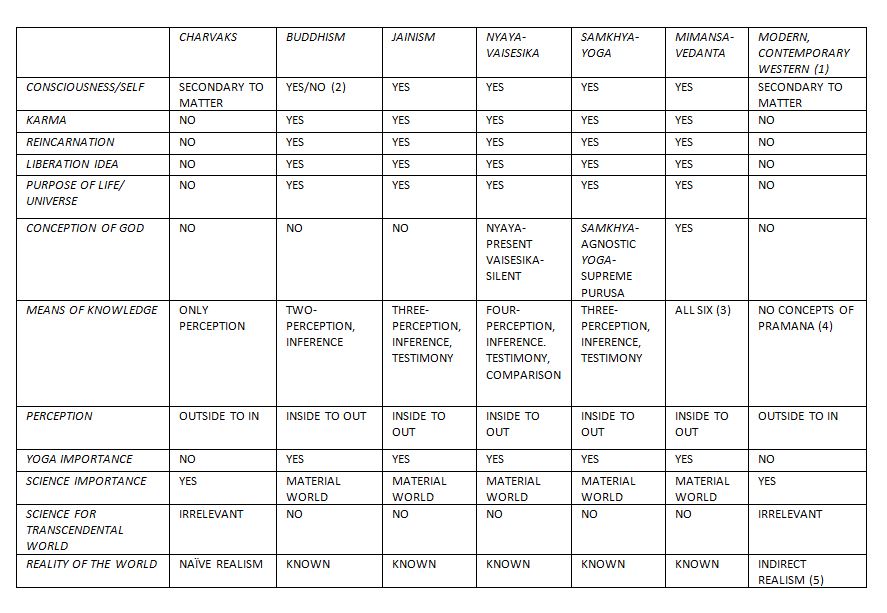
The table and the notes have major inputs from Sri Chittaranjan Naik
These are some very broad generalizations. There are many nuances and complexities but the table is purely for the purpose of an easier grasp of the concepts.
- Western philosophies imply only modern contemporary thought and it does not include its ancestral lineage and a few ignored branches. For example, the conception of God is present in Aristotle as well as in Western Scholastic philosophy but is absent in modern and contemporary philosophy. Again, the idea of reincarnation is present in Plato, Pythagoras, Orpheus, and even in one school of Christian Patristic Philosophy (the philosophy of Origen) but is absent in all later philosophical works. The conception of the universe having a purpose (telos) may be present in Greek and Scholastic philosophies but the notion disappeared after the advent of British Empiricism (on the other hand, the philosophy of Hegel brings in a peculiar notion of a historical movement towards some grand purpose).
- Consciousness in the dominant Buddhist schools is a consciousness that flashes with objects, and in the absence of objects it is absent. Indian astika (orthodox) philosophies regard this as a kind of nihilism.
- The positions of Mimamsa and Vedanta vary from sub-school to sub-school. Advaita Vedanta has 6 pramanas but Dvaita and Vishishtadvaita believe in only 3 pramanas. Similarly, the Bhatta school of Mimamsa has 6 pramanas whereas the Prabhakara school has only 5 pramanas.
- The concept of pramana does not exist in Western philosophy. The Western definition of knowledge as justified true belief sometimes determines whether a belief (or a propositional attitude) may be knowledge or not.
- Contemporary Western philosophy may adhere to Indirect Realism (where the real world is unknown) but in the world of Science, most practitioners, i.e., scientists, unthinkingly believe in a kind of Naive Realism or a kind of Lockean Dualism. For Charvakas, Naive Realism holds good.
In the final part, we shall delve into the objections to Direct realism of Indian traditions and the replies to them. We shall also see the ingenious ways of proving the existence of the Self despite always being an eternal subject and never an object for study.
PART 5
CONSCIOUSNESS, PERCEPTION, AND DESCRIPTION OF REALITY
In the final part, we shall see the process of perception as described in Indian philosophies. We shall also see the possible objections to Direct Realism of Indian thought and their replies. Chittaranjan Naik offers proofs for the existence of the Self in his books and we shall see them here.
PERCEPTION, SEEN AND UNSEEN CAUSES, KARMA, AND DIRECT REALISM OF INDIAN TRADITIONS
The instruments of perception are in this three-fold embodiment. Even though the Self has the capacity to reveal objects by virtue of its intrinsic effulgence, Maya obstructs its power of revealing. A clearing appears in the innermost covering of Maya; the middle layer actively reaches out to the object helped by the instruments of perception; and the outermost layer comprising the physical body is the seat of experience. Perception is an inside-to-outside process. Perception and experience of the world occur with a clearing in the veil of Maya.
The clearing appears by the Wheel of Causation operating in nature (Prakriti). This causality is of two kinds: the seen and the unseen. The seen (and immediate) operates between physical objects determined by the nature of the objects themselves. However, only those actions with a moral dimension result in unseen (and delayed) effects. The effect of an individual’s moral actions, either virtuous or transgressive, is Apurva, meaning something arising new. Its effect surfaces at a future time with appropriate fructifying conditions.
The total unfructified Apurvas of an individual is the individual’s past karma (or Adrshta); the accumulated effects of past actions for future fructification. There is perfect synchronicity between the world that an individual being perceives and the individual being’s past karma. The Law of Causation (or Wheel of Dharma) projects the manifested world in accordance with the collective past karmas of individual beings. The physical body is the seat of this experience and the regulated uncovering of the innermost veil of Maya determines which part of the world the individual will experience. The overarching Law of Causation that Indian tradition espouses does not violate the physical laws that operate between objects by virtue of their physical natures (dharmas). The causal force of Dharma Chakra acts as an unseen ordering force.
THE INSTRUMENTS OF PERCEPTION
In Advaita, perception is by the sense organs (jnanendriyas) contacting the object in the universe. The faculty of perceiving the universe cannot be an object of the universe because it would make the perceived quality of an object into a representation of the quality existent in the faculty itself. Each sense-organ senses a substance (or element) by the latter’s distinctive quality; The five substances or classical elements (tanmatras) are ether, air, fire, water, and earth and the distinctive qualities are sound, touch, form, taste, and odour respectively. The five elements, unknowable through empirical science, are abstractions beheld by an unimpeded consciousness. The mixing and aggregation of the five elements is panchikaranam (quintuplication) to form the mahabhutas.
These five classical elements are commensurate with the five sense organs and everything perceived in the universe must be by means of them. This is true even with our mental conceptions of objects; for an object of mental conception and its corresponding object in the universe are the same object appearing in a different condition of its existence. The Indian tradition would thus hold the elements of the Periodic Table as compounds of the five classical elements that compose all objects of the universe.
THE PERCEPTUAL PROCESS
Perception is by the removal of the covering of Maya (avidya or nescience) over the individual self, allowing the conscious light of the Self to reveal external objects. The mind, in a process called vrtti, assumes the form of the target object of cognition during a conceptual act. The mind forms a vrtti both when it mentally constructs an object or when it contacts an external object to assume its form. Perception is thus a composite process in which the Self, the mind, and the sense organs together establish contact with the object.
Thus, the attributes perceived such as color, and taste are not subjective qualities but are objective qualities inhering in the objects themselves. In the Indian theory of perception, there is no transformation of the object. Once the mind and sense organs contact the object and assume the form of the object by forming a vrtti, there would be nothing in between the self and the object to hinder the conscious luminosity of the self from revealing the object in its true form.
The mind and sense organs become distorting filters only when they have a defect hindering them from assuming the form of the object. When such defects are absent, there would be transparency between the Self and the object; revealing the latter in a true manner. Thus, perception reveals the object in its actual form. Such contact is instantaneous since the consciousness that appears within the body is the same consciousness that exists without the limiting adjuncts of the body and in conjunction with all objects. Hence, perception is nothing more than the removal of the covering of Maya over the individual consciousness to reveal the conjunction that already exists with the object.
PHYSICAL BODY
The gross physical body does not figure in the contact theory of perception, at least when the perception is free from defects. This exclusion is the greatest strength of the theory and not an omission. Perception reveals the object in its true form because of the non-involvement of the physical body. The embodiment of the Self comes as a cognitive condition (a mental idea) and not a physical process. The Self, a pure witness, is unchanging and immutable. The Self’s affections from bodily functions are a simulacrum, a cognitive conditioning, that sees a parallelism between the bodily functions and the affections of the embodied self. Affections of the Self are affections of the inner layers of the body (subtle body). The latter, because of their proximity to the conscious Self, display the properties of being conscious just as an object appears to have light when it is only reflecting the light falling on it.
A faulty perception is primarily due to an adverse state of the individual’s Adrshta (karma). This reflects either a defect in the instruments of perception (internal defect) or in adverse situations (external defect) preventing perception. The defect of the physical organ is also a simulacrum. The body is the seat of experience for the Self to take its place as an actor through which an individual being experiences the fruits of its past karma. It experiences the fruits of its past karma; also, it performs karma with the window of free will. Equipoise is when the body is transparent to perception. Thus, bringing the body back to a state of equipoise through surgery, like cataract surgery for dim vision, constitutes a recovery of transparency.
THE SENSE ORGANS
Each sense-organ is a subtle part of the element with which it is commensurate. The sense-organ is the element itself as it appears split up through the prism of erroneous cognition. Thus, the ear, skin, eye, tongue, and nose are subtle parts of ether, air, fire, water, and earth respectively. The sense-organ is no different than the element that stands revealed during perception. Thus, perception is a transparency to the world despite the body standing between the subject and the object. The body only appears to be standing between the subject (Self) and the object due to the same erroneous cognition causing both the embodiment and the internal senses.
In embodiment, the gross physical sense organs are the seats of the subtle sense organs. The individual being attributes the power of sensing objects to the gross physical sense organs instead of to the subtle senses. The instruments of perception include also the mind. If the sense-organs reach out to an object but the mind is attentive to some other object, perception of the object does not occur.
In Western traditions, the main problem with the stimulus-response theory of perception is, in effect, the problem of consciousness. It is impossible to perceive an object without there being consciousness of the object. As a logical consequence of assuming a stimulus-response model of perception, consciousness would logically belong to the sphere of noumena which is a delusional non-existent realm, as we have seen earlier. Contact theory overcomes the logical conundrums of representation systems.
OBJECTIONS TO DIRECT PERCEPTION AND POSSIBLE PROOFS
Amongst many arguments, one important is the important time-lag phenomenon. Light travels at a finite velocity, and so there is always some time interval between the reflection or emission of light from a physical object and the light’s reaching our eyes. For a distant star, the time interval may be so considerable that, by the time the light reaches our eyes, the star may no longer exist. If something no longer exists, we cannot now perceive it, let alone directly perceive it. Hence, the conclusion is that Direct Realism is false.
However, all the premises are theory-laden with the assumptions of the theoretical framework of science, namely that:
(i) light travels with respect to an observer, and
(ii) we perceive objects because of a stimulus-response process.
The arguments, therefore, suffer from stating propositions that are in question.
Another argument against Direct perception says that we must perceive all its parts at once to perceive an object. But we, at best, can perceive only a spatial part of it. Direct Perception, by perceiving only a part of the whole cannot make a claim about the whole. However, the premise is false because the whole is not the sum of the parts but is a distinct object different from the sum of the parts. Thus, it is not the perception of the totality of all the parts that will amount to the perception of the object. One perceives an object when the universal (of which the object is a particular) comes into perception. For example, to perceive a cow, universal ‘cowness’ is important. The assumption of perception of all parts of the object would lead to an infinite regress. Each part will have more parts to perceive and so on, ad infinitum. Universals, a necessary structural element of objects, correctly identifies both the attributes appearing in one’s immediate awareness and not in one’s immediate awareness.
EXPERIMENTS TO PROVE THE INDIAN TRADITIONAL THINKING
Chittaranjan Naik offers an ingenious experiment called the ‘Simultaneity Experiment’ to address the major objection of time lag against direct perception. The finite velocity of light leads to certain paradoxes like the shrinking of the size of an object and the stretching of time at light speeds. Infinities arise at the speed of light even as aging slows down. It is a huge paradox to understand that though it takes billions of years for light to travel from a distant star to a measuring telescope; for the particle of light, the travel has been instantaneous. If Consciousness is like light itself, then the immediate perception also may become more understandable.
The speed of light has always been from the source of light to another object, but never from the source of light to the sentient observer who would observe the light instantaneously. A nuclear explosion at 44,000 miles or so from Earth, instruments for measuring the speed of light from the event to a space station above Earth, and sentient observers recording the event on their watches on the same station; are the paraphernalia for the experiment. If the Indian thinking is correct, the sentient observer would detect the nuclear explosion instantaneously and much earlier than the instruments. This is a challenge for any future experiments which can change the present scientific-philosophical paradigms.
THE EVIDENCE FOR THE SELF
Chittaranjan Naik (On the Existence of the Self) gives detailed arguments to prove the existence of the Self. He demonstrates that goal-oriented actions emanate from a unique power of the Self (also known as kriya shakti) beyond the laws of physics. Naik dismantles the idea that the physical universe forms a causal closure (a strict cause and effect working purely at a physical level). He also shows how influential Western philosophers like Hume and Kant buried the idea of the soul in Western traditions. In fact, Socratic and Descartes’ dualism are more in line with Indian traditional philosophy. Socrates and Plato held the belief, like Indian traditions, of a distinct indestructible and eternal soul separate from destructible matter. The rejection of Cartesian dualism led to increasing confusion in Western philosophy continuing to date.
Kriya Shakti is the power of consciousness that can cause movement and effect changes in physical bodies. In materialism, this power has its source in the mechanisms of the physical body and the brain. Indian traditions ascribe this power to an intangible incorporeal substance existing within the body. Physicalists tend to dismiss both free will and any substance (soul or mind) exercising this free will over physical objects. However, the physicalist account of perception brings into question the very existence of physical objects. In Indian philosophy, the perceived world is the real world. Even for Advaita Vedanta with a provisional acceptance of such realism, the perceived world is still the real world.
‘ORDER’ AND VERIFIABILITY CRITERIA
In thermodynamics, the terms ‘order’ and ‘disorder’ are closely related to entropy which is a measure of the thermal energy in a system that is unavailable for doing useful work. All physical processes within a closed system involve an increase in entropy or decrease in order; this is an inviolable law of physics. According to some people, entropy can decrease in pockets, apparently defying the second law, but is extremely unlikely (like the odds of shaking the parts of a watch and having them fall into place as a working timepiece).
Evolutionists attempt to show how ordered complexity can indeed arise from natural phenomena over long periods of time, occurring one small step after another. However, whether a clock comes into existence or disintegrates, the thermodynamic entropy of the system always increases. Even in evolution, the thermodynamic law of entropy stays intact. Obviously, scholars confuse the notions of entropy and order as defined in thermodynamics with the common-sense notion of order.
Naik looks at the phenomenon of ‘order’ as a change in spatial dispersions of matter from an initial chaotic (or random) state to a final state of a spatially ordered configuration. This creates a sense of order in our minds. His strong hypothesis is that order of this kind would never come about through the operations of physical laws alone. This ‘order’ has nothing to do with thermodynamic entropy or thermodynamic order.
There are many million instances of such ordered complexity every second arising from disordered dispersals of matter. Brand new cars, clocks, beehives, microchips, aircraft, and giant buildings come into existence all over the planet every second. Order comes out of disorder on a regular basis, yet we fail to notice it amazingly. In all the examples above, there is one thing in common: the creation of order out of disorder springs from the presence of living beings. Clearly, life tends to disrupt the operations of the physical universe.
Any hypothesis in Indian traditions needs verifiability for acceptance (unlike the falsifiability criterion of science). The verification criterion that the author chooses to employ uses difference in probabilities between the following two cases:
1. The probability of the creation of an ordered spatial configuration when they are subject purely to physical laws.
2. The probability of the creation of an ordered spatial configuration when there is the intervention of living beings.
He then shows by mathematical arguments in detail that when matter is subject purely to physical laws, the probability of the material parts coming together in some ordered configuration tends to zero. But in the presence of human intent, suddenly the probability of the material parts coalescing into some ordered configuration begins to approach the value of one. Thus, one will have to presuppose that the human being cannot be merely an aggregate of the physical bodily parts but also consists of an incorporeal (intangible) substance possessing the capacity for intentional action.
This correlation, or vyapti in Indian logic, enables one to infer the presence of the soul from the presence of goal-oriented actions. For, where there is an intentional action, there is always a soul present as the source. Yet, in contemporary discourse, intention does not have the pride of place as an ontological principle. It simply is a manifestation of some underlying physical state in the brain or body. The ‘explaining away’ is not through a logical elucidation but by asserting a dogma. The dogma lulls the mind into thinking that the phenomenon cited for the inference of the self is a mere appearance leaving the reader confused regarding the nature of the proof.
He then considers four major objections to his thesis that proceed from the dogma and show them as unsustainable:
1. Intentional action is a result of the body’s mechanism
2. The actions performed by computer-controlled machines disprove that goal-oriented actions require the presence of a soul
3. It is possible for all kinds of objects to achieve accidental creation
4. Natural Selection can create complex objects
Random dispersions of matter do not rearrange themselves into ordered dispersions of matter when left to themselves and to the laws of physics. The probability of it occurring would be so minuscule that it would likely take a million years or a billion years for the result to actualize in the world. Yet, when human beings with the intent to produce such ordered dispersions of matter are present, these events do occur many times over; even millions of such ordered dispersions every month or every year. There is a correlation along with temporality of the highest order (when A comes before B, the correlation is near one; when B comes before A, the correlation is near zero). Such correlations prove A causing B; in this case, the soul causing ordered physical matter from disorder.
Evidently, the presence of human beings introduces something more to the situation than the behaviour of material objects operating solely under physical laws. One needs to pre-suppose the presence of some entity, namely the Self or soul, as a resident within the body of the human being. Ordinarily, this would suffice to prove the existence of the Self because it constitutes a valid inference.
Yet, the contemporary world views intentional or goal-oriented action as a manifestation of some underlying physical process in the body or brain. The invariable correlation between goal-oriented actions and the presence of living beings (the origin of the goal-oriented actions) points to the existence of an element, namely the soul, within living beings. Thus, purely physical causes and physical processes cannot explain goal-oriented actions. It follows then that the physical world does not form a causal closure.
Naik meticulously lays the foundational basis of Indian logic based on Nyaya with which he refutes Western philosophers arguing against the concept of soul and substance. He discusses in detail how Western philosophers such as Hume and Kant influentially discarded the notion of the soul which led to many inconsistencies in Western philosophy. However, their arguments were flawed and deficient. Descartes’ dualism was in fact more in line with Indian thinking and explained reality better. The uniform rejection of Cartesian dualism by Western philosophy was unfortunate but more importantly, equally flawed as Naik shows in detail.
CONCLUSIONS
The problems in Western philosophical traditions arise due to many factors: the conflation of the concepts of soul, consciousness, mind, and the self; the confusion of the relation between mind and matter; and making philosophy subservient to scientific dogma. Indian traditional philosophies, with slight variations, are extremely clear on the primary irreducible nature of Consciousness (also called the Self, Brahman, the Soul); the relation between mind and matter; the nature of the individual self and the world; the nature of perception; and the purpose of philosophy (or the Darsanas).
It is a fallacy (a colonial story internalised by most Indians today, a classic case of colonial consciousness) to believe that science did not have importance in Indian traditions. Indian traditions are clear again that science applies to the world of matter (Prakriti) and not to explain or understand the nature of the Brahman or Consciousness. Indian and Western philosophical traditions run on two parallel tracks consequently. Western traditions stay hegemonic in their belief that only the West has the undeniable right to speak about humanity; Indian traditional scholars remain cocooned in their own safe world unaware of Western discourses which clash with their ideas strongly and yet dominate the world of ideas.
Dialogue seems to be almost impossible.
Karma and reincarnation are an extremely integral part of Indian thought. The lower and higher truths are important in understanding Indian traditions with their rich and varied customs, rituals, gods, and traditions. The greatest strength of Indian culture was the rituals. It was the great genius of our rishis and sages of the past who created a ritual-based society that fulfilled the need for a harmonious society and a route to individual moksha. The entire corpus of Indian thought strives to tell human beings that freedom is possible for everyone; freedom comes by many routes; freedom does not involve stopping any ‘secular’ activity; and freedom is never a pressure to convert.
Indian culture has always been about experience and knowledge. It is an amazing facet of Indian soil that almost all the spiritual giants, both past and contemporary, speak the same language after attaining moksha. Adi Shankara, Vidyaranya, Ramana Maharishi, Nisargadatta Maharaj, Meher Baba, Ramakrishna Paramhansa, and Swami Chinmayananda are just some whose sayings and writings show a consistent similarity in the experience of the Self after dissolving the limiting embodiments. There has only been a confirmation of what our rishis said in the Vedas and Upanishads. This itself should tell us how Indian philosophy becomes a tool for intense personal transformation.
Philosopher Vishwa Adluri says that the quest for all of science, technology, spirituality, and philosophy across time and space has been to find immortality in a mortal frame. Indian philosophy, illustrated and represented to a large extent by Advaita Vedanta, perhaps sorted the issue ages back. The Upanishads, Bhagavadgita, and the scriptures reiterate the immortality of the Brahman in every mortal frame.
Indian philosophy, to reiterate, has never been a dry intellectual exercise and holds a definite purpose to propel humans into the highest realms of bliss and happiness. It is an optimistic philosophy giving hope to every sentient being in the world. Karma and reincarnation are parts of the necessary scheme to achieve salvation. It is individual effort only which takes us to the Truth. The Gita gives immense hope by emphatically telling us that we start off from wherever we leave in the previous birth. Not one single step goes to waste.
Man, God, and Nature are but superimpositions upon the one Brahman (Consciousness, Self, Purusha) with the essential attributes of Awareness, Existence, and Bliss. Consciousness is everywhere-immanent and transcendental. The whole idea of evolution in Indian philosophy, and which Indian thinkers like Sri Aurobindo and Swami Vivekananda repeatedly stressed, is the struggle of matter to reach the state of pure unity. In this scheme, even animals as sentient beings are manifestations of the same Consciousness. Indian traditions are not in conflict with evolution at any point. The universe does not stand apart from this Brahman. Consciousness is finally a state of pure sentience where all dualities (opposites of nature) and the triads (seer, seen, and seeing; knower, known, and knowledge; and so on) disappear.
Atheists shoot down the concept of an all-powerful God sitting high in the heavens by many arguments. Indian Darshanas did the same thousands of years back with Swami Vivekananda calling the idea of such a God juvenile. The only way to reach is to uncover the layers of ignorance, also called illusion or Maya, surrounding the Atman. This Maya is composed of the body, mind, intellect, space, time, matter, energy, cause, and effect – everything that science deals with.
The Self is ever free, but only appears embodied by an erroneous mental cognition. The erasure of this cognition leads to Self-realization and freedom. A freedom that was always there, but was hidden in the layers of the body. The potential for freedom exists in every individual irrespective of time, place, sex, religion, caste, creed, ethnicity, culture, or any personal identity. The words of a realized soul look so remarkably similar despite great distances in time and place that one must accept that the Unity reached by a Nisargadatta is no different from that of a Ramakrishna; and the means are only self-effort.
The Universe has a purpose, and that is to help the individual attain liberation. Of course, with regard to action, nothing matters with respect to the state of the Universe. Thus, in the realm of the material world, all action is irrelevant. However, with respect to the alaukika or the transcendental, action unfettered by desire is the ‘right’ action and can create the correct conditions to remove the cognitive error and gain the liberating knowledge of Moksha. This was the overwhelming message of Adi Shankara’s Advaita. The paradigm of Indian philosophy directly challenges Western thought which stays faithful to scientific developments.
The unique aspect of Indian arts, music, poetry, sciences, cultures, and philosophies is an intense ‘spiritualization’ of its activities. Every single route – grammar too, can be a means to liberation. This is clearly missing in Western thought. Sadly, most traditional Indian scholars are simply indifferent to outside philosophies. They do not either acknowledge Western systems or do not understand them because of unconnected terminologies. Many concepts of Western philosophy do not make sense to Indian philosophers. Yet, they keep silent. Unfortunate, because Indian philosophy can seriously mount a challenge and give answers to many questions plaguing Western philosophy. A more vigorous enterprise by Indian scholars will not only be a precursor to a change in thinking in the sciences but also serve to reinvigorate the Indian tradition. It would also allow Indian tradition to reclaim its rightful place in the contemporary world.
In a vital Constitutional debate, Sanskrit as a medium of instruction across the country lost by a single vote to English when tied at 50-50. It is nice to speculate now how differently our country might have evolved had Sanskrit won. The colonials left, but ‘colonial consciousness’ persists in all our departments, especially humanities, as Dr SN Balagangadhara says. The English language played its major part here undoubtedly, as we think, speak, and write in English. The Western narratives in philosophy remain unchallenged as we automatically take the latter to be true. Our philosophies stood silently, serenely, and strongly, transcending all other philosophies for centuries as the latter struggled and fought trapped in a maze of inconsistencies and confusions. Perhaps it is time for them to look up and, as a first step, realize that there is an alternative giving a better understanding of reality and human purposes.
REFERENCES AND FURTHER READINGS
1. History of Western Philosophy by Bertrand Russell
2. Fundamentals of Indian Philosophy by Ramakrishna Puligandla
3. Presuppositions of India’s Philosophies by Karl H. Potter
4. Essentials of Indian Philosophy by M. Hiriyanna
5. The Story of Philosophy by Will Durant
6. The Mystery of Consciousness by John Searle (1990)
7. koenraadelst.blogspot.com/2013/08/when-did-buddha-break-away-from-hinduism/ Koenraad Elst
8. https://vivekavani.com/swami-vivekananda-quotes-evolution/ Collected quotes of Swami Vivekananda from his Complete Volumes on evolution
9. Sri Aurobindo’s Theory of Spiritual Evolution by K. Pratap Kumar https://www.ijream.org/papers/IMC18713.pdf
10. The Man Who Knew Infinity: A Life of the Genius Ramanujan by Robert Kanigel.
The book is a beautiful account of the life of Ramanujam. He attributed his deepest insights into mathematics to the grace of his village deity. This irritated his atheist mentor in England who could not understand the proofs of theorems on many occasions. Ramanujam simply skipped many intermediate steps and explained that it was intuitive at a certain level. It used to be a challenge to spend hours in trying to reach the proofs of Ramanajum who did not bother with many intermediate steps. The most important point here is that the clash between ‘science’ and ‘religion’ (the problematic conversion of Hindu traditions as religions is another matter) never existed in Indian culture. There is no dichotomy when a rocket scientist breaks a coconut in the temple.
11. Natural Realism and Contact Theory of Perception: Indian Philosophy’s Challenge to Contemporary Paradigms of Knowledge by Chittaranjan Naik.
Bookauthority.org ranks it as one of the best books on Indian philosophy. This seminal book is the basis for these essays and the former is necessary for understanding Indian philosophy and how it contrasts with Western philosophy and how it interacts with the ‘other’ watershed areas like science and ‘religion.’
12. On the Existence of the Self: And the Dismantling of the Physical Causal Closure Argument by Chittaranjan Naik
13. Apaurusheyatva of the Vedas by Chittaranjan Naik in (https://pingaligopi.wordpress.com/2022/10/29/apaurusheyatva-of-the-vedas-by-chittaranjan-naik-2/)
14. The Nyaya Theory of Knowledge: A Critical Study of Some Problems of Logic and Metaphysics by Satishchandra Chatterjee.
A wonderful book explaining the Indian systems of logic that strive to explain the reality of the world around us. It shows how Indian logical systems differ significantly from Western logical systems that focus more on rules and constructions of sentences than explaining the world.
15. Methods of Knowledge – According to Advaita Vedanta by Swami Satprakashananda.
A classic text explaining the Advaitic position on the means of acquiring knowledge in surprisingly a lucid and easy style.
16. Eight Upanisads vol-1 & 2 by Swami Gambhirananda.
A great resource for understanding the Upanishadic wisdom in simple yet beautiful language.
17. Back To The Truth: 5000 Years Of Advaita by Dennis Waite
18. What Do Indians Need, a History or the Past? A challenge or two to Indian historians by S.N. Balagangadhara
19. The Nay Science: A History of German Indology (2014) by Vishwa Adluri and Joydeep Bagchee
20. Cultures Differ Differently: Selected Essays of S.N. Balagangadhara (2021) edited by Jakob De Roover and Sarika Rao
21. The Heathen in His Blindness: Asia, the West, and the Dynamic of Religion by SN Balagangadhara.
A classic text where Dr. Balagangadhara explains his notions of religions and traditions in detail. It shows clearly how the entire process of converting our traditions into religions is at the root of all ‘religious’ frictions in India.
22. Do All Roads Lead to Jerusalem? The Making of Indian Religions. Co-author: Divya Jhingran.
Scholars and lay people did not understand the above book fully but that did not prevent the scholars from vehemently opposing the ideas of Dr. SN Balagangadhara. The allegations included Dr. Balagangadhara’s ‘more than justified belief’ in the power of secularized Christian discourses. This is a slimmer and simplified version of the above book written along with Divya Jhingran.
23. Reconceptualizing India Studies by SN Balagangadhara Rao.
This book is about many problematic issues in the studies involving India and her past (Indian society, traditions, and its evils like the ‘caste-system’, ‘religious fundamentalism’, ‘corruption’, ‘poverty’, and so on). A deep ‘colonial consciousness’ is the cause of this violence that prevents us from looking at the West from our perspective. More importantly, we look at ourselves from a Western perspective, a fact that we do not know and do not even want to know.
 RANDOM MUSINGS