Letter published on 03.09.23 in THI
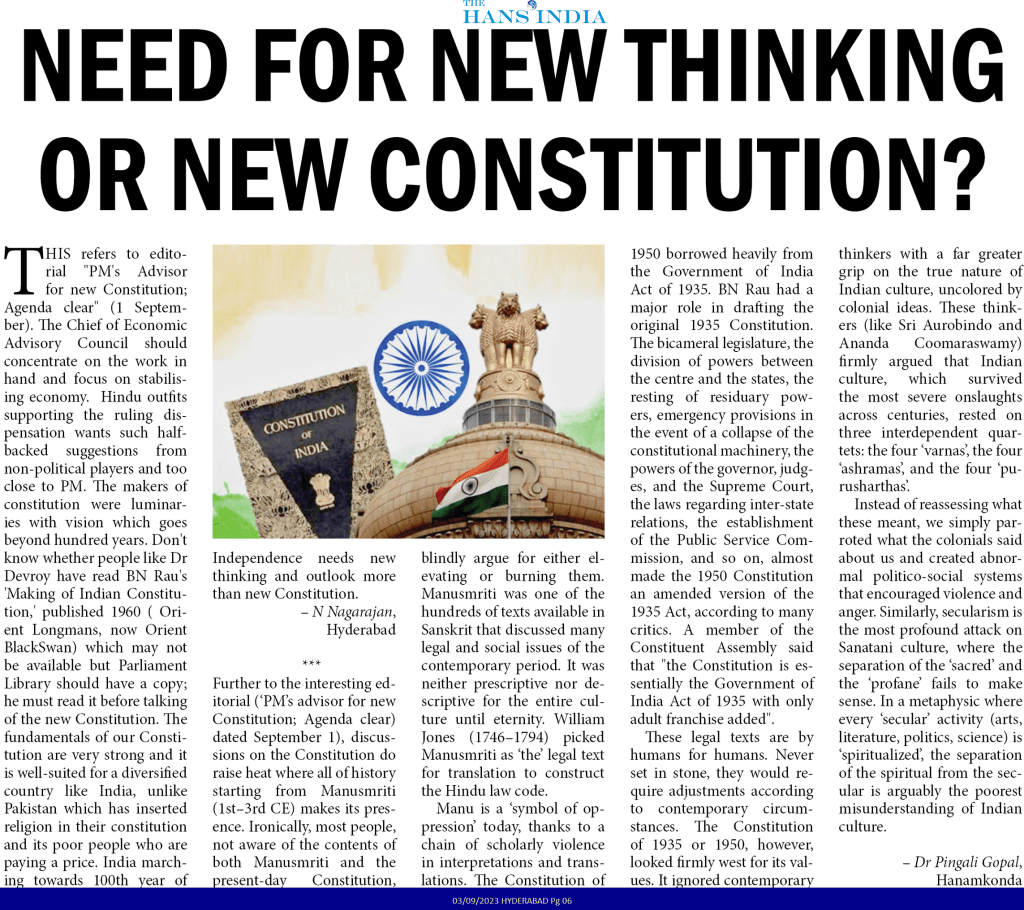
Further to the interesting editorial (PM’s advisor for new Constitution; Agenda clear dated September 1st), discussions on the Constitution do raise heat where all of history starting from Manusmriti (1st–3rd CE) makes its presence. Ironically, most people, not aware of the contents of both Manusmriti and the present-day Constitution, blindly argue for either elevating or burning them. Manusmriti was one of the hundreds of texts available in Sanskrit that discussed many legal and social issues of the contemporary period. It was neither prescriptive nor descriptive for the entire culture until eternity. William Jones (1746–1794) picked Manusmriti as ‘the’ legal text for translation to construct the Hindu law code.
Manu is a ‘symbol of oppression’ today thanks to a chain of scholarly violence in interpretations and translations. A verse from the 10th chapter containing the word ‘vyabhicara’ (translated as sexual misconduct) famously articulates some of those constraints. As scholars show, in gross violation of the strict rules of Sanskrit grammar, translators remove half the words present in the verse with eight Sanskrit words, replace them with many words not present in the source, and exhibit the result as ‘translation’. Interpretations of a narrow, caste-ridden society appear to precede the translation of text instead of the other way around.
The Constitution of 1950 borrowed heavily from the Government of India Act of 1935. BN Rau had a major role in drafting the original 1935 Constitution. The bicameral legislature, the division of powers between the centre and the states, the resting of residuary powers, emergency provisions in the event of a collapse of the constitutional machinery, the powers of the governor, judges, and the Supreme Court, the laws regarding inter-state relations, the establishment of the Public Service Commission, and so on, almost made the 1950 Constitution an amended version of the 1935 Act, according to many critics. A member of the Constituent Assembly said that “the Constitution is essentially the Government of India Act of 1935 with only adult franchise added”.
These legal texts are by humans for humans. Never set in stone, they would require adjustments according to contemporary circumstances. The Constitution of 1935 or 1950, however, looked firmly west for its values. It ignored contemporary thinkers with a far greater grip on the true nature of Indian culture, uncolored by colonial ideas. These thinkers (like Sri Aurobindo and Ananda Coomaraswamy) firmly argued that Indian culture, which survived the most severe onslaughts across centuries, rested on three interdependent quartets: the four ‘varnas’, the four ‘ashramas’, and the four ‘purusharthas’.
Instead of reassessing what these meant, we simply parroted what the colonials said about us and created abnormal politico-social systems that encouraged violence and anger. Similarly, secularism is the most profound attack on Sanatani culture, where the separation of the ‘sacred’ and the ‘profane’ fails to make sense. In a metaphysic where every ‘secular’ activity (arts, literature, politics, science) is ‘spiritualized’, the separation of the spiritual from the secular is arguably the poorest misunderstanding of Indian culture.
 RANDOM MUSINGS