Sanatana Dharma is the closest correlate to the ‘Hinduism’ we know today. The latter is a construct evolved over centuries by an alien understanding of our country as a land and culture. A huge confusion in semantics is the root problem in contemporary Bharat. Sanatana Dharma is the overarching philosophy of the land and is finally a huge conglomerate of traditions (Vedic and non-Vedic, including the so-called tribal), encompassing the whole of the land. Sanatana Dharma is metaphorically the trunk of the tree from which various traditions branched off at different points in time. These branches are both Vedic and non-Vedic. The latter includes even atheism (Charvakism). All the different traditions in the country grew into symbiotic relationships with each other. The relationship between various traditions was ‘dependent yet independent’. The most fundamental essence of traditions is an ‘indifference to differences.’
To reiterate, the traditions are not completely independent and unconnected from the rest. For example, as scholars like Ananda Coomaraswamy say, the superficial differences between ‘Buddhism’ and ‘Hinduism’ disappear on a deep study when they start resembling each other. Buddhism might have rejected the Vedas as an authority like the Jains or the Sikhs, but the messages they give are clearly Upanishidic in nature.
Traditions fundamentally behave differently from religions. A West rooted in religion could not imagine that a culture can exist without religion. Hence, when the colonials came to India and stayed in a hegemonic position of power to set the narratives, they saw the various traditions around them and constructed religions out of them. In this regard, all the indigenous ‘religions’ of India are an ‘experience’ of the colonials, in the words of SN Balagangadhara.
In a religious culture, doctrines are important. Religions stand severely in contrast to traditions. At a fundamental level, religions say, ‘I am true and you are false.’ The only way religion deals with the ‘other’ is to kill or convert. With the impact of many historical factors, religions have settled into more ‘tolerance’ and ‘mutual respect’ modes, primarily in the form of secularism, but the underlying intolerance is active. This is especially true at the central levels of the organisation of religion. Secularism, of course, was primarily meant for only Christendom at a specific time in European history, and it was not a universal solution for all cultures across space and time. Secularism is not able to handle the strife generated by the influx of Islam into Europe today, and neither does it seem capable of handling the ‘communal’ problems in India.
In stark contrast, traditions stay indifferent to differences, saying, ‘I am true, but you are not false’. This allows diversity without the need to kill or convert. This is the fundamental configuration of Indian culture. The reason we have relative peace in the country is because most religions, which came from alien lands, started behaving as traditions. They became integrated into society and culture. Of course, there were huge frictions, but the syncretism happened gradually as the religions were getting traditionalized. They could practice their own faith and build their own churches and mosques, but they would lose the great zeal for conversion as its primary mover.
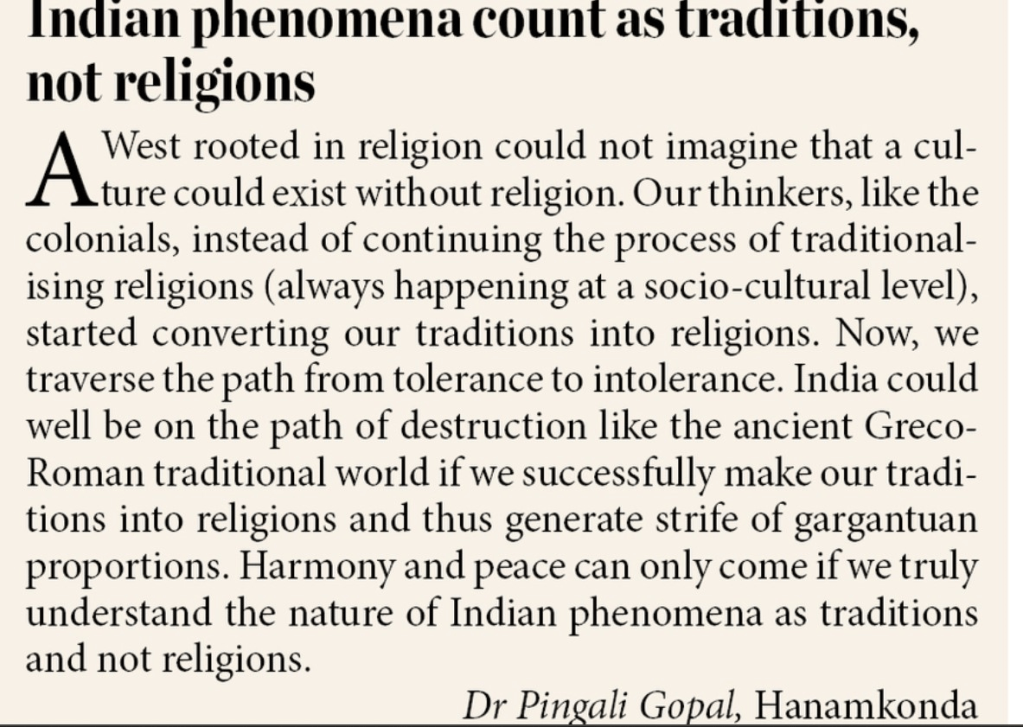
In reverse, our thinkers, instead of continuing the process of traditionalizing religions, started turning our traditions into religions. Now, we traverse the path from tolerance to intolerance. An aggressive Christian faith in the early part of the millennium obliterated the Greco-Roman multi-traditional world. India could well be on the path of destruction like the Greco-Roman world if we successfully make our traditions into religions and thus generate strife of gargantuan proportions.
In which case, Hinduism (the trunk of Sanatana Dharma in a metaphorical sense after all the branches have branched off) will enter into severe battles with not only Christianity and Islam but also the ‘religions’ of Sikhism, Jainism, and Buddhism. We see such things starting to happen in contemporary times. The discomfort with the notion of ‘Hinduism’ as a religion was evident in the writings of scholars like Bankim Chandra Chatterjee, Sri Aurobindo, Ananda Coomaraswamy, and SN Balagangadhara Rao. The last has most clearly developed this strong thesis in his writings.
Harmony and peace can only come if we truly understand the nature of Indian phenomena as traditions and not religions. Converting our traditions into religions would generate only strife and violence in the days to come. The country has solutions for not only India but for the rest of the world too, which sees increasing diversity packed into smaller geographical areas. In the understandings of the white Christian Europe of the past and its secularised versions today, many present narratives of non-western cultures override the traditional understandings. Perhaps the future of the country and the world lies in India’s past. But, to achieve that, we have to see and study India through our own lenses rather than those provided by Europe (or the US in recent times).
A SEVERELY EDITED LETTER ON 15TH SEPTEMBER 2023!
 RANDOM MUSINGS