The history of Indian economics is very difficult to understand for a layperson since the interpretation of the same set of facts by different historians vary widely. Are we rich or poor? Were we rich or poor? What is the truth? Like in many cases, it seems to be in the middle.
This is a four part series written from the perspective of a lay Indian citizen to try and understand what the experts have told about our country. The overall picture is more of hope and optimism and there are definite reasons to be genuinely proud of the country. Yet, we can do better.
The first part is the economic history of ancient and medieval India. The second and third parts deal with the Indian economic scene during the Islamic and colonial period. The final part deals with the Indian economic story after independence. The references are at the end of the fourth part.
Understanding Indian Economy: Ancient To Modern – Part 1
Understanding Indian Economy: Ancient To Modern – Part 2
Understanding Indian Economy: Ancient To Modern – Part 3
Understanding Indian Economy: Ancient To Modern – Part 4
PART 1
ANCIENT INDIAN ECONOMY
Introduction
It is frustrating for a layperson to understand the economic history of India when the same set of facts gets opposite ‘expert’ interpretations. Was and is India rich or poor? If we were so poor, why did the whole world come to plunder us when we should be doing so in reverse? If we are a poor country, why does the world still come to us? For a long time, Marxist historians had a hegemonic hold on only one type of discourse. Marxist linear history represents India and its traditions as the past, or decadence, and the West as the future, or progress. Without denying the patriotism of the Marxist scholars or the politicians using their ideas in formulating our economic policies, we have almost fossilised our self-understanding as that of a permanently poor country for ages.
The GDP (gross domestic product) of India was always high. However, the GDP per capita, that is, the GDP divided by the population of India, was never so high. The high population in the denominator always seems to be a factor pulling the numbers down. Is a high population good or bad? Despite all the disputes, the Indian economy stood on strong ground, with a mix of the bad and ugly too, across the centuries. We now stand among the top five economies in the world. Left alone, we might have evolved in a better manner. The invasions and colonisations may have had their proponents and apologists, but they were clearly disruptive. One does not seek reasons for history because it is an exercise in futility. However, in a world where globalisation, trade, and mutual exchange are a given, it is disagreeable to argue that perhaps we needed an invasion or colonisation to open our eyes to the world.
The following sections are a compilation of many sources to understand the entire Indian economic story without making any claims of primary scholarship. The idea is to understand, as an ordinary citizen of Bharat, the depictions of our economic history. Disturbingly, most of our histories are Delhi-centric. Regional economic histories of the North-East, Marathas, and South (especially the rich maritime trade) remain largely neglected. The recent past has seen a sustained effort towards regional history. As one scholar says, this deliberate positing of regional history will extricate us from an empire-centered view of history, which continued even after independence, in which the Mauryan, Mughal, and colonial British Empires formed a norm of continuum.
Economic History of India- Complex and Controversial Trends in Depiction
The economic history writing in India originated in the controversial assessment of British rule on the Indian economy, says Mamta Dwivedi in her wonderful paper, Trends in Economic History Writing of Early South Asia. Historiography has been through several dominant schools of history writing: colonial, nationalist, Marxist, post-structural, postcolonial, and so on. These were neither successive nor mutually exclusive, with overlaps in methods, theories, and research interests.
As Dwivedi writes, colonial writings, like those of James Mill and Max Mueller, rejected the unhistorical and mythological Indian texts with incoherent periods in terms of millions of years. The firm fixing of periods was mainly after the clear establishment of the ‘Buddhist period’ (using Pali literature and inscriptions at temples and monasteries). Roman and Greek writings on Alexander also helped. James Mill distinguished three periods: Hindu, Muslim, and British, which gradually became the ancient, mediaeval, and modern periods, respectively.
Karl Marx took this forward without ever visiting India or studying India the way he studied other colonised countries. For him, India was a classic example of an “Asiatic mode of production”. This was the absence of private ownership of land; the predominance of a village economy with occasional towns functioning more as military camps or administrative centres than commercial hubs; self-sufficient and closed village economies meeting their own agricultural needs and manufacturing essential goods; a lack of surplus for exchange fostered by the state that collected large shares of the surplus used by a despotic ruler for his luxurious life; complete subjugation of rural communities; and control over the irrigation works by the state. This became a template for all future Marxist descriptions of India.
As Dwivedi explains in the article, the discoveries of the Indus Valley Civilization and Kautilya’s Arthashastra in the early 20th century challenged these ideas radically. Indian civilization was now at least 5000 years old, and ancient Indians’ capacity for rational thought put them on par with the Greek and Roman political and economic thinkers. Archaeological studies problematized the periodization of Indian history, clearly a gross injustice that the entire Indian history of thousands of years before Islam became a single package of ‘ancient’.
Arthashastra demolished the notion of an apolitical India of stagnation, lacking a sense of history, and ruled by a typical despotism of the Orient. An indigenous ‘nationalist’ school of history now tries to restore the great Indian past and its rich heritage through discussion on topics like agrarian structures, property ownership, urbanism, city planning, and long-distance trade.
Marxist history gained prominence in the 1940s, and more so after independence, where economic determinism became the underlying philosophy of critiquing the West along cultural, political, and economic lines. The period between 1950 and 1990, a phase of socialist leaning, had economists seeing great relevance in history.
The discipline of economics abandoned the paradigm of Marxist political economy in the phase after economic liberalization. Over the last decade, historiographical studies have seriously placed ideas in their historical contexts. These explore the encounters between Western rationalism and Indian philosophies. They illustrate how Western scholars struggled with the Indian concepts of time, history, chronology, and identities.
The different schools of history writing have different perspectives on various issues like the organisation of agricultural society, defining urban spaces and urbanisation, the development of states by economic activity, the relation of Buddhist monks and Indian Vysya guilds to developing trading connectivity, and the Indo-Roman trade (who benefitted? India, Rome, both, or none); and so on. Today, a major point of contention in the history of the economy is whether British rule was good or bad for India.
ECONOMY OF ANCIENT INDIA
This section is a summary of a brilliant six-part series (www.indictoday.com/long-reads/role-ancient-indian-economy) by Sneha Nagarkar. Vartta (livelihood) was a recognised branch of knowledge along with Anvisiki (philosophy), Trayi (Vedic knowledge), and Dandaniti (royal, just rule).
Vartta, composed of the three fundamental vocations of agriculture, trade, and animal husbandry, supported most ancient and mediaeval pre-industrial economies. Across centuries, Indic texts stressed Vartta as the prime duty of a king and made it obligatory upon him to provide his subjects with the same. In the four human purposes of human life, Dharma, Artha, Kama, and Moksha; Vartta was the means to artha (money) based on dharmic principles. Also, other purposes too remain difficult without artha. Vedas; Rama’s counsel to Bharata; Narada, Vidura, and Bhishma speaking at various times in Mahabharata; BhagvatPurana, and many major texts incorporated the importance of dharma in acquiring money. This knowledge, glorifying austerity but not poverty, ensured individual and group material prosperity.
Agriculture of Ancient India
Agriculture has been the most enduring foundation for the Indian economy. Mehrgarh (now Pakistan) shows the earliest evidence of agriculture, dating back 10,000 years. The Vedas considered agriculture a noble profession and described ploughs, ploughshares, ground furrows, canals, wells, water resources, and agricultural processes in clear detail. The Ramayana, Mahabharata, Brihadaranyaka Upanishad, Yajur Veda, and Taittiriya Samhita also provide clear descriptions of agricultural fields, processes, types of crops, and the seasons of harvest. Agriculture provided the backbone for urbanisation in the mature phase of the Sindhu-Saraswati civilization (2600–2000 BCE).
Buddhist texts of the 5th and 6th centuries BCE clearly depicted agricultural processes and the associated rituals. It shows a well-developed agrarian economy. Individuals could own land privately. A gama was a rural settlement; the arable lands were the khettas. These words carry the same meaning even today. Later, the Arthashastra of the Mauryan era gives a most detailed exposition on agrarian practices. Land acquisition, the ownership rights, the king’s rights, the different types of grains, irrigation facilities, the provision of loans for cattle and grains, agricultural implements, seasonal harvesting, the tax structure, provisions during famines, and many more issues regarding agrarian practices have a place in this text. Rice, wheat, barley, millets, pulses, and sugarcane were common agricultural products. Megasthenes, who visited Chandragupta Maurya’s court, praised the fertile fields of North India and the irrigation facilities provided by the government.
The Kusanas (1st century CE to 3rd century CE) and the Satvahanas (1st century BCE to 3rd century CE) after the Mauryan (322 BCE–185 BCE) period consolidated the agricultural practices. During the Satvahana period in the South, there were three kinds of ownership of agricultural lands: the state, landholders, and individual farmers. Ploughs, the use of oxen, irrigation facilities, and the use of manure helped agriculture grow. The Guptas and the Vakatakas followed the Kusanas and the Satvahanas, respectively. By the Gupta period, granaries were in existence for storage.
Varahamihira of the Gupta period, in his Bṛihat Saṃhita, gives predictions of rainfall through meteorological calculations. The Krishi Parasarah (4th century BCE to 4th century CE) covers all the aspects of agriculture, such as meteorological observations, field management, management of cattle, agricultural tools and implements, seed collection and preservation, ploughing, and all the agricultural processes involved, right from preparing fields to harvesting and storage of crops.
Trade and Finance of Ancient India- The Role of the Guilds
Ancient India had a vibrant and dynamic system of merchant groups or guilds controlling the manufacturing sector and the trade networks. Collective investments; group travelling for trade purposes; varna and jati groupings; securing identity with localised expertise in crafts; familial transmission of trade practices; urbanisation in the 6th to 7th centuries BCE in the Gangetic plains; and established trade routes were the various reasons that helped in the rise of guilds across the kingdoms. The Vedas and the Brihadaranyaka Upanishad have some references to guild organisations.
Since the 6th century BCE (the first urbanisation phase of the Gangetic Plains), there have been unprecedented economic, political, and religious transformations. Till 320 BCE, the sixteen independent kingdoms (Mahajanapadas) listed in Buddhist and Jaina literature greatly encouraged trade and commerce. The Gautama Dharmasutra (5th century BCE) has the first clear reference to guilds of farmers, merchants, cattle herders, moneylenders, and artisans that had legal power concerning members of their respective groups. The Jataka Tales mention eighteen different kinds of guilds, craft industries, and the principle of heredity in vocations.
200 BCE to 300 CE (the Sungas, Sakas, Kusanas, and Satvahanas) was a golden period of Indo-Roman trade, Buddhist encouragement of trade, and many types of guilds. Mahavastu, a Buddhist text, mentions twenty-four types of guilds, including those for oil pressers, potters, weavers, and bankers. The guilds gave donations, took interest in charitable works, functioned as banks giving interest on the deposited money, and issued their own coins, as evident in archaeological surveys.
Indian guilds were at the forefront of offering their service to the elite as well as the common people. The interest generated by the endowments raised many of the funds. Performing an immense variety of functions, the guilds constructed houses, temples, assembly halls, tanks, parks, and water reservoirs; performed Yajnas; provided food for the needy; helped society during distress and natural disasters; provided for defence expenditures; and allocated funds to the mentally and physically challenged, orphans, and destitute women.
The Buddhist guilds funded the construction of rock-cut dwellings, arable land, pillars, and water cisterns for monasteries. Many of these sites were on major trade routes, and some, like Mathura, were important trading places themselves.
The inscriptions, Panini’s Ashtadhyayi, Gautama Dharmasutra, and Arthashastra describe banking functions like money-lending, creditors, debtors, loans, interest, repayment, and surety, which indicates that around the 5th century BCE, money-lending had become a common function. The Arthashastra has mention of adesa, akin to the modern bill of exchange or a letter of credit.
The post-Mauryan (2nd century BCE to 3rd century CE) world saw an increase in the money economy, coins, and banking services as international trade increased. By the 1st century CE, the guilds were strong in the economic and political spheres, and common people, as well as high state officials, placed immense faith in them for their effectiveness and honesty. Senior royal officers used the interest received on money deposits for charitable work. Permanent endowments in the form of gold and silver to guilds continued in the Gupta period, as noted in inscriptions from near Prayag in Uttar Pradesh.
The Guptas period, prominent from 300 CE to 600 CE, showed a slackened Roman trade but a strengthening with Southeast Asian countries. The Jain and Buddhist texts, the Dharmashastras, art, and poetry of that period, like Kalidasa’s Raghuvamsha, give a description of the growth of guilds during this period. The banking functions of guilds increased, and there were guilds of goldsmiths and carpenters too. The guilds had influence over the king and were part of the jury while trying cases involving traders. However, from the 7th century onwards, in the post-Gupta period, guilds began to gradually decline in trading and economic power.
Indo-Roman Trade: The Golden Period of Indian Economy
Regarding the Indo-Roman trade, the dominant view is that the trade favoured India. An opposite view favours the Mediterranean, Egypt, and West Asia. The third view states difficulty in calculation in the absence of detailed statistics. Indo-Roman trade started in the 1st century BCE, matured in the 1st and 2nd centuries CE, and declined in the 3rd and 4th centuries CE with the fall of Satvahanas and Kusanas in India and the Roman Empire itself in the 4th century CE.
The Sakas and Satvahanas in the north and south, respectively, controlled the sea trade. The Kusanas controlled the land trade and even had Roman gold coins issued to promote foreign trade. There was a Roman influence on Indian art and goods too. Sphinx sculptures in cave complexes, the carving of Bactrian camels, the design of Indian lamps in Roman style, and the issuance of coins with images of large ships are all examples of this influence.
Bharuch in today’s Gujarat, under the Ksatrapa rulers of Saurashtra, was the key port in this trade. The seaborne journey from Rome to the western coast of India took approximately sixteen weeks. Bharuch had trade relations with inland cities: ancient Pratisthana (modern Paithana) and Tagara (or Ter), both in Maharashtra; Masulipattanam and Vinukonda in Andhra Pradesh; and Kalyana near Mumbai.
From India, there was the export of circus animals, muslin, cotton, ivory, tortoise shells, herbs and spices, dyes like indigo, sesame oil, wood, wheat, ghee, fragrant ointments, and precious stones. Roman legislators lamented that the payment of Roman gold and silver to India strained their economy. Except for Chinese silk, India dispatched the rest of the Chinese exports to Rome. India imported wine along with copper, tin, lead, coral, topaz, and waist girdles.
Periplus on the Erythraean Sea, a travelogue written by an unknown Greek sailor and merchant, is one of the major sources for reconstructing the history of this trade. The Periplus informs us about the important ports on the west coast of India, like Kalyana, Sopara (a Buddhist site), Sesecrienae (Aegedi, Goa), and the port of Muziris. The last, somewhere in Kerala, was an important port from where an inland trade route went through Palakkad and reached the East Coast.
The Pandya rulers of Madurai controlled the Gulf of Mannar, well-known for pearls. Going upwards on the East Coast, the ports described were Colamandala, Kaveripattanam, Poduca (Pondicherry), Masulipattanam, known for muslin, Dosarene (Odisha), famous for ivory exports, and Tamralipti (Bengal), known for muslin cloth and tortoise shells.
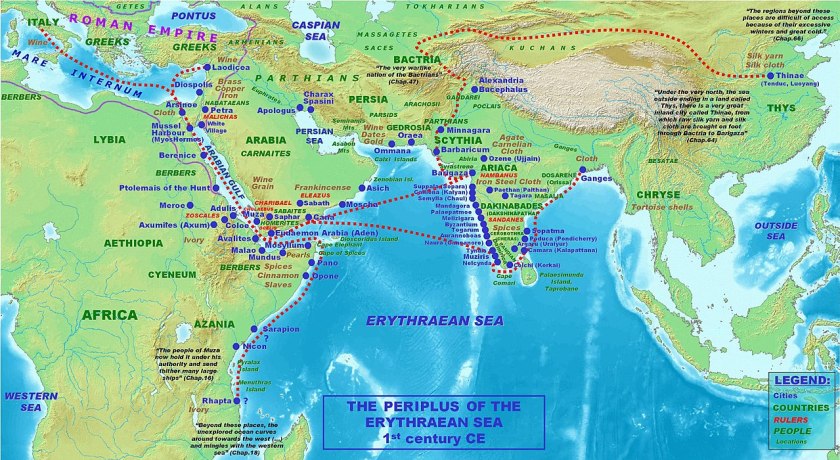
Names, Routes, and Locations in the Text
The Second Wave of Urbanisation- Rise of Cities and Empires (6th century BCE to 5th century CE)
The first wave of urbanisation was the mature phase of the Sindhu-Saraswati civilization (2600–1900 BCE). The second wave, also known as the Painted Grey Ware Culture, started in the Ganga valley in 600 BCE. What constitutes urbanisation? Though contested, archaeologist V.G. Gordon Childe enumerates a few criteria: cities larger and denser in size and consisting of non-food producing classes; farmers cultivating the land outside the villages; cities supported by agricultural surplus; the king collecting the surplus as tax; cities having monumental structures; recording data and predictive sciences like astronomy becoming important; evolution of writing systems, arithmetic, grammar, arts, and crafts; providing of raw materials and state protection to artists and craftsmen; flowering of brisk trade and economy; forming of long-distance exchange networks; and money economy replacing a barter system.
The widespread dissemination of iron technology; the growth of agriculture; the rich alluvial soil of the Ganga plains; coalescing politico-geographical units; and the support of Buddhist and Jain traditions in trade and commerce were the different factors that led to the second wave of urbanisation in the Ganga valley in the 6th century BCE. There is a possibility of kings establishing central cities and then spreading centrifugally. A city could be an administrative, political, religious, or economic centre.
Villages (janapadas) combined to form the Mahajanapadas, which have clear references in the Mahabharata, Buddhist, and Jain texts. Each of the sixteen Mahajanapadas had a capital city. In the 6th century BCE, Campa (Anga), Rajagriha (Magadha), Sravasti (Kosala), Saketa (Kosala), Kausambi (Vatsa), and Varanasi (Kasi) were the six great cities. By the 6th century BCE, there was an established inland trade, mercantile guilds, and caravan merchants.
King Ajatasatru of Magadha (5th century BCE) founded the city of Paṭaliputra (modern Patna) on the banks of the river Ganga. Magadha emerged as the largest and became an empire under Chandragupta Maurya. Second urbanisation attained its zenith during the Mauryan kings (322 BCE–185 BCE). The increasing population settled along the tributaries of the Ganga too. The population of Pataliputra was around 2,70,000 in the Mauryan Age. Other important cities were Taksasila, Kausambi, Mathura, and Ujjaini.
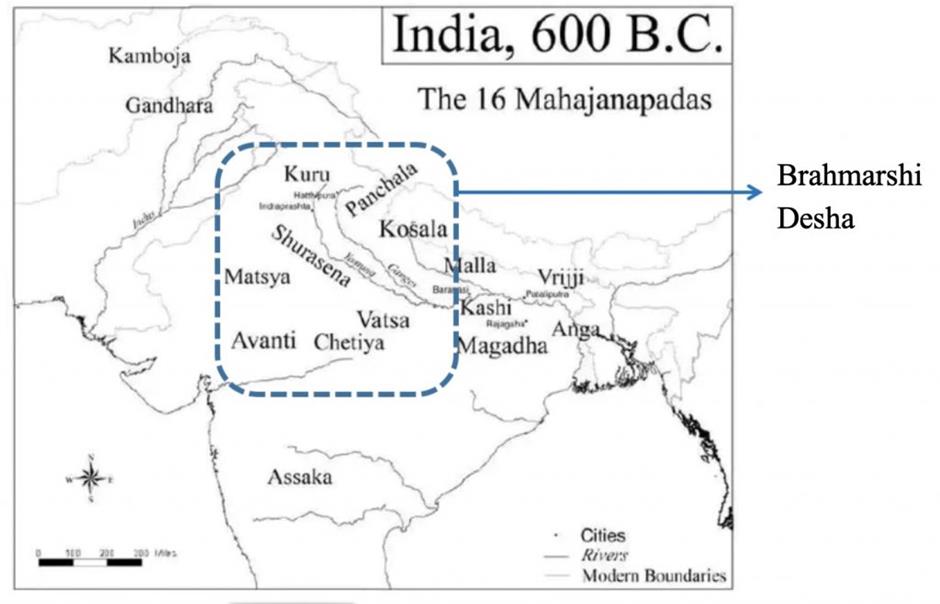
The Deccan and Southern India also experienced their own phases of urbanisation under the rule of the Satvahanas, Cholas, and Pandyas. Many Mahajanapadas had their own full-fledged silver currency. The second urbanisation until the 4th to 5th centuries CE showed great progress in astronomy, arithmetic, and geometry. The science of grammar, the six systems of Indian philosophy, and the non-orthodox philosophies were advanced and well-established during this period.
In the next part, we shall look at the Indian economy during the mediaeval period, dominated primarily by Islamic rule in the north. We shall also look at the impact of colonialism on world order. The new-found principles of nation-states kicked off a huge expansion of colonial powers, causing many disruptions, including economic ones, to the world. Europe was the epicentre of these colonial projects. The British replaced Moghul rule, and both impacted India in many ways.
PART 2
MEDIAEVAL ECONOMY AND THE IMPACT OF COLONIALISM
Part 1 of this series was a summary of the ancient Indian economy. In this part, we shall look at the mediaeval economy of India, which began with the fall of the Gupta dynasty in the 7th century CE and finally culminated with the beginning of the Delhi Sultanate in the 13th century CE. This part also covers the important rise of Europe in dominating the world order through its colonial expansion and how it specifically impacted India too.
MEDIAEVAL ECONOMY OF INDIA
The Early Period: 8th to 12th centuries CE
The Guptas and the Vardhanas, the last of the great Indian dynasties, collapsed by the 7th century CE. The period from the 8th to the 12th centuries CE, between the fall of the Guptas and the beginning of the Delhi Sultanate in the 13th century, had smaller kingdoms across the country. This period suffers from a lack of coins and written sources, which gets two opposite interpretations from economic historians: one as a dark period of stagnation and the other as the development of alternative forms of exchange.
The early mediaeval period saw a huge increase in land grants to feudatories and religious establishments across the country. The classical Marxist scholars subscribe to a model of economy marked by an Asiatic mode of production—a despotic model of stagnation. Feudalism because of land grants resulted in a decline in both urbanism and foreign trade. Centralised state authority broke up to give way to semi-independent rulers, allowing a situation of forced labour, petty officials, and a type of serfdom.
New theories, however, say the opposite and believe that Indian feudalism, unlike the European type, was perhaps non-existent. Conducive agricultural conditions for most of the year, the hump on the Indian bull preventing excessive human labour, and two-crops a year made India a ‘free peasant economy’. The dark period was more applicable to Europe, perhaps. BD Chattopadhyaya postulates a period of integration rather than disintegration, which led to the emergence of new states, the flourishing of trade, and new urban centers. This radically challenges the stereotypical Indian feudalism model, says Vipul Singh, author-historian (Interpreting Mediaeval India).
Another group of historians similarly argues for the assimilation of local polities into larger state structures. There could have been a period of flourishing trade urban centers developed at the sites of old towns, perhaps the period of the ‘Third Wave of Urbanization.’ Economic historian John Deyell says that the non-availability of coins could be a situation of increased demand and not a financial crisis. Cowries (shells) were the mode of exchange instead of silver coins, and there is evidence of using hundika as bills of exchange. There is also evidence of a flourishing trade with the Arab world, China, and Southeast Asia.
The Delhi Sultanate (The Late Medieval Period)
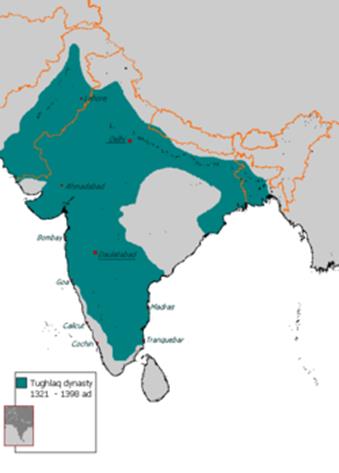
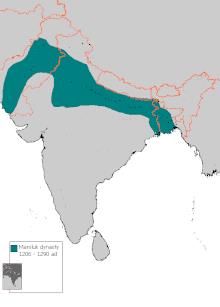
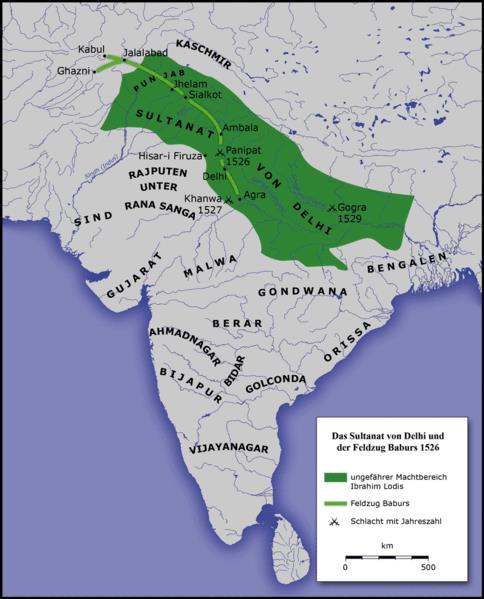
Mahmud Ghazni attacked the Hindu and Buddhist kingdoms from 962 CE to 1030 CE seventeen times but could not get a foothold. Muhammed Ghori finally started the Mamluk dynasty’s rule over Delhi. A total of 320 years from 1206 CE to 1526 CE was the period of five successive Islamic dynasties forming the Delhi Sultanate: Mamluks (1206–1290), Khiljis (1290–1320), Tughlaqs (1320–1414), Sayyids (1414–1451), and Lodis (1451–1526). In 1526, Babur defeated Ibrahim Lodi and began the Mughal Empire.
The Sultanate integrated India into a global cosmopolitan culture, gave some Hindu-Islamic syncretism, established a unique Indo-Islamic architecture, and could withstand the Mongols. However, it was disruptive too, with the destruction of temples, universities, and libraries. The area under its rule peaked during the Tughlaq dynasty. The economic policies included severe centralization of markets, tight controls, heavy taxes (up to 50% of agricultural produce), pricing controls, strict punishments, and licencing regulations. However, the disruption of social and political life did not grossly damage the economy. India’s GDP share of the world declined under the Delhi Sultanate from nearly 30% to 25% and would continue to decline until the mid-20th century. Papermaking became widespread during this period.
The Mughal Empire (1526-1857)- Socioeconomic Status
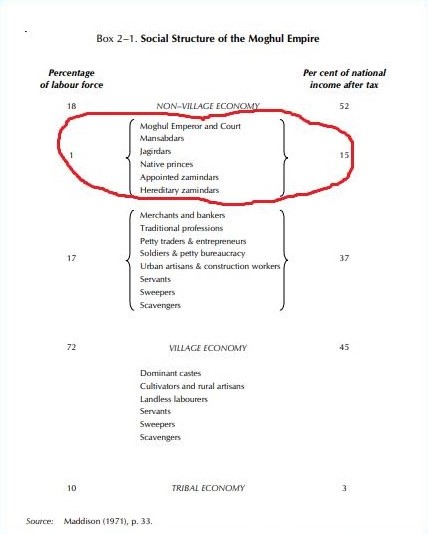
Muslim rulers, the ruling elite, from the thirteenth century until the British takeover squeezed a large surplus from a passive village society. The ruling Muslim elite was only 1 percent of the labour force, contributing to 15 percent of national income.
Urban artisans producing high-quality cotton textiles, silks, jewellery, decorative swords, and weapons, supplied the needs of the extravagant ruling class. The Moghul non-hereditary aristocracy had access to tax revenue from a specified area (a jagir). Influential secular historians propagate a rich Mughal India. Mughal architecture does suggest a rich economy, but there was no general prosperity in Mughal India, says Saumya Dey (Narrativizing Bharatvarsha). Mughal rule was the ruthless exploitation of the primary producers—theartisans and the peasants. The silver wage data unambiguously suggests the divergence between England and India for unskilled workers. Skilled workers could not have fared a lot better. European travellers such as Francois Bernier wrote about the harsh treatment of artisans and their poor payment by the nobility.
Irfan Habib (The Agrarian System of Mughal India) shows the sad plight of the peasantry in the Mughal Empire and its terrible oppression. The peasant was poor and debt-ridden despite increased agricultural produce. The diet and clothing of the rural populace were rudimentary. Famines were frequent. The land revenue levied in the Mughal Empire was steep, amounting to half the produce. The tax was high because two sets of people levied it: the jagirdars (who had to maintain expensive armies) and the imperial authorities (who approximated the surplus produce).
The jagirdars, transferred frequently, rarely had any long-term vision towards improving agrarian production. In the Mughal Empire at its peak (mid-17th century), in contrast to the rest of the world, commodity consumption in the Empire was heavily in favour of only the higher classes. In 1647, only 445 families received 61.5 percent of all revenues, which were about 50 percent of gross agricultural output. Mughal India was not ‘rich’; only the Mughal royalty and nobility were.
THE COLONIAL STORY OF EUROPE AND INDIA
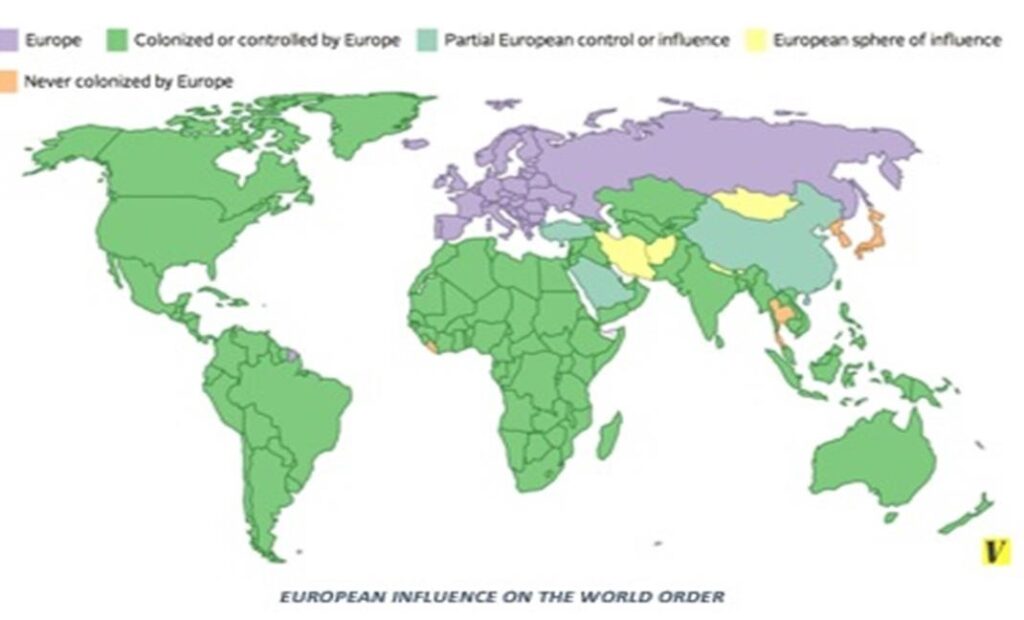
European Nationalism and Colonialism Impacting the World
Some scholars do think that had the British and France not ruled India, it would not have developed as well from the ruins of the Mughal Empire. However, there was a certain unjustifiable moral and ethical deficiency in the European alteration of the world in the name of nationalism. The violent European domination against other parts of the world involved extermination, marginalisation, the conquest of indigenous populations, slave trade, colonisation, material loot, and intellectual plundering of societies.
Angus Maddison (The World Economy) shows how Europe declined economically from the first to the tenth centuries but forged ahead in the next five hundred years. A few major reasons for its growth were improvements and growth in agricultural methods, international trade (sugar, spices, paper, silk), mining, metallurgy, weapons production, shipping, navigation techniques, banking, accountancy, marine insurance, universities, printing, and windmill technologies. The beginnings of the nation-state system also helped.
European colonialism, from the 16th to 20th centuries, led to the establishment of colonies in the Americas, Africa, and Asia. Europeans, with relatively scarce trade resources, but hugely equipped with guile, military resources, nationalistic zeal, and decrees from royalty and the Church; travelled widely to occupy foreign lands. The academics at the universities gave intellectual justifications for these excursions.
Colonialism was of two types:
1) settler colonialism, when primarily European residents established towns and cities (United States, New Zealand, South Africa, Canada, Argentina, and Australia); and
2) exploitative colonialism, purely extractive and exploitative colonies. When Europeans settled in desirable territories, natives gave way to the colonialists, mostly in a violent manner.
The saddest chapter was arguably Africa. The Berlin Conference of 1884 allowed European states with even the most tenuous connection to an African region to claim dominion over its land, resources, and people. It allowed the arbitrary construction of sovereign borders that had never previously existed. During the colonial period, the British and the French colonised more than 95% of the continent. The entry of the Germans, Portuguese, Italians, and Dutch led to the spread of European culture. Today, most of Africa uses either French or English as the second language. The extreme economic exploitation of Africa included the slave trade, one of the most brutal chapters of human history.
In the seventeenth and eighteenth centuries, Britain, the main slave shipper, brought a total of 2.5 million Africans to the Americas. The British abolished the slave trade and slavery by 1833, with £20 million compensation to slaveowners and nothing to the slaves. The table (Maddison) shows starkly the impact of colonisation on the US, with a decrease in Indigenous population, a migration of Europeans, and a thriving slave trade.
| Ethnic Composition of the US Population, 1700–1820 (in 000) | |||||
| Indigenous | White | Black | Total | ||
| 1700 | 750 | 223 | 27 | 1000 | |
| 1820 | 325 | 7884 | 1772 | 9981 | |
The English and the Other Europeans
The Dutch (Netherlands) had a huge presence across the world, constantly fighting the Portuguese and the British, and finally losing many territories. The Dutch, between 1636 and 1658, ousted the Portuguese from Ceylon and made it a major Dutch trading post. Later, in 1796, the British seized control of the Dutch positions. The Dutch replaced the Portuguese in Indonesia, which became the headquarters of the Dutch East Indies Company. The Dutch had bases in Taiwan, Malaysia, Japan, Australia, Iran, Pakistan, Ghana, South Africa, the present-day USA, the West Indies, Suriname, Guyana, Brazil, the Virgin Islands, and Tobago, amazingly.
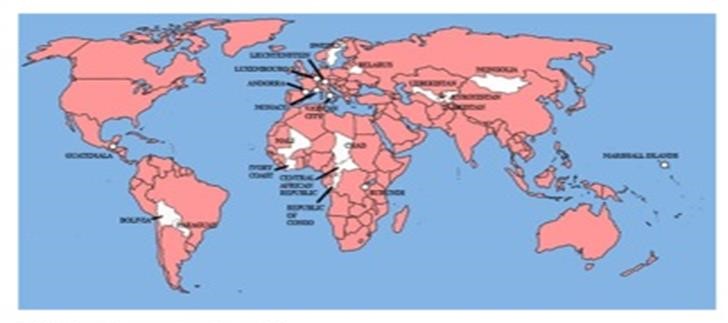
The British invaded almost 90 percent of the countries around the globe at different times. Only 22 of the almost 200 countries in the world have never experienced an invasion by the British. Between 1700 and 1820, Britain rose to world commercial hegemony due to many reasons: changes in British economic structure with a big rise in industry and services; use of a beggar-your-neighbour strategy; and wars that weakened French and Spanish domination. Though it lost the Americas, it extended its control over India. Britain grew further between 1820 and 1913 due to technical progress, absent wars, the growth of the physical capital stock, and improved education and skills in the labour force. It added Africa, Asia, and a major part of India from 1820 to 1913. The total population of the Empire was 412 million (ten times Britain’s size), and three-quarters of this was from India.
Small countries could colonise too. Denmark-Norway had colonies in Africa, the Caribbean, and India (Tranquebar in 1620). Belgium controlled the Belgian Congo from 1908 to 1960 (76 times larger than Belgium itself) and Ruanda-Urundi from 1922 to 1962. Spain had conquests in the Americas and Africa. Portugal had large areas of control in Brazil, Africa, South-East Asia, and, of course, an uninterrupted four-and-a-half-century hold over Goa. Italian colonialism (1890–1941) in Africa included Libya, Ethiopia, Eritrea, and Somalia.
Switzerland, the only paradox, did not colonise any country but did have connections through mercenaries, businesspeople involved in the slave trade, and a widespread network of missionaries. The Swiss turned English colonial expansion to their own advantage. They rose to the top economically through a combination of many factors: avoiding confrontation with the English; producing high-quality goods; maintaining a state of armed neutrality; offering economic concessions to parties on both sides of the war; production facilities remaining undamaged by the war; and the absence of patent law until 1907; which facilitated the emergence of many industries at low development costs. Swiss neutrality, political stability, national sovereignty, and ‘no questions asked’ banking have allowed the most prosperous banking sector to grow. Today, an estimated 28 percent of all funds held outside the country of origin are in Swiss banks.
In the period between 1913 and 1950, the two world wars and the Great Depression shattered the liberal economic order. International migration grossly came down; foreign assets were sold, seized, or destroyed; and overseas empires disintegrated, yet their impact on world economic growth was smaller than expected. The pace of technological advances (transport revolution; road freight transport; tractors; aviation; electricity; automobiles; a huge range of new household products, and so on) was responsible for this. There were also advances in chemistry, which created synthetic materials, fertilisers, and pharmaceuticals.
Colonial India- A Snapshot
The colonial expansion of many European nations, made possible by a few decades of advanced naval power and a sense of religious, intellectual, and racial superiority, deeply impacted India. The British fought 111 wars to capture India, according to one count. Samuel Harrington says,
“The West won the world not by superiority of its ideas, values, or religion, but rather by its superiority in applying organised violence.”
The European naval power used the trade route with India and East Asian countries by sailing around Africa (before the Suez Canal) for colonial expansion starting in the 15th century. Trading rivalries among the seafaring Europeans brought them to India.
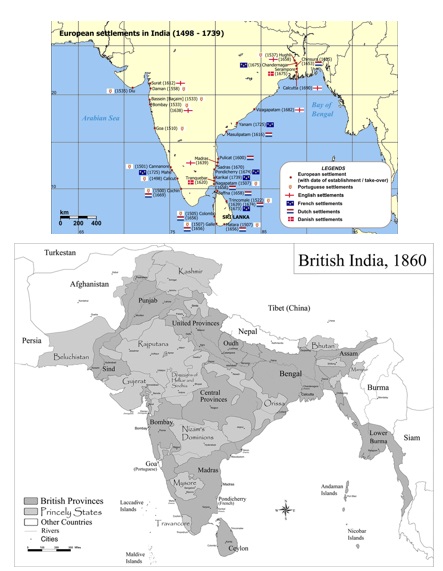
The Dutch (1605–1825), the Danes (1620–1869), the French (1668–1954), the Portuguese(1505–1961), and the British (1612–1947) had a piece of India at various times. They militarily fought amongst themselves on Indian soil, and finally the British emerged victorious. The South Indians and the Marathas were great naval warriors, resisting the Europeans and sometimes defeating them badly. Marthanda Verma (1705–1758), a great Kerala ruler, resisted the Dutch and defeated them decisively. Some claim that if this had not happened, India would have been using the Dutch language instead of English today.
European internal wars and treaties influenced India. The most significant would have to be in 1661, when Portugal, at war with Spain, needed assistance from England. This led to the marriage of Princess Catherine of Portugal to Charles II of England, who imposed a dowry that included southern Bombay. This was a major event for Britain, which kicked off their conquests vigorously. With the disintegration of the Mughal Empire in the early 18th century and the weakening of the Maratha Empire after the third battle of Panipat (1761), many relatively weak and unstable Indian states were increasingly open to manipulation by the Europeans.
In the later 18th century, Britain and France struggled for dominance, partly through proxy Indian rulers but also by direct military intervention. The Deccan wars between the French and the English had Indian soldiers on both sides. By the middle of the 19th century, the British had already gained direct or indirect control over almost all of India.
In 1600, Britain contributed 1.8% of the world GDP when the East India Company was set up. In 1750, India and China constituted 75% of the world’s GDP. When Britain left India, the former was contributing 10% of the world GDP, and India a pathetic 1.8%. The British left behind a society with 16% literacy, a life expectancy of 27 years, and over 90% living below the poverty line. Electricity, first supplied in the 1890s, reached all of Britain, the US, and Europe by 1947. However, merely 1500 of India’s 640,000 villages were on the electricity grid.
India was an ‘extractive colony’. India’s rich maritime trade and advanced banking system came to a grinding halt under colonial rule. The British Raj systematically subverted each of the state machinery tools, such as armies, censuses, bureaucracies, railroads, hospitals, telegrams, and scientific institutions, to its own profit by plunder and manipulation. As Shashi Tharoor (An Empire of Darkness) explicitly states, in the 107 years from 1793 to 1900, an estimated 5 million people died the world over in all the wars combined. But, in only 10 years, 1891–1900, 19 million people died in India due to famines alone. The famines, the biggest colonial holocausts, are at the top of some of the most severe inhumanities in modern times.
The regular Bengal famines were the result of careless planning, Malthusian ideas, and highly racist leaders sitting in England looking the other way. Churchill hated the Indians and thought that they bred like animals. While the people were reeling under famines, rice went as an export from Bengal to feed the soldiers fighting the World War in Europe. Madhushree Mukherjee, in her book, Churchill’s Secret War, details with deep research the role of Churchill in the Bengal famine of 1943, which killed 4 million Indians. This was a crime that puts Churchill on the same pedestal as Hitler.
It is difficult to place a figure, but on an estimate, the British took 45 trillion dollars from India during their 175-year presence (Utsa Patnaik). Of course, there are disagreements about this figure between the apologists and the history-reclaimers, who believe that this figure is an oft repeated myth. Finally, the British, apart from the economic plunder, distorted our cultural-social narratives, which we completely internalised. The British left a bifurcated country, but the discourses they left behind (religions, caste system, Aryan theory, and so on) continue to divide us in many ways.
The Portuguese, a story most Indians are simply ignorant about, ruled Goa for a continuous period of more than four centuries (1510–1961). They blatantly refused to let go of it, even after Indian independence. An army attack, finally led by the Indian government, made them flee without much bloodshed. Ironically, Portugal was and continues to be one of the most backward countries in western Europe. Yet, it was a ‘pioneer in expansionism’, motivating other seafaring and shipbuilding neighbours to explore, conquer, and plunder. Agriculture, infrastructure, industry, and higher education stayed quite static in Goa, as Portugal did not make any great attempts at boosting them. Excise duty was a great source of income. Banco Nacional Ultamarino, the only bank, had the dubious distinction of accepting deposits but offering no interest and advancing loans at the highest rate of interest in the world. Portugal just did not know how to exploit India as effectively as the British!
India And the World Wars – Fighting Without Stakes
The First World War (1914–1918), involving 32 countries, divided Europe into two coalitions: the Triple Entente, or Allied Powers (France, Russia, and Britain), and the Triple Alliance, or Central Powers (Germany, Austria-Hungary, and Italy). The mobilisation of 70 million military personnel made it one of the largest wars in history. An estimated nine million combatants and seven million civilians died as a direct result of the war.
In 1914, the Indian Army was one of the two largest volunteer armies in the world. The Indian Army fought in the North-West Frontier, Egypt, Singapore, and China. The Indian Army also fought in the European, Mediterranean, and Middle East theatres of war. Over one million Indian troops served overseas, of whom 62,000 died and another 67,000 wounded, a war without any personal stake or honour, except for the reason that we were a colony of the British. 588,717 Indians went to Mesopotamia, 116,159 to Egypt, 131,496 to France, 47,000 to East Africa, 4,000 to Gallipoli, 5,000 to Salonica, 20,000 to Aden, and around 30,000 to the Persian Gulf to fight in World War I for the British.
The Second World War (1939–1945) was the deadliest conflict in human history, with 50–85 million fatalities. This war, involving almost 50 countries, included massacres, the genocide of the Holocaust, strategic bombing, premeditated death from starvation and disease, and the only use of nuclear weapons in war. It began with the invasion of Poland by Germany and subsequent declarations of war on Germany. It was a fight between the Axis powers (Germany, Italy, Japan, Hungary, Romania, Bulgaria) and the Allied powers (U.S., Britain, France, USSR, Australia, Belgium, Brazil, Canada, China, Denmark, Greece, the Netherlands, New Zealand, Norway, Poland, South Africa, and Yugoslavia).
2,065,554 Indian soldiers fought in the Second World War, and over 87,000 Indian soldiers died in World War II. Indians fought in the European theatre against Germany; in North Africa against Germany and Italy; in the South Asian region, defending India against the Japanese; and fighting the Japanese in Burma. Indians also aided in liberating British colonies such as Singapore and Hong Kong after the Japanese surrender in August 1945. Claude Auchinleck, Commander-in-Chief of the Indian Army, said that the British ‘couldn’t have come through both wars if they hadn’t had the Indian Army.’ Basically, India fought and lost its sons in a war essentially based on the greed, ambitions, and angers of European powers against each other. This is the briefest description of the main historical events that impacted our economy.
In the next part, we shall look specifically at British rule in India and how it impacted the Indian economy. Ironically, this is also a major point of contention, as there are strong voices that do not agree that the British were an unmitigated disaster for India. A study of the British impact on the economy was in fact one of the great initiators in the field of economic history in India.
PART 3
THE BRITISH PLUNDER OF INDIA (AND THE NAYSAYERS)
In the previous parts, we looked at the ancient and mediaeval Indian economies and the impact of European colonialism on India and the world. The British firmly established themselves on Indian soil and had almost an uninterrupted run of nearly two centuries. When they finally left in 1947, our economy was in shambles, and there were many problems with the intellectual narratives set by the colonials. This part is an assessment of British rule in India and where we stood at independence. Some scholars are vociferous in equal measure for the positives the British gave us, but fortunately, they are a minority.
Britain impacted the Indian economy mostly negatively.
- Agriculture and industry did not develop in India.
- The industry in England developed from the raw materials exported cheaply from India.
- India was a market for the finished products.
This summarizes the British exploitation of India. Others were direct monetary transfers and use of Indian soldiers for the British army. The British rule is divided into two epochs, roughly a century each: the East India Company rule (1757–1858), and the British Government rule (1858–1947).
East India Company (1757–1858)
The East India Company (EIC) came as spice traders, first landing at Surat on August 24, 1608, forever changing India’s face. Later, they traded in silk, cotton, indigo dye, tea, and opium. After Jahangir’s permission, starting with Surat in 1613, they established factories across the Moghul empire. The Battle of Plassey (1757) and the Battle of Buxar (1764) were decisive for the gradual political involvement of the EIC. Progressively, they seized control of the Moghul province of Bengal (1757), Madras and Bombay provinces, and Punjab (from the Sikhs in 1848). They also drove out the French and the Dutch.
The EIC, a story of power and greed, made individuals rich despite the company faring poorly. The rice trade gave them a 900 percent profit. Robert Clive claimed £30,000 a year, about one-seventeenth of the then-annual revenue of Great Britain. Within the next half century after Clive, an estimated £500 to £1,000 million went from India to Britain. Till the mid-18th century, Britain mainly exported textiles and raw silk from India and tea from China. Bullion (gold) made the Indian payments; opium and raw cotton from Bengal made the Chinese payments.
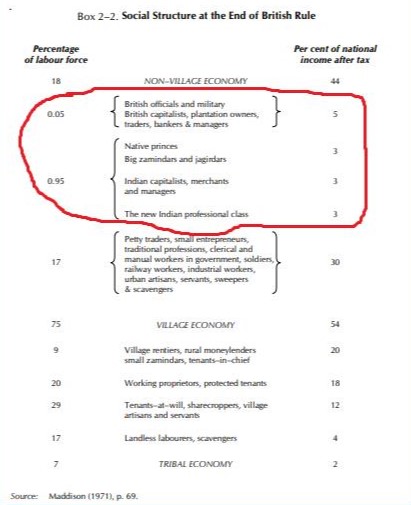
Warren Hastings became the first Governor General in 1772. From 1785 on, there were no Indians in the high-level posts. In 1829, established districts throughout British India had individual British officials as final authorities. Never more than 0.05 percent of the population, there were only 31,000 Britishers in India in 1805, which in 1931 went up to 1,68,000 (about 60,000 in the army and police, 4,000 in civil government, 60,000 in the private sector, and the rest, non-professionals). After the first Indian War of Independence in 1857, the Mughal rule completely collapsed, and there was a power transfer from the Company to the Crown. This began the British Raj, with no further extension of direct rule over provinces governed by Indian princes.
The British Impact on Indian Agriculture
The Moghul tax system provided land revenue equal to 15 percent of national income, but by the end of the colonial period, land tax was only 1 percent of national income. However, the gains from tax reduction went to upper castes, zamindars, and moneylenders in the village economy, as Angus Maddison says (The World Economy). The landless agricultural labourers grew under British rule.
The irrigated area increased to more than a quarter of the land under British rule, compared with 5 percent in Moghul India. Improvements in transport facilities (railways, steamships, and the Suez Canal) helped agriculture by permitting some specialisation on cash crops and in exporting Indian indigo, sugar, wheat, cotton, jute, and tea to England. Hardly significant, as the latter two primary export items were less than 3.5 percent of the gross value of crop output in 1946.
Between 1850 and 1947, there was an increasing commercialization of agriculture, with crop production for sale rather than for family consumption—a deliberate policy to acquire more raw materials for British industries. The peasants now purchased foodstuffs for their domestic needs. Prior to developments in railways and trade, the famines were local food shortages due to crop failure. After 1860, these famines were purchasing power famines with high food prices, unemployment, hoarding, and speculation despite adequate transport. Famines most affected present-day Bihar, West Bengal, Orissa, Rajasthan, Tamil Nadu, Maharashtra, Andhra Pradesh, and Karnataka. The immediate cause of crop failure was inadequate or unreasonable rains.
Additionally, the British created a land system where the property owners had to pay a fixed land revenue to the British but could charge the tenants as much as they wanted. The combination of landowners interested in high rents and moneylenders extracting high interest rates retarded agrarian development and made the cultivating class extremely poor. Unemployed craftsmen and artisans also shifted to agriculture as additional pressure. From the mid-19th century to 1931, the population proportion of those dependent on agriculture increased from 55 percent to 72 percent.
Finally, EIC converted large tracts of fertile land on the Gangetic River plains (nearly 1000 square kilometres by 1850) of Eastern India to poppy farms for the highly valued opium. This went to China in exchange for buying Chinese goods. This consequently led to opium wars in Asia; the major of them was between 1856 and 1860. After China became a part of the opium trade, by 1900, the government had increased cultivation to over 500,000 acres in the Ganges basin.
The EIC and later colonial officials had an exclusive monopoly on production, processing, and exports. As Sarah Deming (The economic importance of Indian opium and trade with China on Britain’s economy) analyses, EIC made opium an efficient and profitable business to service the cost of imperialism while also reducing its trade deficit with China. Except for the Bombay Parsis where the company had less influence, Indians investing in the opium business failed due to the strong EIC monopoly.
The British Impact on Indian Industry
The Industrial Revolution (1760–1840) reversed the thriving previous Indian exports with an increased demand for raw materials for British industry and the need to capture foreign markets for finished products. The inexpensive machine-made goods held a severe competitive advantage over the more expensive Indian handicrafts, India’s largest industry. Later, massive duty-free imports of cheap textiles (cotton, wool, and silk) from England and the unwillingness to give tariff protection caused immense damage to cotton exports from Indian modern mills.
Cotton mills started in Bombay in 1851, preceding Japan and China by two to four decades. Exports were half of the output. By the end of the 1930s, Indians were importing cotton from China and Japan in reverse. With increasing Japanese imports, the British introduced stifling measures to raise tariffs on non-British cotton cloth to 50 percent. Despite all this, Indian mills succeeded in increasing their production, producing 75 percent of Indian cloth consumption at independence.
Only when England rose to industrial supremacy did they advocate free trade in the latter part of the nineteenth century, emphasising the free import of machine-made manufactured goods but not machinery as such. Jute manufacturing, coal mining, steel, insurance, store purchase from Indian sources, and banking boosted in the first decades of the 20th century due to a combined effort of entrepreneurs (often Marwaris and Parsis); the nationalist Swadeshi movement; and some protective tariff measures.
However, lucrative jobs in many domains were with English agencies, intricately linked with British financing and shipping enterprises, which managed industrial enterprises and most of India’s international trade. Thus, the Indian capitalists who did emerge were highly dependent on British commercial capital. The British were also not keen to provide technical and managerial education to Indians.
Military Expenditure and Taxation
In 1922, India’s total expenditure on defence at 63% was significantly higher than many others: the UK (54%), Australia (48%), Canada (24%), South Africa (5.2%), Spain (17.6%), Italy (17.3%), France (20%), the USA (38%), and Japan (49%). These financed wars of imperial interest in Asia and Africa.
After the world wars, the Indian nationalist movement made it politically necessary to finance military expenditure in India by borrowing rather than local taxation. India could liquidate $1.2 billion of pre-war debt and acquire sterling balances worth more than $5 billion. Thus, it became costly to maintain the empire.
The EIC taxed the Indians severely for its extravagances and armed forces. Their taxes on land produce and salt generated almost 1 million pounds per year. The British enhanced taxes on land, trade, occupations, and commodities. In South India, taxes increased from 16% of the gross agricultural produce to 50%, and the calculation was based on the produce of a good agricultural year.
The tax burden was constant despite crop failure. These oppressive systems led to the decay of agricultural, industrial, and trading systems. In 1929, the tax for the people of India was more than twice that of the people of England. The percentage of taxes in India, as related to the gross product, was more than double that of any other country. Most of the taxes extracted went out of the country.
The ‘Drain’
British policies aimed for the prosperity of England and not of India. The peculiar summary of the colonial impact on modernising was India’s integration into world capitalism without taking part in the industrial revolution (Dr. Bipin Chandra). Dadabhai Naoroji (Poverty of India, 1876), MG Ranade, and RC Dutt emphasised the ‘drain theory’ of colonial exploitation.
A unilateral net transfer of wealth and capital from the country was responsible for hampering India’s development. The calculation of this money became an important component of ‘economic nationalism’. Till 1757, European traders purchased Indian cotton and silk goods in exchange for English bullion (gold and silver). After the transfer of power, Indian goods purchased with Indian money, generated through plunder and surplus revenues, went for sale in British markets.
“The Home Charges” were the expenditure to India, remitted to England, for the privilege of their rule and its services. The defence expenditure, civil expenditure, remittance of returns of investments, salaries, and pensions of European employees at abnormally high levels were the most objectionable forms of drain. India forcibly made payments on account of railways and irrigation works. On the capital invested in Indian private railway companies, the investors had guaranteed 4.5 percent returns, from Indian revenues, of course. This guaranteed scheme was wasteful because there was more capital invested than justified economically. Home charges also included European engineers’ and university professors’ salaries, allowances, and pensions to British Indian officials and army officers.
The public debt calculated for India was these Home charges plus the cost of wars waged by England inside and outside India. In 1858, the debt stood at 70 million pounds and rapidly reached 274 million pounds in 1913. The crux of the drain, according to Naoroji, was ‘unrequited exports’—exports without equivalent returns. There was a continuous transfer of huge quantities of gold, silver, precious stones, and other goods.
It is difficult to estimate the drain, or ‘Indian Plunder’ because of a lack of data. Charles Forbes stated in the House of Commons in 1836 that the total annual drain from India could be a little short of five million sterling. According to William Digby, between 1757 and 1815, an average of 17.2 million pounds per annum (a total sum of 1000 million) went from India to the English banks. In the last decade of the 19th century, the average annual remittance to England was 20 million pounds. Further wealth extraction was in the form of priceless manuscripts, antiques, jewellery (the Kohinoor diamond too), and so on, now in the British Museums.
As an example of what the British government invested for India’s ‘development’, the tables show expenditure for science, education, public health, and agriculture as a percentage of net expenditure for the fiscal year 1925–26, including both the central and provincial governments:
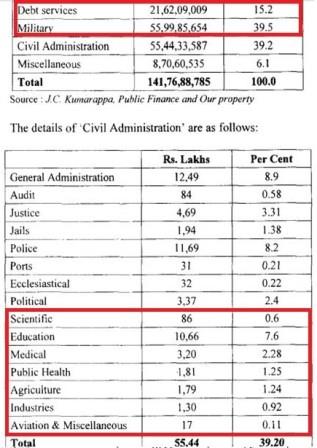
Dadabhai quantified the economic drain at 15,000 million pounds for the period 1787–88 to 1828–29. According to R. C. Dutt, on average, ‘one-fourth of all revenues derived in India was annually remitted to England’. He further estimated that during the 1890s, 159 million pounds out of a total revenue of 647 million pounds went from India to England.
Another estimate showed that annual payments under the ‘Home Charges’ increased from 5 million pounds in 1856 to more than 17 million pounds by 1901–02. There was also a disproportionate tax burden. According to Dadabhai, the average tax burden in the poverty-stricken country was 14.3 percent of income in 1886, as against 6.92 percent of income in England. The EIC helped finance British industries in the initial stages of industrialization. The consequent shortage of capital contributed enormously to the destruction of Indian internal trade and industry. This reduced the country’s power to save and invest and, therefore, inhibited the country’s economic progress.
There are critics of the ‘drain’ theory. Some estimate the drain as a proportion of national income rather than public revenue. Thus, between 1870 and 1900, the drain varied between a meager amount of 0.4 percent and 0.7 percent of India’s national income. The critics question whether all payments constitute ‘drain’. Dividends paid to the EIC shareholders at the transfer of power could be a ‘drain’ on Indian resources. However, the same is not true for interest payments on loans for railways and irrigation works, as there were goods received or fixed assets created. The British capital for railways, irrigation, tea plantations, and jute mills was productive because it raised national income. Indians, by borrowing money from the cheapest capital market in Britain, should be grateful to British investors for filling the deficiency in India’s domestic capital resources. The payments were not a gift; they were for services rendered.
The nationalists contest this strongly and say that drain links with public revenue rather than national income. Secondly, even if relatively small, it continued for a period of not less than 50 years. They strive to show that whenever India’s colonial economic links in terms of foreign trade and the inflow of foreign capital were disrupted (the two World Wars and the Great Depression), the Indian economy, in fact, made strides in industrial development. Hence, the free flow of foreign trade and capital implied economic stagnation, while their absence (partial or total) allowed Indian capital to open avenues of industrial growth in areas choked off by imports.
Was the British India Economy an Unmitigated Disaster? “The Cambridge School”
Some economists, such as Tirthankar Roy, believe that the British impact was not a one-sided disaster because settling Europeans diffused their institutions, skill sets, and entrepreneurships across the world, including India. The drain is debatable, according to these thinkers. Tax revenue was only about 3% of gross domestic product (GDP) in 1931.
The Indian economy during the Raj was in fact a prototype of a classic liberal political economy—small governments and an unregulated open market. After independence, in an eagerness to break away from anything colonial, India implemented big state intervention and a closed economy—exactly the opposite of previous years. Deindustrialization also remains debatable since many skilled artisans survived imports from Britain, and they even contributed to the growth of the national income. Indian merchants set up factories on a large scale, which was problematic for many older models. In colonial India, national income grew, but at a slow pace throughout. Between 1900 and 1947, GDP increased by 60% and per capita income by 10%.
The armed forces expenditure was indeed huge, but this army also gave a fragmented land political unity like never before, albeit at the cost of agrarian development. Also, independent India inherited this army. Naval forces and port control fostered maritime trade in the Indian Ocean. The open economy, one of the biggest pluses of British rule, was compatible with Indian economic interests by creating a robust industrial capitalism with free movement of people, skills, and knowledge until the 1920s.
This centred in the urban port cities of Bombay, Calcutta, and Madras to make them industrial and educational centers. Many Indian entrepreneurs, especially Marwaris and Parsis, flourished, contributing immensely to the Indian economy. They built an industrial infrastructure by importing machines and personnel. There might have been some inefficiency, but the so-called Home charges were finally a payment for skills to join the world economy. The misinterpreted drain of the economic nationalist was for services contributing to national income, public goods, and political stability.
Foreign trade, exports of agricultural commodities, imports of machinery and skills, indigenous banking systems, and easy access to finance increased employment in Indian factories from near zero to two million between 1850 and 1940. Extraordinarily, GDP rose at a rate of 4%–5% per year between 1900 and 1947, comparable to other emerging economies. Outside Europe and the United States, 30% of the cotton spindles in the world were in India in 1910.
However, the slow growth of the agricultural economy and failure to make a dent in rural poverty made the Raj unpopular. Roy says that agriculture stagnated more due to factors like dry land, poor soil, precarious water supply, and overexploitation of land than ‘economic exploitation’. Also, there is no data to show high productivity previously showing a fall in the colonial era. Tirthankar Roy thus believes that there is no theoretical relationship between the desire for political freedom and the economic idea that free enterprise has damaged India. It served the nationalist struggle well but made debates on economic history difficult.
Post-independent India stopped free enterprise and slowed our growth. The big state transformed the agricultural economy and set the base for economic liberalisation, which should have come sooner. The dent in rural poverty caused by huge agricultural investments was something that never happened under colonial rule. Cosmopolitan capitalism with the addition of a large state would have been a better option, but it was unthinkable for the socialistic philosophy in power.
After independence, trade and foreign investment reduced to insignificance due to stiff government controls. GDP did grow higher than colonial levels, but this was from taxpayer’s money rather than commercial profits; this is not a sustainable strategy. The economic liberalisation of the 1990s, which returned India to openness, sustained the expensive agricultural system without leading to an economic breakdown. This was a return to colonial times, says Roy, but taking off on a sound agricultural base.
Criticism of The Return of Colonial Trends in Economic History
Some economists argue that colonial factors led to unprecedented economic development in India. The inhibiting factors in Indian development were overpopulation; shortage of capital; Indian social customs; values like lack of ambition; spending extravagantly on marriages; India’s geographical weaknesses; and climatic conditions. The indigenous control of the domestic market to about 70 percent at independence; 83 percent of deposits in Indian banks at independence; rapid import substitution of major consumer goods and certain capital goods, including iron and steel; growth of urban port cities; and so on, prove the beneficial result of colonialism.
Marxist scholars such as Professor Aditya Mukherjee (The Return of the Colonial in Indian Economic History) strongly condemn these colonial-friendly theories, almost suggesting that India was reversely exploiting England! For Marxist historians, in the colonial era, commodity circulation exclusively benefitted metropolises like London. There was the destruction of the traditional artisanal industry in India and the deindustrialization of the world’s largest exporter of textiles.
According to Mukherjee, all non-colonial developments in the 20th century occurred not because of colonialism but despite or in opposition to it. This period was not decolonization but a continuation of an altered and intensified form of colonial exploitation. Britain, having lost its industrial supremacy in the world by the beginning of the 20th century, emerged as the major financial center of the world. Britain maintained this until the Second World War by manipulating India’s currency, exchange rate, and financial policy.
Britain conceded substantially her industrial interest in the colonial market in favour of financial interest, thus using the colony as a source of capital. It was a switch from one imperial interest to another, not a switch from imperial to Indian national interest. From 1914, in the next ten to twenty years, there was an increase in ‘Home Charges’ (£ 20 million to £ 32 million); military expenditure (£ 5 million to £ 10 million); and interest charges on external public debt (£ 6 million to £ 14.3 million).
During World War II, defence expenditure increased from about Rs. 50 crores in 1939–40 to Rs. 458 crores (75% of the total expenditure of the Central Government) in 1944. This came about by increasing customs revenue, primarily import duties. The import duties on cotton goods had gone up from 3.5 percent in the 1890s to 25 percent for British cotton goods in 1931. During the Great Depression, the colonial government resorted to severe deflation, contracting currency repeatedly, and causing havoc in the Indian economy. A massive export of gold from India averted a total breakdown of the remittance mechanism. Between 1931–32 and 1938–39, more than half (about 55 percent) of the total visible balance of trade was through the net exports of treasure and gold.
Britain took massive, forced loans from India (the Sterling Balance) of about Rs. 17,000 million (estimated at seventeen times the annual revenue of the Government of India and one-fifth of Britain’s gross national product in 1947) at a time when over three million Indians died of famine! After the war, Britain made a serious bid to default on the repayment of the loans. State policy smothered the efforts of Indian entrepreneurs to enter frontier areas of industry during the Second World War. Stagnant agriculture was the weakest point of British rule in an agrarian country, contributing a mere 6 to 8 percent of the national income and employing 2.3 percent of the labour force.
Angus Maddison shows that India was the largest economy in the world for the entire thousand years of the first millennium, accounting for close to 30 percent of the world’s GDP. Till the beginning of the 18th century, India’s was still contributing about 25 percent of the world’s GDP, more than eight times that of the United Kingdom. India’s share was reduced to a mere 4.2 percent in 1950. India faced near-famine conditions repeatedly in different areas in colonial times. The Bengal famine of 1943, just four years before the British left, claimed more than three million lives. Between 1946 and 1953, there was an import of 4 million metric tonnes of food grains worth Rs. 10,000 million, seriously affecting India’s planned development after independence.
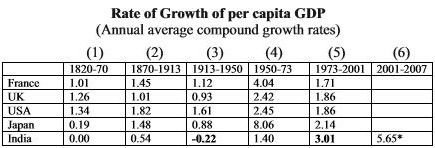
In stark contrast to other narratives, post-independent economic policies based on Nehruvian socialism were a success, according to Mukherjee. During the first three plans, Indian agriculture grew at an annual rate of over 3 percent, a growth rate more than eight times faster than achieved during the half century (1891–1946) of the last phase of colonialism in India. The per capita income grew at 1.4 percent in the first couple of decades (about three times faster than the best phase, 1870–1913, under colonialism) and much faster at 3.01 percent in the next 30 years. Industry, the value of fixed investment, and the rate of capital formation (33% of GDP in 2005–06, about five times the colonial rate) grew sharply in the post-independent period.
In 1965–66, as compared to 1950–51, the installed capacity of electricity was 4.5 times higher, the number of towns and villages electrified was 14 times higher, hospital beds were 2.5 times higher, enrolment in schools was 3 times higher, and admission capacity in technical education was higher by 6 and 8.5 times, respectively. This happened despite the persisting reasons for India’s stagnation, according to colonial-friendly theories, says Aditya Mukherjee sharply.

In the final part, we shall look at the Indian economic story after independence. There have been many contradictory claims and obfuscations. However, despite all the hurdles in understanding the true picture due to the huge volume of ever-increasing data, one can make a gentle claim that it has been an upward trend. The high population seems to be both an advantage and a disadvantage. For a layperson, this can get a little confusing.
PART 4
ECONOMY AFTER INDEPENDENCE
The previous parts were an attempt to summarise the Indian economic story from its ancient roots until the end of British rule from various sources. The understanding of the Indian economy after independence also tends to be a little complex for a layperson to understand because of conflicting opinions. However, the overall story is one of hope and pride rather than shame and disappointment. This part also includes selected references and further readings for those interested.
The second half of the 20th century, with broadly two phases: 1950–1980 and 1980–2000, holds an amazing Indian economic story. From 1900 to 1950, the net growth in income per capita was stagnant because both the economy and population grew at the same rate (0.8%). The slow rise took a sharp upturn in the eighties and nineties. An economic liberalisation standing on the shoulders of a huge agricultural revolution by 1991–2000 increased the GDP to 6.2 percent while population growth slowed to 1.8 percent—a per capita income growth of 4.4 percent a year.
| 1900-1950 | 1950-1980 | 1981-1990 | 1991-2000 | |
| GDP growth | 0.8 | 3.5 | 5.6 | 6.2 |
| Per capita growth | 0 | 1.3 | 3.5 | 4.4 |
Gurcharan Das (India: How a Rich Nation became poor and will be rich again) points out that it is important to remember that the West’s industrial revolution took place at a rate of 3 percent GDP growth and 1.1 percent per capita income growth after 1820. Das says that Nehru’s Democratic socialism pressures, like free power to farmers and other subsidies, dampened growth and reform processes in the first three decades of independence. The state as an entrepreneur failed mainly because of corruption and bureaucracy. Nehru’s strategic planner, P.C. Mahalanobis, made two wrong assumptions: there were no opportunities for rapid export expansion in the 1950s, and competition was wasteful. India’s share of world trade declined from 2.2 percent in 1947 to 0.5 percent in 1990.
Productivity of Indian manufacturing declined half a percent a year from 1960 to 1985, considered the ‘dark period for the Indian economy’. Nehru, perhaps not much to blame, went with the socialist wisdom of his age; many international economists supported him; and he was eager to break from the colonial legacies. Indira Gandhi had the successes of Japan and Korea in view, and yet she persisted with the previous model with more force.
The dreaded licensing system, beginning with the Industrial Licencing Act of 1951, inflicted the worst damage on the private sector. An entrepreneur had to get clearance from a rising hierarchy of controls at the Directorate General of Technical Development, Administrative Ministry, an inter-ministerial licencing committee, and a capital goods licencing committee. Loans, after the completion of previous approval, went through another round of fresh scrutiny! There were huge delays, extensive corruption, and bureaucratic hurdles. Finally, a law punished anyone producing beyond the capacity granted by the licence!
The system resulted in stifling competition, which allowed only state monopolies. Ignorant and inefficient bureaucrats often ran these monopolies in remote places with improper technology. In the late 1960s, Indira Gandhi went for even more controls, along with the nationalisation of banks. Industrial growth plunged from 7.7 percent a year between 1951 and 1965 to 4.0 percent between 1966 and 1980. The poor performance of India between 1950 and 1980 was due to continuing to close our economy and denying the fruits of a golden period of world trade between 1950 and 1970.
An agricultural surplus is a precondition and backbone for industrial growth. We achieved an agricultural revolution in the early 1970s, yet industrial take-off did not happen. Gurcharan Das attributes six state policies as reasons for this:
1) adopting an inward-looking, import-substituting path rather than an export-promoting route;
2) setting up a massive, inefficient, and monopolistic public sector;
3) over-regulating private enterprise;
4) discouraging foreign capital and denying itself the benefits of technology and world-class competition;
5) pampering organised labour to the point of extremely low productivity; and
6) ignoring the education of its children.
Modest liberal reforms happened in the 1980s, but it was in July 1991 that PV Narasimha Rao announced sweeping reforms and opened foreign investment and trade; dismantled import controls; lowered custom duties; removed licenses on private enterprise; lowered taxes; and generally diminished public sector monopolies.
This resulted in a 7.5 percent growth rate, three years in a row, in the mid-nineties. Inflation came down from 13 percent to 6 percent by 1993; exchange reserves shot up from $1 billion to $20 billion by 1993; and they crossed $100 billion by 2003. The successive governments continued this, making India one of the fastest-growing economies in the world by the turn of the century. Information technology was to India’s advantage as a new set of entrepreneurs and professionals contributed eagerly to the growth of the Indian economy.
Gurcharan Das says that uniquely, India had democracy first (1950) and capitalism afterwards (1991), a reverse situation of the West. Because of democratic pressures, ‘welfare’ began before there were welfare-generating jobs. Democracy before capitalism led to the throttling of free enterprise, decreased productivity, and a slowing of growth. Over the decades, the political scene in India has manifested as populist giveaways and loan waivers to win votes at any cost.
India’s damaging fiscal deficit, or spending beyond means (around 10 percent of GDP for the centre and states combined), proves the downside of competitive politics. Thus, the transition is happening at a slower rate. However, this may finally be a good thing, says Das, because it is more likely to preserve its way of life and culture. The routine explanations for the slow economic growth (‘the otherworldly values of the Hindus’, ‘the immobilising caste system’, ‘the conservative merchant caste’) including the label ‘the Hindu rate of growth’ may not be true at all, says Das.
‘Hindu’ Rate of Growth
Economist Raj Krishna coined the ‘Hindu rate of growth’ in 1978 to denote the around 4 percent growth in GDP from the 1950s to the 1980s. Amazingly, despite his knowledge and position in the past, Raghuram Rajan, ex-RBI Governor, recently made a statement that the present economy is ‘dangerously close’ to the earlier Hindu rate of growth. The colonial-missionary narratives attached the problems of Indian social systems to Hinduism, and we still have not been able to reject them. The surprise comes when, either with ignorance or deviousness, even economic issues attach themselves to the Hindu religion.
There were three economic phases in the 20th century: 1900–1950; 1950–1980; and 1980–2000. The first two phases were of stagnation. An economic liberalisation standing on the shoulders of a huge agricultural revolution in 1991–2000 rapidly increased the strength of our economy. In the previous section, we saw Gurcharan Das detailing the various reasons for this stagnation, which were more related to political and economic decision-making than the religion of the majority of people. It is rather an incredible allegation revealing Hinduphobia than anything else.
On the other hand, Angus Maddison’s research shows how India (very Hindu in its character) was contributing to almost 35–40% of the world GDP consistently from the beginning of the common era to the 17th century when the East India Company landed. Indian degeneration in terms of its economy, culture, heritage, and educational systems during the colonial plunder ensured that at independence, India was contributing a pathetic 1.8% to the world GDP.
The question is: if ‘Hindu’ ideas slow economic growth, why did everybody in the world come to India to make money, and why did we cross our civilizational borders only for trade and exchange of culture rather than to loot and plunder?
If at all, Hindu ideas and metaphysics may be a great factor in improving the economics of the country (along with other areas like science, technology, the arts, literature, and music). Hence, unlike what distinguished economists may say, the ‘Hindu’ rate might actually mean hugely positive growth! In fact, historically, Hindu India was cruising along well until other factors halted it, such as colonialism and socialism. Ananda Coomaraswamy and Swami Vivekananda, in fact, argued strongly to include Hindu metaphysics right from the beginning of the education system to have a true renaissance of our country. The English removed Hindu philosophy from our education systems, and sadly, we are continuing to do the same with the distorted application of secularism, where we insist on calling our philosophies religion.
Unique Indian Economy Model
Gurumurthy argues that India’s economic strength comes from household savings, the informal sector, and public sector banks. The household sector is the strongest and most stable component of the Indian economy and a result of a relation-based cultural life. The integrated family institution takes care of the elderly and the infirm, the ill and the jobless, which drives its propensity to save. In the West, atomistic families decrease the pressure to save. In the West, traditional government functions like water supply, road building, and public utilities became increasingly private, even as caring for family became a state responsibility.
Household savings (bank deposits, gold, and properties) have increased after liberalisation despite falling bank interest rates, an ever-growing stock market, and an intense consumerist agenda. The Indian economy grew primarily through domestic savings (from 21 percent of GDP in 1991–92 to 31 percent in 2016). The ratio of spending to savings declined from 64 percent in 1991–2 to 58 percent in 2007–8, implying that Indian families have defied new consumerist trends. A domestically driven economy—both investment and demand—has been the core factor in the Indian growth story. In India, up to 60 percent of India’s goods are for internal consumption. This is unlike China, where most of its goods (64%) are for export.
The corporate sector (domestic and foreign; listed and unlisted; public and private) is glamorous, but its share of national GDP has increased from 12 percent in 1991 to merely 3 percent in two decades of liberalization. In the two decades after 1991, this sector had received foreign investment by debt and equity of over $550 billion and drew over Rs 18 lakh crore from banks as credit. However, it created only 3.5 million jobs (2.8 million in the software sector, the rest 700,000). Ironically, net foreign investment in India during two decades of liberalisation averaged around 3 percent of national investment, mainly funding external deficits.
90 percent of the total 474 million jobs in India are in the non-corporate sector, which contributes half the national GDP. Big corporations employ only 12.5 million people, compared to 120 million in the MSME sector (micro, small, and medium). The Economic Census (2013–14) says that some 57.7 million non-farming and non-construction businesses yield 128 million jobs.
The census classifies them as Own Account Enterprises (OAEs). It is legal, unlike in the West, and remains informal only because the government has been unable to reach out to it. Over 60 percent of OAEs belong to Other Backward Castes, Scheduled Castes, and Scheduled Tribes; more than half of the OAEs and as many jobs provided by them are in rural areas; and nine out of ten OAEs are unregistered. However, this sector, which ensures both social justice and generates jobs, gets just 4 percent of its credit needs, about 11.4 lakh crore, from the formal banking system. Thus, paradoxically, banks fund low-job-yielding corporations and not the OAEs, which generate ten times more jobs.
Finally, the Indian financial economy is bank-driven (mainly Public Sector Banks). The bank deposits to GDP ratio in India was 34 percent in 1992 and is over 70 percent in 2016. Even though bank deposits yield just half as much as stocks do, 40% of Indian household savings move into banks. The share of equities in the total savings stood at less than 2 percent in seven out of the 11 years (2004–2014), despite a compounded return of 14 percent.
Besides mobilising four-fifths of deposits, PSBs are involved in building financial architecture for formalising the economy on a phenomenal scale, which is impossible for the private banks, says Gurumurthy. India is like Japan, where ‘cash and deposits’ represent ‘half of total financial assets.’ It is only 16 percent in the US and 25–33 percent in Europe. Gurumurthy believes in a unique Indian model of economy that agenda-driven economists have profoundly failed to understand. Unfortunately, they direct public discourse.
The Gold Story of The World and India
The anti-gold campaign and the Great Depression forced the US to nationalise gold in 1934. The US government acquired all private gold and increased its official gold reserves from 6,500 metric tonnes to almost 20,000 metric tonnes by 1942. In 1950, member nations of the newly formed International Monetary Fund accepted the US dollar as a global currency.
The US promised to exchange one ounce of gold for $35. The US dollar acquired the status of a global currency, and the US became a global financial power. The international exchange rates were fixed to the dollar from 1950 to 1972. To maintain the price at $35 per ounce, if the unofficial market price of gold rose, the London Gold Pool, formed by eight major European countries, agreed to sell their gold.
Disastrously, the Pool and the US lost almost two-thirds of their gold reserves. The US gold reserves nosedived to 8,000 metric tonnes in 1971 to meet the demand for gold in exchange for dollars. A panicked US government suspended gold-dollar convertibility, legalised private gold, and then emerged with floating exchange rates.
Some two-thirds of the gold-plated US dollars were now outside the US. The US now strategically coerced oil-producing countries to accept payments in the form of dollars—the Petrodollar, which ensured that dollar remained supreme during the globalisation of the 1990s until the 2008 financial meltdown.
The Bank of International Settlements (BIS) said in 2015 that extreme levels of global debts ($49.1 trillion now) threaten the world financial system. More importantly, it conceded that gold and silver offer protection against crises in the financial system.
Indian women, who love gold, may have some lessons for modern economists. Gold has been a highly preferred mode of investment for most Indian families since ancient times. Taking the American cue, Indian establishments first were hostile, then ambivalent, and finally accepted gold as a reality of the Indian economy, now with bank-supported gold deposits, Sovereign Gold Bonds, and gold coins for the people, says Gurumurthy.
The rupee has depreciated against the dollar (47% in the last 5 years), but gold has appreciated (28%) against the rupee. Gold holdings are the quantities of gold held by individuals, private corporations, or public entities. India, at the top with 25,000 metric tonnes, is way ahead of the second (US), with 8133 metric tonnes!
Caste as A Social Capital
Caste as social capital is under-recognised in the Indian economy. In 2013, the Indian economy was growing at a compounded average growth rate of more than 8.5 percent in the last five years. More than 60 percent of the economy was in the service sector, characteristically partnership and proprietorship firms consisting of tiny, small, and medium enterprises. 70 percent of this service sector (mainly construction, trade, hotels and restaurants, non-railway transport, storage, and real estate ownership) was the non-corporate sector, with 90 percent of the funding from domestic savings. In contrast, the US economy has a corporate sector with more than 75 percent of its GDP in 2010.
As Professor Vaidyanathan (Caste as a Social Capital) shows, an exhaustive economic census between 1998 and 2005, conducted by the Central Statistical Organisation [CSO], covering 30.35 million non-agricultural enterprises, threw up surprises. In 1998, in rural areas, SC/ST/OBC’s owned more than 50 percent of these and 45 percent of the total. In 2005, these figures were 55 percent for rural and 50 percent for total. 90 percent were self-financing, coming from informal caste networks.
Scholars now stress the role of social capital in financial growth. Strong communities based on common rules and mutual help, discouraging deviant behaviour, creating trust, uniting against threats from outsiders or natural disasters, sharing technical knowledge, dealing with failures by acting as cushions, handling administrative hurdles, and group financing facilitate a huge financial benefit.
One economist says that human and financial capitals being equal; it is social capital that decides success and failure. The Bania traders, the Palanpur Jains in the diamond business, the Gounders in the Tirupur garment industry, and the Nadars in the matches and printing industry are fine examples of social capital acting as a push for economic growth.
Clusters occupy a significant place in the Indian economic scene. There are approximately 350 small-scale industrial clusters and around 2000 rural and artisan-based clusters, contributing almost 60 percent of the manufacturing exports and 40 percent of the employment in the manufacturing industry. The clusters are self-funded businesses of extended families, castes, and communities developing as full-fledged centres of economic, social, and religious activities. They establish schools, colleges, and other common facilities like marriage halls or temples.
Recognising caste as the natural social capital, Harish Damodaran (India’s New Capitalists: Caste, Business, and Industry in a Modern Nation) delineates three general trajectories of industrial transition by communities: ‘Bazaar to Factory’ route (Banias and Vaishyas); ‘Office to Factory’ route (urban middle class); ‘Field to Factory’ route (rural middle-class communities consisting of many backward castes). The latter two trajectories have undermined the time-honoured association of ‘business communities’ with an exclusive Vaishya order. Thus, caste has played an important role in the consolidation of business, particularly in the last fifty years. Dalits are increasingly getting into entrepreneurship and building impressive empires. The Dalit Indian Chamber of Commerce and Industry [DICCI], playing an increasingly important role, marks the emergence of a nascent trend in Indian economic growth.
Caste has always been a persistent stick for intellectuals to attack anything connected to Indian religions, customs, and culture. The jati-based Indian communities unify families and communities, improve economic status, and provide upward mobility. As Vaidyanathan sums up, with caste (or jatis) as a social capital, it brings unity in economics. Unfortunately, in politics, it brings division.
The Indian Middle Class and the Demographic Changes
Sanjeev Sanyal (The Indian Renaissance) writes on the rise of the Indian middle class. Most industrialization produces a middle class, which becomes politically and socially strong gradually. This happened in Western countries in the 19th and 20th centuries. However, in India, there was already an educated middle class at the time of liberalisation, which spurred growth in the service industry, which included communications, outsourcing, transport, tourism, hotels, and so on. The rest of Asia was more into heavy industry, which required capital and labour. We were grossly deficient in the former, says Sanyal. The policy of focusing on higher education while ignoring primary education led to the creation of an unemployed middle class, many of whom migrated to greener pastures. This was perhaps a major reason for the brain drain that happened in our country, which could be slowing down after 1991.
Our projected demographic changes in the next few decades are a story of immense hope for India. In the next 20–30 years, our average age will be in the 30’s. Every country goes through three phases demographically: first, with a high birth rate and a high death rate; second, when the young working group forms the major labour force; and third, where the ageing population increases. Most western countries and Asian giants like China and South Korea are in the third phase, where the ageing population is a reason for the loss of productivity, increasing healthcare costs, and thus affecting the economy.
Sanyal predicts that the combination of the focus on primary education and demographic changes will cause a huge leap in infrastructure and heavy industrialization. Urbanisation will increase, and the high rural population presently comprising 70% of our country will reduce. Our gold reserves have exceeded our debts, and the capital is no longer deficient. We can indeed look forward to a huge increase in our prosperity and economic progress. However, Sanyal calls for major reforms in our archaic and stifling laws and a decrease in corruption. The cities should be prepared for the massive urbanisation, industrialization, and infrastructural issues. Bangalore, Gurgaon, and Kolkata are examples of random, unplanned growth, and they should not be examples for structuring cities.
Conclusions
In 1500, Asia accounted for 65% of world GDP. For four and a half centuries after that, until 1950, it stagnated while the rest of the world went forward. In 1950, Asia’s share was only 18.5%, and it has doubled over the next half century, making it the fastest-growing economy. Though China and the Far East are growing faster, India’s growth has been impressive too. A GDP per capita growth rate of -0.2 from 1913–1950, jumping to 3.7 in 1990–1999, is impressive.
| Variations in Per Capita GDP Growth Momentum: Resurgent Asia | ||||||
| (Annual average compound growth rates) | ||||||
| 1913–50 | 1950–99 | 1950–73 | 1973–90 | 1990–99 | ||
| India | –0.2 | 2.2 | 1.4 | 2.6 | 3.7 | |
| Resurgent Asia | –0.3 | 3.4 | 2.5 | 3.9 | 4.6 | |
| Western Europe | 0.8 | 2.9a | 4.1 | 1.9 | 1.4b | |
| United States | 1.6 | 2.2 | 2.5 | 2 | 2.1 | |
| (Maddison) | ||||||
With a nominal GDP of $2.94 trillion and a purchasing power parity (PPP) of $10.51 trillion, India is the fastest-growing trillion-dollar economy in the world. It is the fifth-largest overall in 2019 behind the US, China, Japan, and Germany, recently overtaking the UK and France. India is third in terms of purchasing power parity.
The service sector is the fastest-growing sector in the world, contributing more than 60 percent to its economy and 28 percent to employment. The agricultural sector has declined to around 17 percent, but is still higher in comparison to western nations. The Indian economy’s strength lies in its limited dependence on exports, high saving rates, favourable demographics (average age in the thirties), and rising middle class.
Understanding poverty is a bigger problem than understanding the economic prosperity of a country. Economists confuse people by constantly changing the definitions of poverty. Some different methodologies include Income-based calculations, consumption or spending-based calculations, Purchasing Power Parity (PPP), nominal relative basis, Multi-dimensional Poverty Index; and Global Hunger Index. The prevalence estimates of poverty in India using various definitions swing widely: from 6.7 percent to 60 percent of the population!
The rich 1 percent perhaps holds upwards of 58 percent of the total wealth, making it one of the most unequal countries in the world. Only 1.5 crore out of a total population of 130 crores pay income tax. Though about 5.78 crores disclose their income for tax purposes, a whopping 4.28 crores are below the 5-lakh limit with tax exemption. Surprisingly, the number of individual tax payers with an income of more than 5 crores in the whole country is only 8600.
Though India’s annual growth rate has exceeded 7 percent over the last 15 years and is pulling out an increasing number of people from poverty, the main issue of inequality needs urgent addressing. The middle class constitutes more than 50 percent of the Indian population, and obviously there is a gross underreporting of incomes by individuals and institutions. Corruption also accounts for a good amount of unaccounted money.
Extreme poverty, hunger deaths, and famines no longer exist as in colonial times; we have steadily progressed as one of the fastest-growing economies; we have 13,854,000 Indians in the top 10 percent of global wealth holders and 827,000 in the top 1 percent; and yet, what stares at us as a goal in the next few decades is to bring a more equitable distribution of wealth and decrease the levels of corruption in both the public and private sectors.
To a layperson, history can be a variable mix of confusion, anger, and disappointment. The same set of events can have radically different interpretations shaking the very idea of truth. As Nassim Nicholas Taleb says (Black Swan, 2008), history is opaque to cause and effect. The biggest blunder a historian might commit is to retrospectively assign reasons for historical events. Each event is a complex interplay of thousands of factors coming together, and in such complexity, making simplistic explanations is a foolish task.
Taleb rues that the human mind suffers from ‘triplet opacity’ when meeting history: 1) the illusion of understanding what is going on in a world that is more complicated than realized. 2)
the retrospective distortion, or how we assess matters only after the fact, and 3) the overvaluation of information and the handicap of authoritative and learned people, particularly when they create categories.
Whatever the interpretations across decades, our economic past, present, and future should finally give us pride, strength, and hope. The facts and evidence demand this and not despair, despite many contradictions, ambiguities, and controversies. India was a rich country that attracted plunderers across ages; India is a rich country that the world still needs. We never had the need to go out to invade and loot; we did venture out, but only for trade or spreading knowledge.
SELECTED REFERENCES AND FURTHER READINGS:
- https://www.academia.edu/41232833/2020_Trends_in_Economic_History_Writing_of_Early_South_Asia Trends in Economic History Writing of Early South Asia by Mamata Dwivedi
- Orientalism: Western Conceptions Of Orient (2001) by Edward W. Said
- Culture And Imperialism (1994) by Edward W Said
- https://www.indica.today/long-reads/vartta-in-ancient-india/ Ancient Indian Economy by Sneha Nagarkar in six parts
- Ancient Indian Economy: The Role of Vārttā (2023) by Sneha Nagarkar
- The Lost River: On The Trail of the SARASVATI (2010) by Michel Danino
- https://faculty.washington.edu/plape/citiesaut11/readings/Childe-urban%20revolution%201950.pdf The Urban Revolution by V. Gordon Childe
- The Making of Early Medieval India by BD Chattopadhyaya
- Interpreting Medieval India (2009) by Vipul Singh
- https://www.academia.edu/72237165/Early_medieval_currency_pattern_North_India_ Early medieval currency pattern (North India) by John Deyell
- The World Economy: Vol. 1: A Millennial Perspective & Vol. 2: Historical Statistics by Angus Maddison (2007): A must read for anyone having an inkling of interest in the history of Indian economy. For a layperson, no book perhaps opens the eyes to the Indian economic wonder better than this one.
- How ‘Rich’ was Mughal India? In Narrativizing Bhāratvarṣa & Other Essays (2021) by Saumya Dey
- The Agrarian System Of Mughal India, 1556-1707 (2013) by Irfan Habib
- The Ruler’s Gaze: A Study of British Rule over India from a Saidian Perspective by Arvind Sharma
- Ocean of Churn: How the Indian Ocean Shaped Human History (2017) by Sanjeev Sanyal
- An Era of Darkness: The British Empire in India (2016) by Shashi Tharoor
- Churchill’s Secret War (2018) by Madhusree Mukerjee
- The Goa Inquisition: The Terrible Tribunal for the East (2010) by Anant Kakba Priolkar
- The Theft of India: The European Conquests of India, 1498-1765 (2016) by Roy Moxham
- https://citeseerx.ist.psu.edu/document?repid=rep1&type=pdf&doi=8a5a624dce31f3d47d51e5f2fd7e4ffa36650082 The Economic Importance Of Indian Opium And Trade With China On Britain’s Economy, 1843–1890 by Sarah Deming
- The Economic Legacies of Colonial Rule in India: Another Look by Tirthankar Roy in Economic and Political Weekly Vol. 50, No. 15 (April 11, 2015), pp. 51-59
- The Economic History Of India, 1857-2010 (2020) by Tirthankar Roy
- https://fid4sa-repository.ub.uni-heidelberg.de/664/1/Presidential_address_Mukherjee.pdf The Return of the Colonial in Indian Economic History: The Last Phase of Colonialism in India by Aditya Mukherjee
- https://gurcharandas.org/node/255 India: How a rich nation became poor and will be rich again by Gurcharan Das
- https://www.thehindu.com/business/Economy/india-is-dangerously-close-to-hindu-rate-of-growth-says-raghuram-rajan/article66583585.ece India is ‘dangerously close’ to Hindu rate of growth, says Raghuram Rajan
- Education in India; Memory in Education; and Music and Education in India in the book Essays in National Idealism by Ananda Coomaraswamy
- https://www.newindianexpress.com/opinions/columns/s-gurumurthy/2016/feb/18/Indian-Economy-for-Dummies—I-893840.html Indian Economy for Dummies in three parts by S Gurumurthy
- https://www.newindianexpress.com/opinions/columns/s-gurumurthy/2015/nov/14/Gold-Indian-Women-Teach-Modern-Economists-842545.html Gold: Indian Women Teach Modern Economists (2015) by S Gurumurthy
- Caste as Social Capital (2023) by R Vaidyanathan
- India’s New Capitalists: Caste, Business, and Industry in a Modern Nation (2008) by H. Damodaran
- The Indian Renaissance: India’s Rise after a Thousand Years of Decline (2015) by Sanjeev Sanyal
- The Black Swan: The Impact of the Highly Improbable (2008) by Nassim Nicholas Taleb
 RANDOM MUSINGS