My letter dated 12 November 2023 in The Hans India
THE UNEDITED VERSION
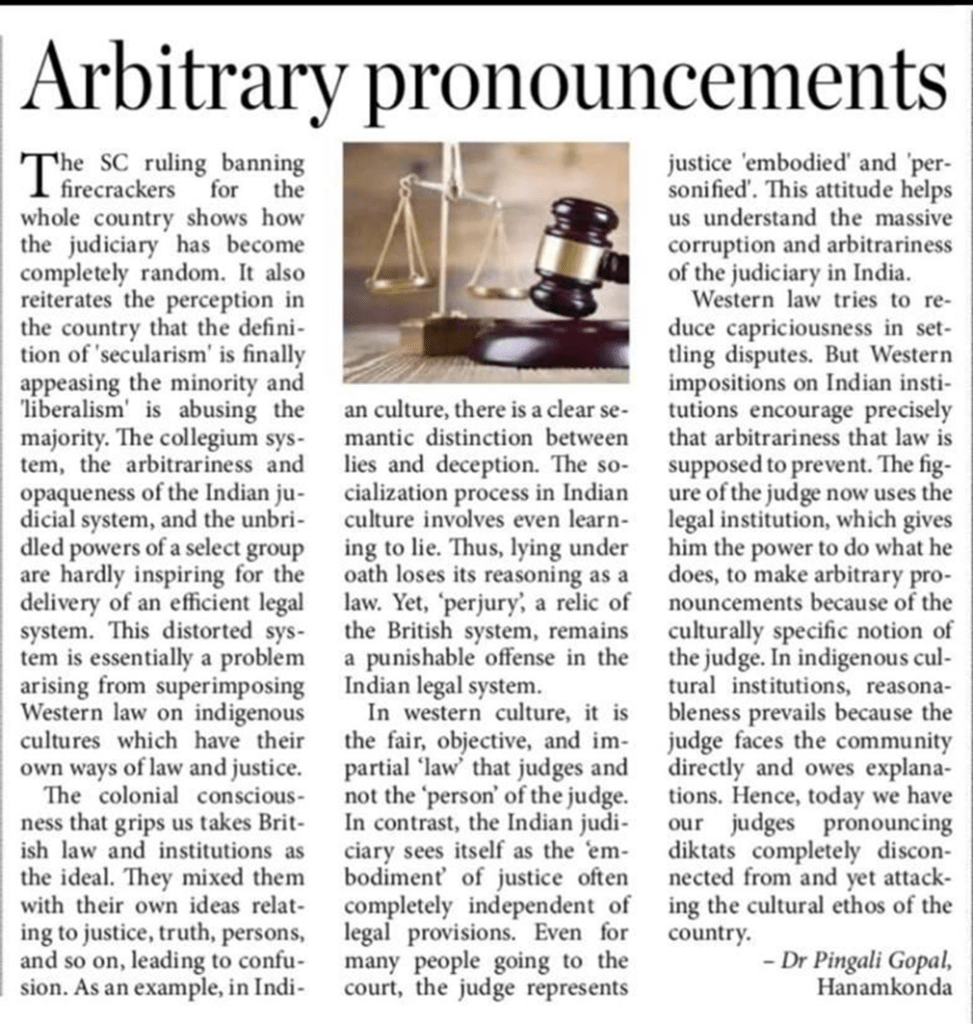
The SC ruling banning firecrackers for the whole country shows how the judiciary has become completely random. It also reiterates the perception in the country that the definition of ‘secularism’ is finally appeasing the minority and ‘liberalism’ is abusing the majority. The collegium system, the arbitrariness and opaqueness of the Indian judicial system, and the unbridled powers of a select group are hardly inspiring for the delivery of an efficient legal system. This distorted system is essentially a problem arising from superimposing Western law on indigenous cultures which have their own ways of law and justice.
There is a rhetoric about the great British law as a ‘gift’ to us. British society and law were corrupt to the core in the 18th and 19th centuries when they were ruling a great part of the globe. Their neighbors, allies, and cultural relatives saw them as corrupt, contemptible, hypocritical, and immoral. The British in India did whatever pleased them but the judges and bureaucrats clothed these acts in legal language and many non-existent laws. There was never equal justice in British India. Local European communities did not allow Indian judges and law officers to try them and they got away with the most brutal crimes through lenient European judges.
The colonial consciousness that grips us takes British law and institutions as the ideal. They mixed them with their own ideas relating to justice, truth, persons, and so on, leading to confusion. As an example, in Indian culture, there is a clear semantic distinction between lies and deception. The socialization process in Indian culture involves even learning to lie. Thus, lying under oath loses its reasoning as a law. Yet, ‘perjury’, a relic of the British system, remains a punishable offense in the Indian legal system.
In western culture, it is the fair, objective, and impartial ‘law’ that judges and not the ‘person’ of the judge. In contrast, the Indian judiciary sees itself as the ‘embodiment’ of justice often completely independent of legal provisions. Even for many people going to the court the judge represents justice ’embodied’ and ‘personified’. This attitude helps us understand the massive corruption and arbitrariness of the judiciary in India.
Western law tries to reduce capriciousness in settling disputes. But Western impositions on Indian institutions encourage precisely that arbitrariness that law is supposed to prevent. The figure of the judge now uses the legal institution, which gives him the power to do what he does, to make arbitrary pronouncements because of the culturally specific notion of the judge. In indigenous cultural institutions, reasonableness prevails because the judge faces the community directly and owes explanations. Hence, today we have our judges pronouncing diktats completely disconnected from and yet attacking the cultural ethos of the country.
 RANDOM MUSINGS