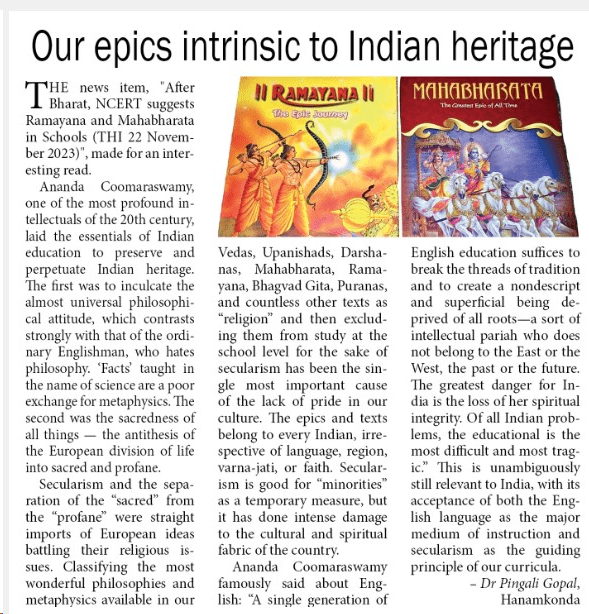
The news item, “After Bharat, NCERT suggests Ramayana and Mahabharata in Schools (The Hans India 22, 2023),” made for an interesting read. Education is the building up of character, and nothing builds the character of a person more than these two epics.
Ananda Coomaraswamy, one of the most profound intellectuals of the 20th century, laid the essentials of Indian education to preserve and perpetuate Indian heritage in his wonderful essays. The first was to inculcate the almost universal philosophical attitude, which contrasts strongly with that of the “ordinary Englishman, who hates philosophy.” ‘Facts’ taught in the name of science are a poor exchange for metaphysics, Coomaraswamy said. The second was the sacredness of all things—the antithesis of the European division of life into sacred and profane. Science, art, agriculture, and commerce are, in the West, secular aspects of life, quite apart from religion. In India, religion idealises and spiritualizes life itself rather than excludes it. Thirdly, the true spirit of religious toleration, illustrated continually in Indian history, and the inherent consciousness that “all dogmas are formulas imposed upon the infinite by the limitations of the finite human intellect.”
Coomaraswamy further elucidates that etiquette, the teacher-disciple relationship, the basis of ethics being “thy neighbour is thyself”, and the importance of memory and one-pointedness were the other intrinsic components of Indian culture and a sound educational ideal for India. For both Coomaraswamy and Sri Aurobindo, the aim was to develop the people’s intelligence through the medium of their own national culture and local vernacular. The national culture should be the only vantage point from which a person can take a wider view of other cultures.
Secularism and the separation of the “sacred” from the “profane” were straight imports of European ideas battling their religious issues. Classifying the most wonderful philosophies and metaphysics available in our Vedas, Upanishads, Darshanas, Mahabharata, Ramayana, Bhagvad Gita, Puranas, and countless other texts as “religion” and then excluding them from study at the school level for the sake of secularism has been the single most important cause of the lack of pride in our culture. Our thinkers did not aim to find out what “religion” actually meant and how they differ definitionally from the many Indian traditions classified as “religions” inappropriately. The epics and texts belong to every Indian, irrespective of language, region, varna-jati, or faith. Secularism was good for “minorities” as a temporary measure, but it has done intense damage to the cultural and spiritual fabric of the country.
Ananda Coomaraswamy famously said about English: “A single generation of English education suffices to break the threads of tradition and to create a nondescript and superficial being deprived of all roots—a sort of intellectual pariah who does not belong to the East or the West, the past or the future. The greatest danger for India is the loss of her spiritual integrity. Of all Indian problems, the educational is the most difficult and most tragic.” This is unambiguously still relevant to India, with its acceptance of both the English language as the major medium of instruction and secularism as the guiding principle of our curricula.
THE EDITED LETTER ON 26 NOVEMBER 2023
 RANDOM MUSINGS