Letter published on 24 December 2023 in THI
THE TEXT OF THE LETTER
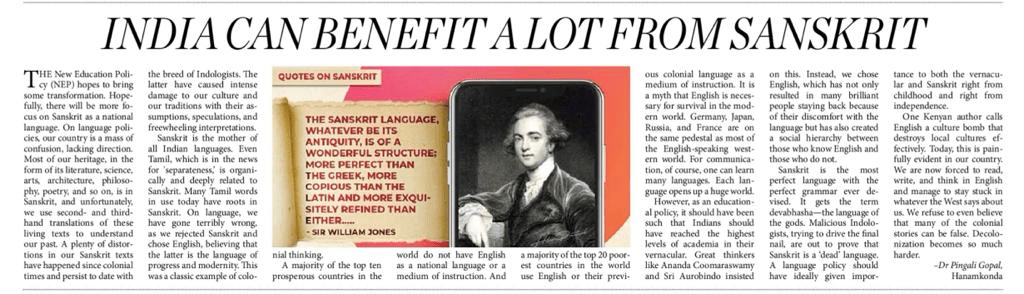
The New Education Policy hopes to bring some transformation. Hopefully, there will be more focus on Sanskrit as a national language. On language policies, our country is a mass of confusion, lacking direction. Most of our heritage, in the form of its literature, science, arts, architecture, philosophy, poetry, and so on, is in Sanskrit, and unfortunately, we use second- and third-hand translations of these living texts to understand our past.
Plenty of distortions in our Sanskrit texts have happened since colonial times and persist to date with the breed of Indologists. The latter have caused intense damage to our culture and our traditions with their assumptions, speculations, and freewheeling interpretations. How many English scholars would agree to a criticism of Shakespeare by reading only Telugu translations of his works? But we have been exactly doing that for at least two centuries, with most of our literary, artistic, and scientific heritage.
Sanskrit is the mother of all Indian languages. Even Tamil, which is in the news for ‘separateness,’ is organically and deeply related to Sanskrit. Many Tamil words in use today have roots in Sanskrit. On language, we have gone terribly wrong, as we rejected Sanskrit and chose English, believing that the latter is the language of progress and modernity. This was a classic example of colonial thinking.
The majority of the top ten prosperous countries in the world do not have English as a national language or a medium of instruction. And a majority of the top twenty poorest countries in the world use English or their previous colonial language as a medium of instruction. It is a myth that English is necessary for survival in the modern world. Germany, Japan, Russia, and France are on the same pedestal as most of the English-speaking western world. For communication, of course, one can learn many languages. Each language opens up a huge world.
However, as an educational policy, it should have been such that Indians should have reached the highest levels of academia in their vernacular. Great thinkers like Ananda Coomaraswamy and Sri Aurobindo insisted on this. Instead, we chose English, which has not only resulted in many brilliant people staying back because of their discomfort with the language but has also created a social hierarchy between those who know English and those who do not.
Sanskrit is the most perfect language with the perfect grammar ever devised. It gets the term devabhasha—the language of the gods. Malicious Indologists, trying to drive the final nail, are out to prove that Sanskrit is a ‘dead’ language. A language policy should have ideally given importance to both the vernacular and Sanskrit right from childhood and right from independence. One Kenyan author calls English a culture bomb that destroys local cultures effectively. Today, this is painfully evident in our country. We are now forced to read, write, and think in English and manage to stay stuck in whatever the West says about us. We refuse to even believe that many of the colonial stories can be false. Decolonization becomes so much harder.
 RANDOM MUSINGS