THE UNEDITED VERSION
One can conceive of Sanatana Dharma metaphorically as a tree comprising various traditions as its branches. Innumerable branches came out of the trunk, which are dependent and yet independent of the trunk. They both grow in a syncretic manner. The branches are all the individual ‘traditions’ like Buddhism, Jainism, Sikhism, and any number of ‘isms’ termed religions. What remains of the trunk proper after all the branches is perhaps “Hinduism,” as it is known today. People still have difficulty defining Hindus and Hinduism, including the constitution and the judiciary.
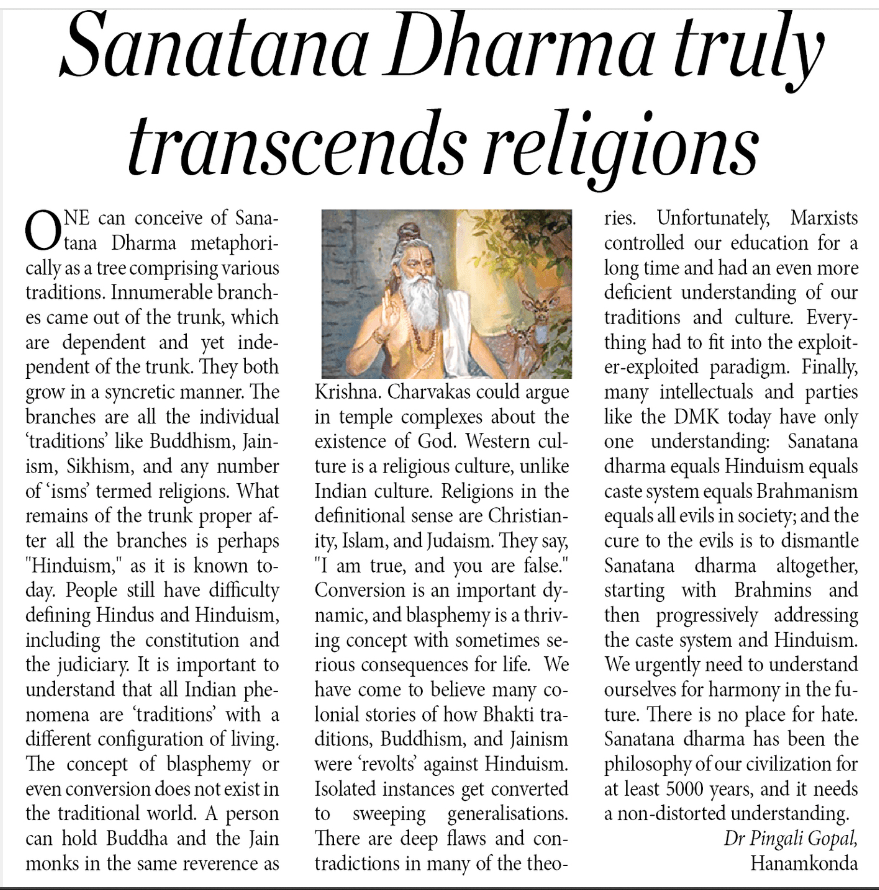
It is important to understand that all Indian phenomena are ‘traditions’ with a different configuration of living. The many traditions are “indifferent to differences” and say, “I am true, but you are not false.” Free criticism is allowed in a traditional world without fear of losing one’s life. The concept of blasphemy or even conversion does not exist in the traditional world. A person can hold Buddha and the Jain monks in the same reverence as Krishna. Charvakas could argue in temple complexes about the existence of God. Western culture is a religious culture, unlike Indian culture. Religions in the definitional sense are Christianity, Islam, and Judaism. They say, “I am true, and you are false.” Conversion is an important dynamic, and blasphemy is a thriving concept with sometimes serious consequences for life. This is a fundamental difference between religions and traditions.
When alien religions came to India, at a social and cultural level, there was syncretism, which happened because religions got traditionalized. They integrated by behaving as other branches of the tree and mainly by developing an indifference to the “other.” At a social-cultural level, nobody has a problem with going to any place of worship. A Hindu can enter a mosque or a church with the same devotion as entering the Tirupati temple. There is no problem for Hindus when Yesudas or Rafi sing the most devotional songs in praise of Hindu gods. Similarly, Christians and Muslims visit temples and sing devotional Hindu songs without fearing a loss of identity.
The problem mainly happened at the political and academic level, starting from colonial times, which insisted on converting our traditions into religions instead of continuing the old process of traditionalizing religions. This religionizing of traditions is, in reverse, making them traverse the path from tolerance to intolerance.
We have come to believe many colonial stories of how Bhakti traditions, Buddhism, and Jainism were ‘revolts’ against Hinduism. Isolated instances get converted to sweeping generalisations. There are deep flaws and contradictions in many of the theories. Unfortunately, Marxists controlled our education for a long time and had an even more deficient understanding of our traditions and culture. Everything had to fit into the exploiter-exploited paradigm. Finally, many intellectuals and parties like the DMK today have only one understanding: Sanatana dharma equals Hinduism equals caste system equals Brahmanism equals all evils in society; and the cure to the evils is to dismantle Sanatana dharma altogether, starting with Brahmins and then progressively addressing the caste system and Hinduism.
There are many problems with such an understanding of Indian culture and Sanatana dharma, which is the overarching framework of harmony. Equating it to all evils is a sign of intellectual immaturity, bias, hatred, ignorance, and perhaps all. At a larger level, it increases the fissures and inequalities in society, which it perhaps wants to address. Santana dharma is not about division or “toxic, masculine, patriarchy.”
Sri Aurobindo, Ananda Coomaraswamy, and SN Balagangadhara Rao in recent times have shown a true understanding of India and how it has solutions not only for the present times of India but for the entire world, where multiculturalism is packing into smaller geographical areas. We urgently need to understand ourselves for harmony in the future. There is no place for hate. Sanatana dharma has been the philosophy of our civilization for at least 5000 years, and it needs a non-distorted understanding.
 RANDOM MUSINGS