Religion has come to play a major role in increasingly polarising the world, including India, and no amount of denial would change this fact. In these troubled times, a ray of hope comes from the philosopher S.N. Balagangadhara. His core thesis, as he explains in his books, is that India is a land of traditions, not religions. Indian phenomena like “Hinduism,” “Jainism,” “Sikhism,” or “Buddhism” belong to the category of “traditions,” and these are different in many respects from “religions” represented by Christianity, Islam, and Judaism.
Traditions have a completely different configuration than religions. At the fundamental level, religions say, “I am true, and you are false,” in contrast to traditions, which say, “I am true, but you are not false.” The two categories of traditions and religions are as distinct as the categories of vegetables and fruits. Indian culture has dealt with multiculturalism and pluralism far better than the West at any time in its history, with far less violence. How did this happen?
Balagangadhara says that when alien religions came to India, they met an already existing, well-formed culture. The culture assimilated religions, making them just another element of the numerous existing traditions. At a social-cultural level, the “traditionalisation” of religions led to numerous instances of genuine syncretism and organic unity within Indian culture. The religions lost focus on “absolute truth” values and the consequent critical dynamics of their proselytisation drive. The correct way to understand Sanatana Dharma is as a huge conglomerate of Vedic traditions, non-Vedic traditions, and the many religions that now behave like traditions. This traditional land, with Dharma as its driving essence, adheres to the philosophy of “indifference to differences” and represents the only path forward in today’s world.
Rather than advancing the ongoing process of traditionalising religions, our thinkers, politicians, and academics are perpetuating the colonial concept of transforming our traditions into religions. Our social sciences have to develop new theories of Indian culture instead of parroting what the West has said or continues to say about us. Converting Indian traditions into proper religions breeds intolerance and fundamentalism. The rise of so-called “Hindu fundamentalism,” an aberration of the highest kind, is the result of this faulty collective understanding of our traditions.
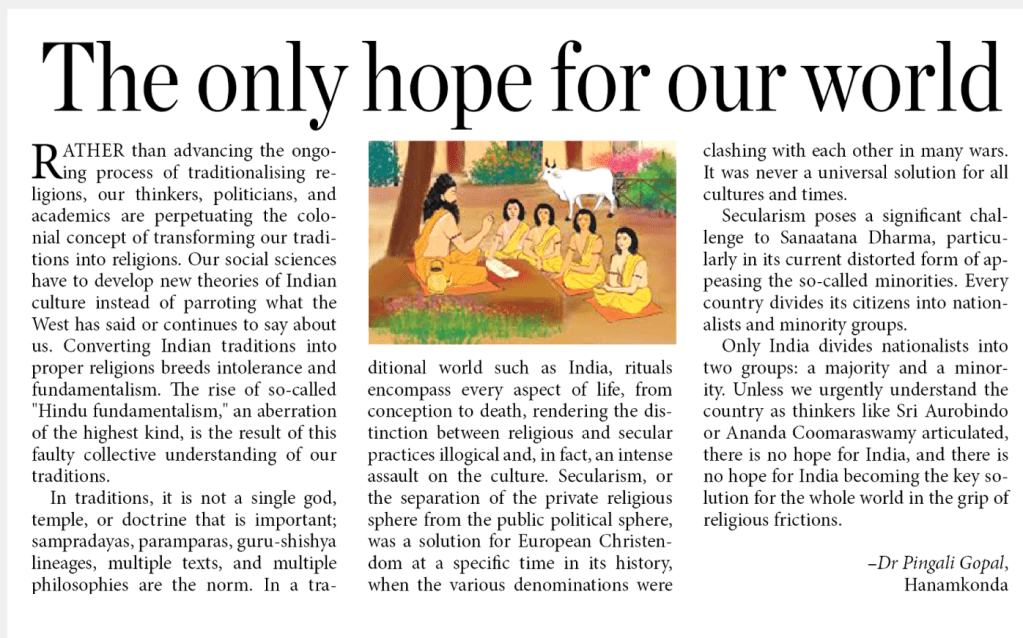
In traditions, it is not a single god, temple, or doctrine that is important; sampradayas, paramparas, guru-shishya lineages, multiple texts, and multiple philosophies are the norm. In a traditional world such as India, rituals encompass every aspect of life, from conception to death, rendering the distinction between religious and secular practices illogical and, in fact, an intense assault on the culture. Secularism, or the separation of the private religious sphere from the public political sphere, was a solution for European Christendom at a specific time in its history, when the various denominations were clashing with each other in many wars. It was never a universal solution for all cultures and times.
Secularism poses a significant challenge to Sanatana Dharma, particularly in its current distorted form of appeasing the so-called minorities. Every country divides its citizens into nationalists and minority groups. Only India divides nationalists into two groups: a majority and a minority. Unless we urgently understand the country as thinkers like Sri Aurobindo or Ananda Coomaraswamy articulated, there is no hope for India, and there is no hope for India becoming the key solution for the whole world in the grip of religious frictions.
 RANDOM MUSINGS