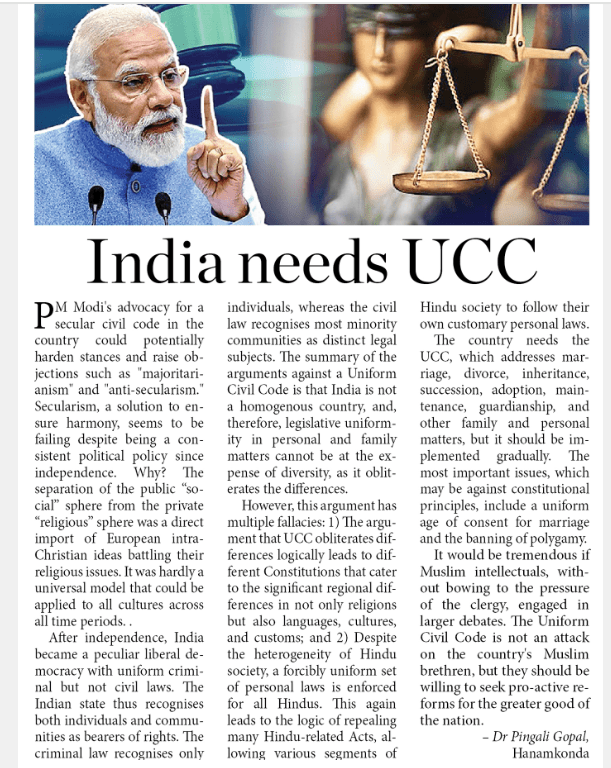
Unfortunately, PM Modi’s advocacy for a secular civil code in the country could potentially harden stances and raise objections such as “majoritarianism” and “anti-secularism.” Secularism, a solution to ensure harmony, seems to be failing despite being a consistent political policy since independence. Why? The separation of the public “social” sphere from the private “religious” sphere was a direct import of European intra-Christian ideas battling their religious issues. It was hardly a universal model that could be applied to all cultures across all time periods. The stress on secularism is all too evident with the influx of Islam into Europe today and the ever-increasing polarisation between Hindus and Muslims despite all efforts to implement secularism.
In India, specifically, there is no clarity on what constitutes religion or whether “Hinduism” is even a religion as exemplified by Christianity, Islam, or Judaism. There is an inherent category error when we refer to a vast collection of “traditions” as “religion.” The former encompasses living gurus, lineages, rituals, deities, mythologies, philosophies, and all aspects of nature, both living and non-living. The latter relies primarily on A Book, A Prophet, A God, and A Temple, concepts that are clearly absent in traditional cultures.
Fundamentally, religions say, “I am true, and you are false,” while traditions say, “I am true, but you are not false.” In a culture with a single religion but different denominations (like European Christendom at a specific time in its history), secularism, with separation of state and church, made immense sense and was successful. Where multiple faiths are involved, like in India, the traditional solution to harmony is essentially an “indifference to the differences,” which far transcends the ideas of “secularism, mutual respects, or tolerances.” India handled multiculturalism far better than any other society, and this did not stem from secularism. We should urgently explore our different solutions instead of pursuing a model that paradoxically increases friction. Our solution was to “traditionalise the religions,” but now we are “religionizing our traditions,” leading to intolerance and fundamentalism. Indian secularism, in particular, faces accusations of appeasing minorities and causing harm to Hindu interests.
After independence, India became a peculiar liberal democracy with uniform criminal but not civil laws. The Indian state thus recognises both individuals and communities as bearers of rights. The criminal law recognises only individuals, whereas the civil law recognises most minority communities as distinct legal subjects. The summary of the arguments against a Uniform Civil Code is that India is not a homogenous country, and therefore legislative uniformity in personal and family matters cannot be at the expense of diversity, as it obliterates the differences.
However, this argument has multiple fallacies: 1) The argument that UCC obliterates differences logically leads to different Constitutions that cater to the significant regional differences in not only religions but also languages, cultures, and customs; and 2) Despite the heterogeneity of Hindu society, a forcibly uniform set of personal laws is enforced for all Hindus. This again leads to the logic of repealing many Hindu-related Acts, allowing various segments of Hindu society to follow their own customary personal laws.
The country needs the UCC, which addresses marriage, divorce, inheritance, succession, adoption, maintenance, guardianship, and other family and personal matters, but it should be implemented gradually. The most important issues, which may be against constitutional principles, include a uniform age of consent for marriage and the banning of polygamy.
Polygamy cannot be ideally accepted in a country that upholds equality before the law, parity between sexes, and gender justice. A gender imbalance in matrimony with excessive unmarried men in the sexually active age group creates social, familial, criminological, and psychological stress on the population. Polygamous societies are more prone to violence and instability, as empirically noticed. Polygamy only for select religious groups can destabilise religious demographic balance, causing disturbances and anxieties detrimental to national unity and integrity. It would be tremendous if Muslim intellectuals, without bowing to the pressure of the clergy, engaged in larger debates. The Uniform Civil Code is not an attack on the country’s Muslim brethren, but they should be willing to seek pro-active reforms for the greater good of the nation.
 RANDOM MUSINGS