LETTER PUBLISHED IN THE HANS INDIA ON 29TH SEPTEMBER 2024
THE UNEDITED VERSION
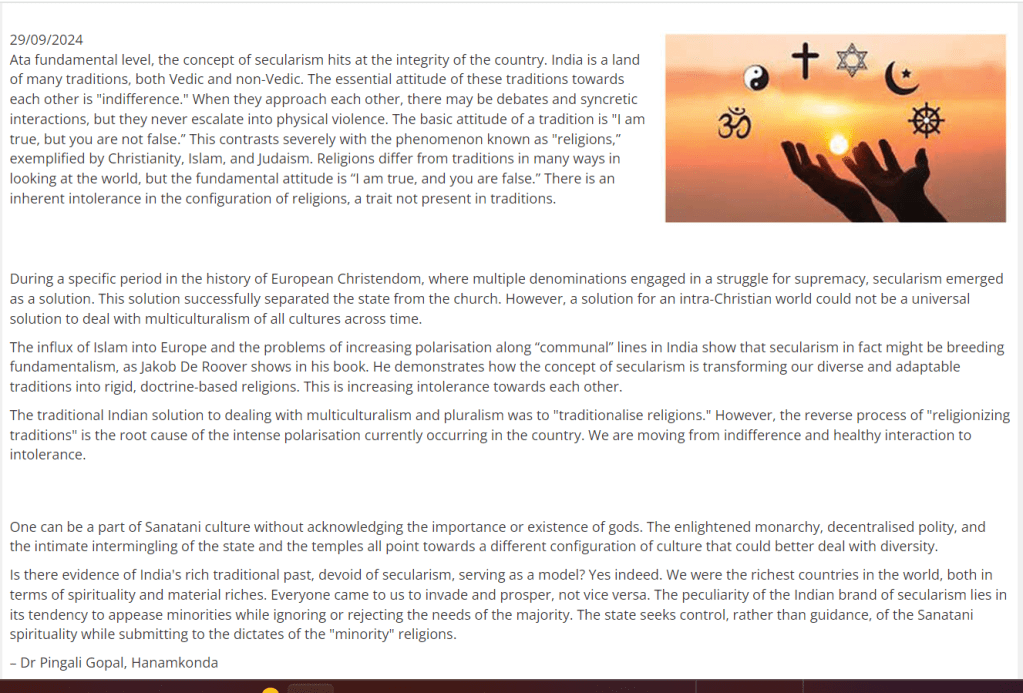
At a fundamental level, the concept of secularism hits at the integrity of the country. India is a land of many traditions, both Vedic and non-Vedic. The essential attitude of these traditions towards each other is “indifference.” When they approach each other, there may be debates and syncretic interactions, but they never escalate into physical violence. The basic attitude of a tradition is “I am true, but you are not false.” This contrasts severely with the phenomenon known as “religions,” exemplified by Christianity, Islam, and Judaism. Religions differ from traditions in many ways in looking at the world, but the fundamental attitude is “I am true, and you are false.” There is an inherent intolerance in the configuration of religions, a trait not present in traditions.
When alien religions came to India, they met a well-formed culture and, at a social-cultural level, started behaving like other traditions, thus either remaining indifferent or growing together in syncretism, barring some exceptions, of course. However, the violence associated with the religious wars in Europe was largely absent in India. During a specific period in the history of European Christendom, where multiple denominations engaged in a struggle for supremacy, secularism emerged as a solution. This solution successfully separated the state from the church. However, for secularism to be a successful model, everyone knew in the background what religion, Christ, or Christianity meant.
A solution for an intra-Christian world could not be a universal solution to deal with multiculturalism of all cultures across time. The influx of Islam into Europe and the problems of increasing polarisation along “communal” lines in India show that secularism in fact might be breeding fundamentalism, as Jakob De Roover shows in his book. He demonstrates how the concept of secularism is transforming our diverse and adaptable traditions into rigid, doctrine-based religions. This is increasing the intolerance towards each other. The traditional Indian solution to dealing with multiculturalism and pluralism was to “traditionalise religions.” However, the reverse process of “religionizing traditions” is the root cause of the intense polarisation currently occurring in the country. We are moving from indifference and healthy interaction to intolerance.
Influential intellectuals such as Ananda Coomaraswamy and Sri Aurobindo have insisted that the secularist idea of separating the church from the state, or the “spiritual” from the “temporal,” is causing damage to our culture. The separation of the “sacred” and the “profane” never existed in our culture. We intensely spiritualised every secular activity in the material world, using it as a pathway to the divine. The antagonism between religion and science in Indian traditions also fails to make sense. When a rocket scientist breaks a coconut in a temple, there is no dichotomy. Similarly, the concept of atheism is also foreign to our culture. One can be a part of Sanatani culture without acknowledging the importance or existence of gods. The enlightened monarchy, decentralised polity, and the intimate intermingling of the state and the temples all point towards a different configuration of culture that could better deal with diversity.
Is there evidence of India’s rich traditional past, devoid of secularism, serving as a model? Yes indeed. We were one of the richest countries in the world, both in terms of spirituality and material riches. Everyone came to us to invade and prosper, not vice versa. The peculiarity of the Indian brand of secularism lies in its tendency to appease minorities while ignoring or rejecting the needs of the majority. The state seeks control, rather than guidance, of the Sanatani spirituality while submitting to the dictates of the “minority” religions.
 RANDOM MUSINGS