Illustrated by: Dr Anand Naregal
There are two distinct professions that are necessary evils: medicine and architecture. While people are acutely aware of the former, they tend to be ignorant of the latter. Nevertheless, as a layperson, I can confidently assert that architecture and architects are humanity’s biggest blessings. That said, there are times when one might wish to bury them in sand under the hot sun for extended hours, particularly when they are in the process of designing your house.
My journey into the world of architecture began in Ahmedabad many summers ago when our family relocated due to my father’s job transfer. When I was a small child, I innocently questioned my father about the construction of so many buildings in the city using only red bricks. Like a typical parent silencing a pesky child with unanswerable questions, he casually replied, “Oh, the owners must have run out of money to plaster and paint the bricks.” I accepted this explanation for a while until I gradually realised that the iconic buildings in our city—such as the IIM, the National Institute of Design, various colleges, large houses, and even my school—were designed using those very bricks. I discovered that this style was known as “exposed brick” and was quite popular among the elite and affluent of the city. Talk about inversion of understandings.
We had a renowned school of architecture in the city, where the finest students in the country studied. A classmate enrolled in the school, and eventually, he granted us access. We discovered why the “school of Archi” was more popularly known as the “school of anarchy” in the outside world. We entered in hushed silence and were struck by an almost bohemian lifestyle. Within the spacious classrooms, students sat backwards in their chairs, forming a circle around the teacher. Outside, some students were smoking while the teacher explained. Others were painting abstractly on the lush lawns, and some were lounging in hammocks, dressed in the shortest of shorts. It challenged our conservative sensitivities profoundly.
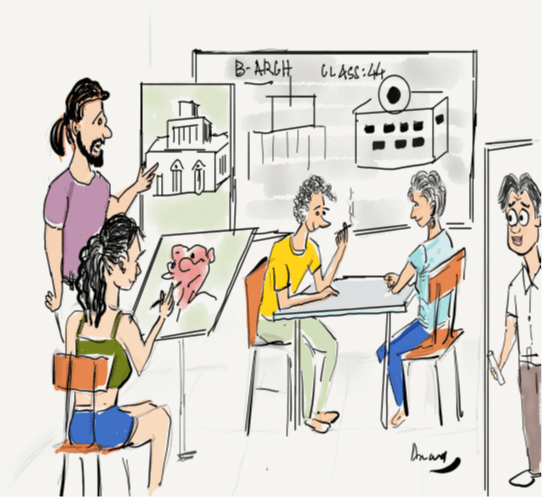
The school of architecture was undeniably a place of rebellion, offering us a thrill when we observed fashionable girls confidently strutting about, oblivious to the wide-eyed ordinary folk. Students of both genders (only two those days) openly smoking in the campus was an unthinkable sight. In the conservative environment of medical classrooms, we could only see the backs of the girls’ heads as they occupied the front two rows, covered in the longest aprons possible. Meanwhile, the rebellious male smokers found themselves relegated to the farthest corners of the campus, hidden away behind bushes and in secluded nooks.
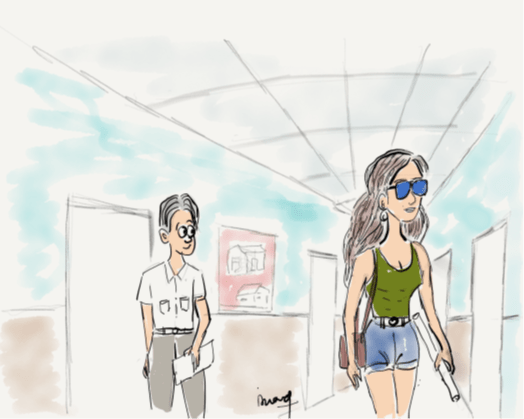
During our day, we discovered that the most effective way to impress an architecture student and initiate a conversation was to mention icons such as BV Doshi, Le Corbusier, Louis Kahn, Charles Correa, and Hafiz Contractor. “Ah! This fascinating guy knows his architectural stuff.” It was a surefire way to capture the attention of a good-looking aspiring architect. A cousin of mine, who attended this school, advised me that the best way to grab any architect’s attention was to drop casually, with a tone of admiration, that only architects could “package and sell light and space”. However, the pinnacle of name-dropping to impress any architect is undoubtedly Howard Roark, the fictional architect protagonist from Ayn Rand’s novel, The Fountainhead. Without exception, every architect regards Howard Roark as the quintessential model, and the quickest way to win over any architect is to suggest that they share Roark’s attitude and mindset.
During the construction of our small nest, we engaged a young team of architects fresh out of college. As clients, we quickly grasped the two fundamental components of any architectural design: aesthetics and function. Sometimes, asking an architect why they chose a particular form can be futile. Some structures stand independent without any grand function. Not every form fulfils a specific purpose, and not every function aligns with the most appropriate form. These are the essential considerations one should bear in mind when interacting professionally with architects. An innocent question such as “Why this particular shape or structure?” may evoke a stern stare, a thump on the head, or, worse still, the architect’s abrupt departure, leaving you in a difficult position. Something is there because it is there. You cannot use everything for drying clothes or storing old shoes.
Howard Roark believed that a true architect should go inside the minds of their clients to design a house. Unfortunately, many architects fail to reach the mind and instead get under the skin, lingering far too long. They can take an excessively long time to deliver their designs, requiring clients to beg repeatedly, grovel, and finally grab their collars before receiving any work. While junior architects may be responsive, with experience, they often become increasingly tyrannical. When it comes to the consumers emptying wallets, doctors are not as effective as top-tier architects (or even the lawyers). You must accept whatever the senior architects provide. There is no room for philosophical discussions. For the client, it is a straight line from dear old Tennyson, “Not to question why, but to do and die.” The most notorious tyrant of all, Hitler, apparently had architectural ambitions. No wonder.
Any project is essentially the collaborative effort of architects, civil engineers, and interior designers. The latter began as a subspecialisation of architecture but has since evolved into a distinct speciality. All three disciplines play a vital role in presenting a unified image for both the client and the project. However, they are often at odds, armed with knives, sticks, and guns in their mutual interactions. The most formidable adversary for architects, as I realised with considerable dismay, was the engineer. Much like a married couple or the relationship between surgeons and anaesthetists, they are intricately dependent on one another, yet maintain a complex love-hate dynamic. Architects are prone to creating elaborate visions—castles in the air—only for structural engineers to shatter these castles, declaring them unfeasible.
The engineers add, remove, edit, and modify here, there, and everywhere, and the architect goes from a sulking to angry mode. This often escalates into conflict, bringing to mind the old adage that applies to the beleaguered client: when the elephants fight, it is the grass that suffers. Clients, too, become familiar with expressions like “caught in the crossfire” and “collateral damage”, as project timelines stretch due to the two factions not seeing each other. The clash between the architect’s vision and the engineer’s realism is undoubtedly challenging for the client.
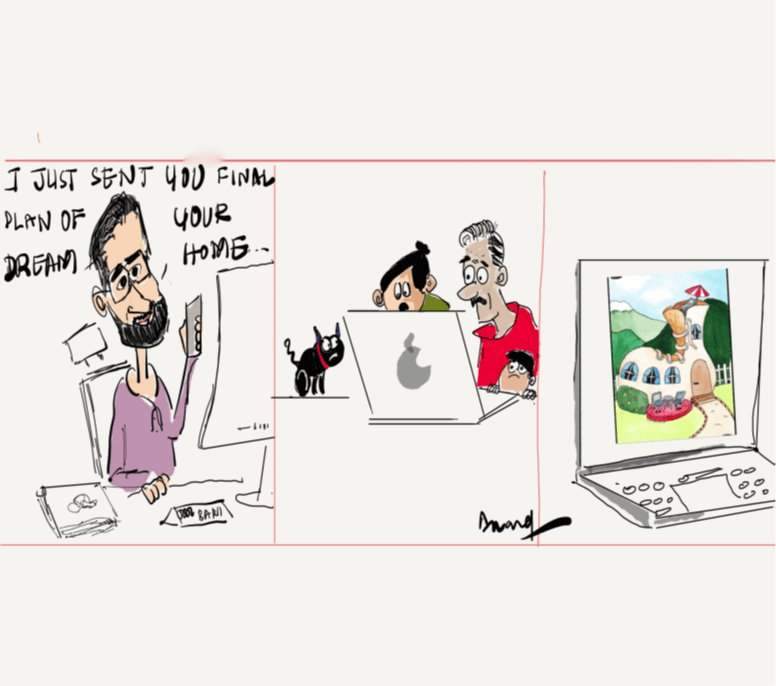
After speaking with us, our young architects decided that the philosophy of air, light, symmetry, subtlety, and “minimalism” would be the theme of our house. The last word particularly appealed to us considering the weight of our wallets. The use of light and air; the design of the walls, tiles, electrical connections, flooring, bathrooms, windows, cupboards, colour schemes, and doors; the incorporation of various elements, like glass and steel; the elevation of the house; the landscaping; the design of the small garden; and hundreds of minutiae were all executed with such precision, meticulousness, love, and passion. At one point, we asked the architects if we could place a nail in a specific spot on the wall, and they recommended positioning it approximately four inches above and to the right of our initial consideration. The reasoning behind each aspect of the house was remarkable. We were deeply amazed and impressed by the world of architects and their work. Of course, there are a great many people involved, but the architect is certainly the key.
We wholeheartedly advocate for the involvement of architects in even the most modest projects. Though their services may seem costly, and one might be tempted to hire a skilled mason for standard designs, an architect plays an essential role in merging aesthetics with functionality into a cohesive and elevated whole. Observe any building, and you will discern the melody and signature of an architect. Of course, there are good, bad, and ugly songs, but it is a distinct one. They are not a luxury meant only for the rich and the beautiful. They are a necessity for the not-so-rich and not-so-beautiful too, as the return on investment is almost always assured. A tip especially for Indians: since most architects in India still belong to Indian culture, they are equally susceptible to hardcore bargaining and emotional blackmailing to reduce their prices.
Our architects insisted on a plain white exterior as the epitome of subtlety. It worked great for me too since I had also run out of money by this time. Unfortunately, one person overlooked this subtleness, believing it would look better once the exterior painting was complete. To him, the white exterior was indicative of an incomplete project. One cannot please everyone. Nevertheless, architects enhance the world we inhabit, even if one might occasionally feel inclined to drill holes into them for their episodes of sheer obstinacy and prolonged slumber. However, may their tribe live long, and bless them forever for bringing light and beauty into our mundane world.

 RANDOM MUSINGS