Illustrated by Dr Anand Naregal
The adage suggests that boys cry less than girls, a notion supported by findings across cultures and age groups worldwide. However, my family presents a notable exception to this norm. We are outliers among the outliers. In my household, this trend is inverted; my wife seldom cries, whereas I discover myself welling up at the slightest emotional scene, whether it be in a cartoon film or a commercial for biscuits. My daughter does cry during emotional moments occasionally, yet she generally aligns more with her mother’s stoic disposition.
I thus hate tragedies where the main characters die. The entire world may be destroyed in a catastrophe, floods, volcanoes, or alien attack, but to me, the hero and the heroine represent the continuity of the world. Thus, their survival is what gives me hope. Thus, any film (Southern and especially Tamil films are notorious for this) where the hero slips into a waterfall, the heroine bangs her head, or both jump into a river while the world is baying for their blood upsets me terribly. Nobody cries in a Walt Disney cartoon movie. I do, especially those sweet princess movies where the stepmother is so cruel.
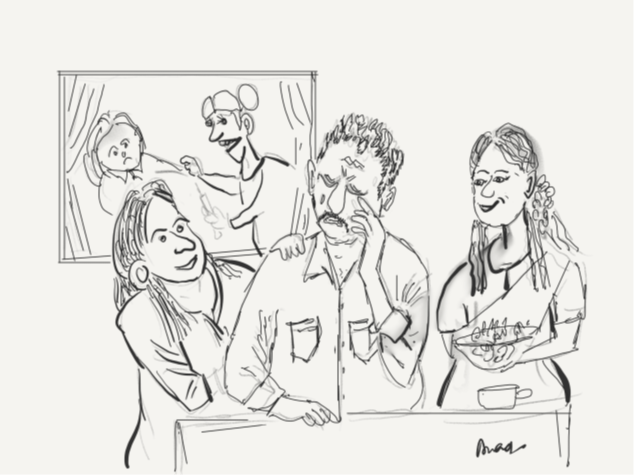
My dear wife’s favourite pastime is watching me during tragic movies. She becomes excited with the emotional or tragic scenes but for different reasons. No sooner does she observe me sniffing and discreetly dabbing my handkerchief than she will alert my daughter and exclaim loudly, “Look, Daddy is crying.” My gently stoic daughter would look at me and emit a hearty laugh that jars my sensitive soul to the innermost core. It can be quite embarrassing when the lights are on. I strictly avoid tragedy films when the family is around, but I occasionally get thrown off by an unexpected scene.
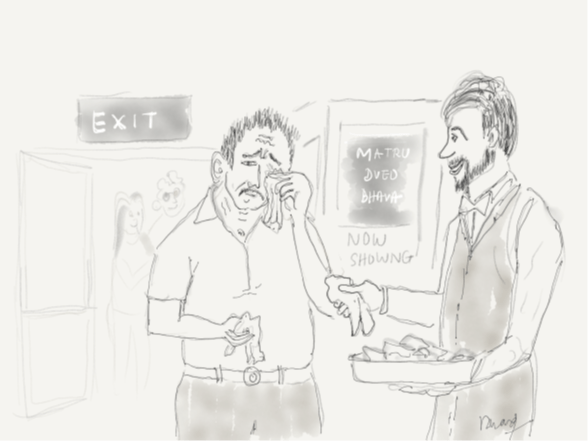
Even without the family around, as a movie enthusiast who values all genres and languages, I consistently steer clear of tragedies. I heard that a Telugu film called “Matrudevobhava” (revering the mother as God) is the final test for the strongest of the strong. The producers allegedly converted the viewers’ tears into gold. In that movie, a widowed lady has five children whom she places up for adoption one after another when she cannot afford to maintain them. The movie continues to depict the emotions as the new parents take each child against their will while the mother watches helplessly.
People say it is the most gut-wrenching and emotionally draining movie ever made in the history of cinema. Many viewers have left the movie halfway through, in tears and unable to cope with the emotional trauma. Legend has it that handkerchiefs were provided for the audiences right at the time of purchasing the tickets. Legend also has it that the movie theatre’s rigid brick walls melted and formed many lakes. My brother-in-law tells me that even this movie failed to move my wife-to-be.
“Kuch Kuch Hota Hai”, “Kabhi Khushi Kabhi Gham”, “Anand”, and “Ek Dooje Ke Liye” are just a few of the many sentimental films that can evoke tears even from the strongest among us. Those of my kind quietly dab their eyes with handkerchiefs in the darkened cinema, while the indifferent and hard-hearted sit amused. We manage to dry our eyes while exiting the hall, but the red eyes still give us away. A well-known Telugu cinema director once produced a series of “triangle” films, each featuring a hero and his two love interests. In one film, the hero perishes; in another, the “other” heroine dies; in the next, both heroines meet their ends, and in the last one I watched, all three die. More films were made featuring character deaths in various permutations and combinations. And all of them were runaway hits, apparently.
What draws us to tragedies and compels us to cry during films? Is it a form of catharsis or simply a calculated tactic employed by the director? Some directors present death in a straightforward manner, leaving viewers relatively unmoved. Others, however, manage to extract tears from the deepest recesses, evoking powerful and intense responses. It is ironic that the most immortal love stories feature protagonists who are decidedly mortal. Be it Heer-Ranjha, Sohni-Mahiwal, Laila-Majnu, or Romeo-Juliet, it is only the tragedies that make audiences weep profusely, and these ascend to the status of the greatest love stories. Had these couples married and settled into mundane lives, I can only imagine that Mr Romeo or Mr Laila would be out buying vegetables or dabbling in horse racing, while their partners would be squabbling with their mothers-in-law in the humdrum of everyday existence. God forbid; they might even be cheating on each other as the fascination wears off.
Conversely, in the medical profession, mortality serves as a catalyst for aggression towards doctors—whether verbal, physical, or legal. There is no romanticism attached to tragedies in this realm. A person is viewed as immortal until they enter the hospital. Words like ’empathy’, ‘sympathy’, ‘connection’, and ‘bonding’ seem to belong to a bygone era in the doctor-patient relationship. Tears shed for a deceased patient were once commonplace among doctors. Nowadays, however, the predominant emotion felt by a doctor when a patient under their care passes away is fear. “How will the patient’s family react? Are they approaching unarmed, or are they armed with insults, sticks, knives, and stones?”
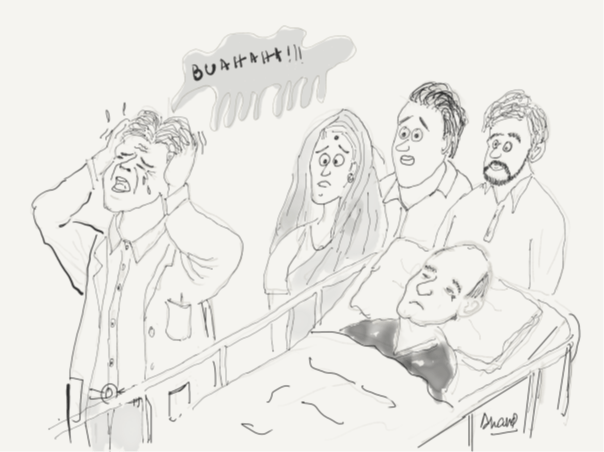
Anyway, I recall an incident when we heard a group of people wailing loudly outside a ward in the hospital after a patient had died. We were taken aback when we realised that the loudest cries came from the treating doctor, who stood at the centre of the crowd. The display of sympathy was astonishing, yet the attendants appeared convinced. This was certainly the height of what we doctors must do to demonstrate our noble intentions.
Anyway, crying is supposedly cathartic for emotions, and quite unsurprisingly, researchers have not left even crying alone. Apparently, when one cries alone or in the company of only one person, it relieves emotional stress. Crying feels worse and does not lead to a mood change when individuals are with two or more people. Of course, a person who cries in front of a thousand people without feeling anything is likely to be a politician. Researchers propose that hormonal influences affect crying, with testosterone inhibiting it and prolactin promoting it. This illustrates the fact that researchers are at a loss for subjects and are scientifically squeezing the world dry. They have also concluded that tears can decrease sexual attractiveness. Seriously!
Researchers, working in the world of publish or perish, are increasingly getting bizarre and taking the fun out of our lives. Soon, we will be having studies on why stones don’t breathe or marbles don’t speak. Avoid such researchers who destroy the wonders, charms, and mysteries of life with their studies. However, one specific group of people have tears when we smile, and they smile when we cry. I can sum up my lifetime research in one line: avoid these people. Crying is beneficial, but it is important to do so just in the right amount and with the right person. Or as the elders would say, excess of anything becomes poison.
 RANDOM MUSINGS