WHY TAIWAN? WHY NOT?
The Far East has always fascinated me, and this festive season in January, we decided to travel there. Our family entourage consisted of two couples: my spouse and I, along with my daughter and her husband. For most Indian tourists, the most popular eastern destinations include Indonesia, Singapore, Thailand, Vietnam, and Cambodia. While I know Thailand is a wonderful place, those who travel there with their families often receive peculiar looks from friends. Unfortunately, people often perceive visiting Thailand as a solely male activity. We also excluded Vietnam and Cambodia due to lingering tensions that our newspapers perhaps highlighted more prominently than reality.
My son-in-law suggested Taiwan, a country famous for its semiconductors, but is largely off the radar for Indian tourists. During our week-long stay, we encountered very few Indian families touring the country. My son-in-law has been fascinated with Taiwan for some time, particularly the Alishan forest area. The budget was reasonable, the conversion rates did not raise gasps (three rupees for a Taiwan dollar), and Indian households generally do not say no to an only daughter and son-in-law.
Some news about China conducting military drills near Taiwan concerned my father. My friends also asked me, “Why Taiwan?” In response, my daughter simply asked, “Why not?” A quick inquiry on Quora yielded answers from some Taiwanese individuals, who explained that China has been needling Taiwan for seven decades and laughed away any fears about visiting the island. So, off we went, and within a few days, we realised what a wonderful choice we had made.
THE BRIEFEST HISTORY OF TAIWAN
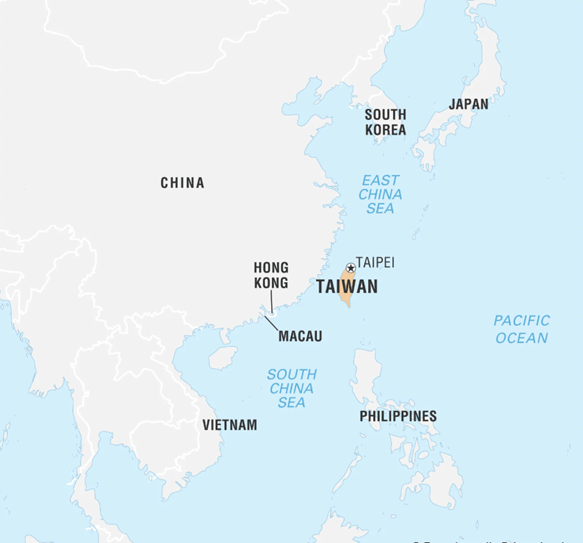
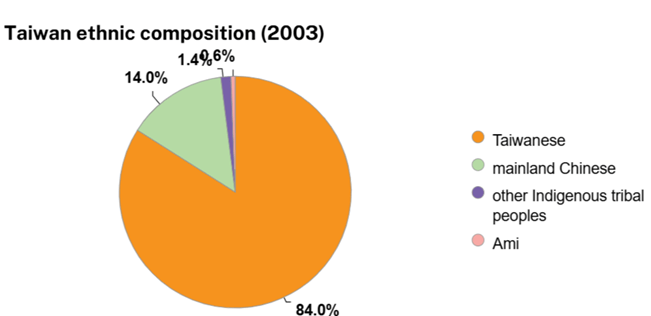
Taiwan, with a population of 24 million, is an island country in the western Pacific Ocean off the coast of China. It is 395 km long and 145 km across at its widest point, with mountains dominating the east and fertile plains in the west, where most of the population lives. The population of Taiwan is composed of four ethnic groups: Indigenous peoples, two groups of Taiwanese (Fukienese and the Hakka), and Chinese from mainland China. All three non-Indigenous groups are of Han Chinese descent. There are officially 16 indigenous groups, each with their language and traditions, existing for millenniums, of which Ami is the largest. However, the recorded history dates from about 400 years ago.
European sailors called this beautiful island Formosa. In the early 17th century, the Dutch East India Company established a base in southwestern Taiwan and brought Chinese labourers to its plantations. In 1642, the Dutch quickly overcame the Spanish attempt to colonise from the north. The Ming dynasty loyalists arrived in Taiwan two decades later and drove the Dutch out. A couple of decades later, the Qing dynasty (1644-1912) of China took control of Taiwan. Finally, in 1885, Taiwan was declared a province of the Qing Empire.
In 1895, after winning a war, Japan took control of Taiwan and ruled the island until 1945. Meanwhile, in mainland China, Chinese revolutionaries overthrow the Qing Empire itself to establish the Republic of China (1911-1912). After the defeat of Japan in the Second World War, world leaders in their Cairo Declaration restored Taiwan to the Republic of China. The restoration was due to the efforts of the important ROC leader, Chiang Kai-shek.
A full-scale civil war between the ROC government and the Chinese Communist Party led to a relocation of the ROC government to Taiwan, followed by 1.2 million people from China in 1949. For 38 years thereafter, until 1991, the island was under martial law, in a period known as “White Terror”.
ROC finally established peace with Japan in 1952. A couple of years later, Taiwan became a military ally of the USA. Since the late 1960s, Taiwan has started growing economically with the creation of economic zones. The previous Japanese rule helped modernise Taiwan to a great extent. In 1971, the UN recognised the People’s Republic of China (PRC), which ruled mainland China, as the only legitimate representative of China in the global body. The ROC withdrew from the UN.
After Chiang Kai-shek died in April 1975, his son, Chiang Ching-kuo, succeeded him as the leader of the Kuomintang and became president in 1978. His administration saw a gradual loosening of political controls, a transition towards democracy, and moves towards “Taiwanisation”. Democratic activists, who started in 1979 in Kaohsiung, a port city of Southern Taiwan, finally formed the Democratic Progressive Party in 1986. In the following year, Chiang ended martial law and allowed family visits to mainland China. Gradually, other reforms gave more power to native-born citizens and calmed sentiments. Elections began in 1991.
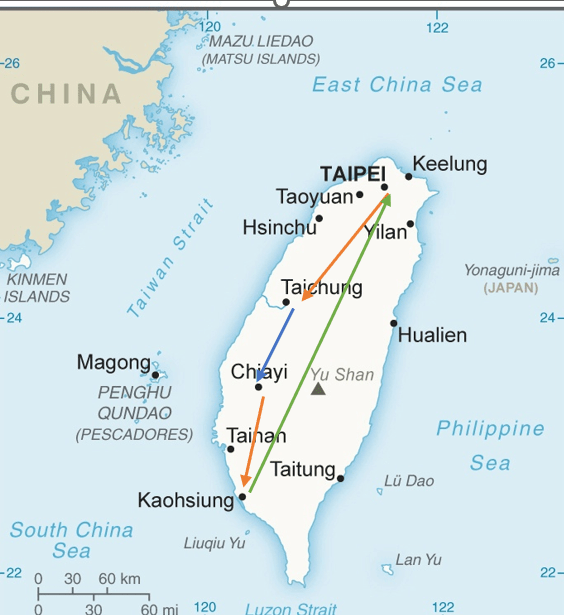
Our Route Map
DAY 1
Landing in Taipei, Indian restaurants
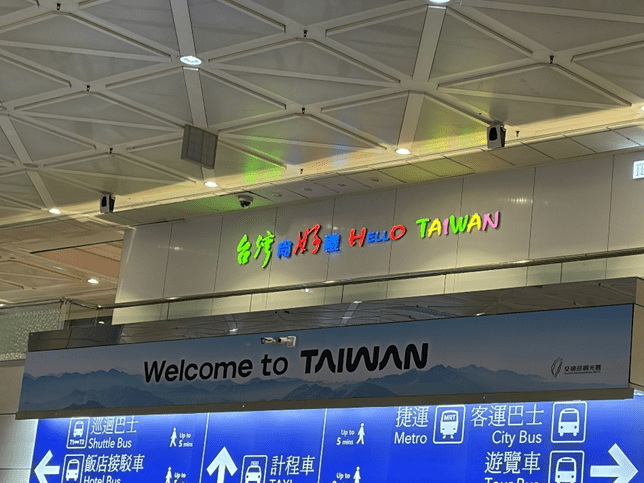
As we drove from Taipei airport to our hotel, the exceptional cleanliness and pothole-free roads immediately struck us. The wide roads of Taipei, primarily arranged at right angles, immediately captivate the Indian mindset, which is accustomed to chaos and blaring horns. The hotel staff was exceptionally polite. We sought an Indian restaurant close to our place run by a guy from Delhi. A brisk walk was what we needed after an eight-hour flight with a layover in Singapore.
The Indian was talkative and gave some initial perspectives about Taiwan. He did not encourage us much for shopping except for a particular brand of shoes! I am not revealing the brand until I am promised a royalty. He gushed that people were delightful and relaxed. In fact, the one word to describe the country after our stay would be “relaxed”. There is no rush, and the traffic appears neat and controlled. People commute by cars, scooters, and cycles in well-defined paths on the road.
The refreshing sense of safety comes from the constant presence of people, similar to India but on a lesser scale, when darkness falls. The 7-Eleven convenience stores are ubiquitous in Taiwan and located practically on every street corner. These stores are particularly useful to tourists for their afternoon lunches. Breakfast and dinner are not usually a problem.
Vegetarian food can be a bit challenging, but we could manage with the help of Indian restaurants at night and the hotel breakfast (bland, though) in the mornings. Bread, jam, butter, fruits, salads, cornflakes, fruit juices, milk, and nuts are fine for filling the stomachs. The idlis and dosas have to wait for the Indian restaurants that generally open late. There are many vegans in Taiwan, mostly Buddhist ones, and vegan options do show their presence. However, Indians accustomed to spice may find even the vegetarian options challenging to consume.

A temple at an Indian restaurant in Taipei
DAY 2
Taipei 101
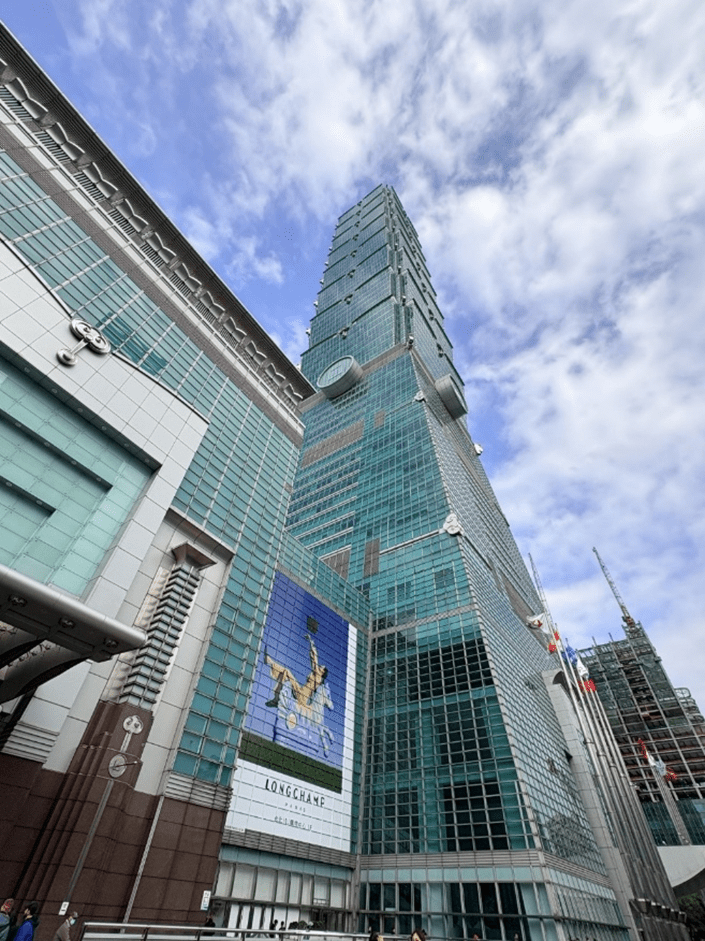
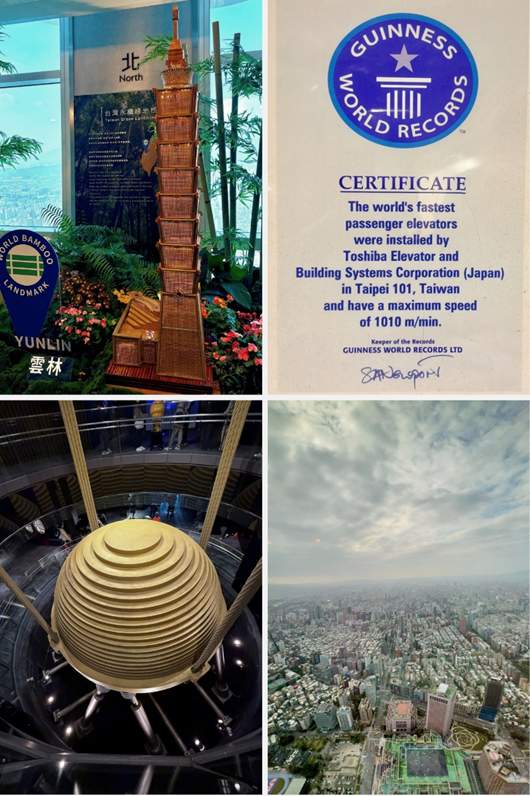
The most famous attraction of Taipei is the Taipei 101, the tallest building in Taiwan. It was the tallest building in the world when it opened in 2004, but the Burj Khalifa took that title in 2009. Today, it is the eleventh tallest in the world and is home to many offices, restaurants, shops, and observatories. There is one observatory on the 89th floor and one on the 101st floor, the latter being a little more expensive for tourists. The building, with Ruyi as a recurring motif that symbolises power and fortune, inspires awe. The overwhelming attractions in this building are the high-speed elevator that transports passengers from the 5th to the 89th floor in 37 seconds, attaining a speed of 60.6 km/hour, and the tuned mass damper, a huge engineering marvel, suspended from the 92nd to the 88th floor that offsets movements in the building caused by strong gusts.
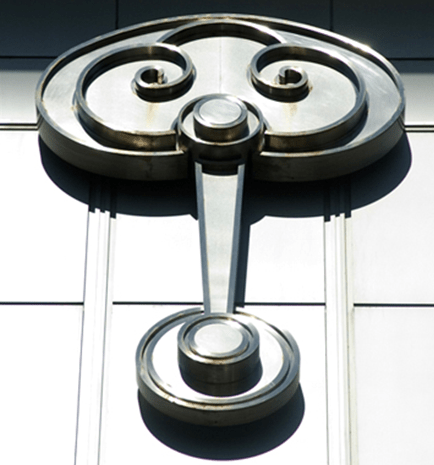
The Ruyi Motif signifying power, good fortune, and prosperity
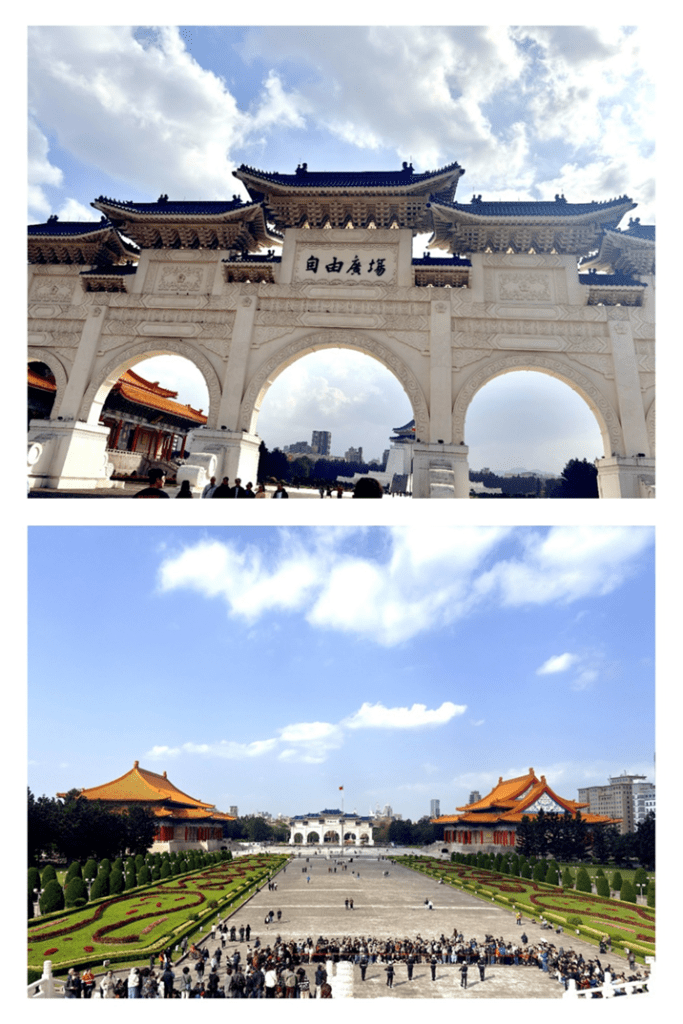
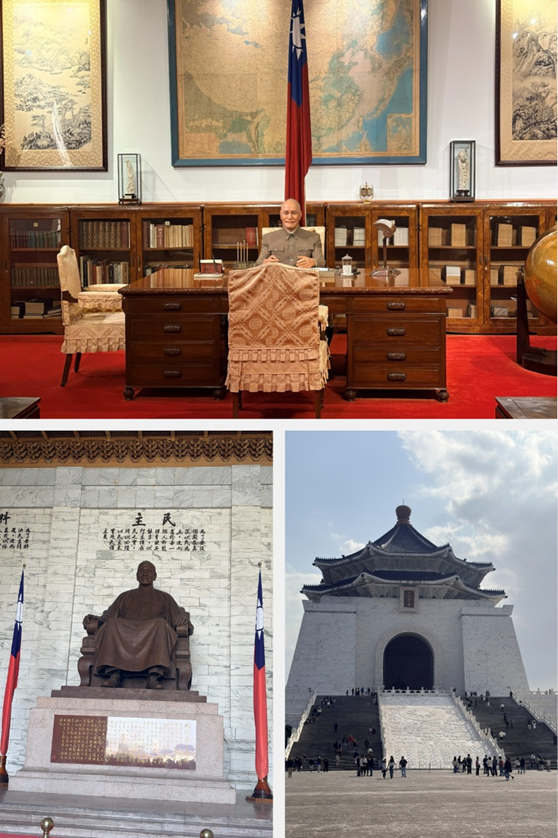
Chiang Kai-shek Memorial Hall
Taiwan is a story of breaking away from China as an independent country, replacing martial rule with democracy, and difficulties for the indigenous tribes. Two major groups underwent persecution in the martial law period: the nation’s Indigenous peoples and the victims of political persecution during the country’s “White Terror” period from 1949 to 1991. The February 28 incident (or massacre) of 1947 was a violent suppression of an anti-government uprising in Taiwan where the National Revolutionary Army belonging to the Republic of China (ROC) killed thousands of civilians.
Chiang Kai-shek is the most polarising figure in Taiwan. His memorial is a crucial site for understanding the complex and painful history of Taiwan. The National Memorial, the National Theatre, and the National Concert Hall stand flanking the huge Memorial Square. A huge statue of Chiang Kai-shek is on the upper floor, with a museum and a library on the ground floor that describe the story of Chiang Kai-shek and the transition to democracy. This site became the hub of pro-democracy events in the 1980s and early 1990s, notably the Wild Lily student movement, which accelerated the transition to democracy. The result of this movement was better than Tiananmen Square.
Taiwan has a complex relationship with mainland China. Most want a status quo as an independent country without a formal declaration that could risk a sure-to-lose war with China. The Pan-Green coalition wants a completely independent status, whereas the Pan-Blue coalition, which includes KMT, the legacy of Chiang Kai-shek, bats for better ties with China. However, there is a rising sense of a separate Taiwanese identity rather than Chinese. The Indian subcontinent is not alone in facing complex equations and a sense of identities.
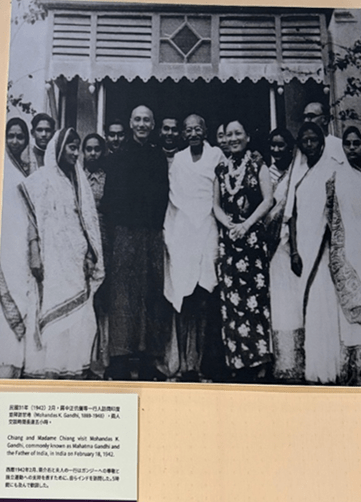
Meeting Gandhiji in 1942 – The Indian Connect
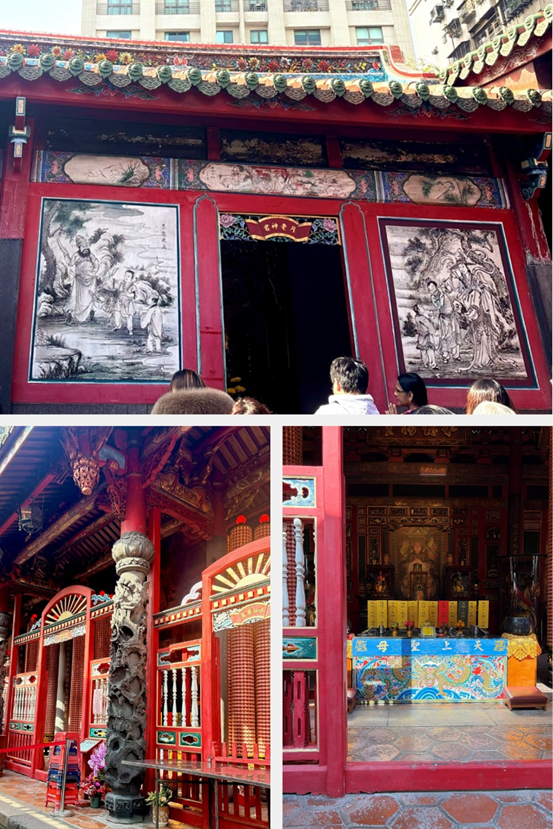
Lungshan Temple
Built in 1738 by Chinese settlers to remind them of their roots, this temple has endured destruction from numerous earthquakes, fires, and air raids, resulting in its constant rebuilding and renovation. This must-see temple is a syncretic blend of Mahayana Buddhism, Taoism, and various folk deities. Visitors can spend an entire day absorbing the stunning architecture, intricate iconography, rituals, and the many deities associated with practical concerns such as success in love, examinations, marriage, and even promotions. The Mahayana form of Buddhism, which is popular in Taiwan and China, along with Taoism, incorporates multiple deities and immortals.
The syncretic combination of folk culture with established traditions, the nature of the rituals, the multitude of deities, and the deep respect shown to ancestors and nature reflect parallels in Indian traditions. Dr S.N. Balagangadhara (The Heathen in His Blindness) presents the following strong thesis: “Tradition” differs fundamentally from the phenomenon known as “religion”, represented by Christianity, Islam, and Judaism. Asia has traditions that typically engage with the “other” with “indifference to the differences” or through an organic syncretism. The typical attitude that traditions hold is that “I am true, but you are not false“. Thus, in Eastern cultures, deities from different traditions like Buddhism, Hinduism, Confucianism, and Daoism sit happily in one temple complex. In contrast, religions tend to have strong divisions between “true” and “false”. There is more intolerance than indifference toward the “other” in religions. Also, the dynamic of proselytism is strong in religions but not in traditions. Rituals, alongside respect for nature and ancestors, are defining characteristics of traditional cultures.
Lunch and dinner were in Indian restaurants and managed by part-time employees who were postgraduates and doctoral students. Surprisingly, most Indian students we met were attached to aeronautical sciences. The university across the country appears to be strong on this subject. We could not visit some other attractions like the National Palace Museum and Shilin Night Market. Perhaps for another day.
DAY 3
Shifen Waterfall
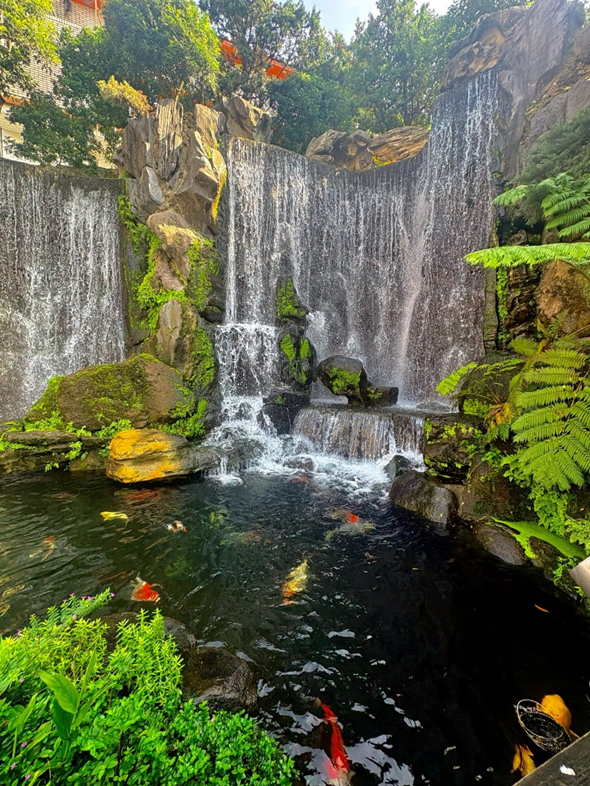
This is a beautiful place on the way to Geo park. The park has been developed well around the waterfall termed the Little Niagara of Taiwan. An impressive four-headed Buddha sits at the beginning of the park. The four heads represent love, compassion, joy, and charity. The iconography apparently represents the Thai-style Hindu creator god Brahma (Phra Phrom), rather than a traditional Buddha. The rituals around the Buddhist idols strongly resemble the Hindu way of rituals, bringing to mind what Ananda Coomaraswamy said a long time ago:
The more superficially one studies Buddhism, the more it seems to differ from the Brahmanism in which it originated; the more profound our study, the more difficult it becomes to distinguish Buddhism from Brahmanism, or to say in what respects, if any, Buddhism is really unorthodox. The outstanding distinction lies in the fact that Buddhist doctrine is propounded by an apparently historical founder, understood to have lived and taught in the sixth century B.C. Beyond this there are only broad distinctions of emphasis.

Yehliu Geopark
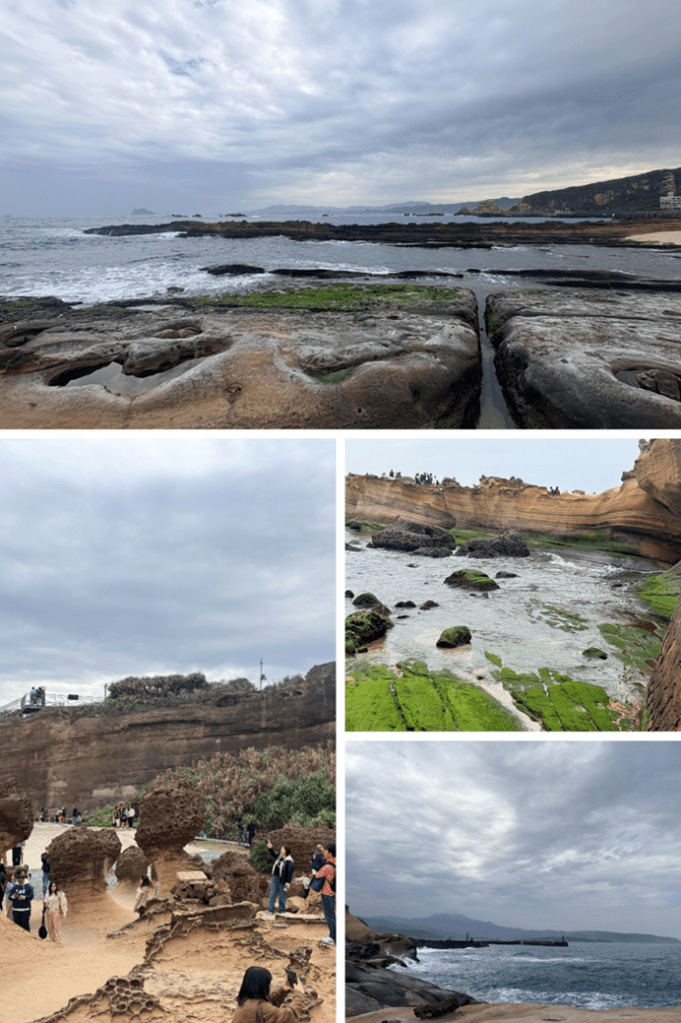
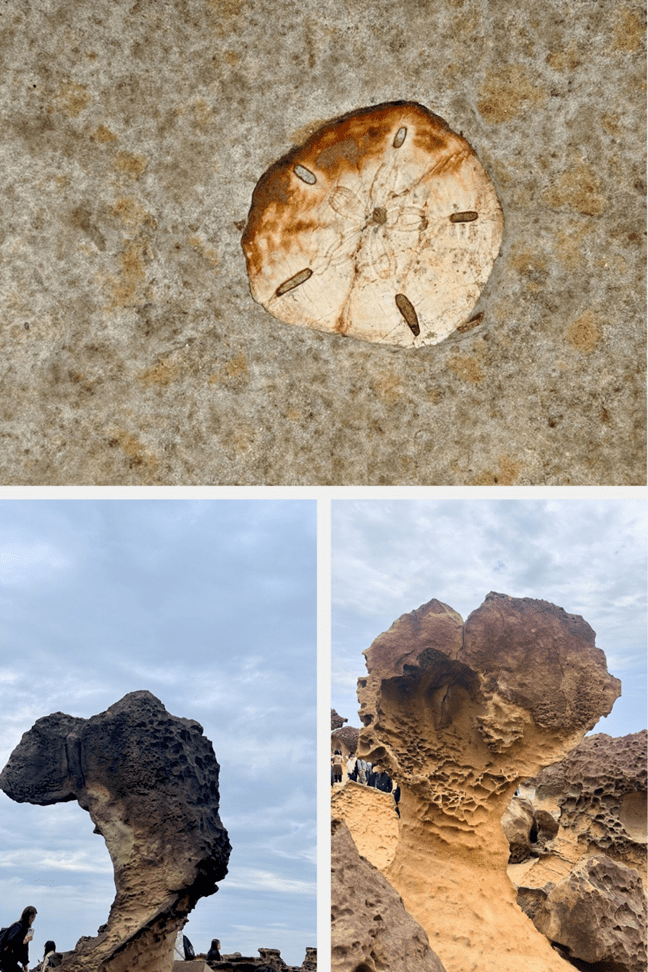
A 30-minute drive from Taipei, Yehliu Geopark is a captivating location on the northern coast of Taiwan. Recognised as a UNESCO Global Geopark, it features a 1,700-meter-long cape that extends from the Datun mountain range, reaching out into the majestic Pacific Ocean. The park is home to a remarkable variety of geological rock formations that have been shaped over millions of years by the natural forces of erosion, weathering, volcanic activity, tectonic movements, and marine processes. It is an excellent spot for photography, with formations that have been creatively named, including Queen’s Head, Mushroom Rocks, and Fairy Shoe. Additionally, there are formations known as Dragon’s Head and Divorce Rock, too! For lunch, we opted for the ubiquitous 7-Eleven store.
Shifen Village and the Lanterns
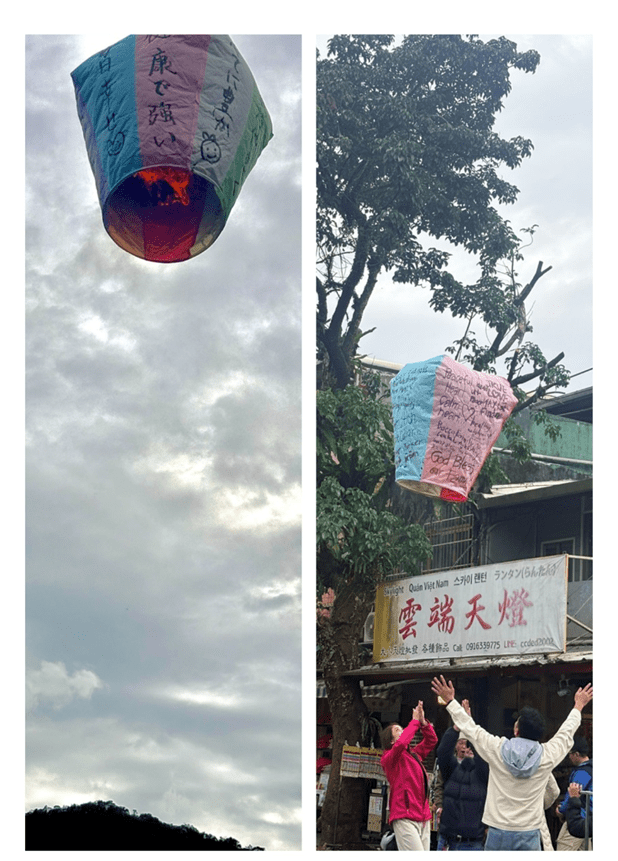
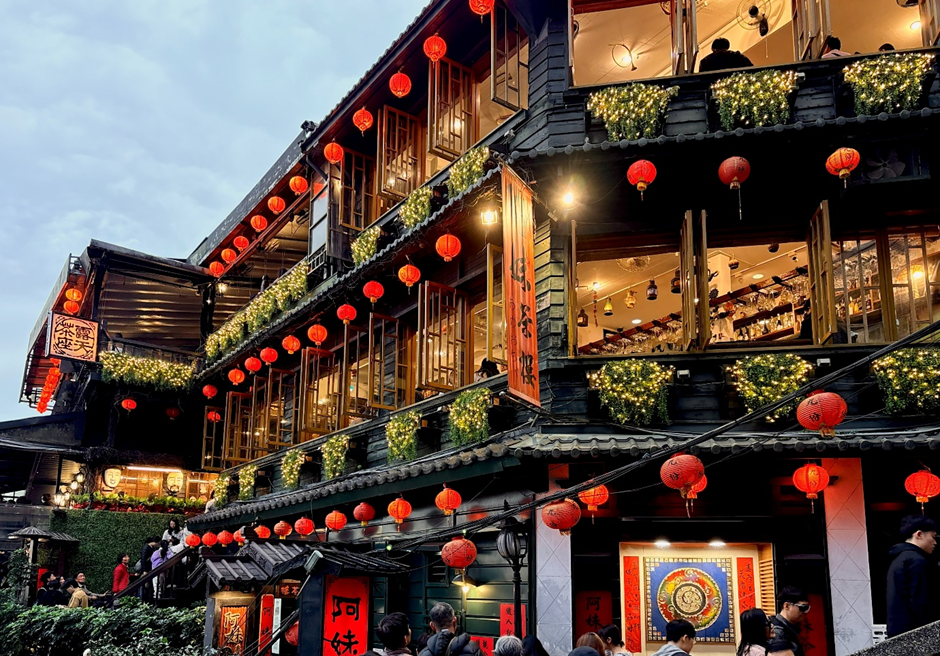
This is a magical place near Taipei, a part of the day trip located along an old railway line that is still functional. This area was once an old mining site, where communication with distant places involved sending lanterns that carried written messages. Now, tourists flock here to write colourfully on these huge paper lanterns. We wrote our deepest wishes on the four sides of the lantern and released them by standing in the middle of the tracks and lighting a candle. Of course, the activity stops when a train passes. This must-visit scenic spot, with its vibrant colours, radiates pure joy. Apparently, this tradition comes alive all the more during the New Year and other festivals. Typical of Asian cultures, colour represents something deeper. Red signifies energy, while blue represents health, for example.
Jiufen Village, Tea Making, and the Steps: Sheer Magic
A day tour package from Taipei includes Jiufen and Shifen, along with the geopark. Jiufen, a former gold mining town in the Japanese era, is a place one instantly falls in love with. A crowded, stone-paved path with shops selling various goods, illuminated by lanterns on all sides and set against a backdrop of mountains and the ocean, creates a sense of deep magic. We were initiated into a traditional tea-preparing ceremony at one of the famous teahouses. The tea making was an elaborate process, and it was great fun to learn. It cost us good money, but sorry, our tongues are more used to Indian tea. The place is suffused with Japanese-style architecture, as our guide informed us. We came back to Taipei in the evening.
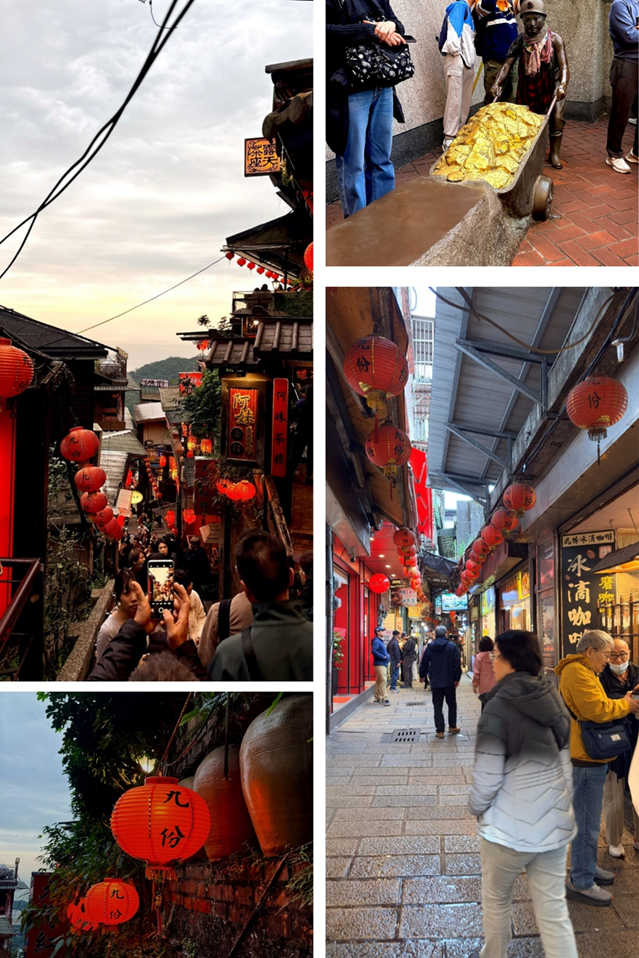
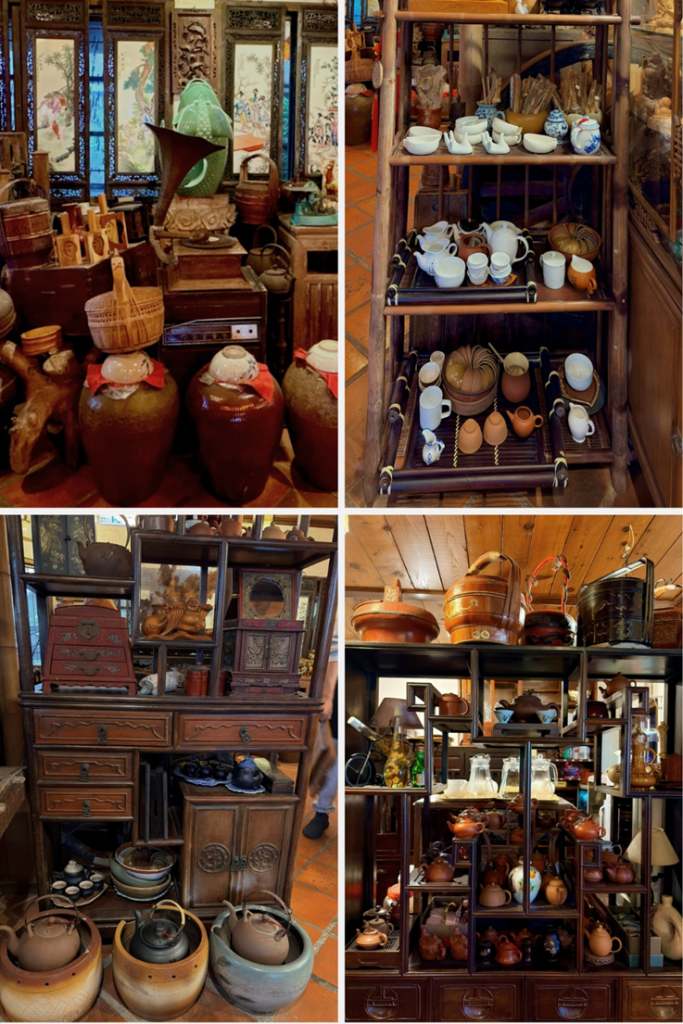
Tea House: Tea Here, There, Everywhere
DAY 4
Central Taiwan: Sun Moon Lake
The Sun Moon Lake in central Taiwan, a three-hour drive from Taipei, is a beautiful destination that boasts of being Taiwan’s largest alpine lake, located 748 meters above sea level with surrounding mountains. It can take two days to fully explore the area known for its cycling paths, boat rides in the clear waters, and temples. The Thao people, now reduced to only about 800, constitute one of the smallest legally recognised indigenous groups in Taiwan. They are deeply connected to the Sun Moon Lake. Lalu Island in Sun Moon Lake is their sacred ancestral home. Interestingly, the ever-needling China, or People’s Republic of China, depicted this lake in its e-passports in 2012, sparking a controversy and a diplomatic outrage. China seems to have a pattern of making similar claims about its surrounding countries. It once told a person from Arunachal that a visa to China is not required, as it is a part of China.
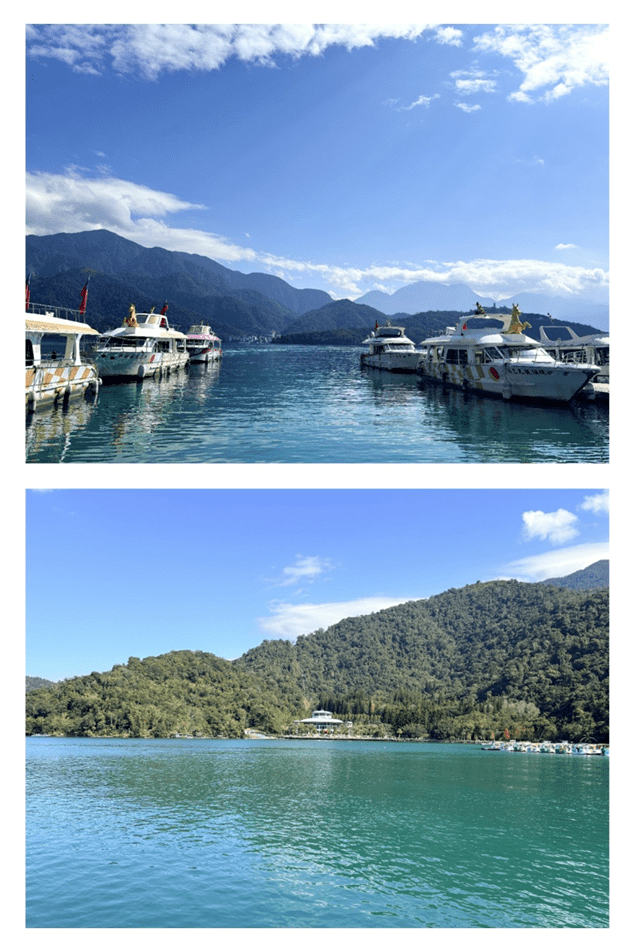
Formosan Aboriginal Village
A beautiful ropeway spanning 1.8 kilometres gave us visually stunning views of the lake and landscape, and it took us to the Formosan Aboriginal Cultural Village. This place showcases the lifestyle in the reconstructed villages of the nine main tribes of Taiwan, which makes for an educational and fascinating experience. Apart from the cultural village, there is a museum and an amusement park that includes a food joint. Designed wonderfully over 150 acres, one can easily spend a day here. Sadly, we had only a few delightful hours that culminated in a tribal dance in which we could also participate. Visitors can interact with Taiwanese aborigines employed to work in the villages. We left this activity for another day, as there was no time. Interestingly, the tribal languages, or the Formosan languages, are a diverse group of Austronesian languages quite distinct from Mandarin.

Wen Wu Temple
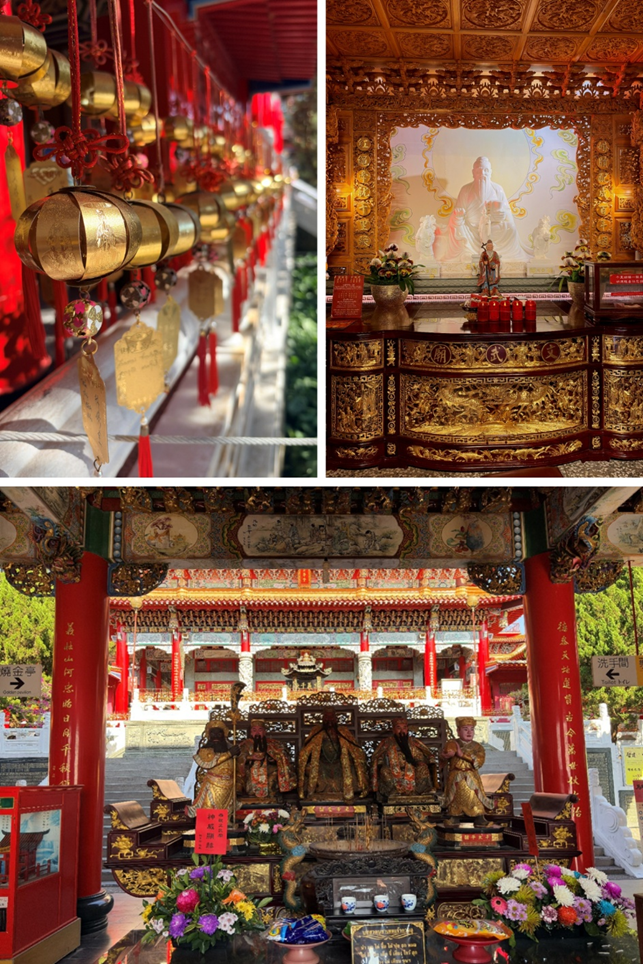
The Sun Moon Lake Wen Wu Temple is a beautiful, exquisitely carved-out temple in a Chinese palace style with dense detail and fine architecture. The temple is dedicated to the first and second ancestors, Kaiji and Zhengyi, respectively, along with various deities related to literature and martial arts. The deities catering to the material world typically tend to be masculine in contrast to the feminine in Indian traditions. There is also a hall dedicated to Confucius.
We drove to Taichung, a culturally rich city and the birthplace of the iconic bubble tea, to spend the night. We proceeded to Alishan the next day and could not explore Taichung itself, a place worth spending one whole day at the very least. We had dinner at an Indian restaurant run by Telugu people from Vijayawada! Except for daytime lunches, dinnertime always connected us to home.
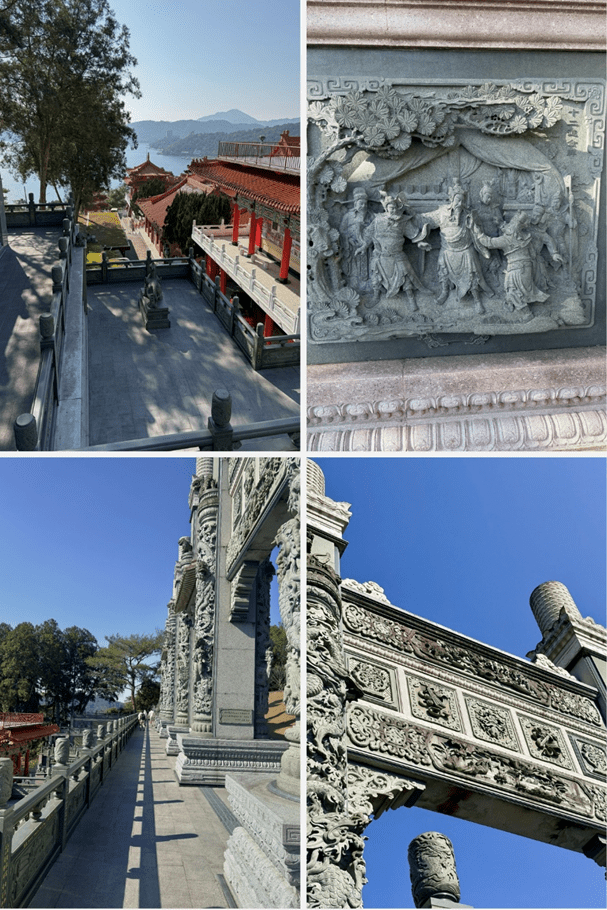
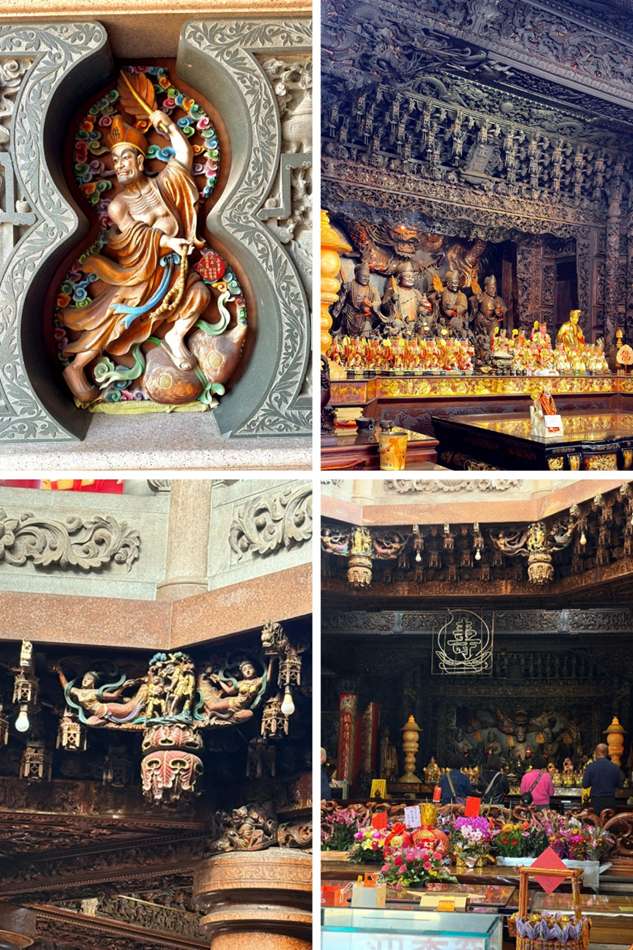
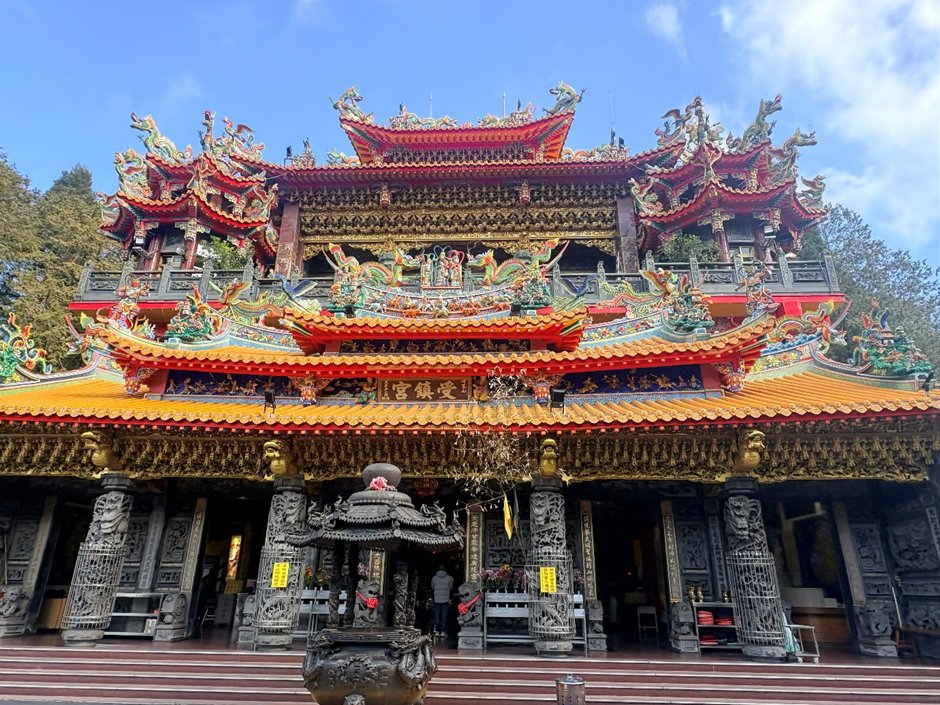
A Diversion: Temples, Traditions, and Deities of Taiwan
Temples typically have elements of Mahayana Buddhism, Confucianism, and Taoism, and the idols are those of the “Bodhisattvas”, “Junzis”, and “Xians”, respectively, apart from Buddha himself. These three have some fine differences.
Buddhism posits that the problem of the world is “suffering” secondary to the impermanence of things. Buddhism asks us to meditate and contemplate to reach a state of Nirvana where the impermanence resolves into a silence. In contrast to Vedanta, which posits a positive ground for everything—the Self—Buddhism speaks of nothingness. Suffering arises because of desire. The cure is the Eightfold Path. Buddhism has many branches (mainly Theravada, Mahayana, and Lama). The Mahayana is popular in Taiwan (along with China and Korea), where the ideal is the Bodhisattva, a person on the brink of Nirvana but who turns back to help others to attain Nirvana. Thus, there is a pantheon of “Bodhisattvas,” like Avalokiteshvara, who answer prayers.
Confucianism has no priests or rituals, and its temples are dedicated to elevated mortals called ‘junzi‘. It cares passionately about the earthly life to help the individual become a fully realised human being or junzi. There is no distinction between the sacred and the secular, as every aspect of life is sacred. The fundamental problem for Confucianism is social chaos or disorder. The solution is to restore the harmony of society. A being can become a junzi—a person of the highest character—through education, Ren (human heartedness as a source of right action), and Li (rituals and propriety of manners). Respect for parents and ancestors is the core value. The exemplar of this tradition is Confucius (551–479 B.C.E.), an ultimate junzi.
Daoism and Confucianism represent the complementary aspects of Far Eastern culture. Confucianism stresses social hierarchy, duties, and strict etiquette; Daoism prioritises freedom, nature, and spontaneity. Daoism has no desire to save the world but offers a path to individual physical and spiritual vitality. Daoism identifies the fundamental human problem as “lifelessness and artificiality,” which stems from our forgetfulness of true nature. The solution is a return to the roots of our original simplicity. The goal is to “flourish” by aligning oneself with the Dao (the Way), a mysterious, impersonal force that flows through all things. Wu Wei is the way to achieve this, and it means “natural or effortless action”. The other methods to achieve immortal life are Yu (wandering) and Qi (preserving vital energy through practical techniques involving diet, exercises, and meditation). Laozi is the author of the foundational Daoist text, Daodejing. The exemplar is the Immortal, or Xian, who possesses supernatural powers which any ordinary person is capable of achieving.
DAY 5
Alishan Forest
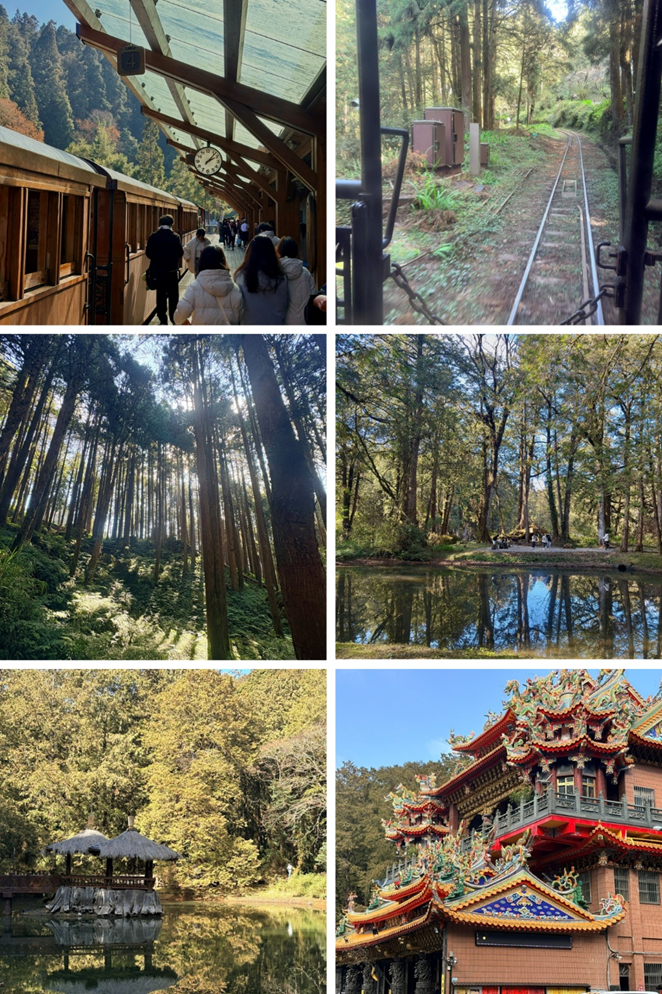
The next day was a drive to Alishan to experience, arguably, the most standout experience of Taiwan, the Alishan Forest Railway. The whole journey covers 50 tunnels and 77 bridges, but we took a small part of the journey from Alishan to Zhushan, about a half-hour ride. After alighting, we descended on foot back to Alishan. The short ride and the hike gave us one of the most breathtaking sights we would have ever seen. The place, exquisitely developed to offer brilliant views of the mountains, skies, and water bodies, is also a hiker’s delight. A trekker might want to spend a whole day here. This experience certainly calls us to return and fully explore the journey that extends from Alishan to Chiayi, which takes about 3 hours.
Despite a turbulent history marked by typhoons, fires, earthquakes, landslides, disasters, and fatalities, the Alishan Forest Railway is now operational and has become one of Taiwan’s most popular tourist destinations. The Japanese initially built it in 1900 to transport the timber from the forests to the ports. There are many switchbacks and spirals along the mountainous railway path. The towering red cypress and yellow cedar trees in the Alishan National Forest are a wonderful sight; a place made for pictures and selfies. The Tsou are the indigenous tribes of the Alishan area.
We drove to Chiayi City for an overnight stay and happened to meet post-doctorates from India staying at the hotel to attend a conference. And guess what? They were astrophysicists. Taiwan universities seem particularly good in this area.
Chiayi itself is a tourist destination that offers forest trails, waterfalls, and ocean views apart from the Alishan Forest Railway. Unfortunately, our experience of Chiayi was limited to the beautiful streets we saw at night while travelling back and forth between our hotel and an Indian restaurant owned by a man from Himachal Pradesh. The traffic is fantastic, and the streets are pristinely clean without a single pothole. We encountered a cab driver who was an avid music enthusiast and maintained his YouTube channel. He asked us whether we were from India and knew Hindi. Upon confirmation, he played a Hindi song that was a translation of the original he had written and composed in Chinese. It was quite enjoyable. AI is certainly doing wonders. The sheer joy the cab driver exuded was infectious, and he asked us to like, share, and subscribe to his channel, which we promptly did.
DAY 6
Kaohsiung
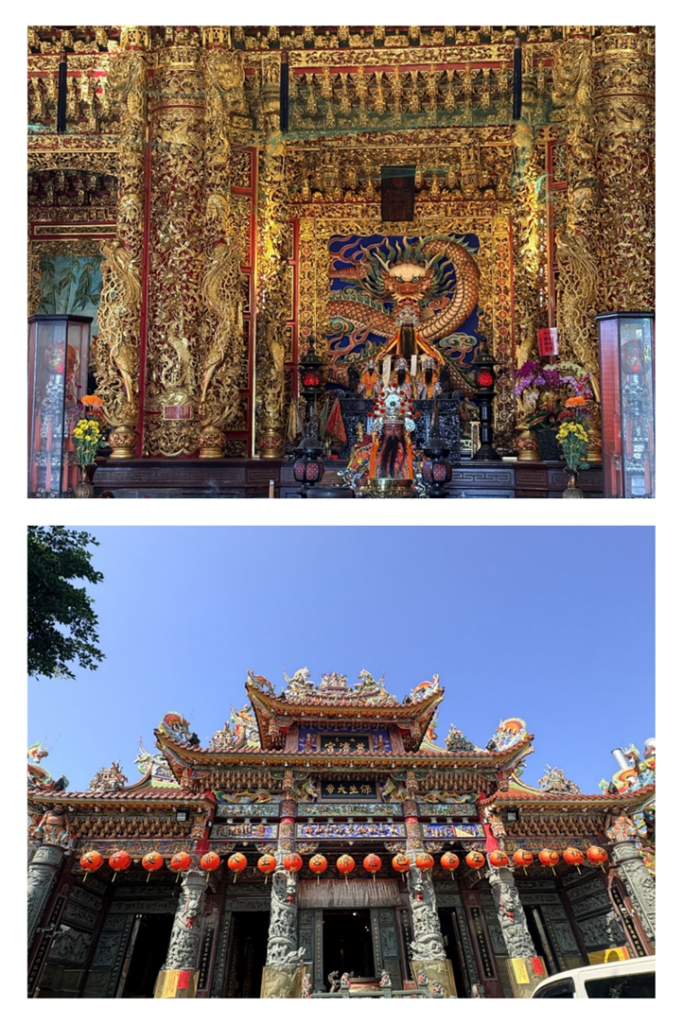
A Temple Opposite the Pagodas
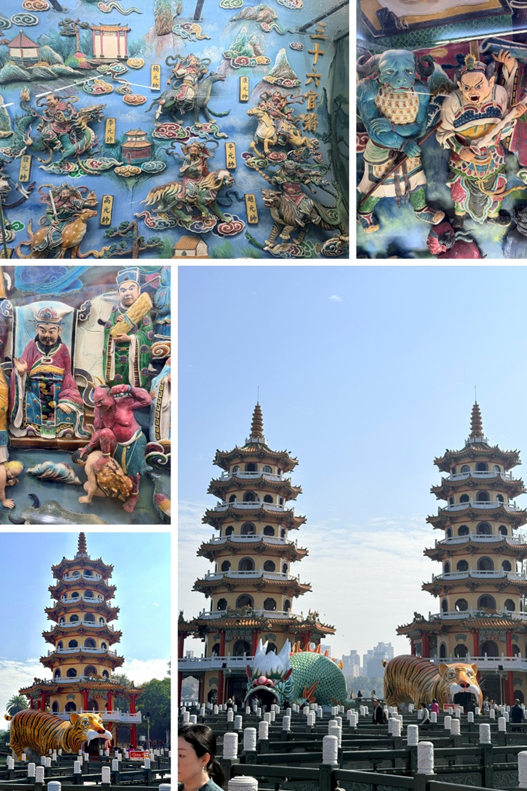
If Taipei is the most prominent place in North Taiwan, Kaohsiung holds a similar position in South Taiwan. Kaohsiung is the heart of Taiwan’s petrochemical industry. The Hokkien dialect here is distinct from Mandarin, and historically, it was the epicentre of democratic movements and Taiwanese sovereignty. The city closely aligns with the independence-leaning Democratic Progressive Party (DPP). We drove straight to the famous Dragon and Tiger Pagodas that were built in 1974 to prevent an impending natural disaster. Typhoon Thelma spared the city one year after the pagodas were built. The seven-tier pagodas represent seven levels of enlightenment in Buddhism.
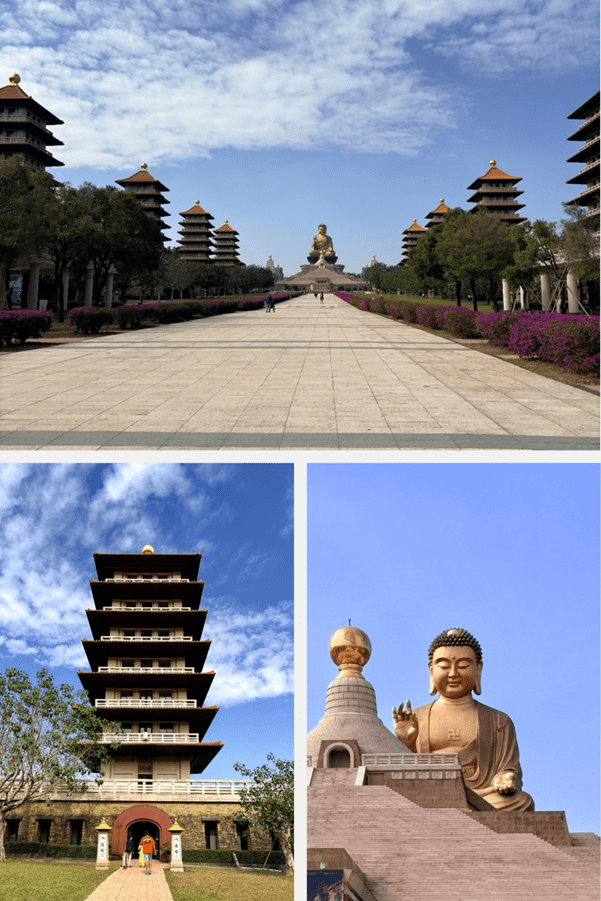
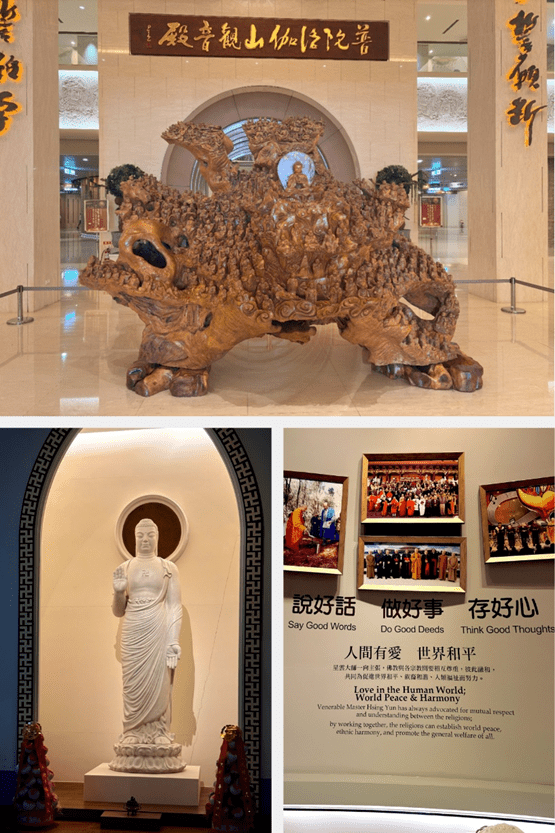
The Fo Guang Shan Monastery is a massive complex that belongs to Taiwan’s largest Buddhist organisation. It was founded by Hsing Yu in 1967. The massive complex was built over many decades and has eight impressive pagodas housing museums and libraries, beautiful lawns, an imposing 36-metre-tall figure of Buddha (Amitabha Buddha), and a main hall that has many attractions, like shows, restaurants, shops, and museums. It is believed that the museum’s dazzling Jade Buddha Shrine contains tooth relics from the historic Buddha. Photography of this statue was strictly prohibited. This was the only restriction we encountered during our entire trip to Taiwan. The site also has a monastery that is inaccessible to tourists.
This order promotes a form of Mahayana Buddhism called Humanistic Buddhism. The closest parallel I could think of is our Tirumala Tirupati Devasthanam-like body that is involved in huge activities related to education, schools, colleges, charity, medical services, publishing, retirement homes, media activity, supporting temples, and so on. It does have a troubled relationship with Communist China. Veganism is popular amongst the Buddhists. We were thrilled to find a vegetarian restaurant inside the complex serving lunch where we could choose food without worrying about the animal products. However, spices coat every cell in an Indian body, and hence we found the food a little bland! Again, this place could take a full day for a decent exploration. Sadly, we had to come out, rather unwillingly, in a couple of hours.
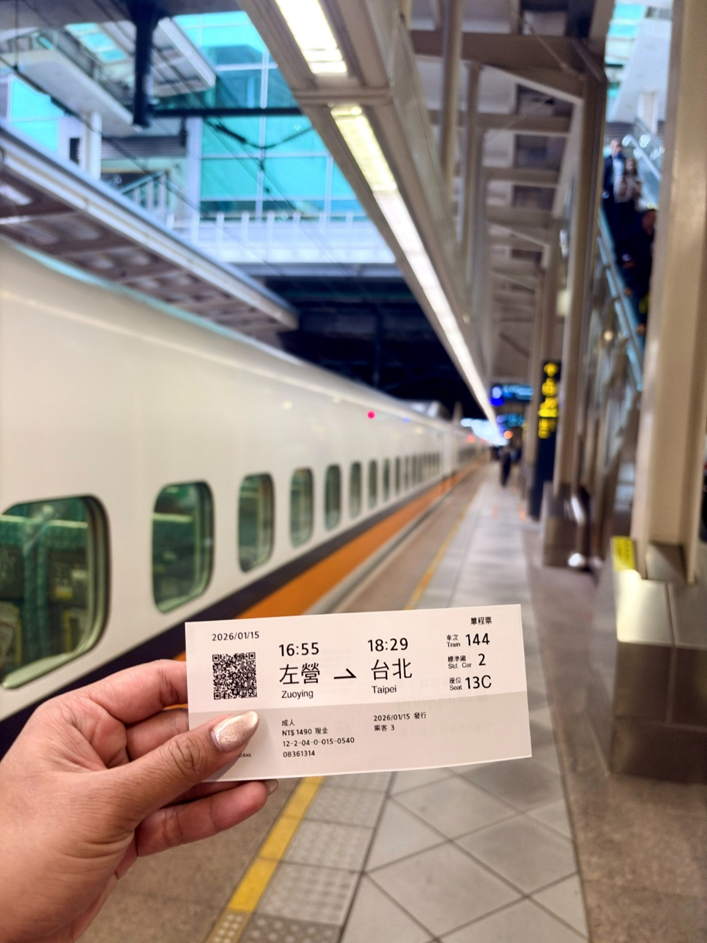
We were dropped at the beautiful Zuoying railway station in Kaohsiung. The railway station also houses a shopping complex and, apparently, an architectural experience. A bullet train, or High Speed Rail, took us back to Taipei in the evening. Achieving high speeds was a new experience for us, as we covered a 350-kilometre distance smoothly in two hours. We are definitely experiencing such speeds these days in our Vande Bharats. Hopefully, we will have more extensive coverage in the days to come. We had a glimpse of the smaller places of Taiwan as the train smoothly rolled across the plains to the destination. We hurried to do some shopping after alighting from the station. Frankly, shopping outside of India feels like a pointless activity because everything is readily available in India. It is also seriously possible that something you pick up in foreign lands is made in India.
Guess what? We had dinner at an Indian restaurant.
DAY 7
Taipei zoo
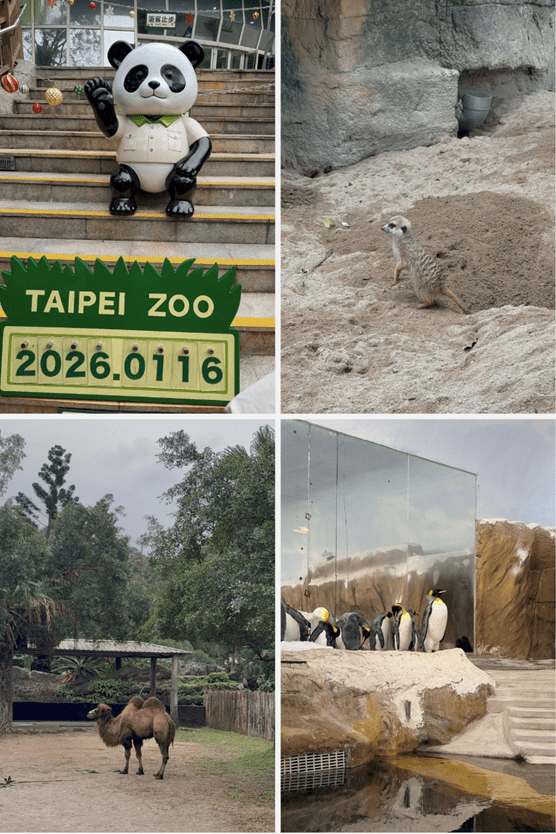
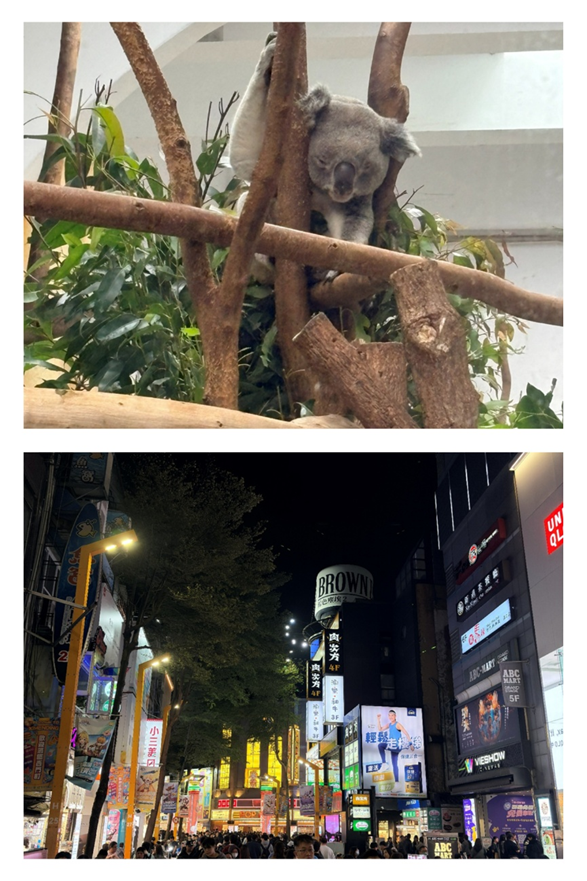
The morning consisted of visiting the wonderful zoo, one of the largest in Asia, as our guide informed us. A proper visit might take a full day. My daughter and son-in-law had a specific interest in the famous pandas and the penguins. The pandas were at the center of some political controversy. The Taiwanese, who were seeking independence from China, resisted the Chinese government’s gift of the pandas strongly. It was perceived as a smart Chinese diplomatic ploy. However, the adorable panda couple, unconcerned with the political fights, produced a baby panda in the meantime. The pandas were certainly a highlight for us. We saw the penguins too and rushed through the rest. However, for visitors to Taipei, the zoo should form an important part of the experience. Personally, going to the zoo is not my favourite activity.
A Brief Visit to the Hospitals
I had a small issue with the glucose levels on the day I landed in Taipei, and I had to visit the emergency room of MacKay Hospital. They promptly took care of me without burning a hole in my pocket. The prompt medical systems and reasonable costs left us quite impressed.
On the evening of the last day, through the good offices of a colleague in India, I gained an appointment to have a wonderful meeting with two wonderful Paediatric Surgeons of Taipei. A dynamic Dr Paul works at MacKay Hospital, a private hospital, while Dr Wen-Ming Hsu, a professor, works at the University Children’s Hospital. Both of them took me warmly around the hospital. The hospitals are clean, and the rates in the private sector are not prohibitive. Apparently, there is government-sponsored universal insurance coverage in Taiwan, and people seem to have adequate and efficient access to healthcare.
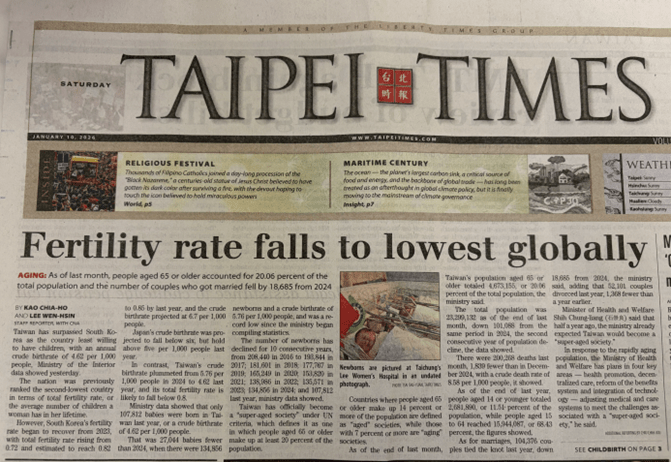
The dedicated surgeons are doing some phenomenal work. We discussed various issues related to the medical systems. There were issues that were common in the Indian scenario, too. However, their main concern was the decreasing birth rate in the country. The first English-language newspaper I picked up in Taipei reported that Taiwan has the lowest fertility rate in the world, as couples increasingly choose not to have children. A moral issue forever: should doctors be happy or sad when disease burden decreases in society? The low number of children born translates into fewer babies with congenital problems and less work for Paediatric Surgeons. Another surgeon made an important comment. “You have seen our roads and traffic. We hardly have cases of road traffic accidents.” This phenomenon is undoubtedly a source of pride and a valuable lesson for India. The day ended with customary shopping and dinner at a Punjabi-style restaurant.
DAY 8: CONCLUDING REMARKS
The only tourists we saw during the week were Japanese, Koreans, and a splattering of Europeans. We noticed just a couple of Indian families. A relaxed, friendly, and safe country, Taiwan offers tourists varied and rich experiences. It is still off the tourist radar for Indians, and I would think, once they get a taste of it, tourism to this wonderful country will exponentially increase. I would like to imagine that in the days to come, the hotels would start offering dosas, idlis, and puris on their breakfast menu.
Language is a bit of a struggle in Taiwan. Their English-speaking skills vary from good to very poor, with most leaning towards the latter end of the scale. The Google translators are a boon. However, Taiwan becomes a vivid example of the fact that English is not the language of economic prosperity or scientific achievements. The only thing we found surprising was the overall lack of colour in the buildings’ designs. India’s colour displays are more vivid. Singapore’s airport brought us back into contact with the warmth and noise of Indians in full flow. There are many places we could not cover, especially the cities apart from Taipei and the famous night markets of Taiwan. Hence, not a goodbye but a ‘we will meet again, Taiwan!’
Culturally, Indians may feel a stronger connection to Asian countries than to Western countries. I have been to a few places across the world, but mostly on the western side. This was our first trip to the east of India. I have travelled widely in India. I can confidently assert that India has an overwhelmingly large number of tourist attractions compared to any other place in the world, without invoking any sense of false pride. No other country can match the sheer diversity of Indian geography, landscapes, cultures, cuisines, and the warmth of its people. However, it is sad; India draws fewer tourists than Singapore.
If we can increase the toilet facilities and decrease the garbage, perhaps no country would be able to match India in terms of tourism. Arguably, the best states in India that have packaged tourism well are Rajasthan, Kerala, and the Northeast. Privatisation may be a solution for developing our tourist spots, as the government seems burdened by a department that is not generating revenue. However, India holds immense potential as a tourist destination, given the right guidance and management.
Acknowledgements: We owe a special thanks of gratitude to Jady, our wonderful guide; Kiwi, our ever-smiling and cheerful car driver; and Annie, who facilitated our entire tour of Taiwan in a very smooth manner. Hope to see them again in the future. The section on religions in Taiwan has been drawn from the informative article by Rama Seshan Chandrasekaran, Religious Literacy: A Comparative Study of 12 World Religions. A special thanks to him for making me better understand the temples of Taiwan.
 RANDOM MUSINGS