Surgeons are simple-minded people and are hence loved by all of the medical fraternity. My boss used to provide me one solid example of their uncluttered thinking. If you feel a firm mass in the right upper abdomen when palpating, it must be the liver and nothing else. On the other hand, look at the physicians. So complicated. You scratch the sole of a patient; the toes go up instead of down, and the problem is in the brain of the patient. ‘Damn the physicians and their Babinski reflexes,’ he used to say.
If you get a skin lesion that itches, a surgeon will likely call it an “itchy skin lesion” and prescribe an all-in-one cream containing a steroid, an antifungal, an antibiotic, an antiviral, and an emollient too that would work for most skin lesions across the world, across all genders, and across all ages. Add to it an antihistamine, an antibiotic, and a sleeping pill, and presto, you are done. But would a dermatologist be so simple? The simple answer is no. A dermatologist would wrestle in his head and get worried about whether the lesion is pityriasis rubra pilaris, necrobiosis lipoidica diabeticorum, or erythema dyschromicum perstans. Probably, he would also take a biopsy, examine it under UV light, discuss it with the pathologist, and worry the patient. He would end up using the same cream, of course, in a narrowed form.
The surgeon is quite happy to remove something from the body and say it is a tumour. That is it. Is the pathologist pleased with that? No to that too. He will spend sleepless nights worrying about whether the lesion is a pleomorphic xanthoastrocytoma, syringocystadenoma papilliferum, or an esthesioneuroblastoma. The surgeon sees the lesion and takes it out, goes home, has a drink, watches some sports, and sleeps happily. Simple people. One of my juniors during residency was a prototype of the simplicity and straightforwardness of surgeons.
Tongue-tie is a condition where the tongue is tethered to the floor of the mouth by a tight band of tissue. If severe, a child may experience feeding difficulties or struggle to distinctly articulate certain syllables later as speech develops. There are unique challenges associated with tongue-tie during significant life events, such as licking an ice cream cone in childhood innocence and engaging in a French kiss as that innocence fades. Yes, inability to execute the French kiss is a scientific reason for releasing the tongue to function without limitations.
Anyway, this dear junior was somewhat clueless about the condition. The first page of the admission case notes was for complaints and history. The resident doctor had to write about the origin, duration, and progression of the complaints, how they were noticed by the family, and why they brought the child for a consultation. It also had columns to record any past conditions as well as allergies. The whole page had only one entry, “tongue tie”. The case sheet’s next two pages, which contain all the clinical details, are of utmost importance. These pages record the general condition, pulse, temperature, blood pressure, and so on before an all-systems examination and a detailed local examination of the specific problem at hand. The whole two pages of the case sheet had another simple entry by the junior, “tongue-tie”.
The surgery was over smoothly, and the junior wrote the operative notes too. The operative notes are generally under four main headings: “incision, findings, procedure, and closure” to be modified as per the nature of the surgery. The resident wrote, “Tongue-tie release done.” The unit chief randomly selected this case sheet during the ward rounds the next day and saw only five words on the entire sheet. He had to be resuscitated using electric shocks, and following the recovery, the poor, simple junior was sent packing to the library to spend a day there and gather everything he could about tongue tie.
This particular instance was perhaps the most extreme contrast to the practices of our American surgical colleagues. We have been told that, in the US, a surgery of exactly one minute takes at least a couple of hours. Under pressure from the lawyers, who apparently outnumber the doctors in any typical hospital, the consenting process, which includes potential complications such as an earthquake or a typhoon that could interrupt the surgery, may take another hour. The consenting might even include future scenarios after surgery, like the child deciding to drop out of college or changing their designated gender. The operative notes take another hour, where every step of surgery, including the number of times the surgical site has been painted, is described in excruciating detail. American systems are destroying the inherent simplicity of surgeons.
I am digressing. This is to illustrate the fact that surgeons, especially Indian ones, are the most uncluttered people among all the specialities in medicine. Of course, during exams, surgeons become somewhat more sophisticated. We learn that the technical term for tongue-tie is ‘ankyloglossia’ and the surgery done is not release of tongue-tie but ‘frenuloplasty’. We still use such terms for Google-obsessed clowns impressed by high-sounding words. For most people, we stick with the simple words that characterise surgeons.
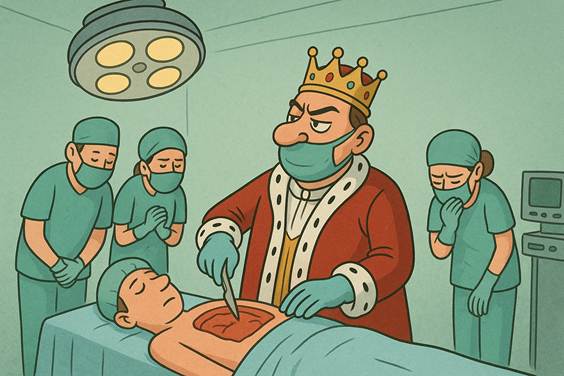
The medical world is divided neatly into two categories: surgeons and non-surgeons; the gods and the devils; the kings and the peasants; the class and the mass; the bourgeoisie and the proletariat; or simply the rulers and the ruled. Surgeons are simple, super, and splendid and also have a great rule of taking respect and not reciprocating because, as mentioned before, they are gods. Do you now understand, dear friend, why surgeons are adored, loved, and deeply respected by everyone in the world, especially the rest of the medical folks?