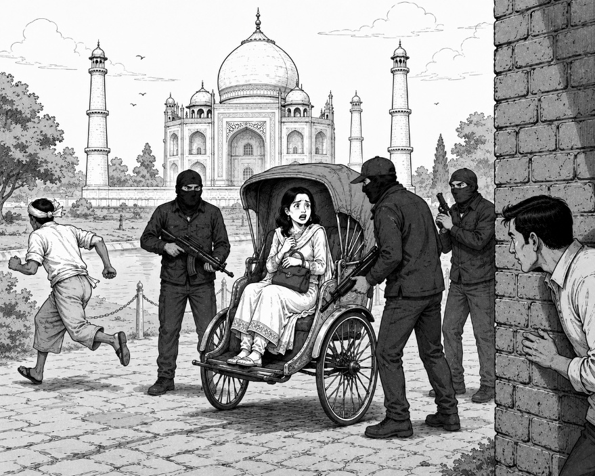
Can there be open and shut cases while making moral judgements? The Taj Mahal has the reputation of being the greatest symbol of love. The story goes that a lady was willing to die if her lover agreed to build a monument like the Taj. However, a visit to the Taj Mahal by a friend has left permanent scars in his marital life that refuse to heal, even with the best medications. A long time ago, one of our walking group friends was gently going around the precincts of the Taj in Agra, holding his dear wife’s hands while in the back seat of a human-driven “Tonga”. Suddenly, they saw a dozen masked men all around them with guns and machine guns in their hands. Their intentions certainly did not seem noble. Blaring sirens and loudspeaker announcements followed the attack, urging everyone to take cover as terrorists invaded the area.
Our dear friend jumped from the Tonga, ran hard towards a house, and hid behind a brick wall, leaving his dear wife all alone behind. The Tonga puller, meanwhile, had also vanished into thin air. Suddenly, armed security appeared, apprehending the terrorists without any loss of life. A sense of relief came over my friend when a second announcement came that the incident was actually a mock safety drill in the event of a terrorist attack. The wife was fuming when the relieved friend came back to pull her down from the Tonga. She refused to hold his hand and, to this day, after a good twenty years, has neither forgotten nor forgiven him.
My friend explained that in the face of danger, a person must first save himself before saving others. Over the years, nay, decades, he has tried to strengthen his arguments using real-life examples. He stated that every flight around the world reinforces this message through the air hostess’s explanation of the safety precautions. When the oxygen level drops for any reason and the masks drop down, the passengers are told to put the mask on first for themselves before trying to help others. Another time, he uses a popular Hindi devotional song that goes, “Doosro ki jai se pehle, khud ko jai kare.” (Rough translation: Before saying ‘Victory’ to others, first be victorious yourself.)
The wife remains supremely unimpressed over these two decades. This behaviour is clearly not the kind of altruism or heroism that she subscribed to. Today, this issue has sparked intense debate among our walking group members. Many people viewed the situation as a morally unambiguous tale in which the husband appeared clearly guilty, yet there were supporters of his actions. We decided anyway to take a vote as per the democratic norms of our country, where a brute tyranny of the majority decides over merit or competency. We thought the husband would emerge as a sure loser. We were in for a shock and surprise. The vote was tied among the fourteen members, with it standing at 7 ‘yes’ to 7 ‘no’. ‘Yes’ meant the friend was guilty of cowardice or malicious intentions, and the wife was justified in her anger, while ‘no’ meant that the friend’s reasoning and actions were rational and logical.
For some time, we waited for a new member to join, as this person would have the final vote to sway the decision. When a new member finally joined, we unfortunately had to disqualify his vote due to his peculiar reasoning. He enquired about the couple’s years of marriage at the time of the incident. When told it was after 15 years of marriage, he said that the husband was right. The husband would have been incorrect if it were fewer than ten years of marriage. The new member controversially added that it is difficult to decide if the marriage period was between 10 and 15 years. This stance was even more morally dubious, and after a substantial amount of discussion among the walkers, we decided, by voting again, to disqualify his vote. Now, the walking members are again tied at 50:50.
Now we also needed to obtain the ladies’ vote on this crucial issue. At a family get-together, we first asked our friend’s better half for her opinion on why she felt wronged by her husband’s behaviour on that fateful day. There was no quiet reasoning or explanation. Suddenly, a mild-mannered, peaceful lady became red-faced and expressed a series of lucid expletives that made us shut our ears. The transformation of a sheep into a roaring lion was terrifying. Then, the other ladies voted on this issue. The tie among the ladies’ votes brought us even more shock and surprise. Half the ladies, without condemnation, supported the husband’s repeated stance of saving oneself before saving others.
So, there we stand today with the husband still in the dock. O. Henry, in a classic story called ‘Proof of the Pudding’, demonstrates how extraordinary circumstances can make one behave completely opposite to what one may think is ideal. A writer, who uses plain dialogue for his characters in crisis situations, keeps getting rejected by an editor who believes that a person would use dramatic language in such crises. When they confront an extraordinary situation – their wives run away to pursue their careers – the writer laments in dramatic, poetic, Shakespearean language while collapsing to the floor. The editor reacts by throwing colloquial epithets and ordinary shouts. Therefore, it may be difficult to predict a response from an otherwise loving husband when presumed terrorists strike while he is going around in a human-driven rickshaw with his wife for fifteen years. They say, “Cometh the hour, cometh the man,” but occasionally, the villain also cometh.
Anyway, we are waiting for new members to join our walking group and decide on this excruciating unresolved question for quite some time. Is the husband guilty or not? We see the chances of new members being remote because one of the criteria for our group is late walking from 9 am to 10 am. During this period, the vast ground, particularly in the harsh summers of our state, is inhabited only by us and the bacteria living in the soil. Few would dare to join the group because the late walking is a sine qua non criterion. The dear friend has escaped for now with a tied vote, but for how long? In the meantime, our friend, though he knows he is standing on thin ice, strongly defends his stance. Save yourself before saving others, he reiterates. The opposing group (and that includes me) shouts that this is warped altruism at best and mischievous intent at worst. Or simply cowardice. However, the jury is still hanging.

