From the book From Here to the Stars
Illustrated by Dr Anand Naregal
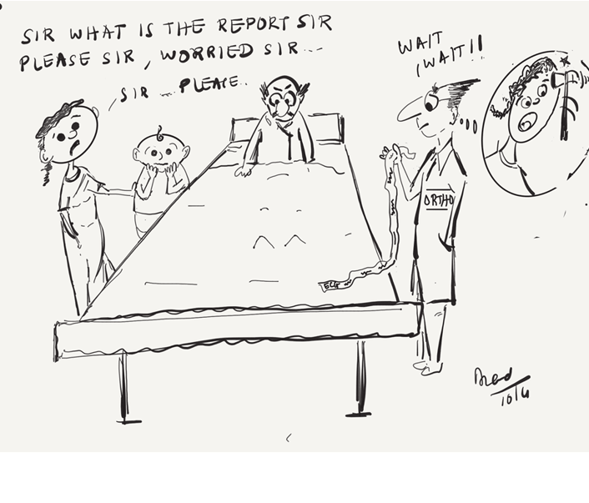
It is a great fact that laypeople do not understand doctors. It is a greater fact that doctors do not understand doctors any more than laypeople. Show me an EEG, the reading of human brain activity, and I would stare at it with the same ferocity as the cleaner in my house. It simply does not make sense to anyone. I am sure the neurophysicians are playing a joke on the entire world, including the doctors. The handwriting of doctors, of course, is legendary, but the extreme example is when one of my colleagues could not decipher his own prescription when the pharmacist confronted him with the prescription. It is not fiction but true.
The specialities in medicine have proliferated at an amazing rate, and we are indeed in close competition with the prolificity of bacterial asexual reproduction. And added to that, the internet has come into the market, and there has been a huge explosion of knowledge. I am severely deficient in the knowledge of my field and even in my thesis topic. Type a word about my so-called subject of expertise, and the malignant Google viciously ejects some three million references. Sometimes four million. And then, to rub it in, it declares the time (0.02, 0.0032, 0.00004 seconds) of sorting out the references. If this can happen to your field, then what can you say about other fields? Surely and absolutely, I know nothing about them.
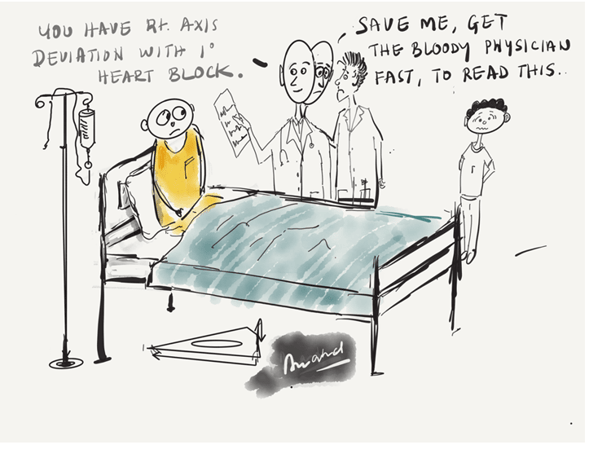
The biggest scare is when people expect you to know about every single medical problem and understand every doctor’s prescription and test. I quiver when an eager patient or a relative with super-trust in my professional abilities throws an ECG at me. I know there are p, q, r, s, and t waves. My benign professor told us about them twenty-five years ago in medical school. I know some patterns that denote maybe a heart attack, but they were textbook pictures, never ever having a correlation to the real-life world. I can also diagnose death on a flat ECG line, but that knowledge has come from watching movies; that is another matter. Anyway, that is the complete A-Z knowledge I have of the ECG.
When I see those graphs today, most of them look like wild pictures. It is a very scary moment when the patient or his attendant is looking eagerly at me to make some comment, and I try desperately to scan the ECG for some automatic reports. God bless the new technology that types some reports at the top of the ECG in small letters, and the best bet is to pick them up. I again do not know why they are up there, because most cardiologists debunk them with a sarcastic smirk and a cynical laugh. They are not meant for the cardiologists, apparently; they are not meant for the patients, obviously, because a term like ‘second-degree heart block with right axis deviation’ is not very illuminating and may or may not mean their death sentence. Maybe they are meant for the poor breed of non-cardiologist doctors like myself, when patients and my own relatives push an ECG under my nose. So, I act intelligent, say that there is some right axis deviation, point vaguely at some waves, and escape by saying that it needs further evaluation by a cardiologist. Saved by the nick with my reputation intact!
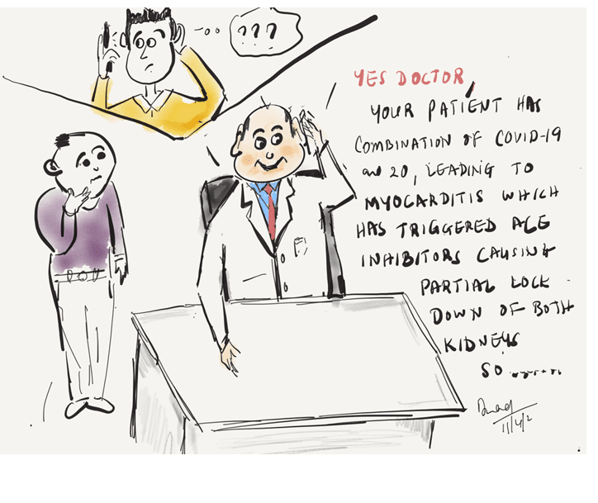
If you feel handling reports outside the field is a difficult job, try talking to specialists outside your own field. They will throw terms at you, presuming that you read their subject, just like the morning newspapers or the interest devoted to gossip magazines. But I think some of them do it on purpose, and they derive sadistic pleasure. At least I do. I am not sadistic, but it is one of the divine pleasures I get in my dreary and forlorn life. I lick my lips when an attendant pushes his phone towards me to speak to his doctor’s relative.
The first inquiry would be whether the other person is a paediatric surgeon or not. It would be an unlikely scenario because the percentage of the most stupid and imbecile doctors taking up this dumb speciality is teeny-weeny small. Then, I bombard the hapless doctor with the most technical terms, and they must mumble incoherently with an intermittent “yes, yes, of course” many times. Otherwise, the doctor will look stupid and lose face. I feel good; the doctor on the other side is relieved to end the conversation; the annoying relative is satisfied; and I win the game.
However, one is easily and mostly on the other side of the telephone. The nephrologist whom I spoke to recently regarding one of my favourite cousins simply threw in terms like AGN, RPGN, sclerotic picture, and steroids versus methotrexate versus cyclophosphamide with such rapidity that I was sure he was silencing me very effectively. If I had asked him, “What is RPGN?” I would have looked very stupid. So, I kept quiet, nodding my head, and mumbling incoherently, “Yes, yes, of course.”
The worst people to talk to are the dermatologists, of course. Now, surgeons are the lowest in the evolutionary chain, just two notches above the bacteria but a notch above the orthopaedic surgeons. Most evolutionary biologists tend to put surgeons and orthopaedic surgeons in the same genus, but we think that is not correct. Surgeons are a little above them. Surgeons truly believe that if something in the body is inoperable or irremovable, it does not simply exist. For surgeons, all such conditions exist in the realm of Maya, or illusion. So, they know nothing about fevers, coughs, colds, malaria, dengue, and all such exotic conditions because we cannot operate on them. So, as advice, do not come to us expecting treatment for these imaginary conditions.
However, we are better than the orthopods, whose idea of elegance is to bang a ganglion to bits by smashing a heavy book onto the lesion. Eeks, that is true! And we are aware of the kidney and that it produces urine because we can remove it and operate on it for many other conditions. The orthopaedics, we suspect, are not even aware that kidneys exist. There was this legendary postgraduate orthopaedic colleague of mine whose idea of a good urine output in a postoperative patient meant filling up their urine bags with a “urinish”-looking light yellow Savlon (an antiseptic solution) before the chief’s rounds. This was because the boss was obsessed with urine, and his idea of a good surgery meant a good urine output. And then people want to club us together. Anyway, enough about the lowly worms with the flashiest cars in town. We are talking about dermatologists.
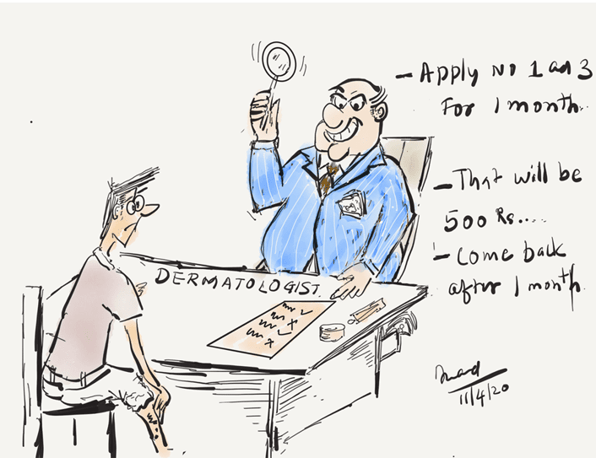
There is this dermatologist in my town who sits in his air-conditioned office with clean, unstained clothes; disposes of patients at the rate of one every five seconds; does not listen to any drivel spoken by the patients as there is no need to; makes a diagnosis using a handheld lens in a majority of cases; uses exactly four ointments and three drugs present in his armamentarium; makes millions and buys plots all over the town; changes the luxury cars every two years; closes his clinic at 7 pm every day; and goes clubbing with friends every alternate night; in fact, a guy who needs to be shot right in the centre of the head. I am not jealous. I am not jealous.
I do not promise anything to my patients, but the slightest deviation from their expectations makes them throw stones at me. This dermatologist promises the moon for all skin ailments. They get treatment for half their lives and play an important role in the EMIs for his new luxury car; nothing happens by way of cure, and they silently shrink away into alternative forms of medicine. Homoeopathy, Ayurveda, Unani, and sometimes even magnetic therapy, fish therapy, moondust therapy, raw mushroom extracts, rose powder, tea powder, sand—anything except coming back to him And the derma guy laughs all the way to the bank.
I am digressing, but this dermatologist, who is a good friend, gave me a call the other day. “I have sent this patient for a biopsy. It looks like an acrodermatitis chronica atrophicans or probably an acrokeratitis verruciformis. Of course, it could be a Speckled Lentiginous Naevus too; tell me what you think about it.” And gives a laugh as if he had indeed cracked a sublime joke. Duh? Duh? Is he doing it on purpose? One never knows. I look at the lesion and then give him a call back after practising a bit and speaking out one of the three diagnoses. I tell him it might be ‘that one’, and, as he rightly pointed out, a biopsy will settle the issue. You now see why a surgeon is so scared of talking to a dermatologist. They make you feel so small and insignificant in the cosmic scheme of things.
Most specialists make me feel very low and pathetic, like when a geneticist talks about mutation analysis and genetic splicing to diagnose Holt-Oram osteodystrophy or some such condition; when a foetal medicine specialist talks about the sensitivity and specificity of quadruple markers and their implications for trisomy; when a neurophysician talks about anything; and so on. In fact, there are major gang wars going on where every speciality gang is up against every other group. This is, of course, when they are not fighting, abusing, and ripping each other’s throats inside the individual speciality.
So, to the world out there and especially the patients: doctors and their reports are very difficult for doctors to understand. The next time you show me those meaningless, wildly fluctuating lines and waves running over ten pages (yes, ten), which the sadistic neurologists call an EEG, and ask for my opinion on it, I will roll it up and use it to smash a fly, or smash it on your head, or, best of all, shove it down your throat.