First published in Darpana, e-souvenir released for the IAPS (Indian Association of Paediatric Surgeons) annual conference held at Bengaluru, September 2026
The link to the souvenir: https://heyzine.com/flip-book/84b79bb370.html
Illustrated by Dr Anand Naregal
Disclaimer: Fullest respect to all the medical specialties. I hold deep affection for all of them, but this article is solely intended to uplift paediatric surgeons who are on the brink of either jumping off a cliff without a parachute or plunging into the depths of the sea with a ton of bricks tied to their feet.
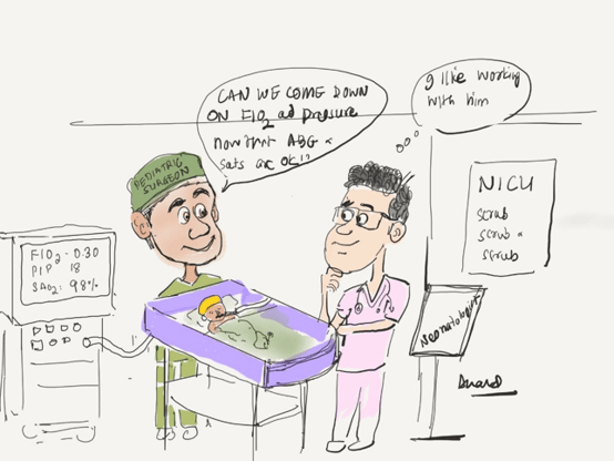
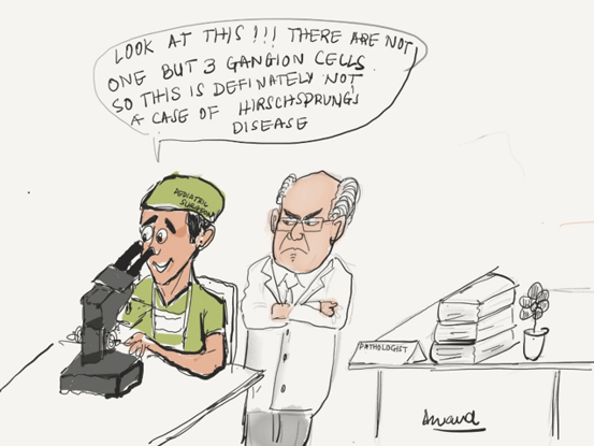
Here is a typical paediatric surgeon walking in the wards of a hospital. He or she goes to the Neonatal Intensive Care Unit (NICU) and examines a postoperative patient with a diaphragmatic hernia. The neonatologist comes and discusses the ventilation settings with the paediatric surgeon. There is discussion on whether the cardiologist has seen the patient, and just then he or she drops in. There is talk of pulmonary hypertension, PDA, and saturation differences. The next patient is a child who has undergone a rectal biopsy for constipation. The paediatric surgeon decides to visit the pathologist to have a look at the slides and decide whether ganglion cells are present in the biopsy.
Then the surgeon walks to the radiology department to reduce an intussusception under USG guidance. After the successful reduction, he or she comes out and greets the pediatrician to discuss a case of suspected appendicitis. As the conversation ends, an ENT surgeon walks up and requests paediatric surgical help for a recurrent thyroglossal cyst. Soon, the paediatric surgeon meets a general surgeon and discusses tips for doing a laparoscopic procedure. A neurosurgeon calls up and says that he is sending a case of meningomyelocele for evaluation and surgery. A urologist sends a case of hypospadias for surgery, and the dermatologist, whose terms the paediatric surgeon is clueless about, asks for a skin biopsy. Later during the day, the gynaecologist refers a case of labial fusion, calling it a possible vaginal agenesis.
You understand the gist. The paediatric surgeon spreads the wings across all fields and communicates with confidence, authority, and awareness to any specialist, including orthopaedic surgeons, gynaecologists, foetal medicine specialists, physicians, endocrinologists, gastroenterologists, haematologists, oncologists, and psychiatrists too. Even the obscure and mysterious ophthalmologists who carry out their secret and esoteric practices in hidden corners of the hospital get to discuss a blocked lacrimal duct or a cyst growing near the angle of the eye. There is absolutely no doubt that only paediatric surgeons are capable of carrying on intelligent conversations with most of the specialities without appearing dumb. However, can we say the same about the others?
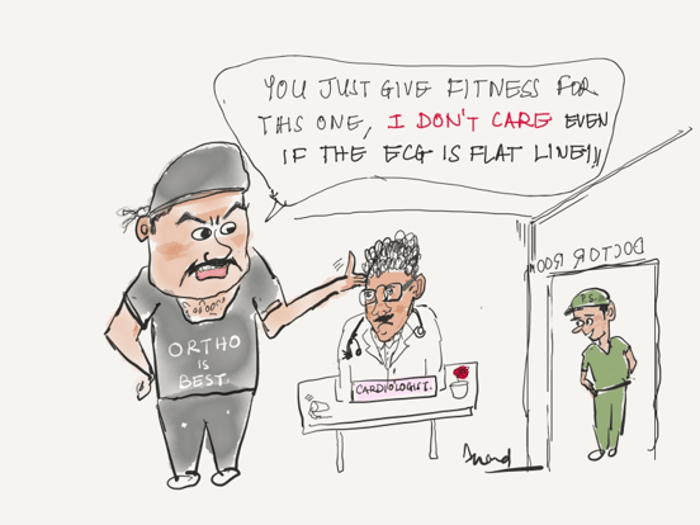
There can be no conversation between an orthopaedic surgeon and a cardiologist, for example. The former would only want a clearance for his surgical case. The cardiologist is generally threatened into giving a clearance at the fear of having his or her neck squeezed or even limbs broken by the burly, loud-mouthed, muscular, and unshaven man. On the other hand, the cardiologist, with a binary division of the entire medical field into “cardiology” and “others”, is simply incapable of talking to anyone except about the heart. The synonyms for the humongous homogenous group of non-cardiologists includes “the rest”, “the dumb”, and “the idiots”. As an aside, regarding the gender dynamics, generally it is an ‘he’ in orthopaedics, but I have been told that the female gender is making great inroads to a traditional male bastion. The rest of the alleged fifty genders are still an unknown phenomenon among medical practitioners. I am digressing but would an ENT surgeon be aware of the existence of a dermatologist? Or a psychiatrist? There is no way they would speak to each other except, of course, if they are married or are related. Professional conversations concerning patients would be a sheer impossibility, I would say.
A cardiologist, upon seeing a sweating young patient with both tibia fractures and loads of internal bleeding, most likely would proceed with an ECG and 2D echo and declare that the heart is fine. What would a paediatric surgeon do? He would put an intravenous cannula, resuscitate the patient with crystalloids or colloids, and arrange for a blood transfusion. We are the smart people. A patient in septic shock may be receiving twenty different types of drips and medications. Ask a gynaecologist to see the patient and see what happens. The gynaecologist comes, does a vaginal examination, and declares all is well. Ask a radiologist to treat fever and cough, and he or she will hide behind the USG machine. Ask a pathologist to examine a live person, and you might see dust rising from a sprinting person escaping a hungry tiger. You get the idea again. In the disconnected world of medicine, where there is a specialist for each finger and toe, it is only paediatric surgeons who provide solace and comfort. We form the glue, cement, and binding link in medicine, and we offer our services to all and sundry, both among the doctors and patients.
We closely work with the pediatricians even while fighting them in academic institutes and hugging them in private practice. We understand their vaccines, growth charts, and percentiles, and that is an ultimate test. Well, some aggressive paediatric surgeons want to start vaccinating and treating coughs, colds, and fevers, but that is a sure way to lose friends and make enemies. We deal with all the organ systems. Well, almost all. Dealing with many systems provides us a perspective that few achieve. And hence, we are not hopelessly lost when any specialist talks about their expert line of work, a common phenomenon for most others.
We do not get confused when an immunologist talks about immune suppression and we understand pulmonologists when they talk about cavitary lesions. We are one of the rare few who can converse intelligently with the wonderful breed of anaesthesiologists when they talk of hypnosis, relaxation, analgesia, regional anaesthesia, retrograde amnesia, difficult intubations, inhalational agents, workstations, or critical care. Ask a specialist who does not enter the operation theatre, except as a patient, what an anaesthetist does, and he or she will splutter, mutter, and mumble incoherently. In all probability, the anaesthetists would be shadowy figures moving aimlessly and haunting some remote corners of the hospital.
We had this phenomenal professor, who, apart from all the regular surgeries involving the brain, spine, lungs, liver, kidneys, bladder, intestines, and soft tissues, was equally adept at treating growing fractures of the skull, exstrophy of the bladder, endoscopic clipping of varices, PDA ligations, removing foreign bodies, and even cleft lips. Of course, overall expertise in dealing with all organ systems for individual paediatric surgeons has diminished in recent times due to increasing subspecialisation. On the other hand, in recent times, brilliant paediatric surgeons have been pushing all boundaries regarding minimally invasive procedures. Their expertise and the range appear too mind-boggling for other specialists to come anywhere nearby.
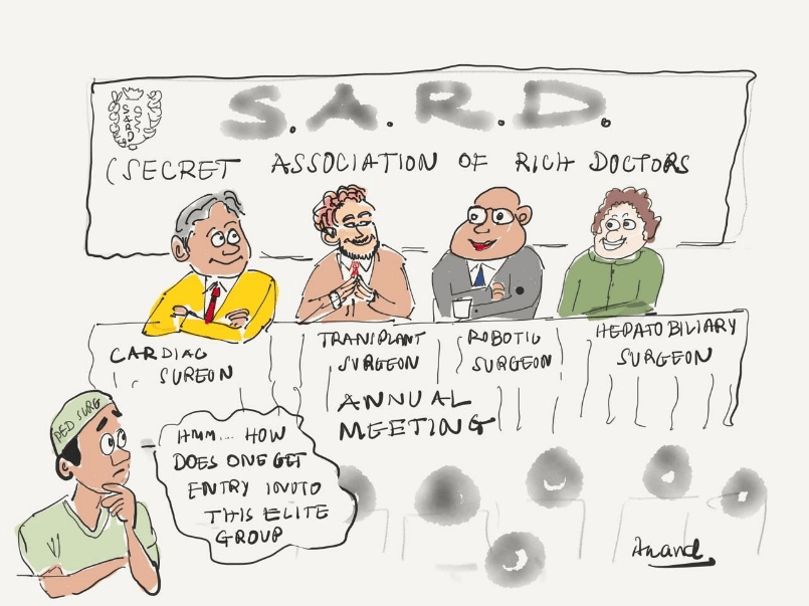
The obstetricians and foetal medicine specialists have undoubtedly collaborated to reduce our neonatal cases of congenital abnormalities. Yet, we have adequate reasons to remain busy and help children and families in their times of distress. We are certainly the chosen ones, I believe. Of course, overall, we are somewhat bereft of glamour, glitz, and general awareness. The SARD (Secret Association of Rich Doctors) in any city or town might have the lowest representation of paediatric surgeons. Hospitals don’t carry advertisements for urgently needing paediatric surgeons at premium salaries.
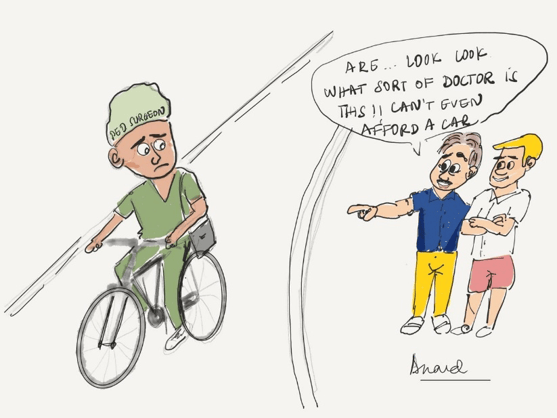
Unfortunately, we cannot be trendsetters either. I once started cycling to work to popularise cycling in my town. I stopped when my dear wife pithily said that if I cycled, it would be a terrible advertisement for paediatric surgery, but if the neurosurgeon cycled, it would be a wonderful advertisement for cycling. Do not become upset when the ever-well-dressed neurosurgeon boasts of his European holiday, the busy cardiologist talks about the fanciest cars, and your sweet obstetrician shows off her latest iPhone. There is no problem if your budget holiday is at a nearby resort, you drive a modest car, and you use a basic Android phone, but take heart in the evident fact that paediatric surgeons might actually be at the centre of the medical world. Our range, expertise, and interactions in the medical world far surpass those of any other speciality. Though we have miles to go before we rest, we are the best of the best. Yes, yes, dear paediatric surgeons. We are the best.